
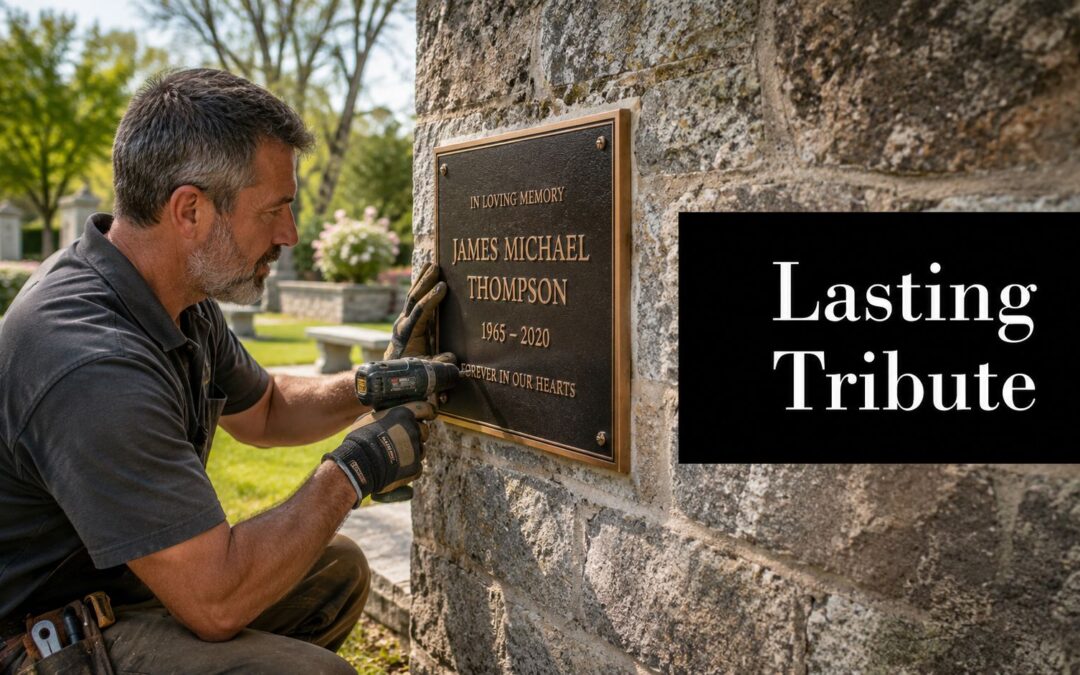
You're not just selecting a plaque today, you're selecting what remains on a wall, a seat, or a garden edge for the next decade or more. The standard sample card and the premium sample card can look nearly identical at a glance, then the quote lands, and the differences show up in material, fixings, finish, and how much heat, UV, and salt the plaque has to survive. That's the decision most funeral directors and council planners are making, and it's the one that matters.

A good starting point is to treat the plaque as a system, not a slab. Material, engraving method, mounting, wording, and lead time all affect whether the result still reads cleanly after years outdoors. If you want a gentle reminder of how personal memorial choices can be, choosing a lasting tribute is a useful read before you lock in the brief.
Evright Industrial approaches these jobs the same way it handles industrial marking, with production discipline, proof control, and laser consistency. That matters because Trotec Laser equipment is built for repeatable engraving on detailed memorial work, not just decorative output, and evright.com Industrial can turn that into a clean production path when a plaque has to be right the first time. By the end of this guide, you should know what material to pick, how to mount it, what to specify on the artwork, and how to keep the whole job on schedule.
Why Outdoor Memorial Plaques Are a Decision Map, Not a Product
A memorial planner stands at a counter with two sample cards that seem almost identical. One is a granite plaque, the other is bronze, both look dignified, both can be engraved, and both can be mounted neatly. Then the quote comes back, and the gap appears, not just in price, but in lifespan, upkeep, and how much the plaque will tolerate Australian weather before it starts looking tired.
The outdoor environment changes the brief
Outdoor memorial plaques live a harder life than indoor plates. They face UV, rain, dust, heat cycling, and in some places coastal air, so the question is never just what looks good in the room, it's what will still read clearly on site. Australian government climate guidance makes that regional exposure plain, because intense UV and harsh outdoor environments vary sharply by region, and that turns material choice into a performance decision.
That's why I tell funeral directors and council staff to think in layers. First, pick the substrate. Then match the engraving method to the substrate. After that, decide how it's fixed to the wall, seat, base, or post. If the plaque has a ceremony date, the schedule matters too, because a beautiful design that arrives late is still a problem.
Practical rule: if you're comparing two plaques that look the same, compare what happens after year five, not what they look like on proof day.
Production quality matters as much as design
Laser production changes the result because it keeps detail consistent across letters, borders, emblems, and photo work. A Trotec Laser machine is especially useful when you need crisp repeatability on memorial plaques that include fine lines or small text, because the machine head can produce controlled detail without the unevenness that often shows up in older mechanical methods. Evright Industrial uses that kind of production discipline to keep memorial work aligned with the rest of its industrial engraving process, and that is the standard to expect if you need granite plaque engraving that holds its detail outdoors.
For a council planner, that means a cleaner proof-to-finish workflow. For a funeral director, it means fewer surprises when a family wants a logo, emblem, or photo-relief portrait added to the same piece. For both, it means the plaque is being made with the same attention you'd want on an industrial asset label, just with a very different emotional brief.
The right question isn't “Which plaque is best?” It's “Which material, finish, fixings, and timeline fit this site, this weather, and this date?” If you are still weighing personal tribute choices, choosing a lasting tribute is a useful reminder of how much meaning sits behind a small object. The rest of this guide walks through each decision in that order.
Materials and Finishes That Withstand Australian Conditions
Granite, bronze, aluminium, and slate each solve a different problem. The mistake is choosing on appearance alone, because Australian outdoor conditions punish the wrong material quickly. UV, salt air, heat, and constant exposure all change how a plaque ages. If you want a plaque that still looks composed later, buy for durability first and presentation second.
Granite and bronze are the safest long-game choices
Granite is the clearest recommendation for long service life. It holds up where exposed memorials need steady performance, and it keeps its shape and clarity when weather becomes the main test. Bronze sits in the same conversation, with similar longevity and a strong record in public memorial settings. Councils keep returning to these two because they balance cost, engraving quality, and weather resistance better than flashier materials.
Slate is the compromise material. It can look refined and natural, but weathering shows earlier than it does on granite or bronze, so it suits lower-exposure sites or shorter planning horizons. That makes it a deliberate choice, not a default one. In a sheltered placement, it can be the right call. On an open site, it asks more of the maintenance schedule.
Aluminium is the budget-friendly option for lighter-duty applications, especially when the brief needs speed and modest cost. It suits simple designs and sheltered installations where the plaque is not carrying the same exposure risk as a cemetery-facing or coastal piece. For buyers who need a practical reference point on the stone side of the job, stone memorial plaque guide is useful for understanding why granite stays the default recommendation in harsher settings.
Finish and fixing choices decide whether the plaque stays readable
The finish matters because glare, corrosion, and surface wear change legibility faster than most buyers expect. Laser engraving does well on stone and anodised aluminium because it creates fine contrast without relying on heavy surface cutting. That helps the inscription stay clear when the plaque is read in full sun or from a standing distance. If the brief calls for a clean, repeatable finish, use laser production rather than chasing effect for its own sake. Evright Industrial's own granite plaque engraving approach is a practical example of how granite needs its own setup.
Hardware matters just as much. Match the fixings to the plaque's service life, not to the drawing. Stainless or bronze fixings belong on exposed installs, and decorative hardware that only looks right on paper should be left out of the job. If you need a practical stainless reference for exposed installs, Contractor's Den Fastgrip screws point in the right direction because the mounting choice has to survive the same weather as the plaque.
Finish also affects how long the plaque reads cleanly. A polished surface can look sharp in a proof and become difficult in strong light, while a more controlled finish usually gives steadier visibility outdoors. In production terms, the right substrate and the right fixing method matter more than decorative extras. They decide whether the plaque still looks intentional after years in weather.
Customisation, Fonts, Artwork and Photo Etching
A plaque can be built to last and still fail in use if the wording is cramped, the font is ornate, or the artwork asks too much of the surface. Start with legibility at the normal viewing distance, then add design elements only where they strengthen the tribute. On outdoor memorials, restraint usually wins because it reads better in weather and light.
Keep the wording short and the hierarchy obvious
Most plaques fit 15 to 40 words, and smaller pieces often stay within two or three lines (memorial engraving guide). That is not a style preference, it is a layout limit. Once the message runs long, line breaks get awkward, the name loses prominence, and the plaque starts working against itself.
Use the name first. Put the dates next. Add one short line of sentiment only if it earns its space. If the family wants a quote, keep it brief and check that the plaque still reads cleanly from standing height. The strongest outdoor plaques do not try to tell the entire life story on one plate.
Short rule: if you need a second breath to read the draft aloud, the text is too long for most outdoor plaques.
Fonts, emblems and photo relief need machine consistency
Clean serif and sans serif fonts stay legible as the surface ages, which is why they are the safest choice. Script fonts can work as a small accent, but thin strokes lose strength quickly outdoors. Borders, wreaths, military emblems, religious symbols, and council crests should be scaled so they leave enough white space around the main inscription.
Trotec Laser machines earn their keep here. A good laser head holds line quality across repeated runs, which is what you want when one plaque carries a logo, another carries a portrait, and a third carries a dedication line with a municipal mark. Evright Industrial can run that kind of work with the same production logic it uses for industrial labelling, which helps keep the proof and finished piece aligned.

If you need wording help before production starts, memorial plaque wording examples is the practical reference to use. It is much easier to settle layout early than to ask a workshop to rescue overcrowded copy later.
Mounting and Installation That Prevent Early Failure
Most outdoor plaque failures start at the fixing, not the face. A great plaque can loosen, tilt, stain, or crack if it's mounted on the wrong substrate or installed with the wrong hardware. The practical answer is to match the fastener to the surface, the plaque size, and the exposure.
Match the mount to the site, not to convenience
For stone or brick, use masonry screws or anchors. For timber, use wood screws. If the plaque is larger than 8" × 12", the guidance recommends post mounts for better stability, and heavier signs do better with threaded studs welded to the back and inserted into pre-drilled holes (custom outdoor plaque best practices). That's the cleanest way to stop shifting, twisting, and vibration damage.
Outdoor adhesives should be treated as a secondary bond, never the only bond. They help, but they don't replace proper mechanical fixing in exposed Australian conditions. If the plaque sits near irrigation, lawn runoff, or a surface that stays damp, move the install point or improve drainage before the mounting day.
A plaque should not be fighting water from the day it's installed. If the base can trap moisture, the fixings will age faster than they should.
Practical substrate checks save rework
On brick cemetery walls, check that the mortar and brick face can hold anchors without crumbling. On granite bases, make sure the surface is level enough for even load distribution. On timber memorial seats, inspect the thickness before you choose screw length or backer plates. On lawn installations, use a post or deep-ground anchoring system and verify that the plaque won't sit where mowing, sprinklers, or pooling water will hit it constantly.
Here's the rule I use on site:
- Brick Wall: Use stainless steel pins and non-corrosive epoxy for porous surfaces.
- Concrete Base: Confirm the base is level and cured, then use vibration-dampening pads where the design calls for them.
- Lawn Installation: Use a deep-ground anchor system so the plaque doesn't tilt or lift in soft ground.

If you're coordinating signage around a facility, room identification signage shows the same basic truth from another angle, clear fixing and clear placement prevent avoidable callbacks. For memorials, the stakes are emotional as well as practical, so the hardware has to be right the first time.
Council, Cemetery and Heritage Rules Across Australia
A plaque can be beautifully made and still fail on site. Approval comes first. Before anyone signs off the artwork, check whether the plaque sits in a public space, whether the cemetery trust or site owner controls size and fixing, whether a heritage overlay applies, and whether tactile or accessibility features are required. Compliance sits between the brief and the workshop, so get the rules clear before production starts.
Start with the site owner's rules
Local councils often control structures in parks, reserves, and public thoroughfares, and cemetery trusts usually set their own rules on size, wording, material, and fixings. Heritage-listed buildings and gardens add another layer, because the plaque has to suit the site visually and structurally. Skip that step and the quote loses value fast, because the design can be rejected before anyone makes it.
The safest workflow is straightforward. Get the relevant conditions first, then build the artwork around them. That keeps proof changes small and avoids an extra round of revisions after the family has already approved the design emotionally.
Regional exposure still affects compliance, but in a different way than simple material preference. High-UV, high-wind, or salt-exposed sites can trigger closer scrutiny of finishes, fixings, and maintenance expectations, and heritage overlays may ask for extra documentation on how the plaque will hold up in those conditions. Site approval and material approval belong in the same conversation, because the same plaque can be acceptable in one district and questioned in another.
Accessibility and heritage should be checked early
Where tactile or Braille elements are required, plan them in the production brief from the start. Do the same for listed sites, where the plaque's scale, contrast, and fixing method may need to respect the heritage setting. Laser production helps here because it gives consistent repeatability when the brief demands exact placement or fine line work.
Do not wait until installation day to find a wording problem. Councils and cemetery managers usually care about appearance, permanence, and maintenance, so the proof needs to show the final size, mounting points, and text layout clearly. If the site has heritage constraints, keep the design disciplined and avoid trying to make one plaque carry too many messages.
The team that receives a compliant brief can move faster and make fewer corrections. That is how memorial work should run, steady, accurate, and site-aware.
Lead Times, Pricing and the Ordering Workflow
A fixed unveiling date changes the brief. A plaque that needs to be ready for a ceremony cannot be treated like a standard sign job, because the material choice, engraving method, proof cycle, and mounting method all affect the schedule. Start with the production method, then work backward from the date you need.
Match the date to the production method
Cast bronze plaques usually take 15 to 20 business days after proof approval, with total project time often 4 to 6 weeks including shipping (custom memorial plaque design guide). For the same guide, Laser-engraved plaques can be delivered in 2 to 3 business days, while more complex deep-etched or photo-relief pieces take 20 to 25 business days. If the plaque is tied to a ceremony, plan at least 45 days from brief to installation, because proofing and production both need room.
That timing gap is real. Laser work gives you speed and flexibility when the date is fixed. Cast bronze with a custom layout needs earlier sign-off, and once the proof is approved, the schedule should stay locked.
Budget follows material and detail
Pricing follows the same pattern. One source pegs small to medium bronze memorial plaques at about $500 to $2,000 for standard sizes with basic text (custom memorial plaque pricing). Another market guide puts entry-level aluminium at $25 to $40 for 6×4 inch pieces, mid-range plaques at $75 to $150, and premium bronze at $200 to $500, with custom shapes, logos and portraits adding $50 to $200 to the base price. Material comes first, then size, then detail, then hardware. That is the order that drives the quote.

A clean workflow saves time and stress
The order should move in this sequence, proof approval, production, quality check, dispatch, and installation. Evright Industrial runs memorial plaque jobs through a controlled brief-to-proof-to-production process, then uses Trotec Laser machinery where the design calls for precise engraving and consistent repeatability. If the plaque needs to align with a service date, brief it early and keep the approval round tight.
Send the inscription, site dimensions, mounting surface, and any artwork files through Evright Industrial. A clear brief gets a cleaner proof and fewer corrections, and that is what keeps the plaque on schedule and fit for the site.
Recent Comments