
A procurement brief lands on your desk because the current plaques have failed again. The print has faded, the laminate has lifted, or the finish looks cheap against the building, equipment, or memorial setting it sits in. At that point, the conversation changes from “what's the quickest option?” to “what will still be readable and presentable years from now?”
That's where granite plaque engraving starts to make sense. Not because granite is fashionable, but because some jobs demand a material and marking method built for permanence. In industrial sites, that can mean identification that stays legible through weather and handling. In civic and memorial work, it means an inscription that still looks deliberate, not temporary.
The Need for Permanent and Professional Marking
A plaque usually gets serious attention after a previous one has already failed in service. The text has worn off, the surface looks dated, or the finish no longer matches the standard of the site. For a procurement manager, that shifts the decision from short term cost to service life, readability, and presentation over time.
That is why the marking method matters as much as the stone itself. Granite can carry a professional finish for years, but only if the inscription is applied with enough control to hold sharp edges, consistent depth, and clean contrast. A poor process can leave polished stone looking uneven, shallow, or difficult to read after installation.
Where permanence has to hold up
The requirement changes by sector, but the failure points are familiar. Plaques are expected to stay legible through weather exposure, routine cleaning, handling during installation, and day to day contact. In regulated settings, they also need to support traceability and a formal appearance, not just basic identification.
In practice, buyers usually need one or more of the following:
- Facilities and infrastructure teams need identification that stays attached, readable, and presentable outdoors or in plant conditions.
- Healthcare and government buyers need a finish that looks official and remains consistent across buildings, departments, or programs.
- Memorial planners and funeral professionals need inscriptions that look deliberate and respectful, with clean lettering and image detail.
- Industrial operators need information that can still be read after mounting, cleaning, and routine wear on site.
At Evright Industrial, we treat permanence as a specification issue, not a styling choice. If a plaque carries safety information, donor recognition, asset identification, or memorial text, the mark has to survive the actual use environment. That means choosing a process with repeatable results, not one that only looks good at dispatch.
Why serious buyers specify laser engraving
For serious granite plaque engraving, the question is how to achieve a permanent mark with tight detail and consistent quality across a batch. Laser engraving answers that better than many older methods because it gives controlled, repeatable marking on polished stone without relying on inks, films, or surface-applied graphics that can degrade first.
Trotec laser systems are a strong fit for this work because they give precise beam control, predictable output, and good repeatability from one plaque to the next. That matters when the job includes fine text, logos, crests, serial information, or layout standards that have to be met every time. The point is not novelty. The point is getting a cleaner, more durable result with less variation between pieces.
Practical rule: If the plaque has to carry authority, detail, and long service life, specify the material and the marking technology together.
For memorial projects, wording, stone choice, and finish often sit alongside broader decisions about marker style and long term presentation. This Cremation.Green headstone guide is a useful outside reference for that early planning stage, before artwork is finalised.
Why Choose Granite for Your Plaque
Granite works because it solves several problems at once. It's hard, stable, visually substantial, and suited to polished finishes that help engraved content read cleanly. In high consequence environments, that combination is difficult to replace with lighter or more disposable materials.

Material properties that matter on site
A plaque isn't judged in the workshop. It's judged after transport, mounting, exposure, and cleaning. Granite performs well in those conditions because it resists the kind of superficial deterioration that makes cheaper signs look tired.
Commercial engraved granite plaques are typically made from solid polished granite around 0.25–0.375 inches, or about 6.35–9.5 mm thick, which provides a practical balance between breakage resistance and manageable fabrication and mounting (granite memorial plaque specifications). In Australian work, that thickness range is a sensible engineering compromise when you want stiffness without excessive bulk.
That thickness also affects handling. Go too thin and edge chipping becomes more likely during transport or installation. Go too heavy for the application and mounting becomes more demanding than it needs to be.
Why polished surfaces matter
Polish is not just aesthetic. On granite, the front finish directly influences how cleanly the engraving reads. A polished face gives a clear visual difference between the untouched surface and the engraved area, which is why polished blanks are commonly chosen for plaques intended to stay legible and presentable.
For general background on the stone itself, Tiles Mate's granite information is a useful primer on why granite remains such a common architectural and decorative material. In plaque work, those same qualities translate into a better long term substrate for permanent marking.
Colour and contrast
Not all granite behaves the same way under engraving. Dark, more visually uniform stone tends to produce the clearest contrast for laser work, especially when the design includes fine text or image detail. Lighter or heavily speckled stone can still be used, but the design usually needs to work harder. Bolder fonts, stronger spacing, and simpler graphics become more important.
Here's a perspective:
| Granite choice | What it does well | Where it can fall short |
|---|---|---|
| Black or very dark polished granite | Strong contrast for text, logos, and imagery | Shows layout flaws if artwork is poor |
| Mid tone granite | Balanced appearance for formal plaques | Fine detail may read less sharply |
| Heavily speckled granite | Natural character and decorative appeal | Small details can visually break up |
The stone should match the reading distance and the message. Decorative grain is fine. Decorative grain behind tiny text usually isn't.
Laser Engraving vs Traditional Methods
When buyers compare processes, they usually start with the wrong question. They ask which method is newer, cheaper, or faster. The better question is what kind of mark the plaque needs. On granite, the technical decision is often a choice between depth and detail.

What laser engraving is doing
Laser engraving on polished granite changes the surface in a highly controlled way. It doesn't rely on physical cutting pressure in the way mechanical methods do, so it's well suited to detailed artwork, fine line elements, and consistent repeat jobs. On a modern Trotec Laser system, that control is the reason buyers can move from a digital proof to a clean, repeatable finished mark without the variability that often shows up in more manual workflows.
That matters if the plaque includes more than plain text. Logos, seals, line illustrations, and portrait style imagery all benefit from a process that can follow digital artwork precisely rather than interpret it loosely.
Laser engraving isn't just adding a mark. It is permanently altering the polished surface so the information becomes part of the plaque itself.
A related comparison for other plaque materials sits in this custom metal plaque engraving overview. The same procurement logic applies. Match the process to the job, not the other way around.
Where sandblasting still makes sense
Sandblasting remains a valid and established method for granite. Independent memorial guidance notes that it is the standard method for granite headstones and markers because a rubber stencil masks the polished face while abrasive pressure cuts exposed areas, producing recessed lettering. That same guidance also makes the trade off clear. Sandblasting supports flat, shape, and relief carving, with each step adding dimensionality as well as more production time and cost (memorial engraving guide).
If the priority is deep, recessed text that has to read from further away, sandblasting is often the right answer. If the priority is photographic detail or fine artwork, laser etching is usually the better fit, especially on dark granite.
Why mechanical methods are less attractive for granite
Mechanical engraving has its place in many materials, but granite is hard and brittle enough that the process becomes less forgiving. Tool wear, vibration, and physical contact all work against fine stone detail. You can still mark granite mechanically, but it usually isn't the process of choice for polished plaques where the expectation is a neat, premium finish.
Here's the practical comparison:
- Laser engraving suits fine text, detailed graphics, logos, and consistent repeat production.
- Sandblasting suits deeper carved lettering and a more traditional dimensional look.
- Mechanical engraving is generally less suitable where brittle stone and polished presentation are both in play.
Later in production planning, speed also matters. The memorial trade's broader process evolution shows why industry moved toward more efficient and repeatable systems. Sandblasting became popular around 1930, and by 1940 it had completely overtaken hand carving for memorial engraving according to the historical record already cited earlier in this article.
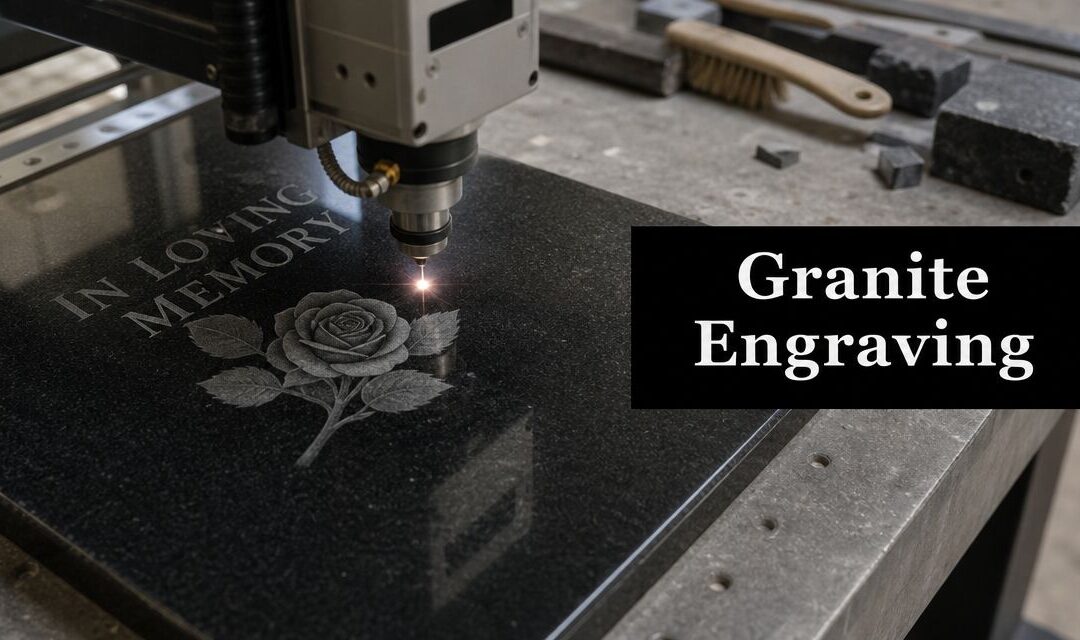
A quick visual of the production environment helps here:
Designing Your Engraved Granite Plaque
Good granite plaque engraving starts well before the laser runs. Most production problems trace back to artwork that looked acceptable on a screen but was never suitable for stone. The fix is usually straightforward. Build the design around how granite reads, not around how the file looks at full zoom on a monitor.

Start with the right file type
For text, borders, logos, and line graphics, vector artwork is the clean option. Files such as AI, EPS, and properly prepared PDF artwork define shapes mathematically, so curves and edges stay sharp when scaled. Raster files such as JPG and PNG can still be useful, particularly for photographs, but they depend on pixel quality and image preparation.
If a buyer sends a low quality logo screenshot and expects a crisp engraved result, the problem isn't the machine. The problem is the artwork source.
The broader development of engraving technology explains why digital file quality now matters so much. The move from the pantograph in 1945 to diamond drag engraving in 1947 made the process faster and more precise, and those milestones paved the way for today's computer controlled lasers and their ability to reproduce complex digital artwork on durable materials like granite (engraving methods history).
Design choices that survive translation to stone
Some layouts look elegant in a brand guide and weak on granite. Fine scripts, hairline borders, and tightly packed lettering often lose impact once transferred to stone.
Use these rules early:
- Choose readable fonts: Sans serif or well proportioned serif fonts usually hold up better than ornate scripts.
- Keep line weight honest: Thin strokes can disappear visually, especially on patterned stone.
- Respect negative space: Empty space improves legibility. Crowded layouts don't look premium. They look unresolved.
- Simplify logos when needed: Secondary taglines and tiny device marks often need to be removed or enlarged.
Workshop note: If text can't be read clearly in the proof at likely viewing distance, engraving it won't fix the design.
Preparing photographs and detailed imagery
Photo engraving works best when the image has strong tonal separation. Muddy, low contrast images usually produce flat results. Strong portraits and artwork need clean highlights, defined shadows, and an understanding that stone is not paper. It won't reproduce every subtle transition.
For clients working on commemorative pieces, wording matters just as much as layout. This collection of memorial plaque wording examples is useful when the project needs both inscription guidance and production practicality.
For buyers comparing presentation materials more broadly, Custom Mark's crystal awards solutions are a helpful contrast. Crystal rewards clarity and internal light play. Granite rewards permanence, contrast, and outdoor credibility. The artwork approach should change accordingly.
Applications in Industrial Medical and Government Sectors
A procurement manager usually reaches this stage after the material shortlist has narrowed. The question is no longer whether the plaque can display text. The question is whether it will still look credible after years of weather, cleaning, public contact, and scrutiny from the people who signed off on the project. That is where granite, engraved with the right laser system, separates itself from lighter plaque materials.
At Evright Industrial, we see the same pattern across serious projects. Buyers in industrial, medical, and government settings are not choosing granite for novelty or decoration. They are choosing a hard, stable substrate and a marking method that holds detail, stays legible, and suits formal environments where a plaque reflects on the organisation that installed it.
Industrial settings
In industrial sites, plaques often mark commissioned equipment, capital works, plant upgrades, facility openings, and infrastructure handovers. These are not short-term signs. They are records attached to assets and projects expected to outlast paint systems, site reconfigurations, and routine maintenance cycles.
The marking method matters as much as the stone. Traditional methods can work, but they introduce more variability in fine detail, line consistency, and repeatability across a batch. Laser processing gives tighter control. On granite, that means cleaner text, better logo definition, and fewer compromises when the plaque needs to read clearly from a practical viewing distance.
For procurement, that translates into less risk. A well-produced laser etched granite plaque for industrial and commemorative use gives you a durable face material and a controlled production method. That combination is useful when the plaque has to look formal on day one and remain readable years later.
Medical and healthcare environments
Medical and healthcare projects usually call for a cleaner visual style than heavy industrial work, but the selection logic is similar. Donor walls, foundation plaques, building dedications, departmental markers, and recognition installations all benefit from materials that feel permanent and professionally finished.
Laser engraving is a strong fit here because precision affects presentation. Small alignment errors, inconsistent fills, or soft lettering stand out quickly in hospitals, clinics, and research facilities where the environment is closely managed. Trotec machines help maintain that control, especially on fine text and artwork that needs to stay disciplined rather than decorative.
Granite also sends the right message in these settings. It signals permanence, order, and institutional confidence. That matters when a plaque is tied to philanthropy, public trust, or a major capital program.
Government and civic use
Government and civic plaques carry another layer of scrutiny. They often sit in public view, represent official decisions, and need to match the seriousness of the site. If the plaque looks flimsy, dated, or poorly resolved, the material choice becomes part of the public impression.
This is why granite continues to hold its place for memorials, civic markers, opening plaques, and departmental installations. It has the weight and finish expected of official work. Pair that with laser engraving, and the result is not just permanent in theory. It is precise in execution.
The practical buying criteria are usually consistent:
- Authority: The plaque needs a material and finish that suits official settings.
- Legibility: Names, dates, titles, and insignia need to remain clear in service.
- Repeatability: Multi-site or staged projects need consistent output across the order.
- Low upkeep: Public-facing plaques should not require constant cosmetic attention.
A plaque in these sectors does more than identify a building or mark an event. It shows how seriously the organisation treats permanence, presentation, and public record.
Installation Maintenance and Sustainability
A granite plaque can be made correctly and still disappoint if it's installed poorly. Most failures after delivery come from bad support, uneven fixing, or mounting methods that don't suit the substrate. Granite has strength, but it still needs proper handling and secure installation.

Installation basics that prevent trouble
The right fixing method depends on where the plaque is going. Wall mounted plaques may use concealed rear studs for a more architectural look, while flush mounted work can use suitable high bond construction adhesive where the surface and load conditions allow. Ground mounted markers need a stable and level base so the plaque doesn't rock, twist, or sit under uneven stress.
Three practical checks matter before installation:
- Confirm substrate condition: Uneven or weak surfaces create long term stress.
- Match hardware to the environment: Exterior conditions need durable mounting components.
- Handle edges carefully: Polished granite can chip if knocked during positioning.
Keeping the plaque presentable
Maintenance is one of granite's strengths. Day to day care is simple. Mild soap, water, and a soft cloth are usually enough to remove surface dirt and keep the polished face looking clean.
Avoid aggressive cleaning methods. Abrasive pads, metal brushes, and harsh chemicals can damage the surface finish or dull the visual contrast that makes the engraving easy to read.
Clean gently and consistently. Most plaque damage comes from overzealous cleaning, not from neglect.
The sustainability case
Granite also makes sense from a lifecycle perspective. It is a natural material, and its long service life reduces the replacement cycle that often comes with lower durability alternatives. When a plaque is intended to stay in place for years, longevity is part of sustainability.
For buyers looking at process options as well as materials, laser etched plaques show how precise marking can support long term use without relying on applied prints or short life surface treatments.
How to Order Your Custom Granite Plaque from Evright
Ordering usually goes smoothly when the buyer knows four things early. What the plaque needs to say, where it will be installed, what artwork exists already, and whether the job prioritises deep cut text or high detail laser work. Once those are clear, production becomes much more predictable.
The working process
The usual flow is straightforward:
Initial consultation
The plaque purpose, size, setting, and artwork are reviewed so the specification matches the application.Artwork proofing
Text, layout, line weight, and contrast are checked before production. Most preventable issues are resolved during this process.Production on the selected process
For laser based granite work, Trotec systems are used where the job calls for controlled detail and repeatable output.Packing and delivery
The finished plaque is prepared for transport with the nature of stone handling in mind.
What affects lead time and cost
Price and timing usually come back to a short list of variables:
- Plaque size
- Granite type and finish
- Engraving complexity
- Quantity
- Mounting requirements
A simple text plaque on standard polished granite is a very different production exercise from a larger plaque with image content, complex layout, and custom fixing.
Evright Industrial handles laser engraving and asset labelling work for industrial and commemorative applications, with ordering support backed by the broader experience of evright.com, which has been operating for nearly six decades according to the company profile provided. In practice, that means the job usually starts with a conversation about application, not just artwork, because the correct result depends on both.
If you need a plaque that looks permanent because it is permanent, Evright Industrial is a practical place to start. Send through your wording, artwork, size, and installation context, and the team can advise on whether laser engraved granite is the right fit for the job.
Recent Comments