
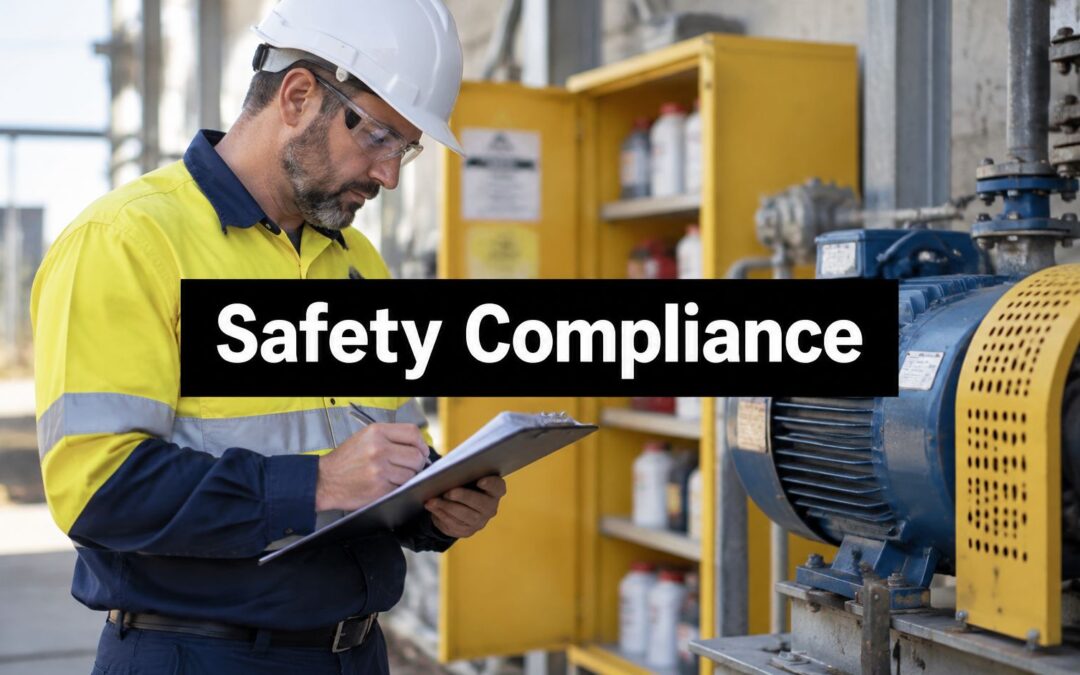
The most common advice on safety compliance standards is also the most misleading. Buy one tidy sign pack, stick the same labels on every site, and you'll look compliant. You won't necessarily be compliant. In Australia, the law that governs a sign depends on where the work happens, what the hazard is, and which regulator checks it.
Matching signs are easy to photograph for a tender. They're much harder to defend when an inspector asks which Act you relied on, who approved the wording, and where the record sits.
Why Matching Signs Still Leaves Gaps
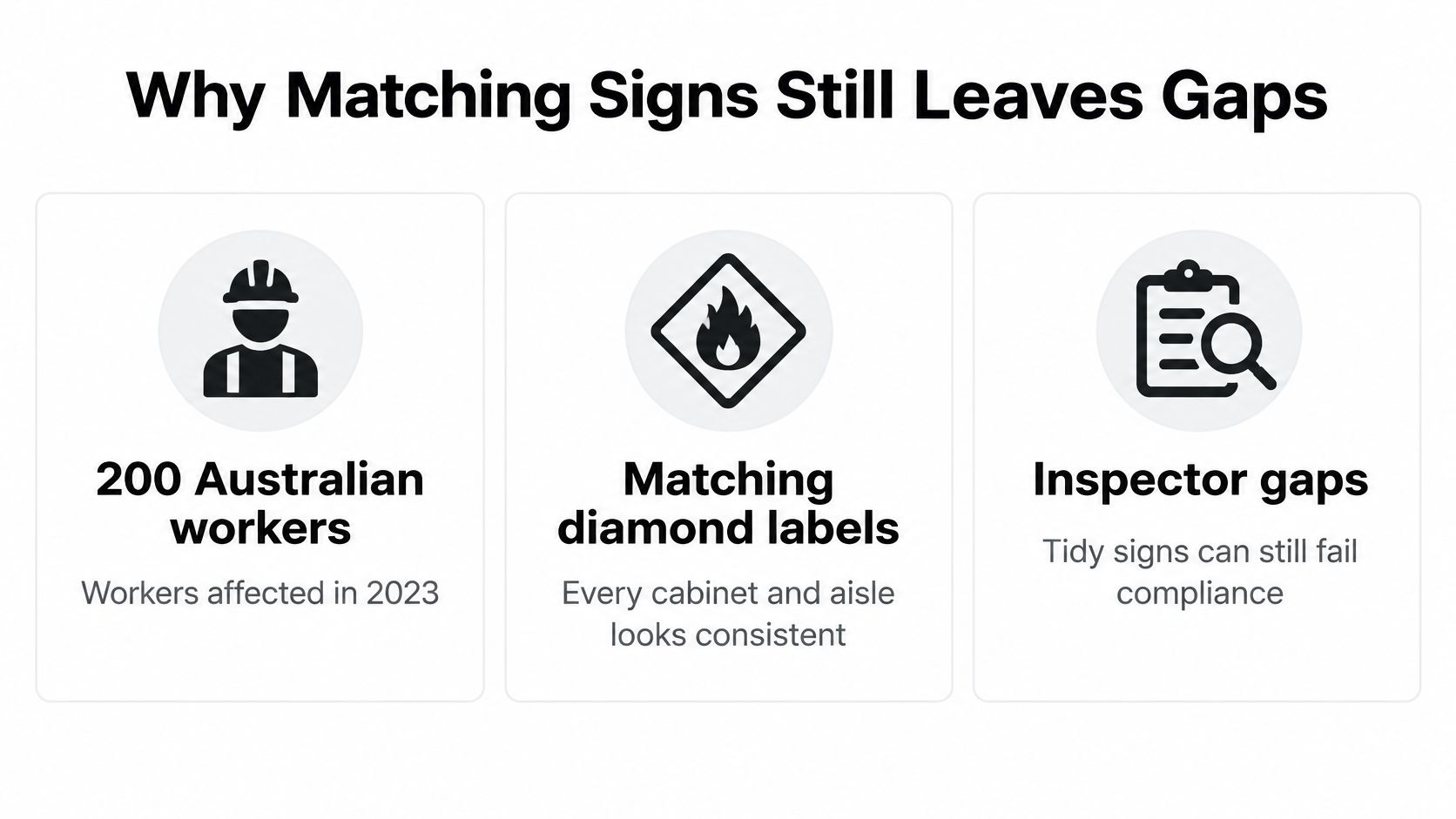
Say a workshop manager walks the floor before an audit. Every cabinet carries the same neat diamond label, every aisle has a matching warning, and the chemical store looks orderly from the doorway. It feels finished.
Then the inspector starts asking questions. Where's the current safety data sheet for that drum? Why does mobile plant share a walkway with pedestrians? Who checked the work at height controls on the mezzanine? The signs match, but the system behind them doesn't.
The Risk Is Wider Than the Chemical Store
The numbers show why a label audit alone can't carry a safety system. Safe Work Australia's 2024 national statistics recorded 200 workers who died from traumatic injuries sustained at work in 2023, a fatality rate of 1.4 deaths per 100,000 workers, consistent with the five-year average from 2019 to 2023.
Vehicle incidents accounted for 42% of deaths, or 84 fatalities, while falls from height accounted for 15%, or 29 fatalities. The same dataset recorded 139,000 serious workers' compensation claims in 2022-23.
- Body-stressing injuries: 32.7% of serious claims, which points to manual tasks and layout, not just warning wording.
- Mental-health conditions: 10.5%, or 14,600 claims, an increase of 19.2% from the previous year and 97.3% over the preceding decade.
- Mobile plant and vehicles: The largest fatality mechanism, so traffic routes and separation matter as much as a sign on a gate.
That spread pulls safety compliance standards past the chemical store into vehicles, height work, manual handling, workplace layout, communication and psychosocial risks. A durable asset label can make a control visible. It can't complete a risk assessment, train a worker, maintain plant, or run an emergency procedure.
A sign is evidence of a control only when the assessment, training and inspection behind it are also real.
The legal duty is broader. You must eliminate a risk where it's reasonably practicable, or minimise it when elimination isn't possible. Signs and labels support that duty, they don't replace it. The useful question isn't whether your signs match each other. It's whether each sign matches the rule set for that site.
Which Safety Rule Applies Where and Why
Start with the site before you touch the artwork. Two depots can display near-identical danger signs and still answer to different Acts, different regulators and different records. The map below matches each location and hazard to its rule set, so work through it before you order a single plate.
| Rule set | Where it applies | What must be in place | Who checks it |
|---|---|---|---|
| Model WHS Act and Regulations | Commonwealth, ACT, NSW, NT, Qld, SA, Tas and WA | Duties, consultation, risk controls and high-risk work rules | The WHS regulator in that jurisdiction |
| Victorian OHS laws | Victoria only | Separate occupational health and safety Act and regulations | WorkSafe Victoria |
| GHS chemical labels | Hazardous chemicals used or stored at work | Nine pictograms, signal word, hazard statements and precautionary statements | The WHS or OHS regulator for the site |
| Chemical register and Schedule 11 placards | Hazardous chemical storage | Current safety data sheet in a register, and placards above the Schedule 11 threshold | Regulator and emergency services |
| TGA labels, ARTG and UDI | Medical devices supplied in Australia | Device identity, warnings, and human-readable plus machine-readable UDI where required | Therapeutic Goods Administration |
| Workplace Exposure Limits | Airborne contaminants on the site | Monitoring and records tied to the task; a label is not a substitute | WHS regulators |
How Harmonisation Actually Worked
Australia built a broadly consistent structure rather than a single national law. Safe Work Australia endorsed amendments to the model Work Health and Safety Act on 29 April 2010 and published the agreed model WHS Regulations on 4 November 2011.
The Commonwealth, Australian Capital Territory, New South Wales, Northern Territory and Queensland implemented the model laws on 1 January 2012, followed by South Australia and Tasmania on 1 January 2013. Western Australia passed its version on 10 November 2020, which became operational on 31 March 2022. Victoria remains the only jurisdiction that has not adopted the model WHS laws.
That history matters on the floor.
Each jurisdiction still owns its legislation, its regulator, its enforcement approach and some local requirements. The Act and regulations that apply are the ones of the place where the work is done. So a matching sign pack across three states can still mean three different answers when an inspector asks who did the assessment and under which code of practice.
When Equipment Moves, the Check Moves With It
Say a pump set leaves a Queensland depot for a Victorian shutdown. Its asset plate, isolation tags and warning labels travel with it, and the governing Act changes at the border. Someone needs to verify the wording, codes of practice and sector requirements for the new site before work starts.
Cross-border work is where overlapping frameworks leave gaps. A worker doing the same task can sit under different rules in different states, and plant built to one jurisdiction's code can need fresh checks under another's. The exposure is broad rather than niche: manufacturing, transport, construction, health care and public administration together account for most work-related traumatic fatalities and serious workers' compensation claims in Australia.
Practical rule: Visual consistency is not legal consistency. Record the jurisdiction for every site, then design the sign.
For plant and machinery, that site check also covers guarding and isolation, and guidance on safer production systems through compliant safeguarding helps you test whether the physical control matches the warning. Electrical gear needs the same discipline, which is why our guide to electrical equipment safety requirements sits beside the jurisdictional map rather than replacing it.
Don't adopt one national sign pack and hope. Name the regulator, the Act and the record for each site, including depots and yards where plant is only stored.
Standards Beyond the Statute
Statute sets the minimum you must meet. Standards and management systems usually show you one accepted way to meet it. Confusing those two layers is where many sign orders go wrong.
A manager might say, we're certified, so we're covered. Certification can help you organise evidence, but it doesn't cancel a state Act, a regulation, or an inspector's question.
The Three Layers Most Sites Use
- AS 1319: Commonly used in Australia for general safety sign layout, categories and design. It's a practical starting point for danger, warning, mandatory, prohibition and emergency information signs.
- ISO 7010: An international symbol library for safety signs. Use a symbol from it only where it matches the local requirement and the wording your regulator expects.
- ISO 45001: A voluntary occupational health and safety management system. It structures risk assessment, consultation, training, incident review and continual improvement.
The Globally Harmonized System, or GHS, sits in a different place again because it underpins Australian chemical labelling. Its pictograms and signal words aren't a branding choice. They're hazard communication tied to classification.
A Worked Choice for a New Workshop
Say you're fitting out a maintenance workshop with a wash bay, battery charging area and chemical store. You'd use AS 1319 thinking for sign layout and placement, check any imported symbol against ISO 7010 before printing, and use ISO 45001 style processes to generate the consultation, training and review records.
Then you'd still go back to the statute for the site. Does the sign meet the duty for that hazard, in that jurisdiction, for the workers who'll read it in poor light, wet gloves, or a hurry?
A certified management system doesn't by itself prove compliance with a jurisdiction's Act.
Keep the layers separate in your register. Record the law you must meet, the standard you used to design the control, and the record that proves you checked it. That discipline carries straight into chemicals, medical devices and airborne contaminants, where the label content itself is prescribed.
Chemical Labels Placards and Exposure Limits
Think of a chemical label as the link between a container and its safety data sheet. If that link breaks, a worker can't quickly connect what's in the drum to how it can hurt them and what to do next.
Australian workplace labels generally require GHS hazard communication. Safe Work Australia's labelling guidance identifies nine GHS pictograms, normally presented as diamond-shaped symbols set at 45 degrees, with the signal words "Danger" and "Warning" communicating relative severity.
What Has to Line Up
Under the model framework, a person conducting a business or undertaking, or PCBU, must manage the whole chain. Safe Work Australia's guidance on chemical records and signs requires correctly labelled containers and pipework, a chemical register containing the current safety data sheet for each hazardous chemical, and placards when stored quantities exceed the relevant Schedule 11 threshold.
Audit every container, transfer line, storage area and emergency-services entrance against the current SDS and inventory. Record label condition and visibility as inspection criteria, not as housekeeping.
- Container and pipework: Correct pictograms, signal word, hazard statements and precautionary statements for the current classification.
- Register: The current SDS for each hazardous chemical, accessible to the people who need it.
- Placards: Displayed when quantities pass the Schedule 11 threshold, so emergency responders get location-specific information fast.
Durability helps only if the information stays correct. A plate can survive ten years of washdowns and still become non-compliant the day you substitute a chemical and don't change the wording. That's why sites handling aggressive products need labels built for chemical exposure and a revision trigger after every process change.
Transport adds another check, because workplace labelling and transport classification aren't the same task. If goods leave your site, guidance on classifying hazardous substances for transport helps your team avoid assuming a store label covers a road movement.
Exposure Limits Change the Record, Not Just the Sign
From 1 December 2026, Australia is scheduled to adopt Workplace Exposure Limits for airborne contaminants, replacing the current Workplace Exposure Standards, according to a 2026 Australian safety update. That update also notes NSW's silica dashboard reports more than 20,000 workers had been notified to the state silica register by 30 September 2026, and requires notification within 28 days for workers commencing high-risk crystalline-silica processing work.
So what should stay visible on the asset or work area? Use a minimum set: asset ID, hazard classification, isolation status, inspection date, owner, and a QR link to the controlled record where that helps.
Don't make the QR code the only control. It fails with no signal, poor light, a damaged phone, or in an emergency where seconds matter. Labels support traceability, but they can't substitute for risk assessment, engineering controls, air monitoring or health monitoring.
Healthcare Marks That Must Survive Use
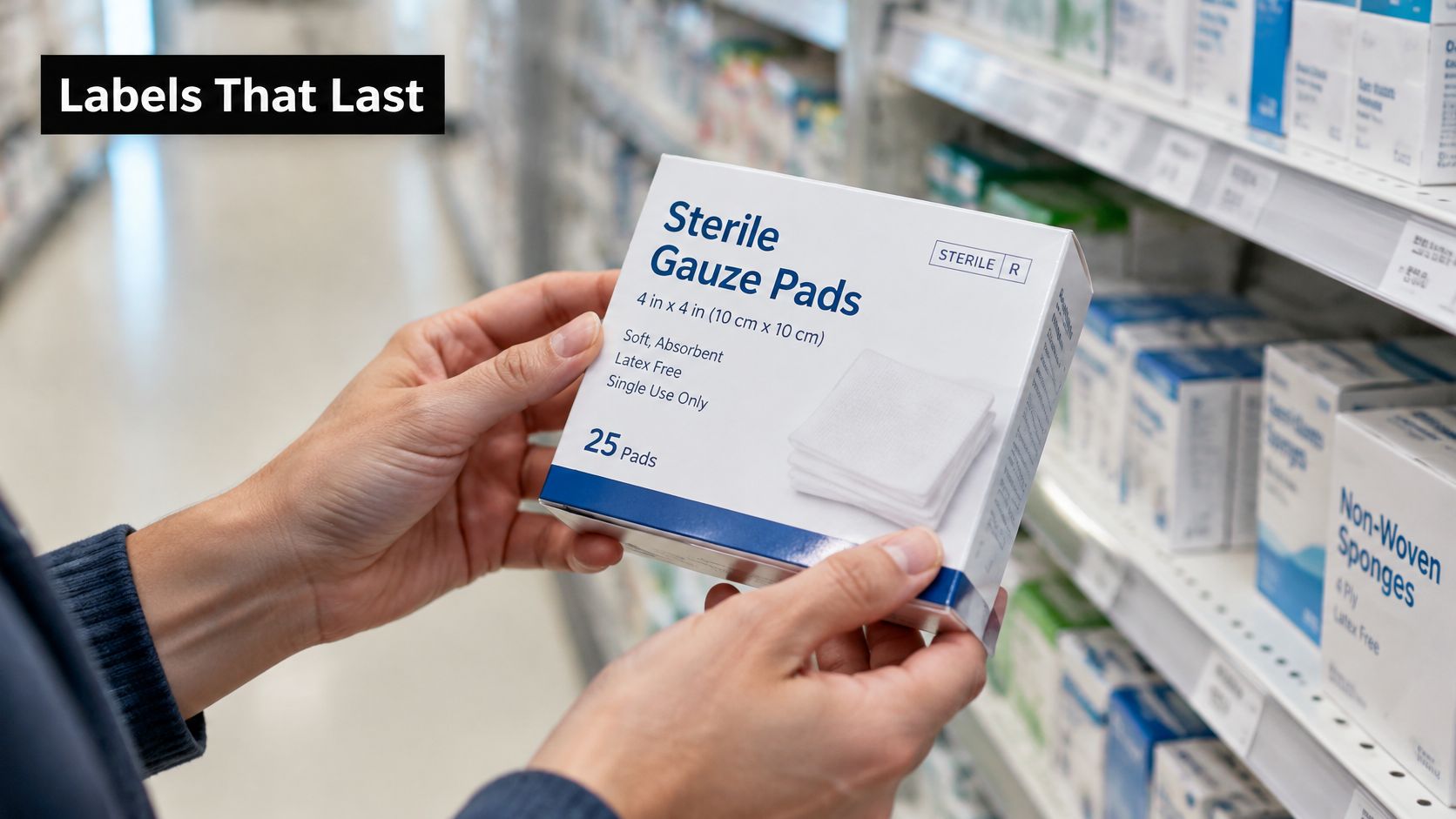
In a sterile store, a label gets handled with gloves, moved between trolleys, cleaned, stored, and checked under time pressure before a procedure. Nobody reads it at a desk. A mark that smudges or peels in that environment has failed at the exact moment it was needed.
The image below shows the everyday reality behind healthcare identification, where packaging has to stay readable in the hands of the person selecting it.
Australian rules set the floor for what that label must carry. Therapeutic Goods Administration guidance on labelling medical devices requires enough information for users to identify the device or its packaging contents. That can include the manufacturer's name and address, intended use, intended user, patient type, handling or storage requirements, warnings, restrictions, precautions, and special operating instructions, plus single use, custom-made, or clinical investigation status where applicable.
Devices also sit inside a wider supply system. The TGA medical devices labelling overview states all medical devices supplied in Australia must meet the relevant Essential Principles for safety and performance, and unless specifically exempt or excluded, be included in the Australian Register of Therapeutic Goods to be legally supplied.
UDI Makes Identity Follow the Item
For in-scope devices, the TGA Unique Device Identification requirements require a UDI on labels and packaging and a corresponding record in the Australian Unique Device Identification Database. The UDI must be supplied in both human-readable and machine-readable forms, using linear barcodes, Data Matrix codes, or QR codes, and marked directly on the device where required.
Take a surgical instrument first. It needs a direct mark that stays readable after repeated cleaning, because a sticker that lifts in processing isn't a control. Now take an implant or cannula. Its identity has to follow the item through supply, storage and use, so staff can trace exactly what was used.
The video below shows permanent marking in a production setting, which is the practical issue behind direct part identification.
Permanent marks like these are laser-engraved so the identifier sits in the surface rather than on an adhesive layer. Evright Industrial marks medical items for Unique Device Identification (UDI) traceability, including glass beakers and test tubes, medical instruments, orthopaedic and trauma surgery implants, plastic cannulas and surgical instruments. Laser marks on medical items will never detach and are completely safe for the patient.
The same durability principle applies wherever a readable mark ties an asset to its history, including the maintenance discipline behind pharmaceutical equipment reliability. For the identification side, the detail on medical device labelling requirements covers what the mark must carry. Keep the scope straight, though. A compliant device mark only governs the device. The signs on the walls of the hospital, laboratory or cleanroom where it is used still sit under the WHS or OHS law of that state or territory, and copying the signage style from another site does not transfer its compliance. Check which Act and regulator govern each location before treating the room as covered.
How to Build a Site Based Compliance Program
You don't need a thicker manual. You need one procedure a safety lead can run site by site, with a named owner for each decision.
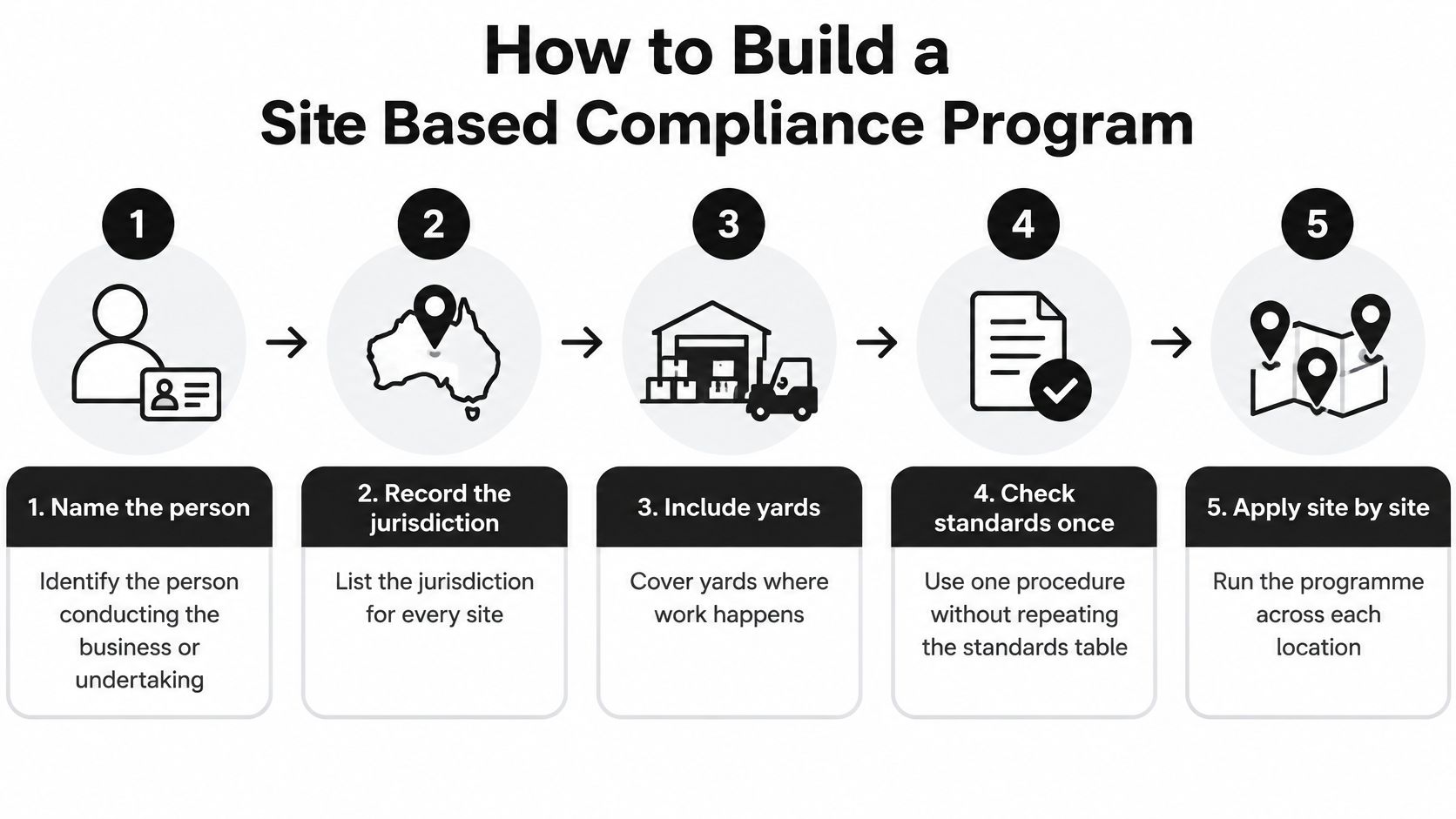
Six Steps You Can Run This Month
- Name the PCBU and jurisdiction for every site. Include yards and depots where plant is only stored, because work, maintenance and deliveries still happen there. If you can't name the regulator, you can't yet approve the sign.
- List hazards and attach the matching rule set. Split chemicals, height, mobile plant, manual tasks, psychosocial risk and, if relevant, medical devices. This stops a chemical-store checklist pretending to cover a loading dock.
- Decide what must stay visible and what lives in the record. Asset, pipe, container, entrance and work area marks should carry what a worker needs at the point of use. Put the full SDS, monitoring history and revision log in the controlled record, not in tiny print on a plate.
- Appoint who approves wording and who checks moves. One person verifies the jurisdiction when gear crosses a border, and one process removes old plates when a revision is issued. Copied signage from another state creates false confidence because it looks finished while answering the wrong law.
- Produce durable marks, then inspect them in place. Check legibility, contrast, symbol shape and hazard-to-equipment association after installation. Check again after cleaning, damage, or any chemical or process change, because an obsolete pictogram can leave a physically perfect label legally wrong.
- Train people and review after change. Workers need to know what the mark requires them to do, not just that it's there. Review the set after an incident, a substitution, or a law change such as new exposure limits, and keep SDS and exposure records current.
Don't let a QR code be the only path to critical information in a blackspot, a blackout, or an emergency.
Keep the Register Simple Enough to Use
Use one register with headings your supervisors will complete: site, jurisdiction, asset identity, hazard, standard relied on, last inspection, owner. Add a field for the current SDS or device record where that applies.
If a row has no owner, treat it as unfinished. If the jurisdiction field is blank, don't print the artwork yet. Those two habits prevent most copy-and-paste compliance errors.
Confirm the Marks Before Your Next Audit
An audit rarely fails because a sign is missing. It fails because a sign looks finished while answering the wrong law, so pick one site and one hazard this week and test it against the map: which Act, regulator and record govern that location.
Check three things before anything else. Confirm the jurisdiction that applies to this location, the current safety data sheet or device record behind the wording, and the person who owns that wording. Then stand where the worker stands and read the mark in poor light, after cleaning, and at the distance where a decision gets made. A plate that reads perfectly on a desk can fail all three tests on the floor.
- Faded or damaged: Replace it, but verify the wording first rather than reprinting old artwork.
- Obsolete after a change: Issue a revision and remove the old plate the same day.
- Copied from another site: Re-check it under the Act and regulator for this location.
Once the wording checks out, production is the straightforward part. Evright Industrial runs a full sampling and testing program before full production of customer-supplied items, so the approved sample sets the standard for the whole run. The work covers asset labels, safety signage, steel plaques, panels, switch plates and electrical switchboards, produced with advanced laser machinery that marks permanently and holds fine detail. For healthcare sites, marking extends to medical instruments and implants where identity has to stay with the item through cleaning and use.
The standard still belongs to your business. A mark helps only when the wording, jurisdiction and record agree, so confirm those three things before your next audit rather than after an inspector finds the gap.
If your signs look consistent but you cannot name the Act, regulator and record behind each site, start with one location and rebuild its identification from the map. Evright Industrial produces durable asset labels, safety signage, plaques and panels, with sampling and testing before full production so wording and legibility are checked first. Visit Evright Industrial to talk through your site's marking needs and get the next revision right.
Recent Comments