
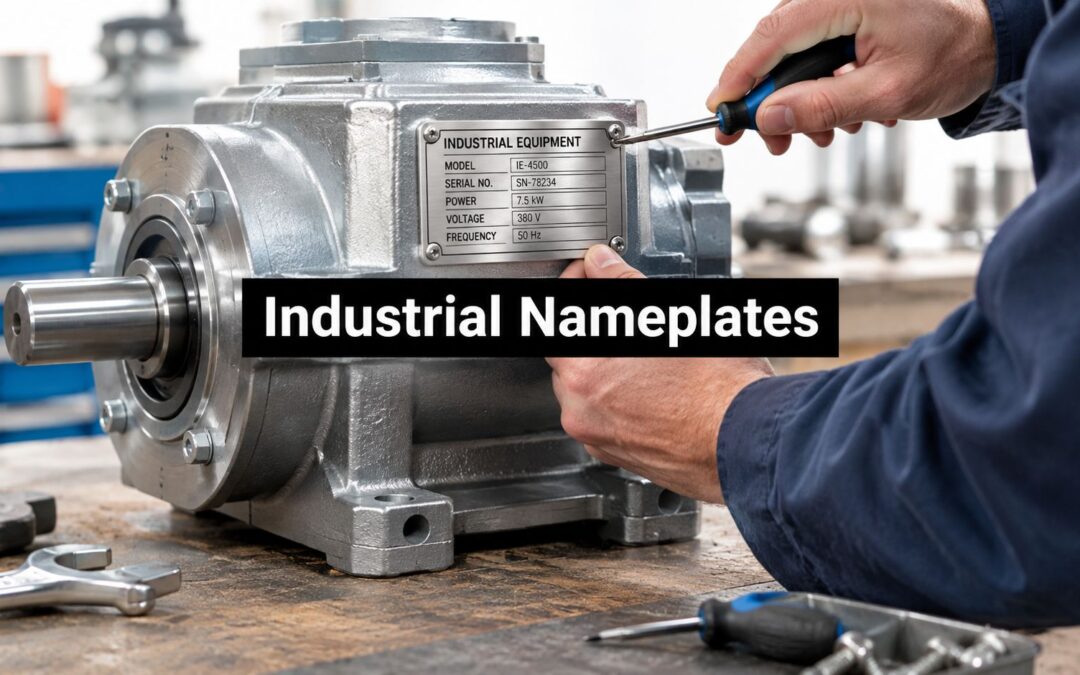
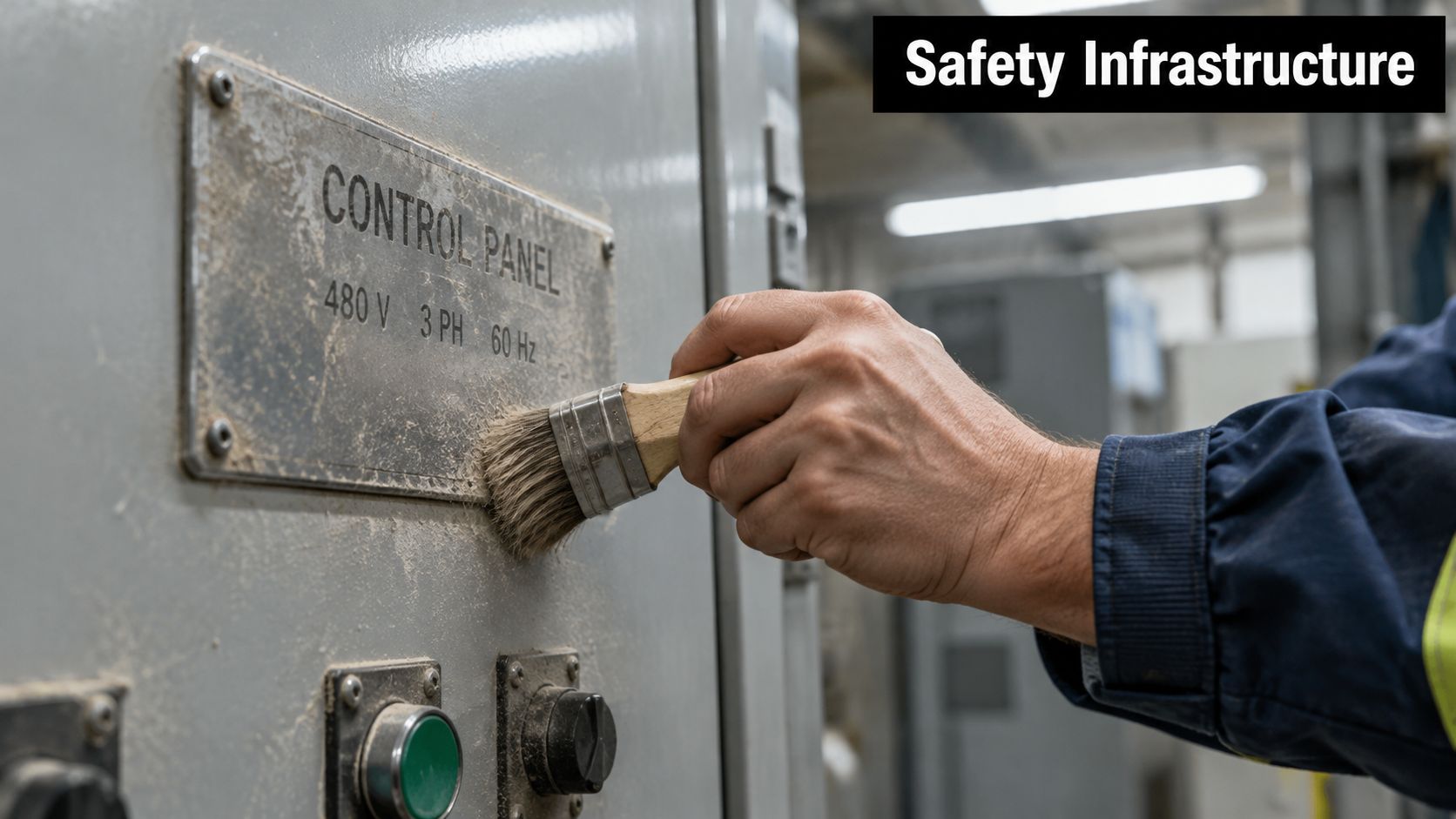
A faded plate on a shutdown line can cost more time than a failed relay. I've watched maintenance teams scrub dust off a corroded tag, cross-check the wrong serial, then lose the lockout window because nobody could read the identification fast enough.
Industrial nameplates look small, but in Australian sites they carry a lot of weight. They help people isolate plant, verify ratings, match records, and keep hazard communication readable long after the original install crew has gone home. Australia's manufacturing sector supported 930,100 employed people in the December quarter of 2024, up 33,900, or about 3.8%, from the December quarter of 2023, which shows just how broad the need is for durable equipment marking across active facilities (ABS labour account data).
If you want a practical reference point for how site managers think about maintenance and environmental risk, Gegan environmental management is useful context. The core lesson is the same across sectors, if people can't read the plate, they slow down, guess, or reach for a separate record.
Why Industrial Nameplates Matter More Than They Look
A plate that is hard to read slows work down. One operator sees a pump tag with half the text gone, another checks a control panel with a faded asset number, and a simple isolation turns into a verification exercise. Maintenance, electrical, safety, and audit teams all depend on the same small surface.
The plate is read by more than one person
The first reader is often the technician on the floor. The next might be the electrician checking ratings, the safety officer checking hazard communication, or the auditor matching the asset to records. On larger sites, those readers may be separated by months or years, so the plate cannot behave like a short-lived sticker.
Australia's long-standing safety-sign framework treats site communication as a system, which is why industrial marking should sit inside that system rather than beside it.
Practical rule: if the plate will not still make sense after dirt, repainting, replacement guards, or a shift change, it is under-specified.
A good plate also keeps the people who never touch the machine directly on the same page. Procurement needs the model and serial. Reliability teams need traceability. Contractors need a clear anchor when they arrive on site under time pressure. One plate, read correctly, keeps those jobs aligned. It works like a control point for the asset record, not just a label on metal or plastic.
Why the Australian context raises the bar
Australian sites deal with UV, moisture, wash-down, dust, vibration, and cleaning chemicals, often on the same asset. That is why the material and the marking method have to be chosen together, not separately. A plate that looks fine in the workshop can fail early once it is bolted near a motor, a switchboard, or a process line.
Gegan environmental management is useful context here because it shows how site teams think about durability and recordkeeping under real maintenance pressure. The same question applies to every industrial nameplate, will this plate still return the correct asset ID, serial, and rating to the record after months of UV, wash-down, and shift changes? That is the test that decides whether the plate is doing its job.
What an Industrial Nameplate Actually Contains
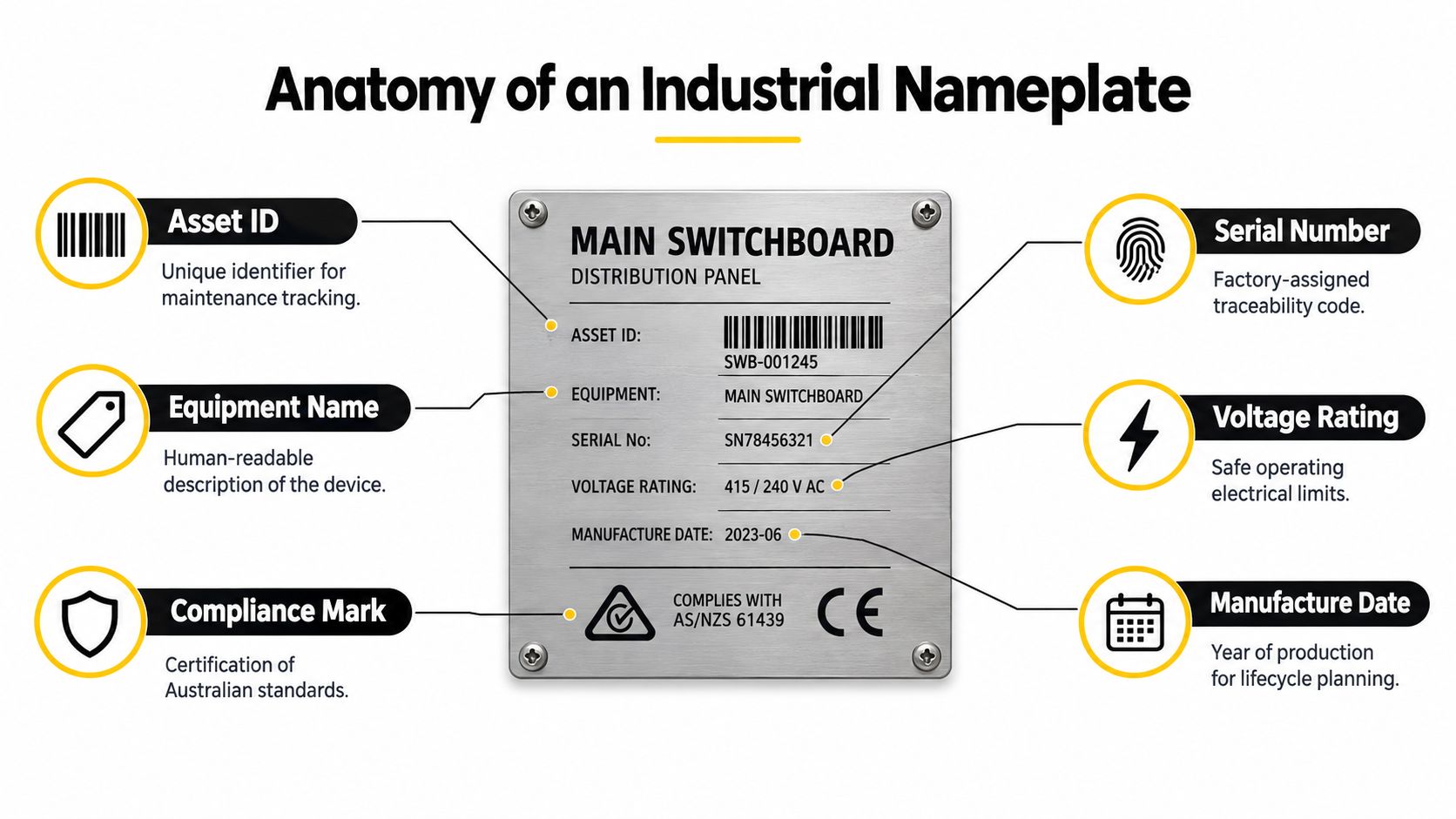
A good plate behaves like a fixed identity card. It gives people the facts they need without turning the equipment face into a billboard. On a switchboard, a pump skid, or a food-plant asset, the fields should be arranged by function, not by who had the most space on the day.
Permanent identity first
Some details belong on almost every plate because they tie the physical item to the record set. That usually includes the manufacturer, model, serial number, and often the year of manufacture. Those details stay with the asset through maintenance cycles, relocations, and handovers, so they need durable presentation and clear contrast.
Plant information can use written text, visual information, signs, symbols, diagrams, or combinations, according to Safe Work Australia plant guidance on manufacturing safe plant. The same guidance says a plant registration number must be marked where it can be easily seen and remain understandable throughout the asset's service environment. That makes the registration or asset number more than an admin label, it becomes the bridge between the object and the record.
Operational data and changing details
Ratings belong on the plate too, but only if they stay readable for the life of the asset. That includes voltage, current, pressure, temperature, IP rating, or other operating limits. Those are the numbers technicians check before they energise, isolate, or service equipment.
Keep the identity permanent, and move temporary status into a separate sign or record.
Keep asset ID, serial and rating on the plate in 3-5 mm minimum character height for arm's-length reading, and move inspection dates and status to the digital record or a separate tag. That rule keeps the plate useful without crowding it into illegibility. If the asset sits in a regulated area, the plate can also leave room for compliance markings or an inspection reference. What you should avoid is trying to print every possible note on one face, because readability at arm's length matters more than squeezing in one more field.
The simplest way to think about the layout
If the information answers “what is it?” or “what does it need to safely operate?”, it belongs on the plate. If it answers “what happened during this inspection?” or “what status is it in today?”, it usually belongs elsewhere. That separation keeps the nameplate stable while the asset record stays current.
For Australian sites, that distinction reduces confusion during service work. A maintenance planner can match the permanent identifier, while the frontline worker still sees the operating limits quickly. The plate is acting as a control point for the asset record, not just a label on metal or plastic.
Materials and Manufacturing Methods Compared
Material choice is where a lot of projects go wrong. People often start with the label face they like, then discover too late that the environment eats the adhesive, smears the print, or scratches the finish. The better approach is to choose the substrate for the site, then choose the marking method for that substrate.
What tends to hold up, and what doesn't
Anodised aluminium is a strong general-purpose choice for many industrial settings because the marking can be high contrast and readable for a long time. Stainless steel suits harsher wash-down, abrasion, or corrosion-prone environments. Traffolyte or phenolic laminates can work well for many panels and signs, especially where engraving exposes a contrasting layer. Polyester and polycarbonate can be useful for smaller labels, overlays, or protected applications, while metalised labels can give a premium look but still need the right adhesive and surface prep.
Marking method matters just as much. Mechanical engraving is straightforward and durable, but it can be slower for small batches and detailed layouts. Chemical etching gives a permanent mark, though it adds process complexity. Screen printing and UV printing can be efficient for colour or branding, but they need the right substrate and finish. Laser engraving is the most precise route for many industrial plates because it gives clean detail and repeatable depth without the same kind of tool wear you get from mechanical cutters.
Rule of thumb: use the substrate to survive the environment, and use the marking method to survive the substrate.
Trotec laser systems are a strong fit where fine detail, repeatability, and batch consistency matter. They're especially useful on anodised aluminium, coated metals, and laminates, where a controlled laser pass can create a sharp, legible mark with consistent results across production runs. For workshops that need the same format over and over, that repeatability is often the difference between a tidy label set and a mixed batch of hard-to-read plates.
A comparison view for procurement decisions
| Substrate | Best marking method | Typical environment | Key trade-off |
|---|---|---|---|
| Anodised aluminium | Laser engraving | General industrial, equipment identification | Good balance of durability and appearance |
| Stainless steel | Laser engraving or etching | Wash-down, corrosion, abrasion | Higher cost, excellent toughness |
| Traffolyte or phenolic | Laser engraving | Panels, internal equipment, general labelling | Good contrast, less suited to harsh abrasion |
| Polyester | UV printing or laser, depending on construction | Controlled indoor equipment | Can be less rugged in severe sites |
| Polycarbonate | Sub-surface printing or laser on suitable layers | Protective overlays, control interfaces | Needs the right build to resist chemicals |
| Metalised label | Laser or print depending on adhesive system | Premium equipment branding | Adhesive and surface prep are critical |
Australian sites also need to respect colour conventions when safety marking is integrated with the plate. Under AS 1318 and aligned guidance, red/white, yellow/black, green/white, and blue/white carry specific meanings on site (Queensland OIR guidance). That means a nameplate and a hazard sign shouldn't be mashed together just because they sit on the same panel.
If you're comparing substrates for real industrial use, this laser marking materials guide is a practical companion for matching the material to the marking method.
Australian Compliance and Safety Standards That Shape Your Plate
A plate does more than carry a name. It fixes the asset record at the point of use, so the operator, maintainer, and inspector all read the same identifier before they make a decision. Use the plate as the fixed key, asset number and serial on metal, and keep the full chemical or electrical record tied to location and system documents instead of crowding every detail onto one face.
Compliance becomes easier once the question changes from “Which rule applies?” to “What has to be visible, where, and for whom?” Once that is clear, the layout starts to make practical sense.
Safety signs and plate identity solve different problems
AS 1319-1994 sets the visual language for occupational safety signs, including warnings, emergency information, and fire-protection information (Standards Australia). A nameplate does not need to imitate a hazard board. It does need to sit cleanly beside any sign that does carry site safety meaning, so the two are never mistaken for one another.
Safe Work Australia's plant guidance takes the same operational view. Plant information can use text, symbols, diagrams, or combinations, and the registration number should be marked where it can be easily seen and understood in service (Safe Work Australia plant guidance). In practice, the permanent identifier needs to stand out before the surrounding clutter does.
Energy Safe Victoria is even more direct for electrical apparatus. Its code says apparatus should, where practicable, be clearly labelled, and it standardises LIVE in white on red, warning signs in yellow or yellow-black, and access-permit signs in white on green, with signs otherwise conforming to AS 1319 (Energy Safe Victoria). For switchboards and isolation points, the technical plate and the status sign must stay separate in both layout and meaning.
If a site needs a plain explanation of how those switchboard labels are usually organised, the switchboard labelling requirements guide is a useful reference.
Chemical handling raises the content bar
Chemical areas ask for more detail, but that detail still has to be disciplined. For containers above 500 mL or 500 g, Australian labelling guidance recommends product and chemical names, the UN number where required by the ADG Code, ingredients, risk and safety phrases, first-aid procedures, and emergency procedures (Safe Work Australia labelling guidance). Hazardous-chemical labels also need a product identifier, manufacturer or importer details, relevant chemical identities, pictograms, hazard statements, a signal word, precautionary statements, and emergency information, with enough contrast and legibility for workplace use (Australian hazardous-chemical labelling rules).
Because that full chemical set cannot fit legibly on one face, specify the plate for identity plus the UN number only, and place the full risk, first-aid, and emergency detail on the adjacent compliant label.
A simple compliance checklist
- Identity fields: Keep the asset number, serial number, and equipment name visible and fixed.
- Safety fields: Put hazard wording or colour-coded warnings where site rules require them.
- Legibility: Choose a layout that still reads after dirt, glare, and wear.
- Durability: Match the plate and attachment method to the actual service environment.
- Separation of functions: Do not load one small plate with every changing status message.
For teams that want a practical electrical-safety companion to those labelling decisions, prevent electrical hazards at work is a useful reference.
Laser Engraving on Trotec Machinery and the Evright Production Process
Laser engraving earns its place in industrial marking because it gives control. You can hold character size, depth, and contrast tightly, which matters when a plate has to stay legible after years of handling, cleaning, and inspection. For small plates, that precision is often more important than decoration or branding.
How the workflow usually runs
The first step is artwork setup. Clean vector files, a sensible layout, and the right font weight matter more than people expect. If the characters are too fine or too compressed, the plate may look polished in proof form and weak in the field.
Then comes substrate selection. That choice should already reflect the environment, because laser settings don't save a poor material match. Once the plate is cut or prepared, the engraving pass creates the mark, either on the surface or through a contrasting layer, depending on the material system.
After engraving, the plate is fixed by adhesive or mechanical fastening. The choice depends on vibration, heat, surface texture, and whether the asset will be washed down or handled often. Surface prep matters here, because even a well-engraved plate can fail early if the mount is contaminated.
What actually affects legibility
Contrast and viewing distance are the big ones. So are character height, line spacing, and whether the plate sits flat enough to avoid glare or shadow. What doesn't help is packing in extra words just because the plate has room on the screen, because the worker in the field won't be reading it on a monitor.
A production proof is only half the job. The other half is whether the plate still reads under fluorescent light, dust, and a tired night shift.
Evright Industrial's industrial division applies that thinking through a workflow built around engraved aluminium, stainless steel, asset labels, and custom plates, drawing on nearly six decades of laser experience through evright.com. The practical value is straightforward, brief in, proof out, production with a focus on durable materials and repeatable output.
For people who like to see the process in motion, this short clip shows the sort of production environment that supports industrial plate work.
Common Applications Across Australian Worksites
The same plate spec does not suit every site, and it should not. A food plant, a switchroom, a clinic, and a memorial project each ask for a different balance of durability, visibility, and message content. The useful question is simple, what has to stay readable, and what can change later?
Four very different use cases
In a manufacturing line, especially food and beverage, wash-down and traceability push buyers toward engraved stainless steel or anodised aluminium with adhesives that hold up under cleaning. The message usually stays tight, equipment identity, ratings, and maintenance references. Plates are often fixed on the machine face or a nearby frame so crews can read them without hunting around the plant.
In an electrical switchroom, the plate must work alongside status signage, isolation control, and site colour rules. The label on the apparatus should stay separate from live, isolated, or permit signs, because those signs describe conditions that can change from shift to shift. Mixing those functions on one plate can confuse the next person through the door.
In healthcare and facility management, legibility under aggressive cleaning matters most. Equipment often moves between departments, so the plate has to survive repeated cleaning and still tie back to inventory, service, and location records. A durable label saves time when a technician is trying to confirm a unit during a service call or audit.
In funeral, memorial, or civic work, the materials and engraving process are similar, but the purpose shifts. The plate may carry commemorative text, dates, or names rather than operational ratings. The same precision still matters, because a poorly finished plaque looks careless wherever it is installed.
Chemical and access contexts need extra discipline
Where chemicals are handled, do not force the entire compliance message onto one small plate. For chemical stores, use a larger stainless plate for asset ID and the UN number at the mounting frame, then keep the full ingredient, risk-phrase, and first-aid panel on a separate compliant chemical label beside it so both remain legible and serviceable, as noted in the Safe Work Australia labelling guidance.
That split matters in practice. The asset plate gives maintenance staff a fixed identifier they can trust, while the separate label carries the changing safety detail that should not be crowded onto a small mounting plate.
For sites where access control and verification matter, the same discipline helps keep records tidy. The article on industrial site security tips that work is a useful companion here, because a clear identifier does not replace security controls, it supports them by making fast checks easier.
Specifying, Ordering and Maintaining Industrial Nameplates
A clean specification saves arguments later. Start with the site conditions, then decide what must stay permanently visible, then choose the material and fixing method that can survive the actual environment. That's much easier than trying to rescue a weak plate after it has already failed.
A practical ordering checklist
- Site exposure: Note UV, moisture, chemicals, heat, abrasion, and cleaning routines.
- Plate body: Choose substrate and thickness based on wear, not appearance alone.
- Fixing method: Use adhesive, screws, rivets, or a hybrid based on vibration and surface condition.
- Viewing distance: Set character height for the actual location, not the bench top.
- Data strategy: Keep the human-readable identifier permanent, and link changing records separately.
The digital layer is becoming more useful, but it still needs a physical anchor. The UN Transparency Protocol's Digital Product Passport model describes records containing identification, sustainability, circularity, and traceability claims, which maps neatly to a plate that keeps the human-readable identifier permanent while pointing to a controlled record (Digital Product Passport specification). That approach works because a QR code can be damaged or replaced, while a durable identifier still lets a technician recover the asset manually.
Maintenance rule: replace the plate when fading, delamination, corrosion, or changed asset data makes the mark slower to trust than it should be.
Installation and upkeep are part of the spec, not an afterthought. Clean the mounting surface before installation, check that the fixings suit the substrate, and inspect the plate during planned maintenance. If the plate gets hidden by a guard, painted over, or mismatched to a new asset record, replace it rather than patching over the problem.
For teams building a repeatable tagging standard, asset tagging best practices gives a sensible framework for keeping the physical plate and the digital record aligned.
If you need industrial nameplates that hold up in Australian conditions, Evright Industrial can produce engraved aluminium, stainless-steel plates, asset labels, and custom safety markings for equipment, switchboards, and records. Visit Evright Industrial to discuss a plate specification that fits your site, your records, and your maintenance routine.
Recent Comments