

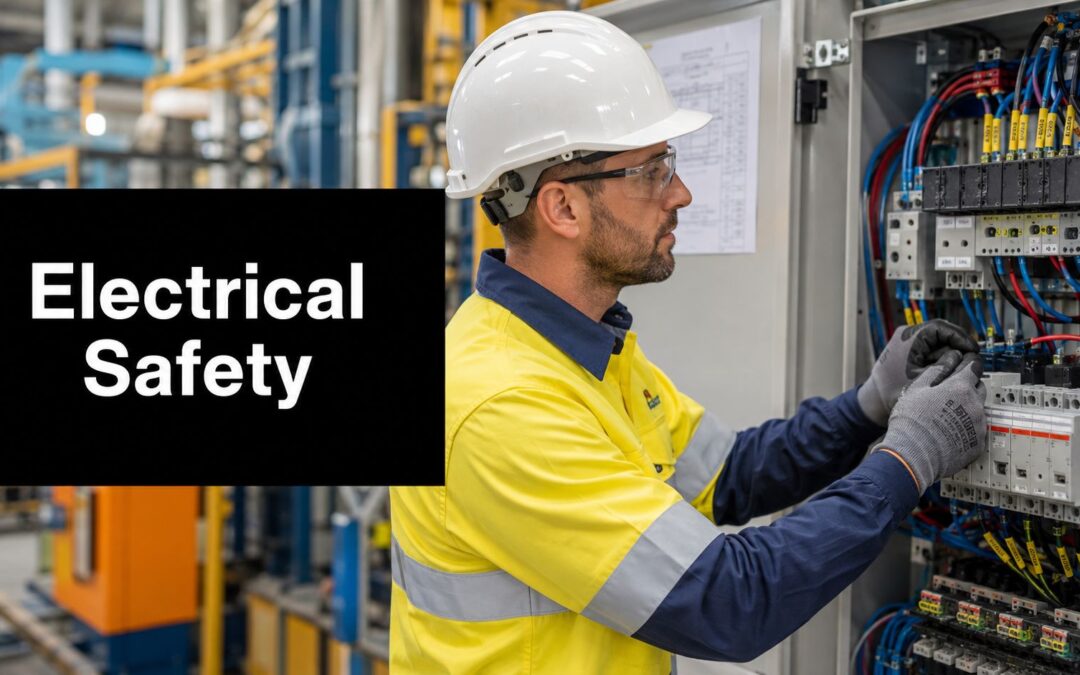
A contractor is standing beside a production machine, ready to connect a three-phase lead. The outlet looks serviceable, but the upstream isolator has no legible identification, the lead carries no visible test status, and the nearby RCD has no accessible trip-time record. The work may appear routine, yet those missing details prevent anyone from proving which device they're using, whether it was tested, or who owns the next action.
That's the practical meaning of electrical safety standards in Australia. The standards only protect people when their requirements become visible on the floor through labels, tags, records, compliant equipment and controlled work practices. Australia doesn't operate under one national electrical regulator. Each state and territory administers its own safety laws, licensing and equipment approvals, while Standards Australia develops the technical standards those laws commonly reference, as explained by the Electrical Regulatory Authorities Council.
Walking a Live Site and Spotting Practical Hazards
A productive walk-through starts at the switchboards, then follows power to the work area. Confirm that circuit identification is readable, isolation points are clearly marked and protective devices match the available documentation. A faded board label is a safety defect, not a cosmetic issue. It can delay isolation when equipment must be made safe.
Move next to the portable equipment workers handle. Check leads, power tools and portable RCDs for durable asset identification, a current test tag and a register entry describing the same appliance. A tag without a matching record creates a traceability gap. A register entry without a legible asset label cannot reliably control the item on the floor.
Practical rule: A label should answer “what is this?” before a worker opens a database. The register should answer “what happened to it?” without guesswork.
Physical conditions are usually the first evidence available to an auditor or inspector. Check whether switchboard labels remain legible, extension leads carry their tags and safety signage has survived cleaning, repairs and relocation. These details also show whether someone owns incoming inspection, retest scheduling and disposal. Repeated missing tags point to a process failure. More stickers will not fix an unassigned task.
Record each gap against the asset, location and risk. Separate immediate isolation from planned rectification, then assign a person and due action for closure. A damaged lead requires removal from service, while a sound lead with an unreadable tag may require identification and record correction. Both outcomes need controlled documentation.
The same walk should test whether records support what workers see. If an RCD, lead or tool has changed location, update the register and signage together. A clean test record is useful only when it identifies the equipment currently in use.
The Standards Stack Behind Every Australian Installation
Think of the Australian system as a chain of evidence. AS/NZS 3000, the Wiring Rules, sits at the installation foundation. Standards Australia describes it as specifying requirements for the design, construction and verification of electrical installations, including the selection and installation of electrical equipment that forms part of those installations. The AS/NZS 3000 product information confirms its role as the core installation reference.
On the floor, that foundation appears as correctly identified circuits, switchboards, isolation points, socket outlets and protective devices. A circuit schedule, engraved board label and RCD identification are the evidence that the fixed installation was designed and installed in a controlled way. For construction and demolition work, AS/NZS 3012 adds requirements for temporary electrical arrangements and site conditions. The physical evidence includes protected socket outlets, identified temporary boards and inspection records that remain available while the site changes.
AS/NZS 3760 governs the in-service inspection and testing of electrical equipment and RCDs. It's the standard that turns a portable appliance into a managed asset. The test tag, inspector identification, test date, outcome and retest status should connect to the appliance and its register entry. Safe Work Victoria's electrical safety guidance reinforces the need for formal inspection, testing and maintenance controls rather than visual checks alone.
At the product level, AS/NZS 3820 provides the essential safety requirements used within the Electrical Equipment Safety System. The EESS essential safety criteria explains that this baseline is used by Electrical Safety Regulatory Authorities to assess whether low-voltage equipment is electrically safe. That evidence belongs in supplier and procurement records, while the equipment itself should retain its identification throughout its service life.

What each layer controls
- AS/NZS 3000: Fixed installation design, construction, verification and identification.
- AS/NZS 3012: Construction and demolition environments, including temporary wiring and protective arrangements.
- AS/NZS 3760: In-service inspection, electrical testing, tagging and records.
- AS/NZS 3820: Essential safety criteria for equipment entering the market through the EESS framework.
The trade-off is straightforward. A site that keeps only installation certificates has weak control over equipment after commissioning. A site that test-tags appliances but ignores switchboard identification has the opposite weakness. Compliance works when each standard's evidence remains connected to the physical asset.
How States and Territories Turn Standards into Law
Australian Standards don't automatically become legislation because Standards Australia publishes them. A state or territory regulator must adopt, reference or enforce the technical requirements through its own legal instruments. ERAC describes this split clearly, with jurisdictions administering electricity safety laws, licensing and equipment approvals while commonly relying on shared technical standards.
NSW provides a useful example. The NSW regulator states that the 2018 edition of AS/NZS 3000 became mandatory under relevant state legislation from 1 January 2019. That date matters to contractors because the applicable edition isn't a suggestion on a bookshelf. It becomes part of the compliance reference used for relevant work under the state's adopting arrangements.
Other jurisdictions use their own legislation and regulatory pathways. Victoria administers electrical safety through its state framework and regulator. Queensland legislation defines the Wiring Rules as AS/NZS 3000. Western Australia, South Australia, Tasmania, the ACT and the Northern Territory also operate under their own electrical safety legislation and regulatory arrangements. The shared AS/NZS suite creates technical consistency, but it doesn't remove the need to verify the local adopting instrument.
| Jurisdiction | Primary legislation | Key reference standard | Adoption trigger / date |
|---|---|---|---|
| NSW | State electrical safety legislation and service and installation arrangements | AS/NZS 3000 | 2018 edition mandatory under relevant state legislation from 1 January 2019 |
| Victoria | Electricity Safety Act 1998 and related regulatory instruments | AS/NZS 3000 and applicable AS/NZS standards | State regulator adoption and enforcement |
| Queensland | Electrical Safety Act 2002 and Electrical Safety Regulation 2013 | AS/NZS 3000, defined as the Wiring Rules | State legislation and regulation |
| Western Australia | State electrical safety legislation | Applicable AS/NZS standards | State regulatory adoption |
| South Australia | State electrical safety legislation | Applicable AS/NZS standards | State regulatory adoption |
| Tasmania | State electrical safety legislation | Applicable AS/NZS standards | State regulatory adoption |
| ACT | Territory electrical safety legislation | Applicable AS/NZS standards | Territory regulatory adoption |
| Northern Territory | Territory electrical safety legislation | Applicable AS/NZS standards | Territory regulatory adoption |
The operational lesson is that a national contractor needs a jurisdiction check before sign-off. Confirm the local legislation, the adopted edition, any amendments and the required certificate or notification process. A technically sound installation can still be poorly documented if the contractor uses the wrong state pathway.
Equipment Compliance Under the EESS Framework
The Electrical Equipment Safety System, or EESS, sits before installation. It addresses whether in-scope electrical equipment can be supplied to the market, while AS/NZS 3000 addresses how equipment forming part of an installation is selected and installed. The EESS describes its purpose as increasing consumer safety for household electrical equipment across participating Australian and New Zealand jurisdictions, and ERAC identifies Queensland, Victoria, Western Australia and Tasmania as jurisdictions where certification and registration of household electrical equipment are regulated through the system. See the EESS framework for the scheme structure.
The baseline is AS/NZS 3820. The EESS rules state that in-scope equipment offered for sale must comply with relevant electrical safety standards and, at an absolute minimum, the design principles in AS/NZS 3820. The manufacturer's declaration, applicable certification evidence and supplier details should be captured before the machine, accessory or device reaches the site.
What procurement should verify
The Regulatory Compliance Mark, or RCM, is a visible starting point, not the whole file. Procurement should also identify the responsible supplier, retain the relevant declaration or certificate and record enough product information to match the paperwork to the equipment nameplate. The EESS equipment safety rules set the market compliance expectation, while the relevant standard guidance makes clear that the applicable edition is the one in force at certification, including amendments and transition dates unless a regulator or working group determines otherwise.
| Risk tier | Approval path | Marking required | Supplier record |
|---|---|---|---|
| Level 1 | Supplier assessment and declaration pathway | Required equipment identification and applicable compliance marking | Declaration and product details |
| Level 2 | Registered responsible supplier with supporting conformity evidence | RCM and required equipment markings | Registration, declaration and technical evidence |
| Level 3 | Higher-risk equipment with stronger certification controls | RCM and required equipment markings | Registration, certificate of conformity and supporting file |
Industrial examples need classification rather than assumptions. Fixed wiring accessories, portable RCDs, junction boxes, industrial plugs and cord-sets may sit under different product requirements depending on their design and use. Standards such as AS/NZS 3112 for plugs, AS/NZS 3105 for cords and AS/NZS 3191 for RCDs should be checked against the product's actual EESS status and applicable edition.
For durable identification options, industrial stainless steel equipment tags can support traceability where labels face abrasion, solvents or repeated handling. The mark alone isn't enough. Documentation must follow the asset onto site.
Workplace Safety, Test-and-Tag, and the Human Cost
Safe Work Australia reports that 44 electricians died from traumatic injuries at work over the past 10 years, with 23 deaths, or 52%, caused by electrocution. It also reports that serious claims involving “electrocution, shock from electric current” occur at a frequency about 6 times higher than the average across all occupations. Those figures are set out in Safe Work Australia's electrician WHS profile.
AS/NZS 3760 matters because it creates a repeatable control before equipment is used. The process combines visual inspection, electrical testing, a durable tag, a register entry and a retest cycle suited to the environment and equipment. A visual check can identify a cracked plug or damaged sheath. Electrical testing can identify faults that aren't visible, including insulation problems, incorrect polarity, earth faults and degradation in protective devices.
The environment changes the control frequency. Construction and demolition sites are hostile environments because equipment experiences movement, rough handling and changing conditions. Wet or dust-laden work areas also demand closer attention. A fixed-plant workshop may support a longer interval than a construction lead, but the interval must be selected from the applicable standard and site risk assessment, not copied blindly from another workplace.
A passed test has value only when the worker can identify the tested item and the business can retrieve its result.
The tag is the handover point
A useful tag shows the test date, next due date, tester identification and outcome. The register should add the unique asset ID, location, environment class, equipment description and test result. For RCDs, the record should also retain the relevant trip-time result, so the site can distinguish a tested protective device from one that merely has a sticker attached.

When equipment fails, remove it from service, identify the failure and control its repair or disposal. Businesses retiring obsolete meters and testers can use a specialist resource for electrical test equipment disposal. For permanent hazard notices, isolation labels and site-specific warnings, custom safety signs in Australia can form part of the broader identification system.
Building an Asset Labelling and Test-and-Tag Program
Start with the asset register, not the label printer. Decide which equipment requires management under AS/NZS 3760, assign each item a unique identifier and record its owner, location and environment. The identifier might be a barcode, QR code or engraved plate, but it must remain readable after contact with solvents, abrasion, heat and routine cleaning.
Create one identity for each asset
The label and test tag should point to the same record. Put the asset ID, current test status and next due date where workers can see them. Put the test date, tester identification, outcome and retest interval on the test tag. The register should hold the deeper history, including location changes, repair decisions and previous results.
A practical register includes:
- Asset identity: Unique ID, description, manufacturer and model.
- Site context: Location, owner, department and environment class.
- Testing controls: AS/NZS 3760 interval, visual inspection result, electrical test result and RCD trip-time record where applicable.
- People and evidence: Tester identity, competency evidence, date completed and attached documentation.
- Lifecycle status: In service, quarantined, repaired, returned to service or disposed.
Incoming inspection is the first control. Confirm the equipment is suitable, identify its EESS documentation where relevant, apply the site asset ID and complete the baseline inspection and test. A contractor handover should include the same identifiers and records, otherwise responsibility becomes unclear as soon as the equipment moves between teams.
Make the workflow enforceable
Schedule retests from the recorded environment and equipment class. Don't allow a tag to be renewed without a corresponding result, and don't close a register task without confirming that the new tag is attached. A tag without a register entry fails traceability. A register entry without a physical tag leaves workers unable to match the record to the item.

Fixed equipment identification also needs to align with installation records. Use switchboard labelling requirements as a reference point when checking circuit names, protective device information and isolation points against the site drawings and board schedules.
Living with Standards Through 2026 Transitions
A certificate with the wrong edition can pass procurement and still fail an audit or site acceptance check. The EESS FAQ requires responsible suppliers to use the current Australian or AS/NZS standard edition and update compliance when a new edition or amendment is issued. Version control therefore belongs in procurement, engineering and records, with the physical label, supplier file and receiving record showing the same basis.
The key 2026 change for emerging products is AS/NZS 4417.2:2020 Amendment 1:2026. Standards Australia published the amendment, adding five product categories to the Level 2 and Level 3 equipment list under the EESS and introducing a 12-month transition period, as reported in the AS/NZS 4417.2:2020 Amendment 1:2026 summary. EV supply equipment and battery energy storage systems deserve early checks. Confirm classification and supporting evidence before the equipment reaches the site, then retain that decision with the asset record.
Product files need an edition history
Standards Australia published AS/NZS 62368.1:2026 in March 2026, superseding AS/NZS 62368.1:2022. The 2022 edition is expected to remain current until 6 March 2029, according to the Standards Australia publication information. Suppliers of audio, video and ICT equipment should record the applicable edition in declarations, technical files and purchase specifications. A standard number alone does not prove which requirements governed certification.

On the shop floor, the change appears in labels, stock records and asset registers. An older label can still identify the product, but the supplier file must show the certification edition and transition rule used. Purchase orders should name the required standard. Receiving staff should quarantine equipment with unclear markings or incomplete evidence until the responsible supplier resolves the gap.
For construction-related document control, free construction standards for 2026 and 2027 provides broader context for managing standards changes alongside electrical records.
A Practical Compliance Checklist for Operators and Contractors
Give this checklist to the person controlling design, procurement, installation and maintenance. It works best when every item has an owner and a retained record.
- Confirm the installation basis. Review the design against AS/NZS 3000 and identify the jurisdiction's adopted edition, amendments and approval pathway before work starts.
- Classify incoming equipment. Determine whether each product is in scope under the EESS. Ask the supplier for the applicable declaration, certificate or registration evidence before acceptance.
- Verify visible marking. Check the RCM where required, the equipment nameplate and any manufacturer identification. Don't accept a loose certificate that can't be matched to the physical item.
- Complete installation documentation. Obtain the required Certificate of Compliance for Electrical Work, or the equivalent state form, and retain it with drawings, schedules and commissioning records.
- Identify fixed equipment. Apply clear identification to circuits, distribution boards and isolation points in accordance with the applicable Wiring Rules requirements, including AS/NZS 3000 clause 2.10 where relevant.
- Baseline portable equipment. Inspect and test equipment under AS/NZS 3760 before it enters service. Record the asset ID, location, environment, result, tester and any RCD trip-time result.
- Set the retest cycle. Match the interval to the environment and risk. The operating plan may distinguish construction, manufacturing and office settings, but the chosen interval must be justified by the applicable requirements and site conditions.
- Control failed items. Quarantine failed equipment, attach a clear out-of-service status and record whether it's repaired, retested or disposed of.
- Keep the register live. Update location, owner, contractor handover, test status and next due date when equipment moves or changes service.
- Review edition changes. Check supplier declarations and technical files against current standards, including the 2026 EESS changes and any AS/NZS 62368.1 transition evidence affecting supplied equipment.
The strongest program is easy for a worker to read and difficult for an administrator to bypass. Labels, tags and records should tell the same story, from procurement to installation, periodic testing and final disposal.
If your site needs durable equipment identification, wiremarkers, switchboard labels or custom safety signage, Evright Industrial can help translate your register and isolation requirements into physical labels, and you can discuss the application directly through Evright Industrial. Their laser engraving capability is suited to asset identification and signage where readability must survive industrial handling.
Recent Comments