

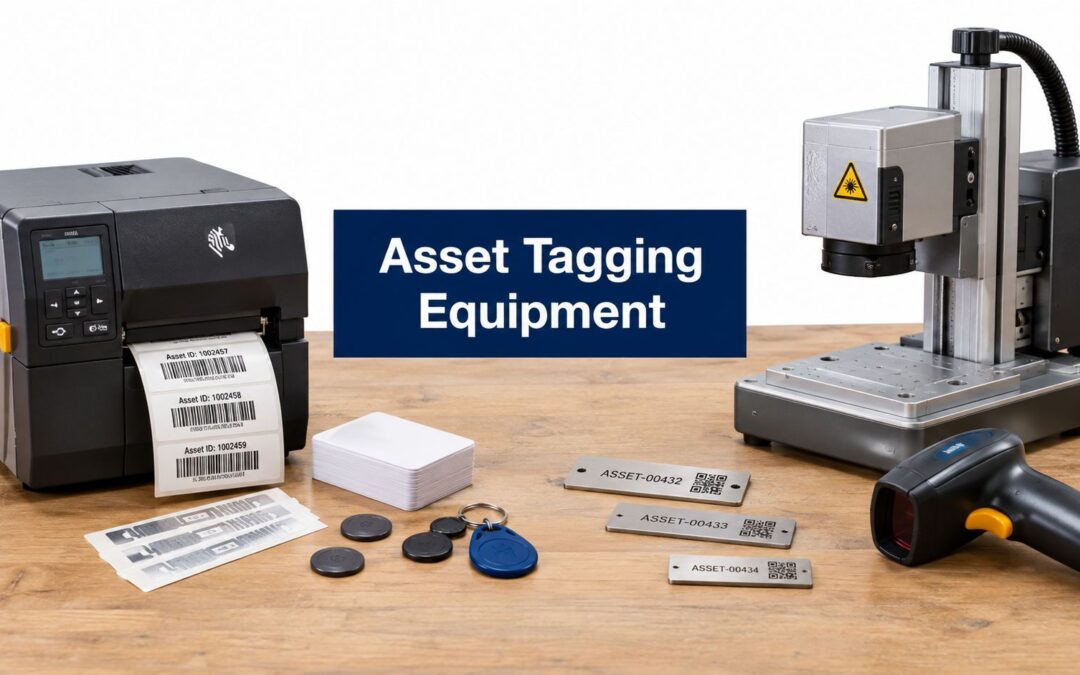
You're probably dealing with one of two problems right now. Either tags are already failing in service, or you're trying to stop that from happening before a rollout locks you into the wrong kit.
That's where most asset-tagging projects go off course. Teams buy labels first and think about conditions later. On an Australian site, that order usually costs more. Heat, washdown chemicals, UV, salt, abrasion and compliance checks don't care that a tag looked fine on the bench.
The practical question isn't “what label should we buy?” It's what asset tagging equipment will keep an identifier readable, scannable and defensible for the life of the asset in this environment. Once you frame it that way, the printer, laser, scanner, applicator and substrate all become lifecycle choices rather than stationery.
Why Asset Tags Fail on the Australian Worksite
A common failure starts in a place that seems controlled enough. A stainless section on a food-processing line. Freshly cleaned. New barcode label applied properly. It scans on day one, survives commissioning, and everyone moves on.
Then the washdowns start. After repeated chemical cleaning and hot water exposure, the face stock dulls, the print loses contrast, and the edges begin to lift. By the time an auditor asks to verify an asset record against the physical tag, someone is standing there with a marker, a spreadsheet and a maintenance fitter waiting for access.
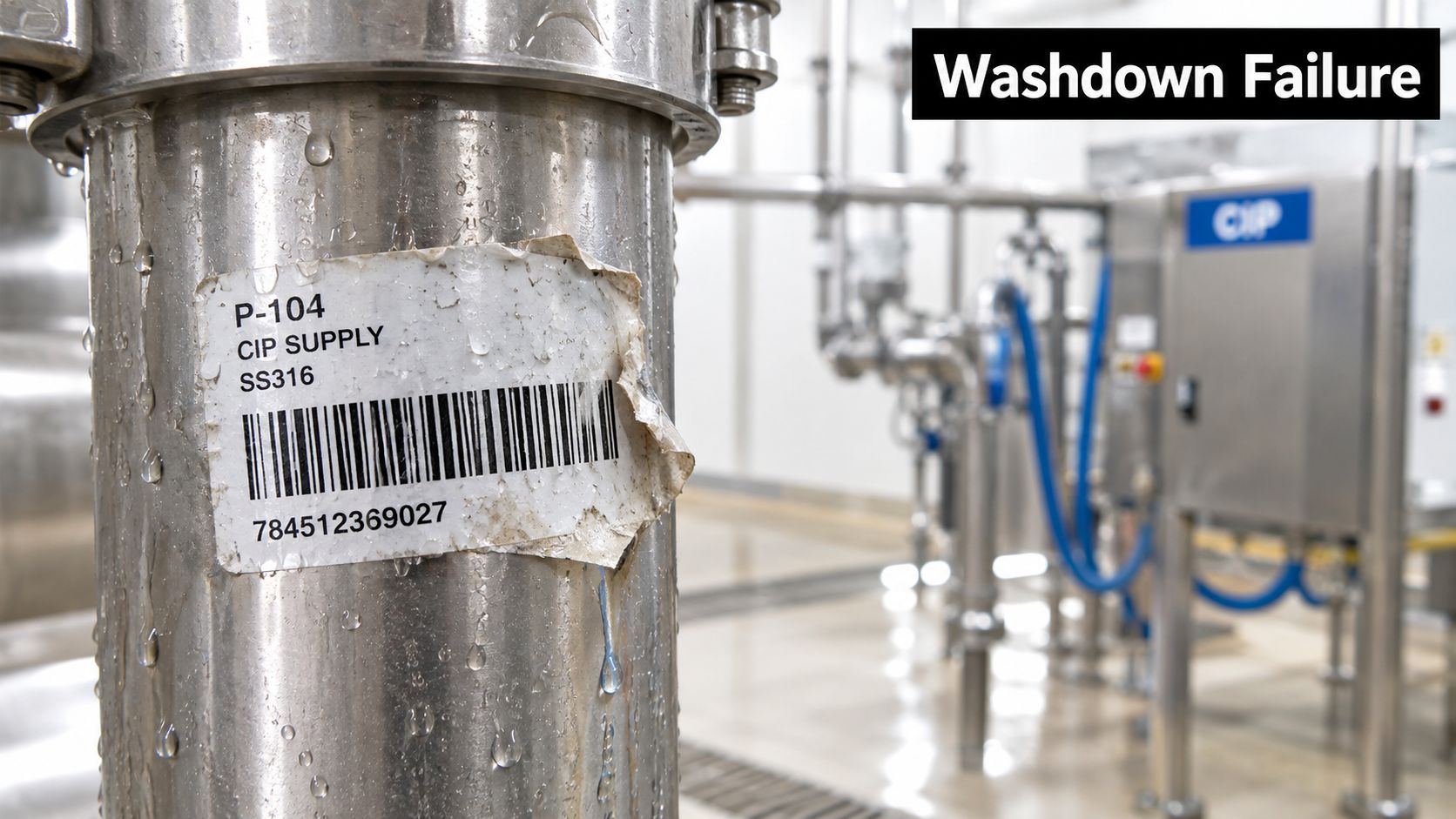
That's why a written equipment tagging procedure matters. If the procedure only says what data goes on the tag, but says nothing about substrate, attachment method or exposure, the tag system is incomplete.
Different sites break tags in different ways
In practice, cheap printed tags rarely fail for one reason. They fail according to the environment.
- Food and beverage lines: Washdown chemicals and regular scrubbing attack print layers and adhesives.
- Pilbara yards and remote compounds: UV exposure fades low-grade print and embrittles films.
- Port-side workshops: Salt spray gets under edges and accelerates lift or corrosion around fixings.
- Hospital equipment rooms: Disinfectants and repeated handling attack weak laminates.
- Mine conveyor and mobile plant areas: Dust and abrasion physically wear away printed information.
Practical rule: If you already expect the asset to outlast the label, you've chosen the wrong tagging system.
The real cost isn't the label
Teams often focus on tag unit price because it's visible on the quote. The expensive part usually shows up later. Someone has to identify the failed tag, confirm the asset, print or write a replacement, reattach it, update the system if numbering drifted, and explain the gap if an audit lands in the middle of that mess.
That's why I treat durability as the first filter, not the last. Before barcode symbology, software integration or whether you want RFID, the first question is simple: what will this environment do to the tag over time?
Once you answer that, most of the equipment decision makes sense.
The Main Types of Asset Tagging Equipment
Most Australian sites end up using a mix, not a single machine. The trick is matching each tool to the job it suits, rather than forcing one marking method across everything.
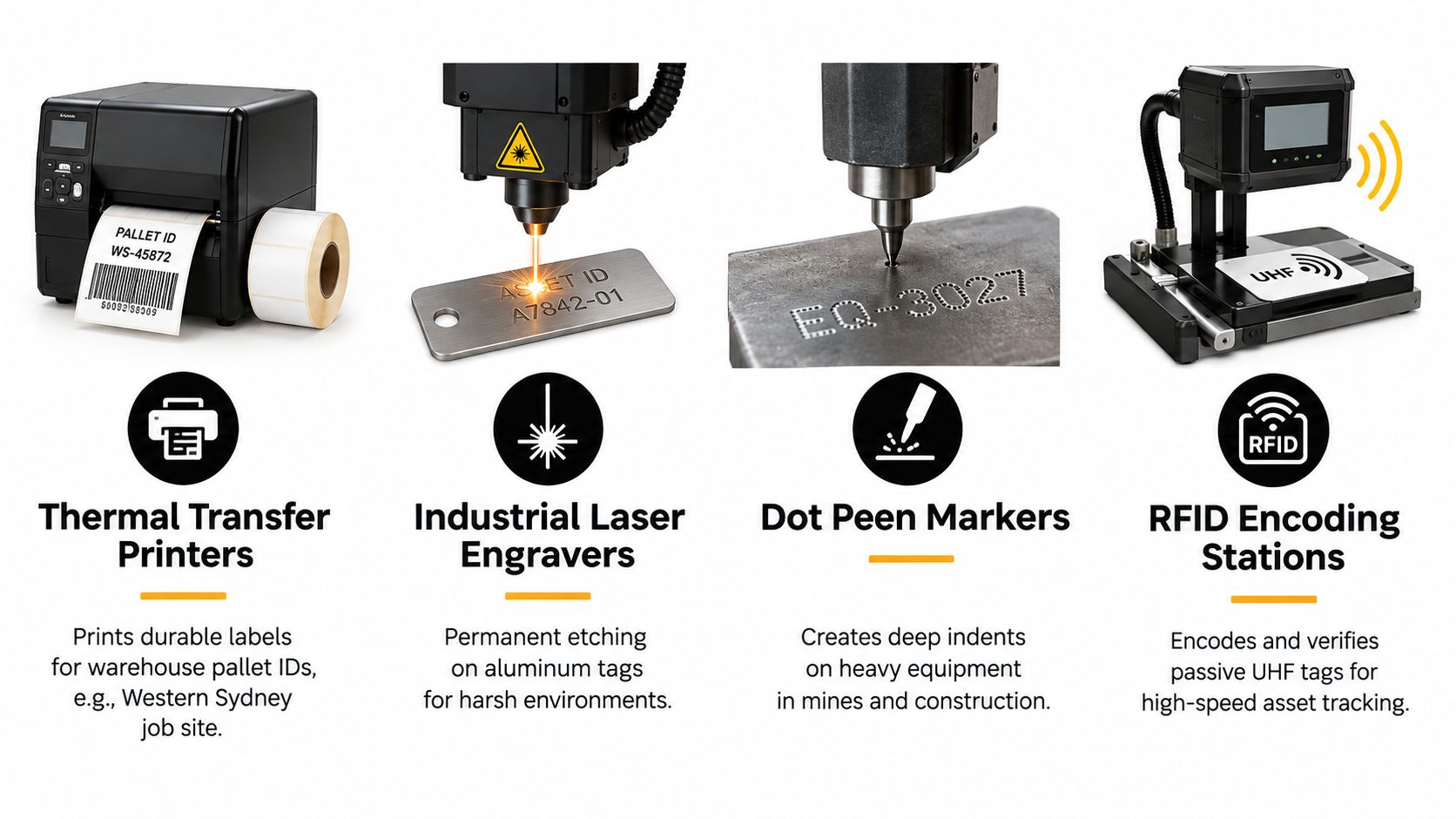
Thermal transfer printers
A thermal transfer printer is still the right answer for plenty of work. In a Western Sydney warehouse tagging pallet locations, shelf IDs, tote labels or short-to-medium-life indoor assets, it's fast, familiar and easy to support.
It works best when:
- The environment is controlled: Indoor storage, dispatch and general warehousing suit printed labels well.
- You need quick changeovers: New asset ranges, revised numbering, or temporary campaigns are easy to handle.
- Staff already know the workflow: Operators can print, peel and apply with minimal specialist training.
It works poorly when the label is expected to survive heavy washdown, outdoor UV, aggressive solvents or years of abrasion.
Industrial laser engravers
For permanent metal labels, the conversation changes. A laser system is the practical step up when assets live outdoors, near heat, around chemicals, or inside compliance-heavy environments where you can't afford unreadable IDs.
A Brisbane utility tagging valves, pump assets or outdoor electrical equipment usually gets better long-term results from laser-marked anodised aluminium, stainless steel or laminated industrial plates than from printed films. Trotec Laser is one of the platforms commonly specified for this kind of work because it suits metal tag and durable nameplate production, and it's the sort of machine imagery worth showing in a serious marking discussion rather than generic mechanical visuals.
Later in the process, production speed isn't the only issue. Consistency of mark depth, edge quality and barcode contrast matter more.
A useful reference when you're mapping tag choices into broader material control is this traceability guide for polymers. It's not about asset tags alone, but it's good at framing how identifiers sit inside a larger traceability workflow.
RFID encoding stations
RFID earns its keep where line-of-sight scanning slows people down. In a Gladstone maintenance depot issuing tools through a crib, an encoder and reader setup can simplify check-in and check-out when assets move in batches or are hard to orient for a scanner.
Its strengths are operational, not magical:
- Bulk reads: Useful when assets pass a checkpoint together.
- Reduced aiming time: Staff don't need to present every barcode to a scanner.
- Hybrid options: You can pair RFID with visible human-readable data and a barcode.
Its weaknesses are just as real. Metal, mounting method and reader setup can complicate deployments, and teams often underestimate the setup discipline needed to keep reads reliable.
A closer look at laser-based tag production helps here:
Scanners and applicators
These are the items buyers overlook. Yet handheld scanners, mobile computers and label applicators often shape labour cost more than the printer itself.
A hospital biomedical team rolling out tags across hundreds of mobile devices can lose time far faster through awkward scanning and hand application than through the actual printing step. If you're reviewing options, a local asset tag label printer guide is a good starting point, but don't stop at the printer. Check the whole handling workflow from print to scan to replacement.
A fast printer paired with a clumsy application process is still a slow system.
Matching Materials and Print Method to the Environment
Most tag failures are material failures first and print failures second. Teams blame the barcode or the printer when the issue was asking the wrong substrate to survive the wrong service conditions.
What the materials actually do
Printed polyester has a place. It's practical for indoor assets, office technology, sheltered equipment and jobs where replacement is easy and expected. It's also the sensible option when the asset itself won't stay in service long enough to justify metal.
Laser-marked metal tags sit at the opposite end. One Australia-based supplier notes that metal barcode labels with graphics sealed in anodic aluminium can offer a claimed lifespan rating of 20 years and resistance up to 350°C in its barcode label ID solutions guidance. That doesn't make metal compulsory everywhere, but it does set the benchmark for harsh environments.
RFID inlays solve a different problem. They improve reading workflow, but the inlay still needs housing or a label construction that suits the site. If the face stock or attachment fails, the chip won't save the deployment.
Material vs Environment Durability Comparison
| Material | Print Method | Max Temp | UV/Solvent/abrasion resistance | Typical asset life |
|---|---|---|---|---|
| Printed polyester | Thermal transfer | Qualitatively suited to general indoor use, not harsh heat exposure | Moderate indoors, weaker under solvents, UV and repeated abrasion | Best for shorter-life or sheltered assets |
| Anodised aluminium | Laser marked | Up to 350°C in the supplier specification linked above | Strong resistance to UV, chemicals and outdoor exposure when properly specified | Suitable for long-life industrial assets, with a claimed 20-year lifespan rating in the supplier guidance |
| Stainless steel tag | Laser marked or mechanically marked | Qualitatively strong in hot, abrasive and corrosive settings | Strong against abrasion, washdown and harsh environments | Suited to long-service plant and exposed infrastructure |
| RFID label or hard tag | RFID encoded, often paired with printed or engraved human-readable data | Depends on housing and adhesive system | Varies widely by construction and mounting method | Best where workflow speed matters and the tag body matches the site |
When cheap labels are rational
There's no prize for overbuilding a tag. For laptops in a low-risk office, indoor monitors, temporary project assets or short-life devices, a printed label is often the right call.
For plant, tools and infrastructure exposed to real punishment, replacement labour becomes the hidden cost. That's where durable asset tracking labels make more sense than repeatedly reissuing low-cost labels that weren't built for the environment.
The tag material should match the asset's service conditions, not the purchasing team's preferred unit price.
Australian conditions force this decision quickly. Strong UV, dust, coastal exposure and frequent cleaning don't give average labels much margin for error.
Australian Compliance Standards That Drive Equipment Choice
On many sites, compliance decides the equipment before preference does. Once a label has to remain legible for inspection, maintenance, testing or register reconciliation, the argument for tougher tag construction becomes much easier to defend.
Portable electrical equipment and test tags
Australian guidance tied to AS/NZS 3760:2022 shows how inspection, test and tag intervals vary by workplace. Construction, demolition or mining sites commonly require 3-month intervals, manufacturing workshops and warehouses often 6- or 12-month intervals, and low-risk offices can be up to 5 years for many items in this Australian asset-tagging guidance. The same guidance says each passed item must carry a durable tag showing at least the test date, next due date, and the competent person or organisation.
That requirement sounds simple, but it drives equipment choice. If tags are cleaned regularly, flexed around leads, or exposed to rough handling, the print process and substrate have to hold together between inspections.
Healthcare and regulated identification
Healthcare is where people often confuse an internal asset tag with a regulated device identifier. The Therapeutic Goods Administration says UDI requirements became mandatory for Class III and Class IIb devices from 1 July 2026, with direct marking obligations starting later for reusable devices in the TGA UDI news and updates. For packaging, the TGA also says the UDI carrier should be applied to the outside of the packaging and must remain readable or scannable for specific device types.
That pushes hospitals and device teams toward label systems that survive cleaning, handling and, for some reusable items, direct marking expectations.
Government and infrastructure rules
Queensland public-sector asset management uses the Single Asset Identifier (SAID) standard. It requires all financial assets and maintainable items to receive a barcode label recorded in the asset management system, with white labels for financial assets and yellow labels for maintainable items, and it says the label should be attached upon receipt with only one SAID label fixed to each individual asset in this summary of custom equipment ID tag requirements.
On the utility side, South East Water's AM2714 Electrical Standard requires significant maintainable equipment to carry an asset prefix, number and description. It also states that electrically supplied equipment external to switchboards must include the source of supply on the label, and it specifies engraved two-colour laminated PVC labels for some internal uses and stamped aluminium or stainless steel labels for exposed outdoor areas in the AM2714 Electrical Standard PDF.
Compliance Standards Mapped to Tagging Equipment
| Standard | Scope | Required Equipment Type | Recommended Material |
|---|---|---|---|
| AS/NZS 3760:2022 | Portable electrical inspection, test and tag workflows | Thermal transfer printer or durable label printer for compliant test tags | Durable synthetic tag stock suited to handling and cleaning |
| TGA UDI requirements | Medical device labelling and packaging, with future-dated mandatory milestones for certain classes | High-resolution printer, scanner verification, and in some cases laser marking for durable identifiers | Packaging labels for UDI carriers, plus durable direct marking where applicable |
| Queensland SAID | Public-sector financial assets and maintainable items | Barcode label production and asset system integration | Durable barcode labels with clear visual distinction by class |
| Utility standards such as AM2714 | Maintainable electrical and outdoor infrastructure equipment | Engraving or metal tag production equipment | Laminated PVC for some internal labels, aluminium or stainless steel for exposed outdoor areas |
Procurement, ROI and Lifecycle Costs
The clean way to compare asset tagging equipment is by looking at the whole system cost, not just the tag. That means hardware, consumables, replacement effort and disruption when tags fail.
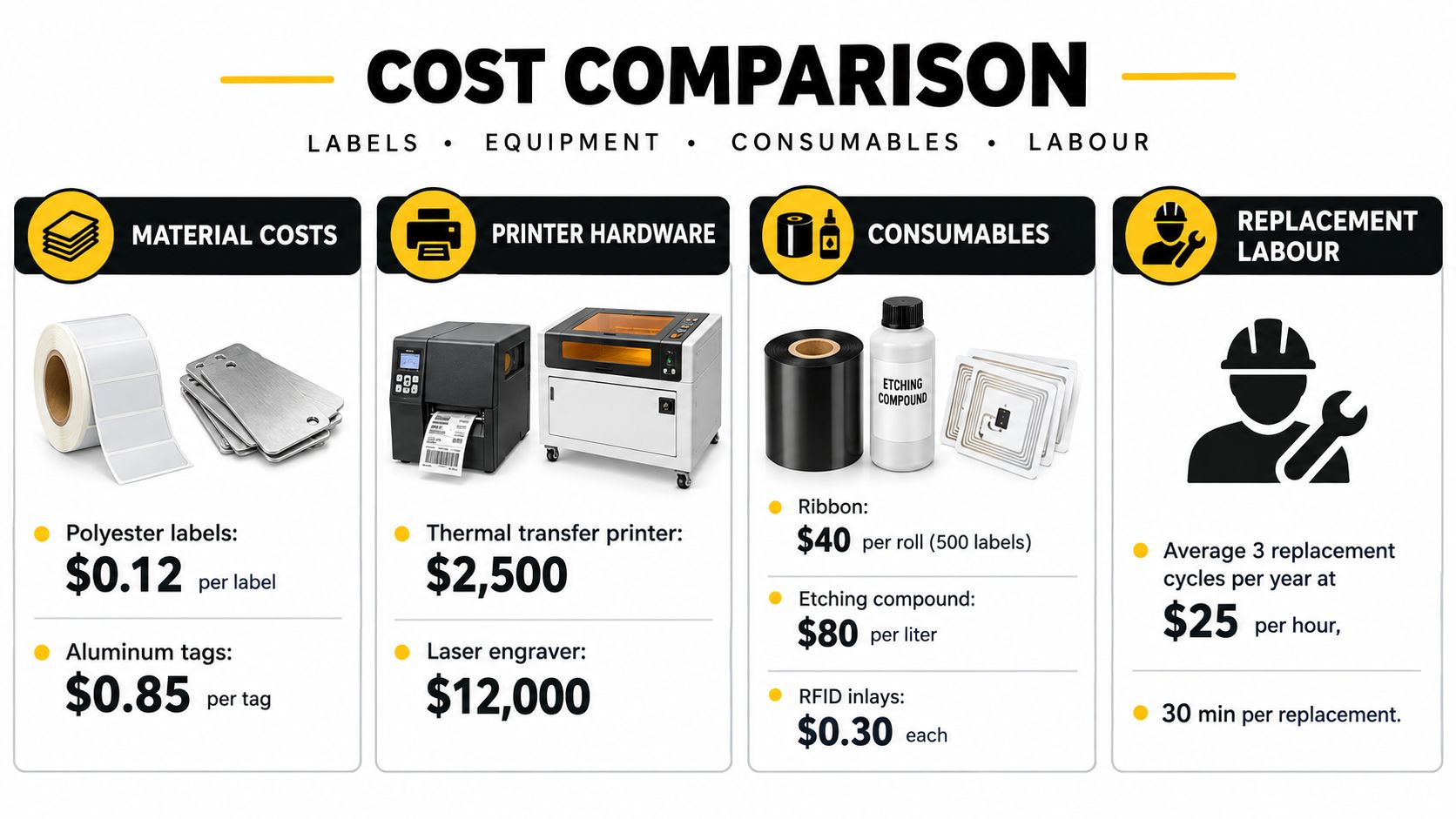
The infographic above shows example figures, but I wouldn't treat them as universal buying numbers without a live quote and a site trial. Real costs swing on volume, substrate, attachment method, barcode verification requirements and whether staff can replace tags without interrupting access to the asset.
The four cost lines that matter
- Label material: Cheap labels are easy to approve. Replacing them on hard-to-access assets is what changes the economics.
- Printer or marker hardware: Thermal printers cost less to enter with. Laser systems cost more upfront but usually change the durability equation.
- Consumables: Ribbons, specialist stocks, metal blanks, RFID inlays and fixtures all matter. Some are cheap per cycle until waste and rework are included.
- Replacement labour: This is the line item many teams don't formally price, even though it's often the most painful.
Where lifecycle cost turns
A printed polyester tag can still be the most economical choice if the asset is indoors, low-risk and easy to retag. That's true for plenty of office IT and short-life equipment.
The opposite is also true. If the asset sits in a washdown area, outdoors, or inside a strict maintenance regime, repeated retagging becomes a recurring job that no one budgeted for. Labour, production access, permit coordination and record correction all get dragged into what looked like a cheap label decision.
Field note: If replacing a failed tag requires a fitter, a shutdown window or infection-control clearance, it was never a low-cost tag.
Financing and support
When buyers hesitate over a laser system, the practical alternatives are straightforward. Lease the hardware, outsource initial production, or split the workflow so durable tags are made centrally and applied by site teams. Any of those can work if the data standard is locked first.
Service support matters as much as the machine. Ask about:
- Laser source warranty: What's covered, and what isn't.
- Spare parts access: Lenses, extraction consumables, fixtures and software support.
- Consumable stockholding: Especially if your operation can't wait for specialist media.
- Training depth: Barcode contrast, metal selection and fixture setup aren't things to wing.
Cheaper printed tags still make sense on low-risk indoor assets. They stop making sense when the environment or audit burden makes failure predictable.
Sector Use Cases for Manufacturing, Utilities and Healthcare
The same equipment can produce very different results depending on where the tag ends up. That's why broad advice like “use barcode labels” doesn't help much on the floor.
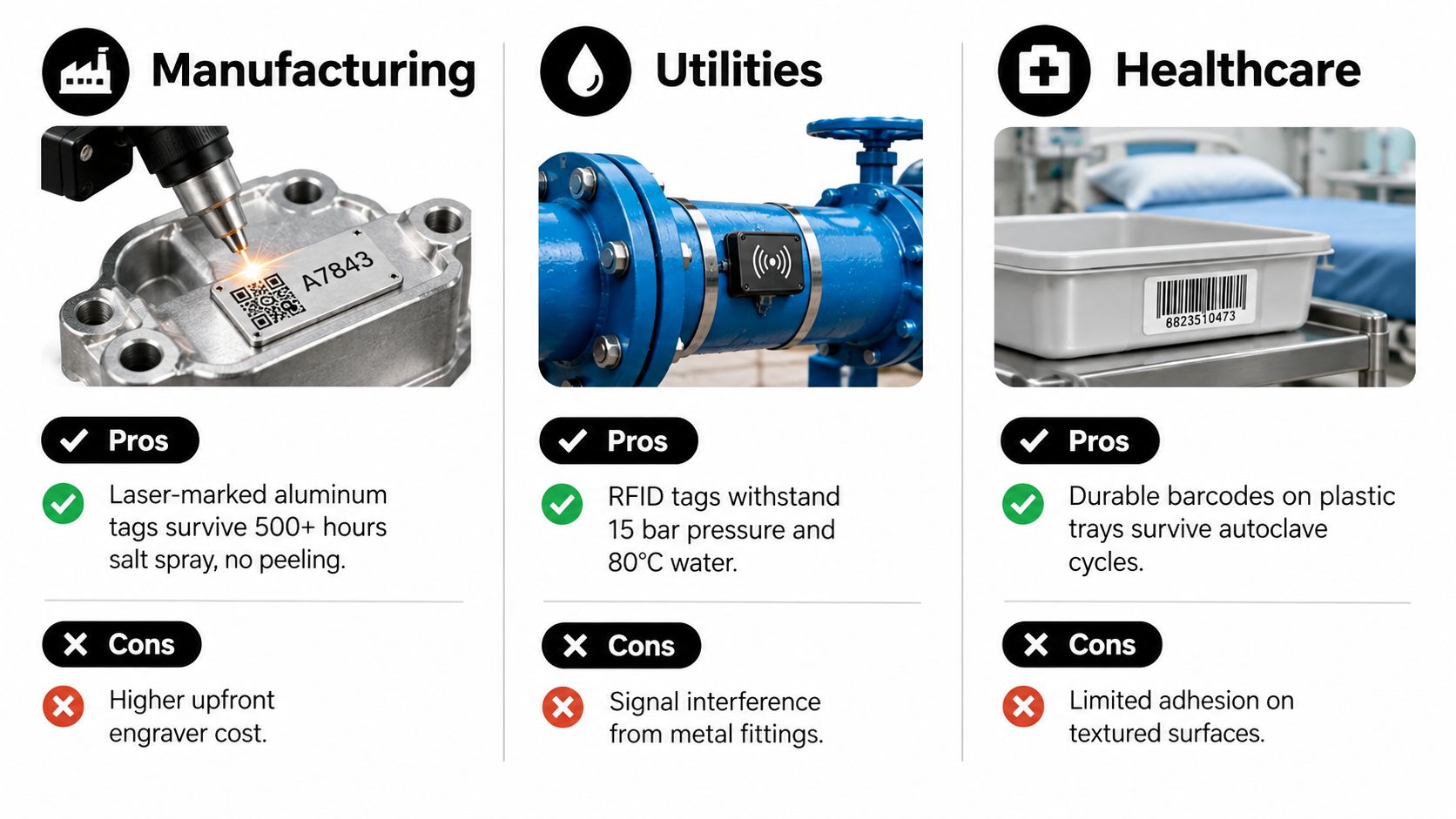
Manufacturing
A powder-coating line asks a basic question: can the identifier survive heat and handling long enough to stay linked to the part and the asset record? Printed films often struggle once heat, prep chemicals and repeated contact enter the process.
Australian practice increasingly aligns physical tags with machine-readable standards such as GS1 identifiers including GIAI and GRAI, while sector rules such as AS/NZS 3000 and AS 1319 affect permanence and safety-colour or symbol requirements in this Australian discussion of asset tags and equipment ID labels. On a manufacturing line, that usually pushes critical plant labels toward more durable, machine-readable formats that remain auditable over time.
A laser-marked aluminium or stainless tag suits that better than a standard peel-and-stick print when exposure is harsh.
Utilities
Utility equipment lives with weather, grime and field maintenance. A pump station tag isn't just there for inventory. It has to help technicians identify the right asset quickly and reconcile that ID against maintenance records.
For many utility and infrastructure jobs, the practical move is an engraved or stamped tag, sometimes paired with RFID if inspection workflow benefits from faster reads. The key isn't the technology label. It's whether the identifier survives in the open and remains readable after years of service.
Healthcare
Healthcare buyers have a different problem. Equipment gets cleaned aggressively, moved constantly and checked against device records under stricter governance than a generic office asset.
The durable choice is often direct marking or a properly specified plate on assets that face repeated cleaning and reprocessing. Internal tracking also needs to stay distinct from regulated device identification requirements, especially as UDI obligations expand across relevant device classes under the TGA framework already noted earlier.
For common hospital asset classes, labels are used to identify and track tools, machinery, laptops, computers, monitors, mobile devices and other fixed equipment, making the label part of inventory control rather than a simple nameplate in this overview of Australian asset labels.
In hospitals, the wrong tag doesn't just fail physically. It confuses the boundary between internal asset control and regulated device labelling.
Procurement Checklist and Where to Source the Right Equipment
A procurement mistake usually shows up six months later. The printed tag fades after washdown, the adhesive lifts on a curved housing, or the barcode scanner starts failing in the field because the code was never specified for that surface in the first place.
That is why I treat asset tagging equipment as a lifecycle decision, not a stationery order. The right question is whether the full system, marker, substrate, fixing method, software, service support and replacement process, will still work after cleaning, heat, UV, abrasion and inspections have had their turn.
Start with the failure point
Before comparing vendors, identify how the current tag or marking method is likely to fail on site.
- Loss of legibility: UV, solvents, steam, disinfectants and abrasion can wipe out printed data long before the asset reaches end of life.
- Attachment failure: Adhesives behave very differently on powder-coated steel, low-energy plastics, textured casings and curved assets.
- Process failure: A tag can survive physically and still fail operationally if the barcode grade is poor, the data field is wrong, or staff cannot scan it during routine maintenance.
- Replacement difficulty: If the asset is hard to access once installed, buy for long service life upfront. That usually shifts the shortlist toward engraved or laser-marked metal tags.
Procurement checklist
A decent RFQ for asset tagging equipment should answer these points clearly.
- Environment: Indoor, outdoor, washdown, chemical exposure, salt air, plant room heat, sterilisation, or mixed conditions.
- Asset surface: Painted metal, bare stainless, anodised aluminium, cast parts, engineering plastics, cable, or rubber hose.
- Expected life: Temporary shutdown tag, five-year depot label, or identification intended to last for the service life of the asset.
- Data format: Human-readable text, serial number, barcode, QR code, RFID, or a combination.
- Fixing method: Adhesive, rivets, screws, wire, banding, or direct part marking.
- Read method: Handheld scanner, phone camera, fixed reader, or manual visual check.
- Compliance record: What must remain readable for audits, maintenance logs, electrical test records or medical asset registers.
- Replacement model: On-demand in house production, outsourced batches, or a hybrid arrangement for standard versus high-durability tags.
Questions to put to shortlisted suppliers
Ask specific questions and make the supplier answer against your actual assets, not generic samples. Weak proposals usually fall over here.
- Which materials do you recommend for our surface types, and which do you avoid?
- How is code quality verified before tags leave the shop or printer?
- What is the service interval for the equipment, and what stops production if that service is missed?
- What consumables or spare parts have the longest lead time?
- What warranty applies to the source, optics, printheads, scanners and software licences?
- Can you produce a trial run using our artwork, our serial structure and our cleaning routine?
- If a tag fails early, is the problem usually material, adhesive, artwork setup, or operator process?
Those answers matter more than a polished brochure.
Where to source the right equipment
Source by equipment family, not by vendor claims. Desktop thermal printers, industrial label printers, dot peen markers, laser systems and outsourced engraved plate suppliers solve different problems. Price comparisons only make sense inside the same class.
For shorter-life indoor assets, a capable industrial printer and the right media may be enough. For plant, utilities, transport yards and healthcare assets that face repeated cleaning or long exposure, permanent metal tags often cost less over the asset life because they avoid re-tagging, re-scanning failures and argument during audits.
If outsourced supply suits the job better than bringing production in house, Evright Industrial is one Australian source for laser-engraved metal asset tags, serial plates and machine labels used in industrial identification. For broader procurement due diligence, vendor checks on warranty terms, local service capacity and spare-part availability are just as important as the tag sample itself.
A practical buying process is simple:
- Audit a small set of high-risk assets first.
- Shortlist comparable systems only.
- Run a site trial under your cleaning, handling and exposure conditions.
- Check replacement cost over the asset life, not just day-one unit price.
Cheap tags are often expensive by year two.
Recent Comments