
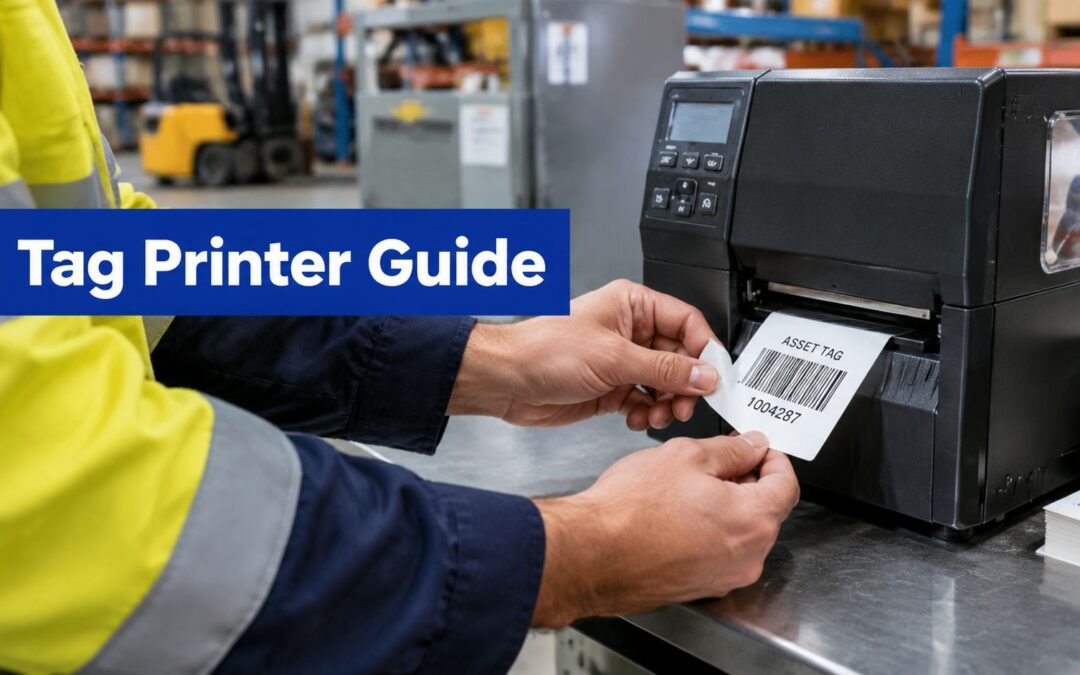
A new pump arrives at a factory, a contractor hands over a switchboard, or a hospital receives replacement equipment. The asset register needs an identifier immediately, and the obvious answer seems simple: buy an asset tag label printer, print a barcode, and apply it. Months later, the barcode may be unreadable, the adhesive may lift, or the tag may disappear during cleaning, outdoor exposure or maintenance.
The printer is only one part of the result. Substrate, ribbon, adhesive, fixing method, barcode design, software and the asset register determine whether identification remains useful in the field. This guide explains how Australian industrial teams can choose between thermal transfer, direct thermal and laser marking, and when a printer is the wrong tool for the job.
| Marking route | Where it fits | Main strength | Main limitation |
|---|---|---|---|
| Thermal transfer | Indoor and industrial asset tags | Durable variable printing and mixed media support | Depends heavily on the correct ribbon, substrate and adhesive |
| Direct thermal | Short-life, controlled indoor labels | Simple printing without a ribbon | Heat and light can shorten label life |
| Laser marking | Permanent plates, tags and equipment marking | Long-term, consumable-free identification | Requires suitable materials and a laser system |
Why the Asset Tag Label Printer Decision Matters More Than It Looks
A maintenance technician scans a newly applied tag beside a production line. The code reads correctly, the text is sharp, and the label looks professional. Later, the same asset sits near wash-down equipment, exposed to handling, cleaning products and changing temperatures. The print starts to lose contrast, one corner lifts, and the technician has to type the identifier manually.
That failure doesn't always begin with the printer. It often starts with a mismatch between the marking process and the environment. A basic direct thermal label may suit a temporary indoor movement label, but it isn't the sensible choice for an outdoor electrical enclosure or a component handled throughout repeated maintenance cycles. A thermal-transfer printer may produce a stronger mark, yet a poor face stock or unsuitable adhesive can still fail.

The real measure of success
The right question isn't, “Which printer has the highest speed?” It's “What identification method will remain legible, scannable and correctly attached for the asset's working life?”
That changes the buying process. Instead of comparing machines in isolation, you need to define:
- Asset exposure: Will the label face sunlight, moisture, abrasion, chemicals, heat or frequent cleaning?
- Code requirements: Does the register need a linear barcode, a two-dimensional code, a serial number or several identifiers?
- Deployment method: Will the label be stuck directly to the asset, attached as a tag with wire, or mechanically fixed as a plate?
- Operating rhythm: Do assets arrive continuously, or is this a one-off rollout with a fixed data set?
- System connection: Will the printed identifier connect to a CMMS or asset-management system, or will the printer operate as a stand-alone tool?
A printer can be an efficient production tool when the team needs variable data on demand. It becomes a workflow bottleneck when staff still have to copy numbers manually, maintain a separate spreadsheet, manage scanners independently and reconcile records after application.
By the end of this guide, you should be able to distinguish print quality from field durability, select a technology that suits the deployment, and decide whether your operation needs a printer, a complete tracking workflow, laser-marked plates, or a combination.
How Asset Tags Fit Into Australian Compliance and Operations
Australian asset tags often sit inside a formal governance process rather than a casual labelling exercise. South Australia's TS0133 specification, published on 21 December 2018, defines two formats, plate and tag, and states that tag labels are attached with wire and connector or cable tie. It also distinguishes between an Asset Location Label and an Asset Identification Label, connecting physical identification with maintenance and energy-isolation work in the South Australian asset-labelling specification.
That distinction matters to printer selection. A label isn't successful because it looked clean at the point of application. It has to remain readable in the position where a worker finds it, and it has to support the record associated with the equipment.
Three technologies in plain language
Thermal transfer uses a heated print head to transfer ink from a ribbon onto a label surface. With a suitable resin ribbon and industrial stock, it's the usual printer-based route for variable asset identifiers that need resistance to handling, abrasion or demanding site conditions.
Direct thermal uses heat-sensitive material. The print head darkens the label directly, so there's no ribbon to install. That makes the process straightforward, but the label surface itself reacts to heat and light, which limits its usefulness for permanent identification in exposed environments.
Laser marking changes the surface of a suitable material rather than laying down conventional printed ink. A Trotec laser system can mark metal, acrylic and other compatible materials for applications where a permanent plate or tag is more appropriate than an adhesive label.
Why governance changes the buying decision
Public-sector asset rules show how tightly identification can be specified. The University of Sydney requires a unique equipment code and a unique barcode asset identifier for each asset, while Queensland Health uses a SAID number barcode label for financial assets and maintainable items, with the identifier recorded in the relevant asset-management system. Those requirements make consistent numbering, repeatable output and durable attachment more important than a printer's headline speed.
Treat the barcode as part of an evidence chain. A failed scan can slow maintenance, complicate an audit and force staff to rely on a manual lookup. The printer must therefore support the selected material, code density and deployment method, not merely produce attractive black text.
Thermal Transfer vs Direct Thermal vs Laser Marking Explained
Thermal transfer, direct thermal and laser marking solve different problems. Treating them as interchangeable is how teams end up using a short-life label where a permanent identifier was required.
Thermal transfer for variable industrial labels
A thermal-transfer asset tag label printer uses a ribbon between the print head and the label. The ribbon formulation matters. Wax can suit less demanding applications, wax-resin offers a broader compromise, and resin is the serious option where abrasion, solvents or environmental exposure threaten the printed surface.
Thermal transfer works well when the asset data changes frequently. Teams can print serials, barcodes and other variable identifiers in-house, then select polyester, PVC or other suitable stocks for the application. The limitation is that the finished result still depends on the complete material stack. A durable ribbon won't rescue a face stock that isn't suited to ultraviolet exposure or an adhesive that can't hold to the equipment surface.
Direct thermal for controlled, shorter-life work
Direct thermal removes the ribbon from the process. That reduces consumables and simplifies setup, which can be useful for temporary labels, internal movement control or protected indoor applications.
The weakness is the heat-sensitive surface. Sunlight, heat and some handling conditions can reduce contrast over time. For a label that must support long-term maintenance traceability, direct thermal deserves a careful challenge rather than automatic acceptance.

Laser marking for permanent identification
Laser marking is different from both printer technologies. It creates a permanent mark on a compatible plate or component, with no ribbon or conventional label ink. It suits equipment identification where the mark must remain with the asset through severe service, and it can support detailed serials, logos and codes when the material and laser settings are correctly matched.
For teams assessing a permanent marking route, Evright Industrial's laser engraving and printing service provides a useful reference point. A Trotec Laser platform is particularly relevant where the project calls for engraved metal or durable plastic rather than a replaceable adhesive label.
Reading printer resolution and speed together
Resolution affects how much information can fit into a small label and how cleanly fine characters or dense codes reproduce. Brother Australia's TJ-4522TN provides 300 dpi output and a maximum print speed of 305 mm/sec, while the TJ-4020TN provides 203 dpi and up to 254 mm/sec, according to the respective Australian product specifications.
Those figures don't declare a universal winner. The higher-resolution machine gives more room for small identifiers and dense code layouts. The lower-resolution option may be perfectly adequate for large asset numbers and basic barcodes where the label has generous space. Direct thermal, thermal transfer and laser marking still need to be selected according to field life, not resolution alone.
Matching Printer Specs to Real Asset Label Workflows
A specification sheet becomes useful only after you translate it into the work performed at the bench and on site. A team printing large, simple equipment identifiers has different needs from one producing compact labels with multiple data fields and dense codes.
Brother Australia's TJ-4522TN supports 300 dpi, up to 305 mm/sec and media widths from 25.4 to 114.3 mm. It also accepts continuous, die-cut, fan-fold, perforated, tag and care-label media, so one platform can handle varied formats without forcing the operator into a separate print process for every application.
The TJ-4020TN takes a different position. It offers 203 dpi, up to 254 mm/sec, a maximum print width of 107 mm and roll widths from 19 to 118 mm, as specified by Brother Australia. It trades resolution for a strong production pace and can suit large serials, broad labels and straightforward barcode work.

A practical comparison
| Printer type | Durability | Throughput | Consumables | Total-cost consideration |
|---|---|---|---|---|
| Thermal transfer | Strong when matched with suitable stock and ribbon | Suitable for recurring production | Ribbon plus label material | Hardware and consumables must be managed together |
| Direct thermal | Appropriate for controlled, shorter-life use | Simple and efficient for straightforward runs | Heat-sensitive media, no ribbon | Lower process complexity, but replacement risk rises if the stock is misapplied |
| Laser marking | Permanent on compatible materials | Suits plate and component marking rather than roll-label production | No conventional ribbon or label stock | Requires a laser system and material preparation |
The choice between the Brother units is mainly a resolution and application decision, not a simple speed contest. Use 300 dpi when small text, compact identifiers or dense two-dimensional codes need clean reproduction. Use 203 dpi where the code and serial are larger and the label design doesn't demand fine detail.
Production rule: Choose the narrowest label and densest code you genuinely need, then test the complete printed label on the actual asset surface before committing to a machine.
Don't overlook media handling. A printer that accepts tag stock and several roll formats can reduce changeovers in a mixed workflow, but only if the operator has defined material specifications, ribbon settings and inspection checks. A fast printer still produces avoidable waste when the label design, stock and software aren't controlled.
Materials, Ribbons and Adhesives That Decide Field Life
The print head creates the image, but the substrate-ribbon-adhesive stack determines whether that image stays attached and readable. A resin ribbon on polyester is a very different proposition from direct thermal paper on a painted cabinet.
Australian suppliers already segment materials by use. Their offerings include V200 antimicrobial materials for healthcare, along with aluminium, polyester and heavy-duty PVC stocks for industrial sectors, as reflected in this Australian material and asset-label supplier reference. That segmentation is practical. Healthcare cleaning, mining exposure, marine conditions and high-UV locations don't place the same demands on a label.
Match the stack to the environment
| Substrate | Best environment | Ribbon type | Typical field life |
|---|---|---|---|
| Polyester | Indoor plant, electrical equipment and general industrial assets | Resin for demanding use, wax-resin for lighter duty | Depends on exposure, adhesive and maintenance conditions |
| Aluminium | Infrastructure, outdoor equipment and permanent plates | Laser marked, or compatible specialist print process | Long-term when mechanically fixed and correctly specified |
| Heavy-duty PVC | Industrial equipment needing flexibility and robust handling | Resin | Depends on chemical, UV and abrasion exposure |
| Antimicrobial material | Healthcare equipment and clinical environments | Material-specific thermal-transfer ribbon where applicable | Depends on cleaning regime and installation surface |
| Paper or basic direct thermal stock | Controlled indoor or temporary identification | Direct thermal, or wax where compatible | Shorter-life and environment dependent |
In a healthcare facility, the cleaning regime is the first question. A material marketed for antimicrobial use may be relevant, but the team still needs to confirm compatibility with disinfectants, the equipment surface and the chosen ribbon.
On a mine site, the label may face dust, abrasion, oils and sunlight. Polyester with a suitable resin ribbon can be a sensible printed route for many assets, while a mechanically fixed engraved plate is safer where the equipment is high-value, exposed or difficult to access for replacement.
Snowy Hydro's requirements are even more direct. Labels must be permanently fixed, visible from the normal access position and mechanically fastened with screws or stainless steel cable ties. They aren't to be glued or attached with double-sided tape unless specially approved, according to the Snowy Hydro asset identification requirements.
The adhesive is part of the specification
Clean the surface, check its energy and account for curvature, temperature and contamination. A label that bonds well to a smooth indoor panel may not hold to a textured coating, oily component or rough outdoor enclosure. The application method also matters. South Australia's tag format uses wire and connector or cable tie, so not every asset identifier should be treated as a peel-and-stick label.
For teams sourcing consumables outside Australia, affordable shipping tag supplies can be a useful comparison point for tag formats and bulk material procurement. It shouldn't replace an application-specific Australian durability assessment.
Where chemical exposure is central, review chemical-resistant labels as part of the material decision. If the label must remain mechanically fixed for the life of infrastructure, specify an engraved plate rather than asking a printed label to perform outside its design envelope.
Where Trotec Laser Systems Outperform Printed Tags
A printer is the wrong answer when the identification must become part of the asset itself. High-value infrastructure, exposed plant, equipment casings and commemorative plaques often need a permanent mark that won't depend on an adhesive layer surviving every service condition.

Trotec Laser systems are suited to this route because they can engrave compatible metal, coated metal, acrylic and other engineered materials with repeatable detail. That makes them useful for serial plates, asset plates, control legends, equipment tags and memorial work where a replacement label would be disruptive or unacceptable.
The decision isn't “printer or laser” in every case. A thermal-transfer printer remains valuable for variable tags produced at the point of receipt, temporary identification and assets that may be replaced or reclassified. A laser system complements that process by handling the assets that require permanence.
When print-only becomes a bottleneck
An asset tag label printer doesn't create an asset register, scan the code or reconcile a maintenance record. A complete onsite arrangement can include a thermal-transfer printer, label stock, resin ribbon, barcode software, scanner and asset-management system. If the team prints the label but records the identifier in a disconnected spreadsheet, the physical tag is only one isolated component.
A durable tag without a dependable record is a durable piece of unexplained material.
Snowy Hydro's mechanical-fixing requirements show why engraved metal plates are often the safer route for critical infrastructure. The engraved metal labels service is relevant where plates need holes, fastening options or permanent marking rather than ordinary adhesive application.
Trotec machinery also suits repeat production. Once the plate layout, serial sequence and material settings are controlled, operators can produce consistent long serial runs without relying on consumable print ribbons. The result is especially useful for mining, infrastructure and memorial applications where the mark must remain legible and physically attached through years of exposure.
The following Trotec Laser video provides a visual reference for the type of production platform used in permanent marking work:
Choosing the Right Set Up for Your Operation
There isn't one winning asset tag label printer for every Australian operation. The defensible choice comes from mapping asset exposure, data changes, fixing method and record ownership before comparing machines.
Manufacturing floors
A manufacturing team with frequent equipment arrivals usually benefits from an in-house thermal-transfer printer, barcode software and a controlled numbering process. Polyester or heavy-duty PVC can suit many indoor industrial assets, while resin ribbon is the safer choice where abrasion and cleaning are part of normal work.
Keep the printer close to the receiving or maintenance function, but don't let operators invent identifiers at the bench. The register should assign the code, the software should generate the label, and a scan should confirm the association before the asset enters service.
Electrical contractors and essential services
Contractors need a method that works across panels, cables, tools and installed equipment. Use printed thermal-transfer tags where the label is accessible and replaceable, then specify mechanically fixed plates or laser-marked components where exposure, access restrictions or client requirements make replacement impractical.
The University of Sydney standard requires each asset to have a unique equipment code and unique barcode asset identifier, installed on or adjacent to the asset so it can be identified in the CMMS record, as set out in its Asset Identification and Labelling Standard. That principle applies broadly: the identifier needs a clear physical location and a reliable digital relationship.
Healthcare facilities
Healthcare managers should start with cleaning chemicals, surface compatibility and inspection access. Antimicrobial material may be appropriate for some clinical applications, but the facility still needs to test the complete label stack against its cleaning process and equipment surfaces.
Queensland Health specifies a particular white barcode label format for its single asset identifier guidance, including an eight-digit numerical code, Type 39 barcode font, 48 mm x 15 mm label size, black text on a white background and a clear polyester over-laminate, as documented in the Queensland Health guidance. This is the kind of detail that can make printer configuration a compliance task rather than a casual purchasing decision.
Infrastructure agencies and memorial specialists
Infrastructure assets often justify engraved aluminium or other durable plates, especially where the fixing must be mechanical and the asset is exposed. Memorial specialists need the same production discipline, but with emphasis on material finish, layout, legibility and long-term permanence.
Evright Industrial offers laser-engraved asset labels and equipment identification that can include asset numbers, serials, barcodes and QR codes. Through the wider evright.com network, projects can be coordinated across laser engraving, signage and custom marking, with Trotec Laser systems supporting precise permanent identification work.
Shortlist test: If replacing the tag requires a shutdown, elevated access, excavation or a return visit to a remote site, price the permanent marking route before committing to printed labels.
The practical setup may be hybrid. Use thermal transfer for adaptable, on-demand labels linked to the asset register. Use Trotec laser marking for permanent plates and tags. Add scanners and software so the identifier joins the maintenance record at the moment of application, not after someone returns to the office.
Evright Industrial provides laser-engraved asset labels, equipment tags, barcodes, QR codes, safety signage and custom marking for Australian industrial workflows. Visit Evright Industrial to discuss the right combination of printed labels, durable substrates and Trotec Laser engraving for your assets.
Recent Comments