

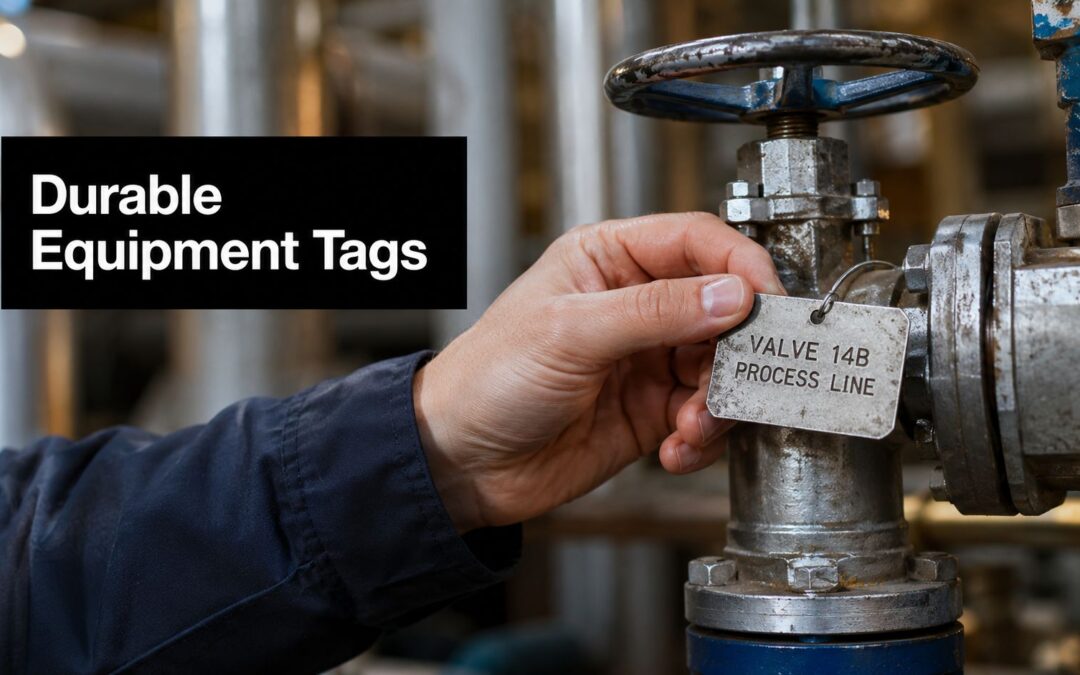
You're usually not looking at a neat asset register when tagging breaks down, you're looking at a torch beam on a catwalk, a dead-read label, and a maintenance crew trying to work out which motor can be isolated without creating a bigger problem. That's what happens when a tag peels, fades, or points to the wrong record, and it's why the equipment tagging procedure has to be treated as an asset-control system, not a printing job. In Queensland, only a person appointed as competent by their employer can test and tag electrical equipment, and the tag must clearly show the test date and the next scheduled test and inspection date after inspection and testing, which makes tagging a formal compliance step rather than a label exercise (WorkSafe Queensland electrical equipment testing and tagging).
When a Missing Tag Stops the Line
The call comes in before sunrise. A pump motor has no readable tag, the CMMS still points to the unit that was swapped out months ago, and a tradesperson is standing on a wet catwalk with a torch trying to confirm the asset before isolation starts. Nobody wants to make a guess at that point, because the wrong guess can turn a routine job into a lockout mess.
That's what inconsistent tagging costs in practice. It creates orphan assets, slows down maintenance, blocks permits, and forces people to verify equipment the hard way, by tracing cables, reading faded stamps, or asking who last touched it. SafeWork NSW guidance makes the logic plain, tags are for providing information to others at the workplace, which is why a permanent label beats a temporary status tag when the asset has to stay identifiable over time (Identifi on SafeWork NSW tagging guidance).
A good procedure fixes the system before the first label is made. It starts with a locked numbering scheme, a verified register, and a placement rule that survives grease, UV, salt spray, and auditors. If the tag can't survive those conditions, the procedure hasn't been designed properly.
Practical rule: if the asset can move, get washed, heated, or replaced, the identifier has to live in the register as firmly as it lives on the metal.
The rest comes down to discipline. The numbering has to be stable, the physical label has to match the record, and the inspection cycle has to keep both honest long after the original project team has gone home.
Planning the Tagging Project Before Anything Is Printed
Start with the asset census, not the printer. Every asset that might receive a tag has to be checked against the CMMS so duplicates, retired units, and empty records are resolved before anyone designs a plate. The University of Sydney's asset identification and labelling standard is clear that new assets need a unique identification number, and where unique marking is needed, a barcode sequence is obtained and fitted to the equipment as part of the start-to-end asset creation process (University of Sydney asset identification and labelling standard).
For industrial sites, planning also means agreeing what the tag has to do. It's not just safety or maintenance, it's both, plus compliance, auditability, and traceability across the asset's service life. You need a simple hierarchy, site, area, system, asset, sub-component, then a decision on what data belongs on the face of the tag and what stays in the database.

A clean handoff package should include the approved asset list, numbering rules, environmental zones, and substrate preferences. If you're building the rollout pack for design, the Evright Industrial asset tagging template is a practical starting point for organising that information into one controlled brief: equipment tagging template.
What works: a sign-off path with one data owner, one requesting authority, and one final approver.
What fails: three teams editing the same spreadsheet and sending different versions to production.
If a Trotec laser is part of the production flow, the timeline needs to include setup, test etching, and batch control. That matters because the tag design isn't final until the data fields, size, and material are approved together.
Designing a Numbering Scheme That Survives Audits
The numbering scheme is where many tagging projects fail. Sequential numbers are simple and readable, but they rely on the register to carry the context. Hierarchical codes like site-area-system-asset help people recognise location at a glance, but they can become brittle if the equipment moves or the plant is reorganised. Functional codes tied to CMMS key fields integrate neatly with the database, yet they only work if the field discipline stays strict from day one.
The safest scheme is the one that doesn't break when an asset changes place, owner, or service status. That's why recycled numbers are dangerous, and why location-tied IDs often cause orphan records after retrofits or mergers. If the tag has to remain useful through those changes, the identifier needs to stay permanent while the context lives in the register.
For machine readability, barcode, QR, and other 2D formats each have trade-offs. Barcode labels are straightforward and familiar, but they need clean line-of-sight. QR-style codes carry more data and are easier to migrate into scanning workflows that auditors already understand. In dense switchrooms, read angle and reflections matter more than people expect, so the code choice should be tested where the asset lives, not in a bright office.
A useful comparison sits in the middle of every procurement conversation.
| Scheme | Structure Example | Audit Strength | Field Readability | CMMS Sync Risk |
|---|---|---|---|---|
| Sequential | 000241 | Strong if the register is clean | High, very easy to read | Low if records are governed well |
| Hierarchical | SITE-A1-PUMP-12 | Good for human sorting | High at a glance | Medium if assets move often |
| Functional | MTR-CRM-004 | Strong in CMMS-led sites | Moderate, depends on naming discipline | Low when key fields are locked |
| Location-tied | WH-03-RACK-7 | Weak after relocations | High until the layout changes | High in retrofit-heavy plants |
Human-readable fields still matter. The tag should clearly show the asset description, voltage, service, and any agreed criticality colour code, so a tradesperson can identify it at 2am without a scanner. If you want a useful external reference for location structure, the GLN supply chain tracking guide is a sensible way to think about how location identifiers stay stable across systems.
The best outcome is a scheme that supports the CMMS first, then gives the floor crew a tag they can trust with or without a handheld scanner. That's the point where audit logic and field logic finally agree.
Choosing Substrates and Adhesion Methods for the Environment
The substrate has to match the worst day the asset will see, not the average one. In mining, food, marine, and process plants, that means thinking about abrasion, chemicals, UV, heat, washdown, and the cleaning regime before you think about aesthetics. An anodised aluminium plate may be fine in a controlled plant room, while laserable stainless belongs where the tag will see harsher treatment and longer service life.
Polyester and rigid PVC still have a place, but they're not equal choices. Polyester suits lighter duty identification where chemical attack is limited and the viewing distance is short. Rigid PVC can work for internal use, but it's not the first choice where heat or aggressive cleaning is part of the daily rhythm.
Adhesion is the same kind of trade-off. 3M 4941 VHB is a strong option where the surface is clean, smooth, and stable, but it won't rescue a poor prep job. Mechanical fixings are slower to install, yet they're still the right call when the substrate won't hold adhesive reliably. Rivet-and-seal sits in the middle for permanent attachment, while silicone RTV can outperform adhesive pads on textured or oily surfaces that resist a clean bond.
If a tag has to stay readable from one direction, the engraving, thickness, and mounting angle all need to support that viewing line. Curved surfaces, hot panels, and rough paint finishes create avoidable failure points, so the substrate needs to be chosen with the installation geometry in mind. The best material on the wrong face still fails.
| Environment | Recommended Substrate | Adhesion Method | Notes |
|---|---|---|---|
| General indoor plant | Anodised aluminium | 3M 4941 VHB | Good balance of durability and clean finish |
| Harsh industrial zones | Laserable stainless | Mechanical fixings or rivet-and-seal | Better where heat, impact, or chemicals are likely |
| Light-duty internal equipment | Polyester | Pressure-sensitive adhesive | Best when the surface is flat and clean |
| Damp or textured surfaces | Rigid PVC or stainless | Silicone RTV or mechanical fixings | Surface prep decides performance here |
Before anything is cut, degrease with isopropyl alcohol, abrade glossy coatings where needed, and respect the ambient conditions for adhesive cure. That prep work is boring, but it's also what keeps the tag on the asset instead of in a drip tray six weeks later. Evright Industrial also offers asset tracking labels built around this substrate-and-fix approach, which is useful when the marking has to live with the equipment rather than beside it: asset tracking labels.
Producing Tags on a Trotec Laser with QA in Mind
Production starts in the artwork file, not the laser cabinet. Clean the vectors in CorelDRAW or Adobe Illustrator, check kerf compensation, and set the text so line weights survive at the planned reading distance. On coated metals, the mark type matters too, because annealing, engraving, and ablation each leave a different finish and a different level of contrast.
The machine setup has to match the substrate. A Trotec Speedy setup isn't about copying someone else's numbers, it's about building a tested parameter set for the material, the thickness, and the finish you've approved. The right wattage, speed, and frequency only matter if the result is legible, consistent, and repeatable on the actual stock in the batch.
Test the offcut first. If the test piece fails readability, the production run will fail faster.
That's why the first-article run matters. Run a small batch, then check it against a QA sheet for contrast, edge sharpness, character spacing, and barcode scan grade before you let the rest of the lot go through. If the contrast is weak or the code reads inconsistently, stop and correct the file or the settings before the job expands.
A controlled job ticket should hold the approved parameters, the material, the batch number, and one retained sample from the run. That way, if the CO2 tube drifts or the focus changes mid-job, the fault is traceable instead of hidden inside a mixed pile of parts. For sites that want precision engraving, equipment marking, and durable labelling on a Trotec workflow, Evright Industrial operates in that production discipline rather than a generic print-on-demand model.
Applying Tags on Site and Syncing the Asset Register
The tag becomes real when it's fixed to the asset and recorded in the register at the same moment. Surface prep should follow the same solvent and abrasion method that was approved in planning, then the label goes onto the agreed spot from the site drawing or measured coordinate reference. If the tag is rotated or shifted by even a small amount, crews waste time hunting for it later, especially on crowded plant.

The crew should apply the tag with the agreed orientation, press it firmly for the full adhesive cure window, and use mechanical fixings where the substrate demands it. As the label goes on, it should be scanned straight into the CMMS or asset register so the physical record and the digital record match on the spot. That's the point where the tag stops being a loose consumable and becomes part of the asset history.
A deployment day also needs evidence. Each asset should get a geotagged photo, the parent-child hierarchy should be checked, and the installation sheet should capture any exception where a tag couldn't be applied. If the field team leaves unresolved entries for later, they create a backlog of records that nobody trusts.
For teams that want a deeper look at tracking discipline, the serial tracking for manufacturers guide is a useful lens on why the register and the physical identifier have to move together. That principle is the same whether you're tagging motors, switchboards, or critical service equipment.
Inspection Cycles, Replacements and Long-Term Maintenance
A tag system only stays credible if someone keeps checking it. Inspection cadence should follow the environment, because dry indoor assets don't age the same way outdoor or washdown equipment does. A practical rhythm is quarterly for dry indoor assets, monthly for washdown or outdoor zones, and weekly UV checks for sun-exposed surfaces, with the condition flag updated in the CMMS after each review.

The RGBY rotation keeps the status readable at a glance. Green means legible, Red means replacement scheduled, Blue means cleaning, and Yellow means further inspection. That colour logic helps floor crews spot trouble without opening the CMMS first, which is exactly what you want during a busy shift handover.
Replacement is triggered by condition, not by guesswork. Edge lift beyond 2 mm, contrast loss from abrasion or chemical attack, and barcode scan failures above the agreed read standard all justify action. If the tag is no longer trustworthy to a technician in the field, it's already failed its job.
Maintenance rule: don't wait for a tag to disappear before you replace it. Once readability is compromised, the register starts drifting away from the plant.
Annual audit prep should include register reconciliation, photographic evidence, and traceability back to the original laser job file. If the record can't be linked to the batch and the site photo, the audit trail is incomplete. For broader timing discipline around inspections, the fleet safety inspection frequency guide is a useful reminder that inspection rhythm has to be matched to risk, not habit.
A quarterly review meeting should tie tagging findings to reliability work, outstanding replacements, and recurring installation issues. That's where the tagging KPI stops being a label count and starts contributing to plant control.
If you need a tagging system that holds up in heat, washdown, audits, and real maintenance work, Evright Industrial can supply precision laser-engraved equipment labels, durable asset tags, and compliant marking for Australian sites. Visit Evright Industrial to discuss substrate choice, numbering logic, and a production process that's built to match the asset register from the start.
Recent Comments