

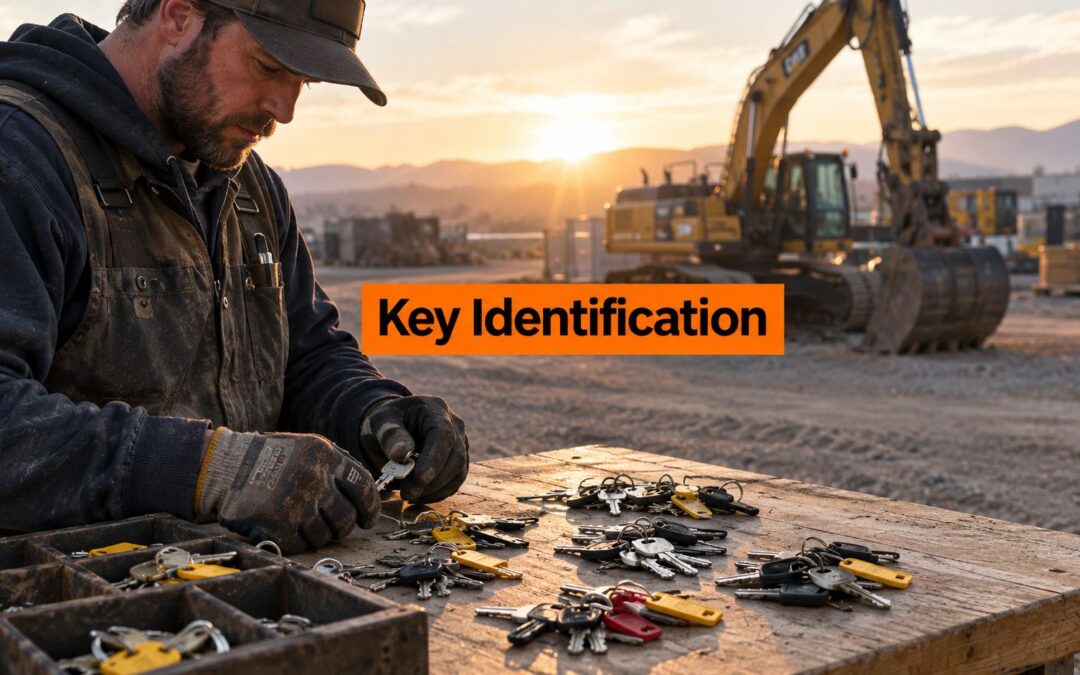
At 6am, a mechanic is standing in a dusty equipment yard with a ring of nearly identical keys in one hand and a work order in the other. The excavator needed for a job twenty kilometres away is ready to leave, but its key tag has faded, the machine plate is buried under paint, and nobody can immediately confirm which asset record matches the unit.
That delay rarely stays small. Weak identification leads to misallocated machines, missed service intervals, disputed ownership, and uncertainty during insurance or theft claims. Heavy equipment key identification is the control that connects physical metal with the records, maintenance history, access rights, and ownership evidence attached to it.
The practical question isn't just whether a serial number has been engraved. It's whether the identity remains readable after wash-downs, abrasion, repainting, hot work, contractor use, and resale handling. The following approach treats identification as a working site system, not an administrative label.
Why Heavy Equipment Identification Matters on Real Sites
A machine can be physically present and still be operationally invisible. If its tag is unreadable or its key can't be matched to the register, the yard team loses confidence in the asset's identity. The mechanic may start the wrong excavator, dispatch a loader with an overdue inspection, or spend time checking purchase documents instead of moving equipment to site.
The same problem appears during maintenance. A technician needs to know that the service history belongs to the machine in front of them, not to a similar unit parked beside it. A durable identifier gives the technician a reliable bridge between the chassis, the work order, the inspection record, and the parts already fitted.
Practical rule: If a person must rely on memory to identify a machine, the system has already failed.
Identification also becomes critical when equipment changes hands or locations. Contractors move machines between projects, rental fleets circulate units among customers, and infrastructure operators manage assets across remote sites. A nationally recognised framework helps reduce ambiguity in those situations. In January 2024, Standards Australia formally incorporated GS1 keys for asset identification, including the Global Returnable Asset Identifier and Global Individual Asset Identifier, creating a recognised structure for unique identity across tags, barcodes, and linked records. The referenced Australian asset identification standard also explains why supplementary barcode and tag data matters in industrial and logistics workflows.
A fleet register only works when staff can reconcile it with what sits in the yard. That's why dispatch teams often pair equipment IDs with location and movement records, using tools such as a haulage software solution when transport coordination spans contractors, sites, and changing loads.
Theft recovery exposes weak systems quickly. South Australia Police recommends engraving, UV marking, microdots, photographs from multiple angles, and records of make, model, and serial numbers, while Queensland Police guidance emphasises unique IDs, warning stickers, and property records. Those principles are relevant to machinery, but large equipment demands more thought about where a mark sits and how it survives.
Victoria Police reported 19,228 tool-theft offences in the 12 months to March 2025, equivalent to one theft every two hours. South Australia Police property-marking guidance provides the broader marking principles, while the operational lesson for heavy equipment is straightforward. A plate that can't be read after months in the field won't support a service decision, an ownership dispute, or a recovery claim.
What Heavy Equipment Key Identification Actually Means
Heavy equipment key identification is a combined system of physical markers, access controls, and linked records. A cut metal key is only one part of that system. The broader “key” can include an ignition key, cab key, isolator lock, keypad code, RFID credential, or another controlled means of authorising access.
The simplest analogy is a house key and its address plaque. The key lets you enter, but the plaque tells you which door belongs to you. On a busy industrial street, either one without the other creates confusion. A key that starts several machines provides convenience, but it doesn't prove which asset was accessed or who used it.

The three identity layers
The asset identifier is the marker fixed to the machine. It may be an OEM serial plate, an owner-applied stainless tag, a barcode, a QR code, RFID, NFC, engraving, or dot-peened code. Its job is to identify the physical unit, even when the machine is disconnected from software.
The access identifier controls operation. It might be the ignition key, cab lock, fuel-cap lock, isolation padlock, electronic credential, or a serialised key blank. It answers a different question: who is authorised to operate, isolate, or maintain the machine?
The record identifier is the matching entry in the asset register or fleet platform. It should connect the physical ID and access control with maintenance history, inspection information, insurance documents, photographs, operator sign-offs, and ownership records.
The chain of identity holds only when all three layers agree. If the tag says one thing, the key cabinet records another, and the software register contains a duplicate, staff can't rely on the system during a rushed dispatch or maintenance isolation.
A useful register should therefore store more than a number. Record the tag location, key or lock code, machine make and model, serial information, photographs, and any replacement history. That turns identification from a label into an auditable control.
Core Methods Used to Identify Heavy Equipment
No single marking method survives every surface and operating condition. A factory plate may carry the legally recognised serial information, while an owner-applied tag provides fleet coding and a scannable link to records. Engraving may protect identity when adhesive labels fail, but it won't compensate for poor placement or shallow marking.
Where each method works
Serial plates and OEM tags remain essential because they carry manufacturer information and the machine's original serial number. Riveted metal plates are stronger than adhesive labels, but corrosion, paint overspray, impact, and deliberate removal can make them difficult to read. They also rarely contain the operator-facing fleet code used by a busy yard.
Barcode and QR labels are useful where workers need to scan a machine and open its digital record. They're economical and flexible, but adhesive performance becomes unreliable on oily, hot, rough, or repeatedly washed surfaces. On exposed machinery, use a protective laminate or mount the printed code inside a riveted metal carrier.
RFID and NFC tags allow contactless or near-contactless reads, which suits inspections where gloves, dirt, or awkward access make manual scanning inconvenient. Their trade-off is the need for compatible readers, controlled encoding, and careful installation on or near metal. A metal surface can affect tag performance if the tag isn't designed or mounted for it.
Engraved and dot-peened marks provide strong physical permanence. They work well on steel components and protected frame areas, but shallow marks can be filed, ground, or hidden beneath repainting. A mark placed behind an assembled guard may survive well but become useless during a routine inspection.
Key and lock codes connect access with a particular machine. They provide the strongest custody when the code, issued key, and asset record match. Keys can still be duplicated, lost, or shared, so the register and issue process matter as much as the lock itself.
Most mature fleets combine methods. A practical arrangement might use the OEM plate as the source of manufacturer identity, a laser-engraved owner tag for fleet control, a QR code for digital access, and a registered ignition or isolation key for custody.
| Method | Durability | Best For | Main Weakness |
|---|---|---|---|
| OEM serial plate | Moderate to high when protected | Manufacturer identity and warranty records | Can corrode, be obscured, or be removed |
| Barcode or QR label | Variable | Fast access to digital records | Adhesive and print can fail in heat, oil, and abrasion |
| RFID or NFC tag | High with suitable industrial mounting | Contactless identification and inspections | Requires readers and correct installation |
| Engraving or dot-peening | High on suitable metal | Long-term physical identity | Can be filed, hidden, or placed out of reach |
| Key and lock code | High as an access control | Authorisation and chain of custody | Keys can be duplicated or shared |
For a broader inventory-control perspective, the AUSFF stocktake methods guide is useful when deciding how physical checks should reconcile with digital records. For industrial fleets, that process can be strengthened with RFID asset tracking where contactless reads justify the additional equipment and setup.
Australian Tagging Standards and Placement Rules
Australian asset identification practice is more demanding than just attaching a plate somewhere visible. Snowy Hydro requirements state that labels must be permanently fixed to, or immediately adjacent to, equipment, clearly visible from the normal access position, and readable after installation. Snowy Hydro's asset identification requirements give a practical placement rule that applies well beyond one organisation.
Australian Rail Track Corporation guidance also expects external labels to be readable from 600 mm and to include manufacturer, year and month of manufacture, serial number, and model or version number. The point isn't to force every fleet into one identical layout. It's to ensure that a person inspecting the asset can identify it without dismantling guards or relying on a photograph taken years earlier.
Separate manufacturer identity from fleet identity
The OEM plate should be preserved. Don't cover it with an owner label, grind it clean, or treat an owner-applied code as a replacement for the original serial information. Add a separate plate that carries the organisation's unique asset code, ownership details where required, and a scannable link to the controlled record.
The exact fields depend on the machine, governing procedure, and customer requirements. In practice, a useful plate may include:
- Unique asset code: The internal identifier used by the register.
- Manufacturer and model: The basic description needed during inspection or dispatch.
- Serial information: The OEM number, recorded exactly as shown.
- Owner details: Company name or contact information where ownership proof matters.
- Inspection information: Inspection or service due details where the operating system requires them.
- Safety data: Relevant ratings and warnings, where the equipment and applicable standard demand them.
A plate made from stainless steel or anodised aluminium can suit harsh environments, but material choice isn't enough. The fixing method, surface preparation, label depth, and position determine whether it remains readable after abrasion, chemical exposure, and wash-downs. A stamped plate riveted to the chassis heel is often more dependable than a sticker fixed to a high-impact panel.

Choose a position people can inspect
Good locations include a protected cab frame, a sheltered frame rail, or an engine-bay surface that remains accessible during normal checks. Avoid boom edges, bucket contact zones, exhaust-adjacent panels, hydraulic wear points, and surfaces regularly scraped by tools or chains.
The University of Sydney's asset-labelling guidance shows how specific placement rules can become. Its spatial barcode labels are allocated to every internal building space in the space database and installed at the top-left corner of the main entry door jamb. The University of Sydney asset-labelling standard illustrates the underlying principle: a consistent location makes an identifier easier to find, verify, and replace.
For broader electrical and site-control responsibilities, teams may also consult resources such as test and tag compliance QLD. For durable industrial plates, stainless steel equipment tags provide one practical format where corrosion resistance and permanent fixing are priorities.
Key and Lock Systems for Chain of Custody
A machine can have a perfect asset plate and still suffer from poor access control. Excavators, loaders, telehandlers, and skid steers often have several custody points, including the ignition, cab door, fuel cap, battery isolator, and maintenance lockout point. Each should have a defined role rather than being treated as one interchangeable key.
NSW transport and safety-isolation guidance distinguishes between personal and equipment locks. A personal lock has a single unique key, while equipment locks can be controlled in sets and keyed to a master key. The NSW isolation and lockout guidance supports the practical distinction between individual worker protection and controlled equipment access.
Compare the control models
Keyed-alike fleets are convenient. One key can operate several machines, which simplifies dispatch and reduces the number of blanks held in the office. The weakness is accountability. A lost key may provide access to multiple assets, and a sign-out record won't show which machine the holder operated.
A master-key hierarchy gives supervisors controlled override access while allowing individual machines or groups to use different keys. It offers a workable balance for larger fleets, provided the master is secured and every issued key is recorded.
Individually registered keys provide the clearest custody. The key blank carries a serial or code linked to one asset, and the operator signs it out and returns it through a controlled process. This creates more administration, but it also makes unexplained access, duplication, and loss easier to investigate.
| System Type | Custody Strength | Operator Convenience | Best Use Case |
|---|---|---|---|
| Keyed alike | Low to moderate | High | Small fleets with simple access needs |
| Master-keyed groups | Moderate to high | Moderate | Mixed fleets with supervisor access |
| Individually registered keys | High | Lower | High-value assets and contractor-controlled work |
| Electronic key cabinet | High when configured well | Moderate | Multi-site operations needing issue records |
Lockout and tagout work needs a separate mindset from ordinary operation. A personal isolation lock should identify the person applying it, while an equipment lock or controlled master system can manage the machine-level isolation point. Mixing these roles creates dangerous ambiguity.
Control the key, not just the barrel. An ignition lock doesn't provide meaningful custody if duplicate blanks circulate without registration.
For resale and insurance purposes, undocumented duplication is also a weakness. A tamper-evident seal on the ignition barrel and a serialised key blank registered to the asset record provide a practical baseline without requiring a complete technology replacement.
A Practical Workflow for Rolling Out Equipment Identification
Start with the fleet as it exists, not as the register says it exists. Walk the yard, photograph every machine, capture the visible OEM plate, record the current owner code, and reconcile each unit against the asset register. This exposes duplicates, missing entries, unreadable plates, and machines that have moved between sites without a record update.
Audit before choosing materials
Classify the assets by operating environment and business importance. A frequently moved excavator working around demolition waste needs a different installation from a sheltered generator or an older machine used occasionally. Decide which units need a full system with physical ID, scannable record, and controlled key, and which only need an owner-applied identifier linked to a basic register.
Create a standard tag template before production. Define the code format, required fields, barcode or QR structure, material, thickness, corner treatment, fixing method, and preferred mounting zones. Consistency matters because technicians shouldn't search for a different tag position on every machine.

Install and document the physical control
Clean the selected surface properly. Remove oil, loose paint, and contamination, then choose a fixing suited to the substrate and vibration. Record the tag's position in the register using a location description or photograph, and take a dated installation image showing the completed plate and its surrounding context.
Laser production can help keep layouts consistent across a fleet. Trotec Laser equipment is relevant where an operator needs repeatable engraving on metal tags, barcodes, or QR-coded plates. The machine is only one part of the result, however. A well-made tag installed in a high-wear position will still fail.
Update the digital record immediately after installation. Link the asset ID to the OEM serial, photographs, maintenance history, insurance documents, operator sign-off sheets, and the registered key or lock code. The equipment tagging procedure should be clear enough for a technician to follow without asking which fields are optional.
The final step is verification. Set a quarterly inspection cycle in which a technician re-photographs the tag, checks that the code can be read and scanned, confirms that the fixing remains secure, and raises a replacement request before the label becomes the failure point during an urgent dispatch.
A complete record should answer five questions quickly:
- Which machine is this?
- Where is its identifier fixed?
- Which key or lock belongs to it?
- Which records and inspections are attached to it?
- Who last verified the identity?
Common Misconceptions That Lead to Failed Identification
A serial plate alone isn't a complete identification system. It may preserve the manufacturer's number, but it usually doesn't provide the fleet code, operator instructions, scan path, key relationship, or evidence of the machine's current location. Paint overspray can hide the plate, and a removed plate can leave the owner with no easy physical link to the register.

Myth one, the original plate is enough
The corrected approach keeps the OEM plate intact and adds a separate, durable owner identifier. The owner tag should be visible from a normal access position and linked to the record that staff use.
Myth two, a barcode survives anywhere
A vinyl barcode stuck beside an exhaust or along a boom arm may scan perfectly on installation day. Heat, oil, scraping, UV exposure, and wash-downs then attack the adhesive and print. A protected code on a riveted metal carrier, or a laser-etched code on suitable metal, has a better chance of remaining readable.
Placement beats novelty. A tag installed where chains drag across it is a poor control, while a simpler tag fixed to a sheltered frame rail may remain useful for much longer.
Myth three, engraving prevents tampering
Engraving makes alteration harder, but shallow marks can be ground down, overpainted, or concealed. A resale tampering attempt may target the visible identifier while leaving other records untouched. Use depth appropriate to the substrate, place the mark where casual grinding is difficult, and pair it with photographs, a second controlled identifier, and a registered key.
The strongest systems create agreement between independent evidence. A physical mark, a digital record, and a controlled access item should all point to the same machine. If one is missing or altered, the discrepancy should be visible during inspection rather than discovered after theft or a disputed sale.
Bringing It Together and Frequently Asked Questions
A yard manager can test any proposed system with four questions:
- Is it readable? Can a person find and interpret it from the normal access position?
- Is it traceable? Does the code connect to maintenance, ownership, inspection, and insurance records?
- Is it tamper-evident? Would removal, grinding, repainting, or key duplication leave an obvious discrepancy?
- Is it accessible to the right operator? Does the lock, key, credential, or isolation process match the authorised user?
Does RFID survive wash-downs? Industrial RFID can perform well in wet and dirty environments when the tag, enclosure, reader, and mounting position are suitable. Test the installed arrangement on the actual machine rather than assuming every tag works equally well on metal.
How often should tags be inspected? Tie inspection to the fleet's existing verification cycle and inspect after damage, repainting, major repairs, or a change of site. A quarterly verification loop is a practical operating choice for many fleets, provided the risk and use pattern support it.
Who holds master keys during contractor work? The responsible site or maintenance authority should control them, record issue and return, and restrict access to the people authorised for that work. Contractors should receive only the access required for their task.
What should happen when a secondhand machine has an unreadable serial plate? Isolate the asset from normal dispatch, photograph the remaining evidence, contact the manufacturer or authorised representative where possible, review purchase and import documents, and assign an owner identifier only after the identity has been checked. Never guess a serial number or overwrite uncertain information.
Standards, durable materials, consistent placement, and key governance work together. A tag is valuable only when the field team can find it, read it, trust it, and connect it to controlled access.
Evright Industrial provides durable equipment ID tags, engraved plates, and asset-labelling options for unique asset numbers, serials, barcodes, and QR codes in demanding industrial environments. Visit Evright Industrial to discuss a tagging format that matches your equipment surfaces, fixing requirements, and chain-of-custody process.
Recent Comments