

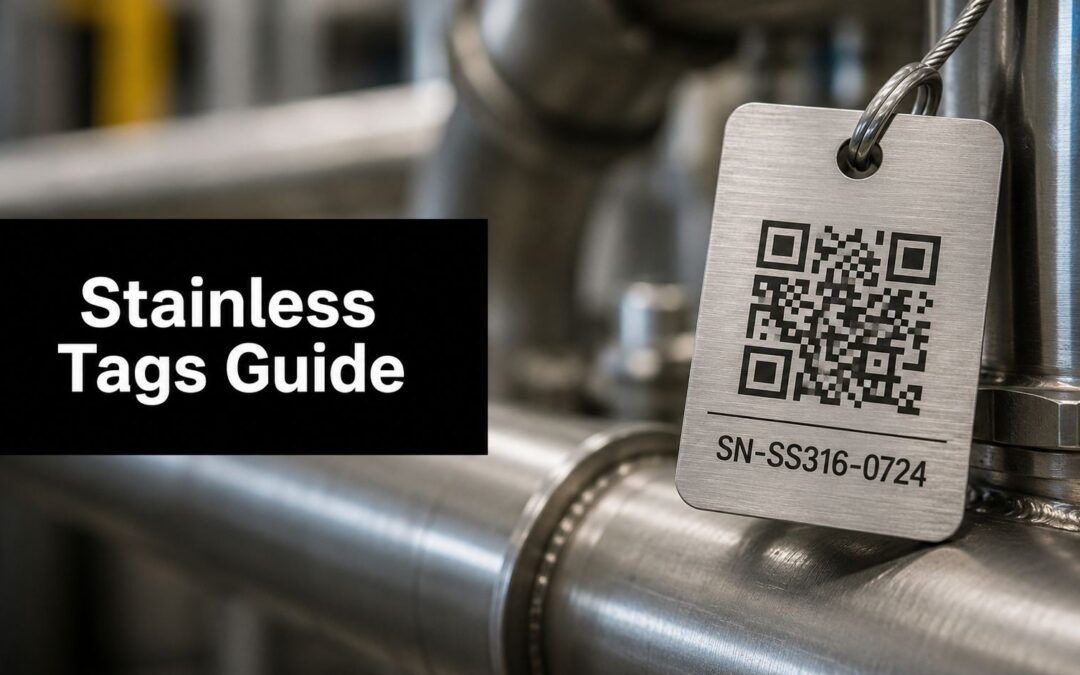
You're probably dealing with one of two situations right now. Either you're writing a tagging spec for a new project and everyone assumes “stainless tags” is enough detail, or you're replacing old tags that have already failed, gone missing, or turned into dull silver blanks that nobody can read without a torch and a guess.
That's where most tagging mistakes start. The purchase order looks tidy. The tag list is complete. Then the site conditions win. Coastal salt, washdowns, UV, chemical exposure, vibration, or poor mounting take a cheap or vague spec apart long before the asset is anywhere near end of life.
For Australian sites, stainless steel equipment tags need more than a material callout and a line of text. They need the right grade, the right marking method, the right layout, and the right attachment method for the environment they're going into. If any one of those is wrong, the whole identification system becomes unreliable.
The True Cost of Ineffective Equipment Identification
A failed tag doesn't just create inconvenience. It breaks the link between the physical asset and the information your team relies on. That includes maintenance records, lockout procedures, isolation points, replacement part references, and inspection history.
When a pump, valve, switchboard, or junction box loses clear identification, the job slows down immediately. Trades stop to confirm the asset. Supervisors get dragged in. Old drawings come out. In the worst cases, somebody works on the wrong item because the marking on site no longer matches what's in the register.
Where bad tags create real risk
The first problem is downtime. A faded or corroded tag turns a quick identification task into a manual investigation.
The second problem is safety. If operators or contractors can't confirm what they're standing in front of, they're relying on memory, local shorthand, or assumptions. That's a poor way to run any industrial site.
The third problem is compliance. Many Australian facilities need durable, legible identification because the tag isn't decorative. It supports inspection, maintenance, asset traceability, and regulated labelling requirements.
Practical rule: If the tag can't survive the environment for the working life of the asset, the spec was wrong from day one.
That's why permanent metal identification keeps gaining ground. The global market for stainless steel tags used in asset identification is projected to grow from USD 6.4 billion in 2025 to USD 9.8 billion by 2035, with engraved tags holding 57.8% of market share, according to Future Market Insights' stainless steel valve tag market analysis. That projection matters because it reflects a practical shift. Buyers aren't treating durable tags as an accessory anymore. They're treating them as infrastructure.
Good tags support the whole asset system
A well-made stainless steel equipment tag performs one essential function. It keeps the asset identifiable without needing constant replacement, reprinting, or guesswork.
That sounds small until you connect it to maintenance planning, audits, shutdowns, and handovers. Teams that take tagging seriously usually also think more clearly about comprehensive asset lifecycle strategies, because tagging is one of the physical foundations of a usable asset register.
A missing tag is often a symptom of a bigger problem. The site may have poor numbering discipline, unsuitable materials, or inconsistent installation methods. Fixing the tag spec often improves much more than the tag itself.
Choosing the Right Stainless Steel Grade 304 vs 316
The most common mistake in stainless steel equipment tags is specifying “stainless” without naming the grade. On an indoor board in a clean, dry plant room, that might not hurt you. On a coastal site, food facility, wastewater plant, or exposed utility asset, it absolutely can.
For Australian conditions, the primary decision is usually 304 versus 316 or 316L. If you get that wrong, the rest of the tag spec barely matters.
Why 316L is the safer choice in coastal Australia
The difference isn't marketing language. It's corrosion performance.
For Australian coastal regions, Grade 316L is specified because it maintains integrity for over 20 years in marine environments, while 304 can degrade within 5 to 7 years under the same conditions, as outlined in this stainless steel valve tag material reference. That gap is exactly why generic “stainless steel” advice causes trouble. Two tags can look identical on delivery and perform very differently once salt and humidity get to work.
The practical reason is molybdenum. Grade 316L contains it. Grade 304 doesn't. In chloride-heavy environments, that matters because pitting and surface attack don't just spoil appearance. They destroy legibility and shorten service life.
Here's the comparison most project managers need in plain terms.
| Attribute | Grade 304 Stainless Steel | Grade 316/316L Stainless Steel |
|---|---|---|
| General use | Suitable for milder indoor environments | Better suited to harsher industrial and coastal environments |
| Chloride resistance | More vulnerable to salt and aggressive moisture | Stronger resistance to chloride-induced corrosion |
| Marine exposure | Can degrade in coastal service | Maintains integrity much longer in marine conditions |
| Best fit in Australia | Dry internal areas with limited corrosion risk | Coastal, tropical, washdown, marine, and chemical-exposed sites |
| Specification confidence | Often overused because it's familiar | Usually the safer call for demanding assets |
Match the grade to the postcode
Many specifications often fail in this regard. A national project gets one standard tag schedule, and the same material is used in inland NSW, coastal Queensland, and a humid plant room near the ocean. That approach saves time in procurement and creates headaches later.
Use 304 only when you've got a genuine low-corrosion environment and the client accepts that decision. Use 316L when the tag will live near salt, moisture, aggressive cleaning, or industrial contamination. For many Australian sites, especially north of Brisbane or near the coast, 316L should be the default discussion, not the upgrade option.
Surface finish matters too. A brushed finish usually gives better day-to-day practicality than a mirror finish because it controls glare and hides handling marks better. Mirror finishes can look sharp on delivery but often create readability issues under plant lighting or direct sun.
If you need examples of fabricated stainless identification products, stainless steel signs for industrial applications show the sort of durable format that works when the material is specified properly from the start.
On exposed sites, 304 often fails quietly. It doesn't announce the problem. It stains, pits, dulls, and gradually becomes the tag nobody trusts.
Selecting the Best Marking Method for Your Tags
Material is only half the answer. The other half is how the information is applied. A premium blank in the right grade still fails if the marking method can't hold contrast, survive cleaning, or stay readable after years outside.
That's why I always separate “what the tag is made from” from “how the data is marked”. Buyers often bundle those together. They shouldn't.

What works and what starts to struggle
Stamped tags can be useful where deep physical impression matters, but they have limits. Dense information becomes harder to fit neatly. Logos, barcodes, and smaller characters are harder to execute cleanly. Mechanical methods can also distort lighter-gauge material if the tag isn't designed for that process.
Chemical etching can produce neat results, but in harsh UV and industrial conditions it doesn't always offer the long-term clarity many operators expect. Rotary engraving has a place too, yet it often lacks the sharp contrast and fine detail needed for modern asset systems.
Laser-darkened marking is the method that consistently solves those problems best on stainless steel. Modern laser-darkened marking produces contrast over 85%, remains readable from 15 metres, and keeps that clarity for more than 15 years, outperforming rotary and chemical etching in high-UV Australian conditions, according to Platinum Labels' guidance on stainless steel cable tags.
Why fibre laser marking suits industrial tags
Good laser marking doesn't just scratch a surface. On stainless, the right setup creates a dark, high-contrast mark that reads cleanly and holds up in service.
That's where Trotec Laser systems stand out in practice. They give excellent control over contrast, line definition, repeatability, and small-detail work. For industrial asset tags, that means crisp serials, barcodes, QR codes, equipment IDs, and logos without the softness you often see from lower-precision processes.
A lot of project managers focus on durability and forget scan performance. If you're using barcodes or QR codes, edge clarity matters. A muddy code that looks acceptable to the eye can still be troublesome for a scanner in poor light or awkward mounting positions.
For a close look at the finish quality this method can achieve, laser etched stainless steel tags are a useful reference point.
The practical advantages on site
Laser-marked stainless steel equipment tags suit assets that need:
- Fine detail for asset IDs, serial numbers, and compact text
- High contrast where operators need to identify equipment quickly
- Durable barcodes or QR codes for maintenance systems
- Consistent output across large tag sets with variable data
A short production clip shows the process in action on laser equipment rather than mechanical engraving.
If the asset is important enough to tag in stainless, it's important enough to mark properly. The cheapest marking method usually isn't the cheapest once replacement and confusion enter the job.
Designing Effective Tag Layouts and Content
Plenty of durable tags still fail because the layout is poor. The steel lasts. The mark lasts. But the person standing in front of the asset still has to hunt for the one piece of information that matters.
Good tag design isn't decorative work. It's hierarchy. The most important data should be visible first, in the size and position that matches how the tag will be used.
Start with the data people need first
The primary identifier should dominate the face of the tag. For most industrial assets, that's the asset number, equipment ID, or tag number. Supporting information comes after that. Manufacturer, installation details, service class, or internal references can sit lower in the visual hierarchy.
This infographic captures the structure well.

Australian industrial facilities often use a structured alphanumeric format such as a-bbb-cc-ddd-e, where each segment identifies a specific data point such as facility, system, and device, based on this Australian tag numbering standard example from INPEX. That matters because a tag layout should support the numbering system, not fight it.
If the official tag number is long, don't shrink it until it becomes unreadable. Instead, choose a larger plate, split secondary content to another line, or simplify what appears on the physical tag versus what sits in the database.
A layout that works in the field
Operators read tags under pressure, at odd angles, with gloves on, in glare, dust, noise, and poor lighting. Design for that environment.
A practical layout usually follows this order:
- Top line. The asset ID or official tag number in the largest type.
- Middle field. Equipment description or function, kept brief.
- Lower field. Supporting details such as serial number or location reference.
- Scannable element. Barcode or QR code only when the site has a reason to use it.
- Safety content. Warnings only when they're essential to the tag's purpose.
Field note: If everything is the same size, nothing stands out. Operators read the tag more slowly and make more mistakes.
When to use QR codes and when not to
QR codes are useful when the site has a live maintenance system, mobile access, and disciplined data management. They're less useful when nobody scans them or when the code replaces plain-English information that should be readable without a device.
Use QR or barcode elements when they support work. Don't add them because they look modern.
A few layout rules keep tags effective:
- Keep the primary ID plain text. Never force a technician to scan a code for the basic identifier.
- Use contrast deliberately. Dark marks on brushed stainless read better than low-contrast fine lines.
- Leave white space. A crowded tag becomes hard to process quickly.
- Match shape to the asset. Valve tags, switchboard labels, and cabinet plates shouldn't all use the same template.
Small valve tags need compact discipline. Larger switchboard or cabinet tags can carry more information, but they still need a visual order. The best tags feel obvious at a glance.
Secure Attachment and Mounting Options
A stainless steel equipment tag that falls off is no better than a paper sticker. Attachment is one of the least glamorous parts of the spec, and one of the most important.
I often observe expensive tags being compromised by careless installation. The plate is right. The marking is right. Then someone reaches for glue because it's quick, or uses hardware that won't last in the same environment as the tag.
Mechanical fixing is the safe default
Australian Standard SHL-GEN-121 requires steel labels to be fastened with nickel-plated screws or similar mechanical devices and prohibits gluing, as set out in Snowy Hydro's labelling standard. That's a useful rule well beyond one document because it reflects what works in demanding plant conditions.
Glue sounds neat on paper. In service, it can soften, creep, fail under heat, struggle on textured surfaces, or let go after cleaning cycles and vibration. Mechanical fixing gives you visible, inspectable retention.
Choosing the fixing to suit the asset
Different assets call for different mounting approaches. The method should suit the substrate, exposure, and maintenance access.
- Screws work well on cabinets, fixed panels, and structural mounting points where drilling is allowed.
- Rivets suit permanent mounting where tamper resistance matters and access is one-sided.
- Ball chains or wire can work for valve tags and hanging identification where a fixed plate isn't practical.
- Welded mounts may suit high-heat or severe-duty locations, provided the substrate and site rules allow it.
The same standard also points out that labels shouldn't be fixed to removable covers or directly on valves when an adjacent fixed structure would provide more reliable identification. That's good site practice. If a component gets removed, refurbished, or swapped, the identification shouldn't disappear with it.
Mount the tag where the asset can be identified consistently, not simply where it was easiest to drill on install day.
Don't ignore adjacent hardware and fittings
Attachment hardware should be chosen with the same care as the tag itself. Mixing unsuitable metals, using poor-quality screws, or letting installers grab whatever fasteners are in the ute can undermine the whole job.
This issue comes up in other equipment contexts too. When you're dealing with stainless hardware around wet-service assets such as connecting polyethylene storage tanks, the lesson is similar. Hardware selection matters because the environment doesn't care which part of the assembly was an afterthought.
For project specs, include these details clearly:
- Fixing method required
- Hole quantity and placement
- Approved hardware type
- Mounting location on the asset
- Any prohibition on adhesives
If those details are left vague, site crews will make a convenience decision. Convenience rarely lasts as long as the equipment.
Navigating Australian Compliance and Standards
Most tagging problems don't start with the engraving shop. They start in documentation. The project team knows the site needs durable tags, but the specification doesn't connect that requirement to the actual Australian standards that apply to the equipment, industry, and environment.
That gap creates rework. It also creates risk. Some tags need only identify an asset clearly. Others sit inside a framework of electrical rules, infrastructure requirements, fastening standards, and material handling practices that are not optional.

Electrical tagging has its own rules
Electrical environments are where many project managers first discover that “tagging” can mean very different things.
For electrical safety, AS/NZS 3760:2022 mandates a quarterly RGBY colour rotation for tags, and non-compliance can carry penalties of up to $500,000 for corporations under the WHS Act 2011, as summarised in this Australian safety tags guide. If you're supplying stainless identification in an electrical context, that doesn't automatically mean the metal tag replaces every test-and-tag requirement. Often it means the permanent asset identification and the inspection tag system need to work together.
That distinction matters. A durable metal asset tag helps identify the equipment permanently. The electrical inspection regime still needs its own compliant process, content, and colour coding where applicable.
AS/NZS 3000 also matters for switchboards and electrical installations. Clause 2.8 requires durable, compliant labelling for circuit functions and safety parameters. On site, that means you need signage and identification that remain clear over time, not labels that fade before the next refit.
Infrastructure projects need contamination control
Material selection isn't the whole story with stainless. Fabrication and handling practices matter as well.
For critical infrastructure in Australia, Austroads Technical Specification ATS 5440 requires tools used on stainless steel to be kept separate from carbon steel tools to prevent cross-contamination, as outlined in Austroads ATS 5440 on fabrication of stainless steel components. That's one of those details many non-specialists miss.
If carbon steel particles transfer onto the stainless surface, they can create localised corrosion problems. On coastal or chloride-exposed infrastructure, that's exactly the sort of avoidable issue that shortens service life and spoils a good tag before the engraving itself has any chance to fail.
Sustainability is tied to service life
Stainless steel is a durable material, but it isn't footprint-free. The average global carbon footprint of stainless steel is 2.90 kg of CO₂ per kg produced, with 1.92 kg from raw material extraction and 0.54 kg from electricity and steam use during processing, according to the stainless steel material summary on Wikipedia.
The practical lesson isn't to avoid stainless. It's to specify it properly so you don't replace tags unnecessarily. Long service life reduces waste, avoids repeat manufacture, and stops maintenance teams revisiting preventable failures.
A compliance mindset that works on projects
The easiest way to stay out of trouble is to treat stainless steel equipment tags as a specification item, not a commodity purchase. Write down the requirements before procurement starts.
Use a checklist like this:
- Environment check. Identify whether the asset is coastal, tropical, washdown, chemical-exposed, or internal dry service.
- Standard check. Confirm whether electrical, infrastructure, safety, or client-specific labelling standards apply.
- Material handling check. Require clean stainless fabrication practices where corrosion risk is serious.
- Mounting check. State the approved attachment method and prohibited methods.
- Content check. Match the layout to the client's asset numbering convention and operational needs.
Compliance problems with tags usually aren't caused by engraving errors. They're caused by vague specifications written too late in the project.
When you approach the job this way, the tag becomes a controlled deliverable. That's the point. If the site depends on identification for safety, maintenance, and operations, the tag deserves the same rigour as any other engineered component.
From Specification to Supply The Evright Process
Once the technical decisions are made, the procurement side becomes much simpler. Most tagging jobs go smoothly when the client provides five clear inputs. Material grade, tag size, marking content, mounting method, and quantity.
The problems usually start when one of those is left open and somebody says, “We'll sort that out later.” That's how projects end up with the wrong holes, the wrong layout, or a material that was never appropriate for the site.

A practical spec template by application
A simple checklist usually beats a long prose specification. Different sectors need different emphasis.
Industrial assets
- Material grade suited to environment
- Asset number format
- Equipment description
- Barcode or QR requirement
- Hole placement and fixing method
Electrical installations
- Permanent asset ID
- Switchboard or circuit labelling requirement
- Clear separation from inspection tag process
- Readability from normal operating position
- Mounting that won't interfere with covers or access
Healthcare and essential services
- Chemical resistance
- High contrast for quick identification
- Cleanable finish
- Consistent department naming
- Long-term legibility under regular maintenance
Memorial and commemorative plaques
- Exterior exposure conditions
- Typeface and layout approval
- Fixing detail
- Surface finish preference
- Proofing for names and dates
If you're ordering custom metal asset tags for Australian industrial use, that kind of checklist will usually prevent most avoidable revisions.
How the process works in practice
A reliable workflow is straightforward. First, confirm the asset environment and the standard the tag needs to satisfy. Then lock the material grade, dimensions, content hierarchy, and mounting detail before artwork is finalised.
After that, variable data can be checked against the asset register, proofs can be approved, and production can run on a controlled system. For stainless work, precision laser equipment matters. Trotec Laser machinery is particularly well suited to this because it produces repeatable, high-contrast results across both one-off and batch jobs, including serialised tags and more complex layouts.
Evright Industrial sits within evright.com, Australia's long-established engraving business, and that matters because the process is built around practical production rather than generic online ordering. The usual flow is consultation, artwork and data review, precision laser engraving, quality check, and dispatch. That makes a difference when your job includes mixed sizes, variable data, or compliance-driven content that can't be guessed.
What affects turnaround and cost
Lead time and pricing usually depend on three things. Volume, complexity, and material requirements.
Large runs with clean data files are usually simpler to produce than mixed batches with manual checking. Tags with multiple holes, barcodes, logos, or varied content take more setup than repeated standard plates. More corrosion-resistant material grades and stricter finishing requirements can also affect the final quote.
The smart move is to standardise where you can and customise where you must. Don't create ten layouts when two will do the job. But don't force one layout across assets that clearly need different sizes or mounting styles.
A good tagging specification saves money before the first plate is engraved. It prevents rework, arguments on site, and replacements that should never have been needed.
If you need stainless steel equipment tags that are specified properly for Australian conditions, Evright Industrial can help you move from vague tag schedules to durable, compliant asset identification. Their team works with project managers, contractors, facilities teams, and asset owners to turn real operating requirements into laser-engraved tags that are readable, correctly mounted, and built to last.
Recent Comments