

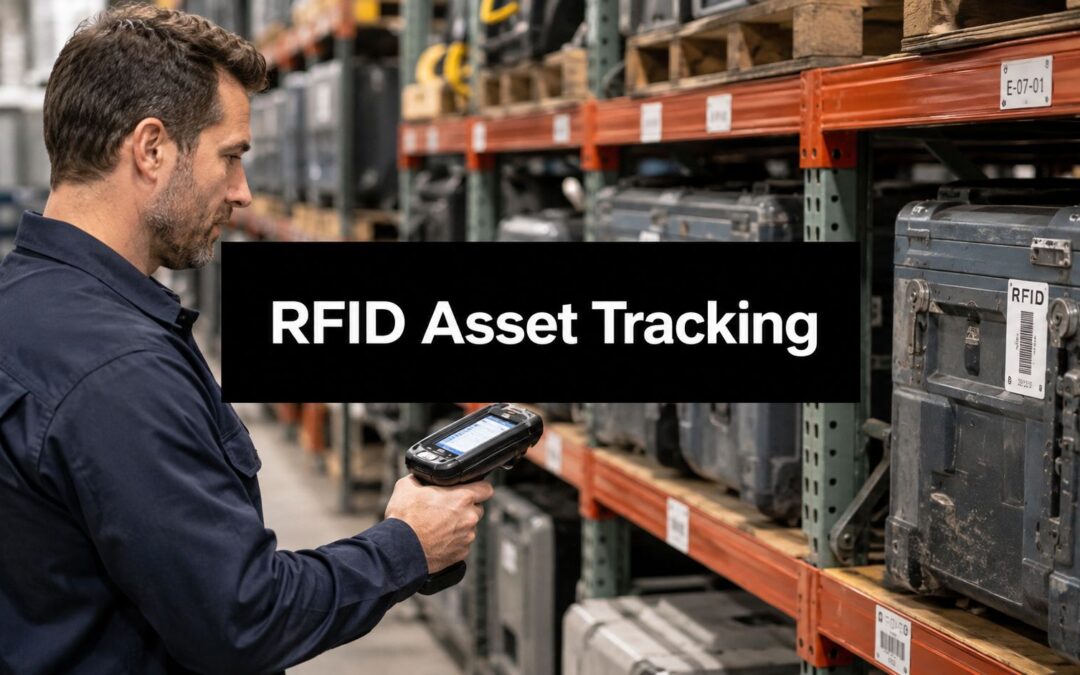
You're on shift, the line's waiting, and someone's sure the spare pump is “around here somewhere”. The problem isn't that the pump vanished, it's that the site never had a durable way to prove where it was, who last used it, or whether it was even the right one. RFID asset tracking fixes that visibility problem, but only if the label on the asset survives grease, heat, cleaning, abrasion, and years of handling.
When a Missing Pump Costs You a Shift
The first failure usually looks small. A fitter walks the bay, checks a spreadsheet, asks two supervisors, then opens a cabinet that should have held the critical spare pump. The line is waiting, the shift clock keeps running, and the team is left guessing whether the pump is on a rack, in maintenance, or loaned out to another area.

That is why RFID asset tracking gets attention on industrial sites. A well-set system can deliver very high read accuracy, and it can cut physical inventory count time sharply compared with manual processes. Plant managers usually care about the practical result, faster audits, tighter chain-of-custody control, and fewer labour hours spent chasing stock that should already be accounted for. Maptrack's asset-tracking ROI summary captures those gains clearly enough to weigh against the cost of manual counts.
The label is where the job starts
Software does not rescue a bad asset label. If the tag falls off a pump body, gets painted over, or cannot be read on metal, the workflow drops straight back into guesswork. On a factory floor, the first design question is whether the physical carrier can stay attached and readable long enough to matter.
Practical rule: if the asset lives on steel, in washdown areas, or near solvents, label durability is part of the system design, not an afterthought.
The same point shows up in any serious use case for asset tracking. The reader can only find what the label still exposes to the field, so the marking method has to survive the life of the asset, not just commissioning day. That is where durable identification matters, and it is why Trotec laser-engraved asset labels, as engineered by Evright Industrial, are a practical data carrier for harsh Australian industrial environments. Their job is simple. Keep the identity readable when the surrounding equipment has already taken a beating.
How RFID Asset Tracking Works
A tracked asset only stays visible when the full stack works together on the floor, not just in the diagram. A tag carries the identity, a reader energises the tag and captures the response, middleware filters and routes the data, and asset management software turns those reads into location and status records. That flow matches the way industrial RFID systems are described, where data is stored on the tag, attached to the asset, then collected by electromagnetic readers for tracking updates. Brady's RFID asset-tracking overview lays out that core architecture plainly.
Passive UHF RAIN RFID is the workhorse for industrial asset control. It conforms to ISO/IEC 18000-63 (EPC Gen2v2) and is the standard most often used for warehouse and asset-control deployments, which is why it fits fixed verification, tool control, and batch audits better than one-asset-at-a-time scanning. In Australia-region deployments using the 865–868 MHz ETSI band, dual-frequency tags can reach up to 5 m of read distance, with 100,000 write cycles, 50-year data retention, and IP67 protection when the tag is built for harsh environments. Perfect ID's dual-frequency tag datasheet shows what that sort of rugged construction looks like in practice.
The tag is only as reliable as the surface and mounting behind it. Metal, liquids, and awkward placement can detune the antenna, so the reader may see a weak or inconsistent response unless the label is designed for the substrate and fixed in the right orientation. I've seen sites treat a tag like a sticker, then blame RFID when the actual problem was poor mounting, bad orientation, or the wrong backing on steel.
A practical visual model helps because it shows the system as a chain, not a single device. The use case for asset tracking from Mappedin ties tag reads to the wider location workflow and makes the read logic easier to understand in an operating site.
The physical identification layer has to be built for the asset, not for a generic label spec. The internal guide to IoT device identification is useful here because RFID only becomes dependable when the marking survives heat, abrasion, cleaning, and handling long enough for the data to matter.

Picking the Right Layer for the Job
The worst RFID projects start with the wrong expectation. If the team needs continuous movement visibility across a wide area, passive RFID may not be enough. If the goal is bulk audits, fixed verification, or keeping a clean compliance trail on equipment that gets counted repeatedly, passive UHF is often the right layer, and barcodes are usually the baseline comparison.
Manual barcode-based tracking typically produces 5% to 15% error rates, while passive UHF RFID supports reliable compliance records and automated reads without line-of-sight scanning. WorldMetrics' auto-ID market summary is useful here because it highlights why many Australian operations move away from manual scanning when the asset count gets large or the environment makes line-of-sight awkward.
Choosing by job, not by hype
| Technology | Typical read range | Best fit | Trade-off |
|---|---|---|---|
| Barcode | Very short, line-of-sight | Low-cost labelling and simple visual checks | Manual scanning, higher error risk |
| Passive UHF RFID | Short to moderate, batch reads | Tool cribs, audits, fixed verification, compliance records | Needs tag and antenna tuning |
| Active RFID | Longer, battery-powered | Continuous visibility for high-value mobile assets | More maintenance, higher complexity |
| BLE beacons | Longer, battery-powered | Large open areas and real-time location tracking | Battery upkeep and infrastructure overhead |
Barcodes still win on cost. They're simple, cheap, and fine when the only requirement is visual identification at close range. RFID earns its place when transaction volume, audit speed, or consistency matters more than the label price, especially where the team needs batch reads without stopping to aim a scanner at every item.
In practice, passive UHF is the disciplined choice for bulk audits and fixed asset verification. Active RFID, BLE, or RTLS should be reserved for the jobs that truly need continuous movement visibility.
That distinction matters because RFID is often oversold as a universal tracking layer. The right answer is usually a layered one, with a durable label, the right tag technology, and a workflow that matches the asset class rather than forcing every item into the same system.
Planning a Rollout That Works on Day One
A rollout that holds up on a factory floor starts with the unglamorous work. Survey the site first, because RF performance is shaped by metal shelving, liquids, concrete, and the way the plant is laid out, not by the brochure. Define the tag format, placement rules, and reader positions before anyone prints labels in bulk. If the physical layer is wrong, the system will still look fine in software and fail in the yard, the crib, or the dock.
Field testing beats assumptions every time. Independent research has shown that tag placement and orientation can create a 120° blind spot for some tag types, and that read performance drops sharply when tags sit directly in front of the antenna. Another study reported 20.60 m of accurate reading distance in unobstructed or concrete-barrier conditions, but only 7.50 m with a metal barrier, which is a clear reminder that the same tag behaves very differently depending on the environment. The concrete-inventory study is a practical reference for rollout planning.
The rollout checklist that prevents rework
- Site Survey: Map metal obstacles, blind spots, and choke points before hardware goes in.
- Tag Spec: Choose the tag for the material, heat, cleaning regime, and mounting surface.
- Reader Placement: Position readers and antennas for the asset flow, not just for convenience.
- Middleware Config: Filter duplicate reads and route events into the right asset record.
- Pilot & Validate: Test a small group of real assets in the exact operating area, then adjust.
A program that can grow also needs approved specifications for each device category, including tag format, adhesive, placement, printing, EPC structure, serialization, reader configuration and exception handling. CompareSoft's RFID asset-tracking guide is useful here because it treats governance as part of the system, not an afterthought. That matters once multiple teams start applying labels, replacing assets, and expecting the records to stay aligned.
For the physical label layer, the internal asset tracking best practices guide is a useful companion. It connects the label spec to the site conditions that decide whether the rollout survives commissioning, cleaning, abrasion, and day-to-day handling. On harsh Australian industrial sites, the label often carries the system longer than the antenna does, especially when Trotec laser-engraved asset labels from Evright Industrial are used to keep identifiers readable after years of use.
For rugged assets, use on-metal or ferrite-backed tags, industrial adhesive or mechanical mounting, IP67 sealing, and temperature tolerance up to 85°C where the environment demands it. The label has to stay attached and readable on steel equipment, plant machinery, and fixed infrastructure, or the pilot becomes a maintenance loop instead of a tracking system.

RFID in Manufacturing, Healthcare and Government
A precision engineering plant usually cares about tool control first. Fixed readers at choke points catch movement in and out of the tool crib, while rugged on-metal tags keep identifiers attached to gauges, spares, and shared equipment that gets handled constantly. The goal is to stop tools from disappearing into the wrong bay or the wrong job packet.
Healthcare has a different pressure. A hospital equipment manager needs to know where infusion pumps and wheelchairs are after rounds, after cleaning, and after a ward swap. In that environment, the label has to survive repeated wipe-downs, and the RFID record has to stay usable even when staff move assets quickly between departments.
Local government works depots have another version of the same problem. Traffic management gear, signage, and portable barriers are often loaned out, returned late, or staged in multiple yards, so chain of custody matters for compliance and incident response. Embedded RFID has been shown to track items through their full lifecycle, with concrete supply chain experiments demonstrating tracking from manufacturing through post-installation in harsh environments. The embedded RFID study is a good proof point for long-life identification in harsh settings.
What survives across all three
The technology changes, but the rule stays the same. The asset needs a durable identity carrier, the read environment needs to be engineered, and the workflow needs to fit the way people move equipment. Where the label is weak, the program turns into a cleanup exercise.
A durable laser-engraved asset label keeps the RFID story alive after the first installation photo is long forgotten. The marking survives handling that would destroy cheap printed labels, and the engraving stays legible as the asset moves through service, cleaning, and redeployment.
ROI, Costs and the Honest Numbers
RFID pays when the labour saved on audits, the accuracy gained in records, and the reduction in re-tagging outweigh the up-front infrastructure cost. The business case is strongest where assets move often, records have to stay clean, and manual counts are slow enough to interrupt work. Market summaries from Maptrack's market and ROI summary point in that direction, and the same kind of reporting is often used to justify pilots before a full rollout.
The honest comparison is between RFID and the process you already run, which may involve clipboards, spreadsheets, and periodic barcode sweeps that still miss items. Barcodes are still the cheaper option, so they make sense for low-value assets, simple identification, and jobs where scan speed is not a bottleneck. RFID earns its place when the cost of a missed item, a delayed audit, or a bad record is higher than the extra hardware and setup.
The payback question in plain language
Ask three questions before spending on readers and tags.
- Transaction volume: How often do assets move, get audited, or need confirmation?
- Accuracy requirement: Does a small error matter, or does it create compliance or production risk?
- Real-time need: Do you need fixed verification, or do you need continuous location visibility?
If the answer points to recurring stocktakes, high-value tools, or regulated equipment, RFID becomes easier to justify. If the answer is mainly “we just need a cheap way to identify things”, barcodes may still be enough.
Practical rule: overspending on infrastructure for low-value assets is a common mistake. The right system is the one that matches the risk, not the most expensive one on the shelf.
Durable labelling changes the cost picture over time. A label that fails in the field creates replacement work, retagging delays, and record cleanup, which drags down the return on the whole system. The physical label and the RFID architecture have to be planned together, because the tag only works as well as the surface carrying it. Evright Industrial asset tracking labels are built around that reality, using a durable marking method that keeps the identity tied to the asset long after normal print methods start to fail.

Why the Label Is the Long-Term Game
A maintenance team can have readers installed, software configured, and asset records cleaned up, then still lose time because the identifier on the equipment failed after six months on the floor. That is common with pumps, tools, mobile plant, and washdown equipment. The RFID design may be sound, but if the label lifts, fades, cracks, or stops reading on the actual surface, the whole process drops back to manual checking.
The long-term issue is physical, not theoretical. RFID asset tracking depends on a tag and label assembly that stays attached to the asset, survives the environment, and keeps the item identifiable even when the chip cannot be read first time. On metal, tag selection and spacing matter. Around liquids, read performance often becomes less predictable. In both cases, the label still has to carry a permanent visual identity that a technician can verify by eye.
That is why the label specification should be treated as part of the system architecture, not a late purchasing decision. Material, adhesive, attachment method, surface preparation, engraving depth, and placement all affect whether the asset remains traceable after years of heat, abrasion, solvents, UV, pressure washing, and routine handling.
A good label has three jobs.
It has to stay attached to the substrate. Painted steel, powder-coated cabinets, stainless housings, textured plastics, and curved handheld tools all behave differently. It has to keep the identifier legible after the surface gets dirty or cleaned aggressively. It also has to support the RFID inlay or sit beside it without creating read problems from poor placement or shielding.
Laser engraving earns its place here because the mark is formed into the label face rather than printed on top of it. In practice, that usually gives better resistance to wear and cleaning than ordinary printed labels, especially where assets are handled hard and relabeling creates extra admin. For teams comparing construction options, laser-engraved asset tracking labels show how durable identification is built for industrial service rather than office conditions.
Evright Industrial is referenced here for that reason only. It uses Trotec laser engraving to produce durable asset labels for industrial environments, which is the part of an RFID program many project teams underestimate until the first batch in the field starts failing.
If an RFID rollout is underperforming, I would inspect the labels before blaming the software. Check what is bonded to the asset, where it is placed, what cleaning chemicals hit it, whether the surface was prepared properly, and whether the visual mark can still be read after normal wear. On a factory floor, the label is not a minor accessory. It is the data carrier that keeps the rest of the system usable.
Recent Comments