
Your warning label was fine. The engraving file was correct. The failure still happened at the surface, where grease, oxide, dust, moisture, or weak profile stopped the mark from bonding the way it should. In industrial labelling, the job starts before the laser fires, and the wrong prep choice can shorten service life in exactly the environments Australian sites deal with every day, from humid coastal plant to hospital equipment rooms and switchgear enclosures. Evright Industrial works in that space every day with Trotec Laser systems, where the preparation step is treated as part of the finished result, not a side task. For a practical starting point on workflow control, see the SOPS resource.
1. Laser Surface Cleaning with Trotec Laser Systems
A part can look clean and still fail at the mark. Light oil, oxide, handling residue, or a thin film of contamination can stop a laser mark from bonding the way it should, especially on asset labels, medical devices, and electrical hardware where residue control and part geometry matter. A Trotec Laser system gives Evright Industrial a way to remove those light surface layers without blasting grit across the part or bathing it in chemicals, which is why it fits controlled industrial labelling work. For stainless steel jobs, the prep step is part of the outcome, and engraving stainless steel depends on getting the surface into the right condition first.
Practical rule: if the part cannot tolerate abrasion, grit embedment, or wet residue, laser cleaning is often the cleaner path to a stable engraving outcome.
Where it works best
Laser surface cleaning performs best on metal parts that need a clean bonding zone right before marking. A manufacturing asset tag, a switchgear plate, or a hospital component can be cleaned in a targeted way so the base material stays unchanged. That matters because the mark depends on the surface condition, and poor preparation can reduce adhesion and shorten service life in harsh environments. Australian corrosion-control guidance places heavy weight on clean substrate condition, profile control, and moisture control in the coating environment, which lines up with the same discipline used before permanent laser marking Australasian corrosion-control guidance.
What to watch
- Use it selectively: laser cleaning is strong for contamination and oxide removal, but it is not the right answer for heavy mill scale or deep corrosion.
- Test first: sample runs help confirm the right power, speed, and focus for the substrate.
- Go straight into marking: once a part is cleaned, do not leave it exposed to recontamination.
- Keep the workflow tight: the cleaner the handoff from prep to engraving, the more consistent the result.
The value here is control. Evright Industrial uses that control in a Trotec-powered workflow to prepare surfaces for durable industrial marking, where a cleaner substrate gives the laser a better chance of producing a mark that lasts. For sites that also need dust discipline and worker protection, the prep plan should align with silica safety for workers.
2. Abrasive Blasting and Media Blasting
Abrasive blasting is still the method crews reach for when rust, scale, paint, and heavy oxidation have to come off steel fast. It removes the contamination, then leaves a roughened surface that gives coatings and permanent marks something to hold onto. In industrial marking work, that profile matters because adhesion depends on what the next layer can key into, and the finish has to suit the substrate as well as the marking method. For crews comparing blast prep with etched finishes on other materials, our glass engraving services show how surface choice changes the final result. Australian guidance commonly treats blast cleaning to ISO 8501-1 Sa 2½ with a 50 to 100 micron profile as the benchmark for demanding steel work.

Why crews still rely on it
On bridge steel, heavy plant, structural frames, and government infrastructure, blasting does what hand methods cannot. It strips contamination thoroughly for durable adhesion and gives the next process a predictable anchor pattern. Broader coating research points in the same direction, with abrasive blast cleaning identified as the most effective method for ASTM A36 steel before coating. The same research also notes that surface preparation can account for 15 to 25% of project cost while governing roughly 80 to 90% of coating outcome quality surface-preparation research overview.
Blast only as aggressively as the substrate and specification demand. If a lighter method can meet the profile target, that usually means less cleanup and less risk of unnecessary substrate damage.
Media choice changes the result
Not every job needs hard abrasive. Media blasting gives more control with softer or more forgiving media for finished surfaces, which is why it matters on jobs where the substrate is already in good condition or the finish cannot tolerate a harsh profile. For industrial marking, that difference matters because a rough steel beam and a finished enclosure panel need different treatment. If the job involves etching or controlled surface modification, the right prep path often starts by matching the media to the material and the finish requirement, then choosing the etching equipment for sale that fits the workflow.
Dust control and media selection also affect worker safety and part quality. Crews should plan blasting around substrate-specific media choice, immediate marking or coating, and silica safety for workers where the abrasive choice or substrate creates a dust risk. The wrong blast profile can leave a part too aggressive for fine engraving, while the right one gives a stable, repeatable base.
Abrasive blasting remains the workhorse for industrial adhesion, but it works best when it is matched to the actual substrate, not just the rust level.
3. Chemical Etching and Surface Activation
Chemical etching is the precision option when mechanical removal would be too harsh. It uses controlled acids or alkalis to strip oxides, remove contamination, and create micro-roughness that improves adhesion without physically scouring the part. For medical equipment labels, surgical instruments, and compliant signage, that low-impact behaviour often matters more than speed.
Why precision matters here
Healthcare and electronics do not reward aggressive prep. A surface that looks clean can still carry native oxide, oils, or residue that interfere with bonding. Chemical activation addresses that problem differently, which is why it is often chosen for sensitive substrates where dimensions, finish, and regulatory consistency all matter. The process is straightforward, but it has to be disciplined, with material-specific chemistry, rinsing, neutralisation, drying, and ventilation handled properly.
Clean concrete guidance from the Canadian government makes the same point in a different setting, preparation is only reliable when the surface is thoroughly cleaned, scrubbed, and rinsed so no residue remains Canadian concrete substrate preparation.
Good fit, bad fit
Chemical etching works well when the job is about surface readiness rather than aggressive removal. It is a better choice than blasting for thin precision parts, and it is often preferred where the finished label or engraving has to stay visually clean and geometrically accurate. It is a poor fit when the surface carries heavy corrosion, thick coatings, or unknown contamination layers that need physical removal first.
The other advantage is repeatability. In regulated environments, repeatable chemical treatment is often easier to document than operator-dependent hand prep, which helps when equipment or signage must meet internal quality controls. For teams choosing a process around etching equipment for sale, the value is controlled substrate preparation rather than brute-force cleaning, and the workflow needs to match that goal exactly.
4. Plasma Surface Treatment
Plasma treatment is one of the smartest options when you need activation without material loss. It uses ionised gas to clean and modify the surface at a molecular level, which increases wettability and helps adhesives, inks, and engraved finishes perform better. For plastics, composites, and mixed-material components, that can be a major advantage because the surface gets activated without changing dimensions.
Why it stands out
The biggest strength of plasma is restraint. It does not rely on abrasive contact, and it does not leave the same residue concerns that come with some wet methods. That makes it valuable for electronics housings, thermoplastic tags, and medical components where the wrong prep step can warp fine features or compromise fit.
Plasma also suits workflows where the surface needs to be treated immediately before engraving or marking. Once a surface is activated, it can lose that state if it sits too long in open air, so production discipline matters. That timing issue is part of the reason plasma works best in controlled industrial settings rather than casual field jobs.
Practical rule: if the part is plastic, composite, or delicate metal and the issue is adhesion rather than heavy corrosion, plasma deserves serious consideration.
Where it fits, and where it doesn't
Plasma is ideal for high-value, low-tolerance parts. It's less useful when the substrate is already heavily rusted or coated, because activation doesn't replace removal. A plant label on a polymer enclosure might benefit from plasma treatment before engraving, while a corroded beam still needs mechanical or abrasive prep first.
The method also rewards process control. Gas choice, exposure time, and machine maintenance all influence consistency, so the team running it has to be methodical. That makes plasma a strong match for manufacturers who want controlled adhesion without reshaping the part.
Plasma treatment is a precision tool, and in the right hands it gives you a clean, activated surface without the footprint of more aggressive prep.
5. Mechanical Grinding and Sanding
A crew needs to clear rust from a bracket, feather back paint around a repair, or clean up an enclosure before marking. Mechanical grinding and sanding are the practical middle ground for those jobs. They rely on portable tools that work on site or in the workshop, and that makes them a familiar choice for equipment plates, electrical enclosures, and infrastructure marking surfaces.
Where they outperform heavier methods
Grinding and sanding give tighter local control than blasting when only part of a surface needs prep. That matters on contoured parts, edges, repair zones, and brackets where a full blast setup would be more than the job needs. They also suit quick field work, especially when crews are already using portable equipment and need a direct way to clean a mark area before engraving or bonding.
The trade-off is texture consistency. Too much hand pressure, a worn disc, or skipped dust removal can leave a surface that looks clean but still behaves unevenly under coating or ink. For concrete, ICRI guidance places grinding around CSP 1 to 3, which shows how mild the profile can be compared with more aggressive options ICRI concrete surface profile mapping. The same practical point carries over to industrial metalwork, grinding helps with removal and local smoothing, but it does not always create the deeper anchor pattern needed for demanding coatings or long-life marks.
Portable tools also raise a dust-control issue that shops cannot ignore. Fine residue settles back onto the part, contaminates the next process, and can interfere with laser engraving or adhesion. In many facilities, that is the point where power washing for your workplace or another cleaning step becomes part of the prep plan, especially when grinding is done on larger equipment frames or around fixed installations.
What good practice looks like
- Match grit to the substrate: harder materials call for a different abrasive choice than softer finishes.
- Control pressure: uneven hand pressure leaves uneven texture and uneven adhesion.
- Manage dust: vacuum extraction matters, especially where the next step is engraving or bonding.
- Let the part cool: heat buildup can change the surface and make finishing less predictable.
A worker wearing protective gloves uses a handheld belt sander to grind a flat metal surface. That image fits this method because it is usually about careful correction, not broad stripping.
Mechanical grinding and sanding are useful because crews can use them quickly and directly, but they only perform well when heat, dust, and pressure stay under control.
6. Ultrasonic Cleaning
Ultrasonic cleaning is the quiet specialist in the group. High-frequency sound waves create cavitation bubbles that lift oils, particles, and fine residues from complex surfaces, including recesses and internal features that brushes can't reach. For surgical tools, precision assemblies, and electronics, that can be the difference between a clean mark and a contaminated one.
Why it's valued in precision work
Ultrasonic cleaning works because it gets into places that mechanical tools miss. A slotted part, a threaded section, or a narrow assembly can come out cleaner without scraping or abrasion. That makes it useful for hospital equipment preparation, laboratory devices, and small parts that need to stay dimensionally intact.
The process still has limits. It removes contamination very well, but it doesn't replace abrasion where rust, scale, or bonded coatings are the problem. It also depends on the right solution chemistry, temperature, and cycle time, so it's only as good as the setup around it.
Cleanliness in precision labelling is not only about what comes off the part. It's also about what stays behind. Residue, film, or loose particles can ruin adhesion even when the surface looks clean.
Where it fits in practice
Ultrasonic cleaning is a strong pre-step before laser engraving on medical or electronic components. It's especially effective where the mark has to be visually crisp and contamination-free, and where there's no room for abrasive texture. A surgical instrument tray, a small control component, or a precision-manufactured part can all benefit from a controlled ultrasonic cycle before marking.
The method is also attractive because it's non-destructive. There's no grit impact, no brushing pressure, and no direct surface wear. That makes it a sensible option when the substrate is expensive, delicate, or tightly specified.
Ultrasonic cleaning is the right tool when precision matters more than aggression.
7. Laser Ablation Surface Preparation with Trotec Laser
A part that looks clean can still fail to bond. A thin oxide layer, a stubborn coating, or embedded contamination can stay on the surface and interfere with adhesion, especially on parts that need durable industrial engraving or permanent asset labelling. Laser ablation addresses that problem directly, and with Trotec Laser systems it can remove specific surface layers with the control needed for electronics, medical devices, and aerospace components.
Why it suits high-value parts
Laser ablation is non-contact, so the part does not see tool pressure or mechanical stress. That matters for delicate housings, precision hardware, and sensitive assemblies that cannot take abrasion without losing fit or finish. It also gives fine control over the prep zone, which helps when only one area needs to be cleaned before marking or engraving.
The broader surface-preparation guidance already places laser removal alongside solvent cleaning, power-tool cleaning, water jetting, sodium bicarbonate blasting, and CO2 blasting, which shows that the choice is usually about matching the method to the substrate and avoiding damage while still achieving adhesion technical surface-preparation overview.
For Evright Industrial, that matters because the prep method has to support the mark that follows. A laser can clean the target area, then move straight into engraving or asset labelling without adding another handling step, which helps keep the workflow controlled and reduces the chance of recontamination.
How to use it well
- Run sample tests: the same substrate can respond differently if finish, oxidation, or contamination changes.
- Move straight to marking: ablation followed by engraving or labelling usually gives better adhesion than waiting.
- Manage ventilation: ablated particles need to be captured and removed properly.
- Set parameters for the substrate: Trotec Laser systems are useful here because the process depends on precise control, not just beam quality.
The trade-off is simple. Laser ablation is not the fastest way to prepare every part, and it is not the right answer for every coating or every corrosion problem. For delicate high-value components, though, it often gives the safest path to a clean surface that can hold a lasting industrial mark.
For Evright Industrial, that is the practical advantage. The same Trotec platform used for engraving can also prepare the surface first, which keeps the process tight and supports the kind of durable labelling that industrial environments demand.
8. Solvent Degreasing and Chemical Cleaning
Oil and grease cause more adhesion failures than many teams expect. Solvent degreasing strips away organic contamination that blocks bonding, while alkaline cleaning offers a controlled alternative when environmental rules or process limits make solvents less suitable. For plant equipment, electrical systems, and machinery that arrive with handling marks or operating residue, this step often separates a durable mark from one that starts lifting too soon.
Why this step gets skipped too often
Crews sometimes assume a visibly clean part is ready. It usually is not. Lubricants, cutting oils, fingerprints, and shop grime can all interfere with adhesion, and the part may still look acceptable until the engraving or coating begins to fail. Degreasing addresses surface chemistry rather than visual cleanliness.
A practical sequence from concrete guidance supports that approach. The Canadian publication on substrate preparation says contaminated concrete should be cleaned with detergent, trisodium phosphate, or proprietary cleaners, then scrubbed vigorously and rinsed thoroughly to remove all residue. That same logic applies to metal and industrial parts, residue left behind is still residue.
Good and poor uses
Solvent degreasing is a strong choice before engraving or marking when oils are the main issue. It is less effective on heavy corrosion or thick coatings, where mechanical prep is still needed. It also has to be paired with proper ventilation, safe handling, and material compatibility checks, because the wrong solvent can create a new problem while solving the old one.
A clean, degreased surface matters in asset labelling, where a mark only has value if it stays legible under service conditions. That is why this step often sits at the front of a serious prep workflow rather than at the end.
Solvent and chemical cleaning form the base layer that keeps contamination from undoing the rest of the job.
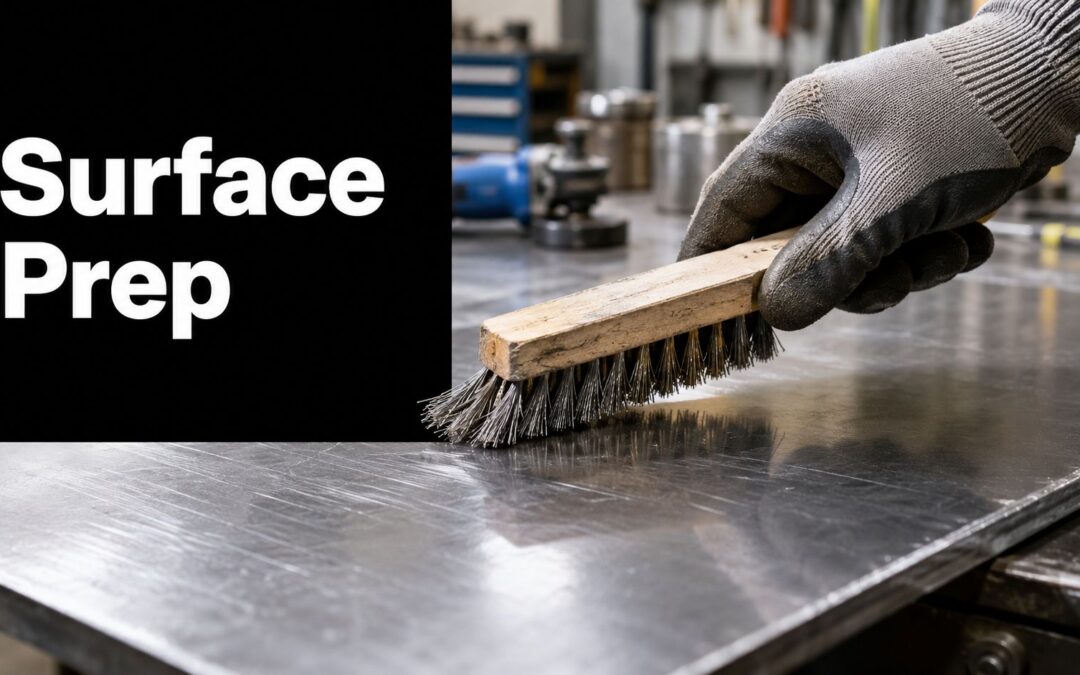
9. Surface Conditioning with Wire Wheels and Brushes
Wire wheels and brushes are old-school tools that still earn their keep. They knock back loose rust, scale, and surface grime on metal using handheld or rotating abrasive action, which makes them useful for field jobs and quick prep on equipment that can't be hauled into a blast booth. For maintenance crews, that portability is a serious advantage.
Why they remain practical
This method is fast to deploy and easy to understand. On lightly corroded frames, brackets, and utility hardware, it can create a better starting point for engraving or coating without the setup burden of blasting. It also works well in spots where a large tool can't reach, especially around bolts, corners, and irregular profiles.
But the limitation is just as clear. Wire brushing can leave embedded particles, uneven texture, or spots that still carry bonded contamination. It's a useful first pass, not always a complete solution.
Practical rule: use wire brushing to open up the surface, then inspect it closely. If rust, oil, or coating residue is still present, don't pretend it's ready.
Field applications that make sense
Government maintenance teams, utility crews, and electrical contractors often use wire wheels on-site when speed matters and the substrate is only lightly degraded. That can be enough for a temporary label, a site tag, or a follow-up prep step before a more precise finish. It's especially useful when access is tight and the job needs to move now.
For permanent industrial engraving, wire brushing often works best as part of a broader sequence, not the only step. It can create a decent interim condition, but strong adhesion usually depends on whether the surface was properly degreased and inspected afterward.
Wire wheels and brushes are practical, portable, and limited. The best teams treat them as a tool, not a finish.
10. Vapor Phase Degreasing and Specialised Solvent Cleaning
A part can look clean and still fail on adhesion if a film of oil, grease, or handling residue is left behind. Vapor phase degreasing is the precision cleaning method for those situations, because it removes contamination without physical contact. Heated solvent vapours condense on the component, dissolve the residue, and leave a controlled surface ready for the next step. For precision electronics, medical devices, and high-reliability manufacturing, that level of consistency is hard to match.
Why specialist facilities use it
The strength of this method is access. It reaches complex geometries without brushing, spraying, or immersing the part in a way that can trap residue. It also suits parts where contamination control matters more than aggressive removal, so it fits specialist work rather than general-purpose cleaning.
The best use case is a component that already has the right form and finish, but still carries oils or handling contamination that could interfere with engraving or bonding. If the part also needs heavy oxide removal, vapor phase degreasing is only one step in the sequence, not the whole answer. Evright Industrial sees the same pattern in laser engraving prep, a clean surface matters, but the right preparation path depends on what is on the part.
The supplied technical material on surface preparation places vapor phase degreasing alongside solvent cleaning and other non-mechanical methods that remove contamination without stressing the substrate technical surface-preparation overview. That range matters because the cleanest result often comes from choosing the least damaging method that still clears the contamination problem. For high-adhesion industrial labelling, that is usually the cleaner choice before a Trotec laser marks the final asset tag or serial.
What to expect in production
Vapor phase degreasing is not a casual in-house clean. It usually belongs in a specialist setup with proper solvent handling, ventilation, and compliance controls. For Australian industrial buyers, that makes it a practical outsourced or partnered step when cleanliness has to be assured before final engraving or permanent marking.
For the right part, it gives a clean, repeatable result with very low mechanical risk. That is why it still has a place in precision manufacturing, especially where surface condition has to support durable marking rather than just a short-term appearance fix.
Surface Prep: Top 10 Methods Compared
| Method | 🔄 Complexity | 💡 Resources & Cost | ⭐📊 Effectiveness / Expected outcomes | ⚡ Speed & Efficiency | Ideal use cases |
|---|---|---|---|---|---|
| Laser Surface Cleaning (Trotec) | 🔄 High, specialized laser systems & trained operators | 💡 High capital; low consumables; energy use | ⭐⭐⭐⭐⭐ 📊 Precise contaminant removal; preserves substrate; no residue | ⚡ Fast for production lines; real-time verification | Medical devices, electrical switchgear, precision engraving prep |
| Abrasive Blasting (Sand/Media) | 🔄 Medium, established process; safety controls required | 💡 Moderate equipment cost; consumable media; dust collection | ⭐⭐⭐⭐ 📊 Excellent for heavy rust/scale; creates strong adhesion profile | ⚡ High throughput for large components | Heavy machinery, structural steel, bridge/infrastructure prep |
| Chemical Etching & Activation | 🔄 Medium–High, chemical controls & process controls | 💡 Moderate equipment; chemical procurement & disposal costs | ⭐⭐⭐⭐ 📊 Consistent micro-roughness; molecular-level cleaning for adhesion | ⚡ Moderate; batch controlled timings | Medical devices, surgical instruments, precision electronics |
| Plasma Surface Treatment | 🔄 High, specialized plasma units and parameter control | 💡 High capital; low consumables; requires trained staff | ⭐⭐⭐⭐ 📊 Activates surface chemistry; excellent wettability; no residue | ⚡ Fast cycle times; activation decays over time | Plastics, composites, medical, aerospace, adhesion-critical parts |
| Mechanical Grinding & Sanding | 🔄 Low–Medium, simple tools but operator skill matters | 💡 Low capital; consumables (abrasives); dust extraction needed | ⭐⭐⭐ 📊 Effective surface texture; immediate readiness; risk of abrasion | ⚡ Fast for small/medium parts; labor-intensive at scale | Metal fabrication, field prep, equipment tag surfaces |
| Ultrasonic Cleaning | 🔄 Medium, tanks, solutions, and controls | 💡 Moderate equipment; cleaning solutions; waste handling | ⭐⭐⭐⭐ 📊 Removes microscopic oils/contaminants; non-contact; residue-free | ⚡ Moderate; batch processing may be slower | Surgical instruments, delicate electronics, precision components |
| Laser Ablation (Trotec) | 🔄 High, precise laser parameterization & skilled operators | 💡 High capital; low consumables; ventilation for particulates | ⭐⭐⭐⭐⭐ 📊 Microscopic precision removal; preserves substrate; minimal collateral damage | ⚡ Moderate; slower per part but highly precise | Electronics, semiconductors, aerospace, medical device prep |
| Solvent Degreasing & Chemical Cleaning | 🔄 Low–Medium, straightforward but requires safety protocols | 💡 Low–moderate cost; solvent or alkaline supplies; disposal needs | ⭐⭐⭐ 📊 Very effective on oils/grease; limited on rust/scale | ⚡ Fast for batch operations | Manufacturing equipment, electrical systems, pre-mechanical prep |
| Surface Conditioning (Wire Wheels / Brushes) | 🔄 Low, simple, portable techniques | 💡 Low capital; handheld tools; minimal consumables | ⭐⭐📊 Good for light/moderate corrosion; variable texture | ⚡ Fast for spot/field work; labor-intensive for large areas | Field maintenance, utility equipment, on-site asset tagging |
| Vapor Phase Degreasing & Specialized Solvent Cleaning | 🔄 High, engineered systems & strict controls | 💡 Very high capital; specialized solvents; regulatory burden | ⭐⭐⭐⭐📊 Exceptional cleanliness for precision parts; repeatable | ⚡ Moderate; automated but energy-intensive | Aerospace, high-reliability electronics, medical device manufacturing |
Your Partner for Durable Industrial Labelling
The best surface preparation methods are the ones that match the substrate, the contamination, and the life expected of the mark. A heavy steel frame, a medical device housing, a switchboard label, and a precision composite component don't need the same approach, and forcing them into one prep method is where projects lose durability. Australian coating guidance keeps coming back to the same fundamentals, clean the surface, control the profile, manage moisture, and verify the condition before the next step Australasian corrosion-control guidance.
That's where Evright Industrial stands out. We work from the premise that prep and marking are one job, not two separate ones. With Trotec Laser systems, we can align cleaning, activation, and engraving into a tighter process for industrial asset labelling, safety signage, and durable identification that's built for Australian conditions.
The right method also depends on what you can't afford to change. Some parts need profile. Others need no profile at all. Some jobs can take blasting, while others need laser cleaning, plasma activation, ultrasonic cleaning, or solvent-only degreasing to protect the substrate and still achieve strong adhesion. The practical value of Evright Industrial is that we understand those trade-offs from the marking side, so the surface prep recommendation is tied to how the final label or engraving performs.
If you're planning asset labels, equipment identification, or safety signage that has to hold up in demanding environments, talk to the team at Evright Industrial. We'll help you match the surface preparation method to the material, the exposure, and the finish you need, then turn that into a durable Trotec-powered result that's ready for real industrial use.
Evright Industrial delivers precision engraving, asset labelling, and surface-ready marking solutions for Australian industry. If your project needs the right prep method before a lasting mark goes on, visit Evright Industrial and speak with our team about a Trotec Laser workflow that fits your material, application, and deadline.
Recent Comments