
You're probably here because a simple purchasing task has turned into a risk decision.
An asset register needs durable tags. A plant upgrade needs new equipment labels. A healthcare or infrastructure project needs identification that stays readable after cleaning, abrasion, weather, or routine handling. You search for etching equipment for sale and get flooded with machine listings, hobby gear, and broad claims, but very little guidance on what will hold up in an industrial environment.
That's the issue. Buying a machine isn't the same as solving a marking problem.
Your Guide to Industrial Etching Equipment
Industrial buyers rarely struggle to find equipment. They struggle to choose the right marking method for the job, the workspace, and the compliance burden that comes with ownership. A machine can look impressive on a spec sheet and still be the wrong fit for asset tags, safety plates, switchboard labels, or long-life identification work.
This matters more now because etching and marking sit inside a wider industrial shift toward traceable, durable identification. The global etching-machine market is estimated at USD 14.12 billion in 2025 and is projected to reach USD 36.45 billion by 2034, with a 11.20% CAGR, according to the FnF Research market forecast. For Australian operations teams, that isn't just a global headline. It reflects a broader move toward precision manufacturing, better asset tracking, and marking methods that don't fail under real service conditions.
What buyers usually get wrong
Most first-time buyers focus on the machine first and the outcome second.
They ask:
- How much power does it have
- How big is the work area
- Can it mark stainless, aluminium, plastic, or coated stock
- What's the purchase price
Those questions matter. They're just incomplete.
The better questions are tougher:
- Will the mark still be legible after cleaning, heat, or outdoor exposure
- Can staff run it safely every day
- What happens when a job mixes materials and plate sizes
- Will in-house production save time once setup, training, and rework are included
Practical rule: If the mark has to survive the life of the asset, buying on headline specs alone usually leads to the wrong decision.
The buy or outsource question starts early
For some operations, owning the equipment makes sense. If you've got steady volume, a narrow material range, trained operators, and a controlled workspace, in-house etching can tighten turnaround and give production more control.
For others, the machine becomes a side business nobody wanted. The team ends up managing settings, maintenance, extraction, rejected parts, and compliance checks instead of getting reliable labels out the door.
That's why the smartest approach is to treat etching equipment for sale as one part of a larger decision. The right answer isn't always “buy the machine”. Sometimes it's “buy the right one”. Sometimes it's “don't buy yet”. And sometimes the strongest ROI comes from using a specialist for the difficult, compliance-sensitive, or mixed-material work.
Understanding Etching Technologies Laser vs Chemical and Mechanical
Not all “etching” works the same way. Buyers often bundle laser, chemical, electrochemical, and mechanical engraving into one category, then compare them as if they're interchangeable. They aren't.
The right way to think about it is this. Each method removes, alters, or marks material differently, and that changes your result, your speed, your maintenance load, and your risk profile.

Laser etching
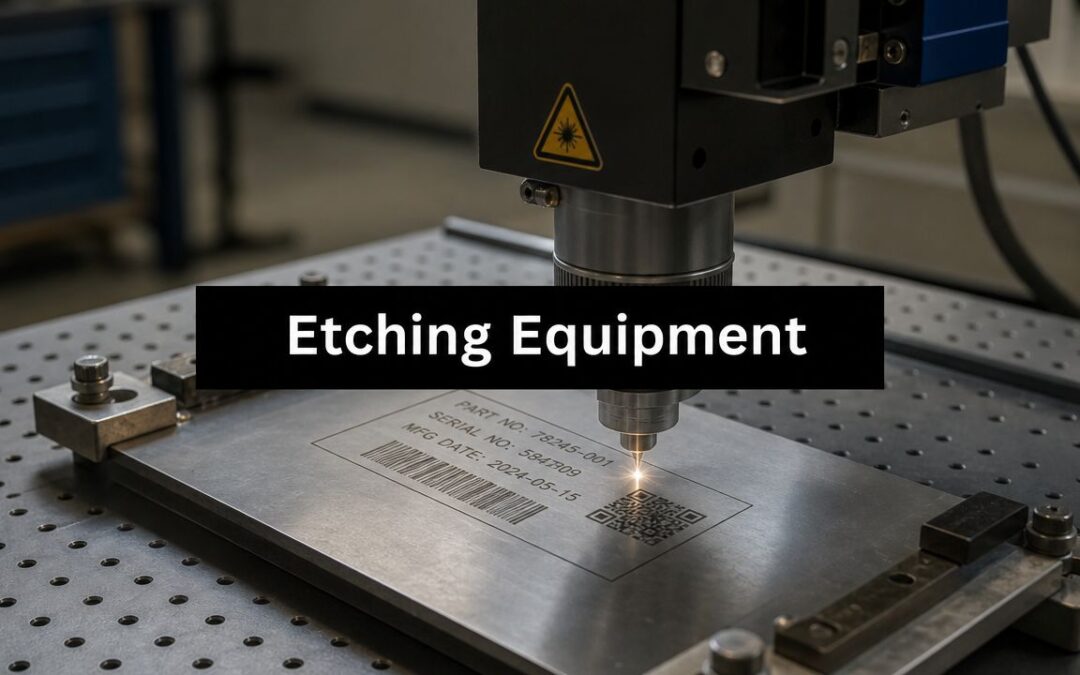
Laser etching is the cleanest place to start because it solves several production problems at once. It uses focused light to alter the surface without physical contact. That means no cutting tool pressing into the part, no bit wear changing the mark over time, and far less risk on delicate or already assembled items.
According to Keyence's explanation of laser etching, laser etching delivers non-contact processing with repeatability from the first part to the millionth. That matters in production. Consistency is what keeps serial plates readable, logos sharp, and variable data aligned across batches.
High-end systems such as Trotec Laser machines are often the benchmark people compare against when they want industrial-grade speed, control, and finish quality. If your work includes metal ID plates, panel labels, or permanent machine tags, it helps to review real examples of laser engraving on metal applications rather than judging a machine by brochure language.
Laser is usually the most forgiving option when parts are small, detailed, pre-finished, or awkward to fixture.
Chemical and electrochemical etching
Chemical etching and electrochemical marking suit a different set of needs. Traditional chemical etching removes material through controlled chemical action and is useful where delicate sheet materials or batch-style processing are involved. It can be effective, but it brings chemical handling, waste management, and process control into the job.
Electrochemical marking is narrower but very practical for conductive metals. The Eumark equipment description states that a typical marking cycle can transfer a permanent design in about 4 seconds using a stencil, electrolyte, and current, and describes it as the fastest method for permanently marking conductive metal surfaces. That makes it attractive when throughput matters and the work is mostly conductive metal parts with repeatable designs.
Mechanical engraving
Mechanical engraving is the old workhorse. A cutter physically removes material, much like a very precise chisel or router. It still has a place. If you want deeper cuts, certain tactile effects, or specific substrates that respond well to rotary tooling, it can do the job.
Its limits show up in three places:
- Tool wear: The tool changes over time, and the finish can drift if maintenance slips.
- Part pressure: Fragile or thin components can be harder to hold without distortion.
- Geometry: Complex shapes and pre-assembled items often become setup-heavy.
Which method fits which buyer
A simple comparison helps.
| Method | Best fit | Watch-outs |
|---|---|---|
| Laser etching | Fine detail, mixed materials, repeatable industrial marking | Fume control, optics care, training |
| Chemical or electrochemical | Conductive metals, fast repetitive marks, some batch work | Chemicals, consumables, process handling |
| Mechanical engraving | Deeper physical cuts, traditional plate work | Tool wear, part clamping, slower setup on complex parts |
If you're comparing etching equipment for sale, don't ask which technology is “best”. Ask which one creates the required mark with the least operational friction.
Key Specifications to Compare When Buying Equipment
The easiest way to waste money on a machine is to buy capability you won't use, or to miss one specification that bottlenecks the whole workflow. Industrial buyers don't need the longest spec sheet. They need the right machine for their parts, materials, and daily volume.

Start with the part, not the brochure
Before comparing brands, answer four practical questions:
- What are you marking most often
- How large are the biggest and smallest parts
- Do jobs repeat, or does every order vary
- What finish quality is essential
A Trotec Laser system can be a strong fit when your work demands precise control across different materials, but even a premium platform needs to match the production task. If your plates are oversized, your workholding is awkward, or your jobs involve lots of changeovers, the wrong bed size or software setup can slow everything down.
Specifications that actually change output
Some specs matter every day. Others mostly matter in sales presentations.
Power and speed settings affect how quickly the machine can process work and how it handles different substrates. More power can support faster throughput or tougher materials, but only if the rest of the system, including optics, extraction, and software control, is built around stable production.
Work area size decides whether you can run multiple small parts in one setup or fit larger signs and plates without awkward repositioning.
Resolution and beam control matter when the work includes small text, barcodes, serial data, logos, or dense layouts. Buyers often underestimate this until they see a fine-font asset label go fuzzy at production scale.
Material compatibility should be checked against your actual order mix, not your ideal order mix. Stainless, anodised aluminium, coated metals, laminates, engineering plastics, and acrylics all behave differently.
For buyers balancing capital spend against output quality, there's also value in understanding the wider issue of managing precision part costs. The same logic applies here. Tight tolerances, repeatability, and surface finish expectations often drive costs more than people expect.
Questions to ask the seller
Use a short checklist when reviewing etching equipment for sale:
- Show me my material: Ask for a sample on your actual substrate, not a generic demo coupon.
- Explain setup time: A fast machine can still be a slow process if every job needs fiddly alignment.
- Ask about operator controls: Menus, presets, and job management matter once different staff run the machine.
- Check service support: Downtime on a specialised machine hurts more than a slow but dependable workflow.
A machine demo is useful when it shows the controls in action.
Don't buy based on the cleanest sample in the showroom. Buy based on the ugliest real job you have to produce every week.
Assessing the True Cost Ownership and Maintenance
The sticker price is only the admission fee. The ongoing cost sits in everything required to keep the machine productive, safe, and accurate after the excitement of delivery wears off.
That's where many first-time buyers get caught. They compare a machine quote against outsourcing invoices and assume ownership wins. Sometimes it does. Sometimes the hidden costs erase the savings quickly.
The visible costs
The obvious items are easy to list. You'll pay for the machine, installation, accessories, software, and operator time. If the system uses consumables, you'll also carry the ongoing cost of replacements, cleaning items, stencils, electrolytes, or process materials depending on the marking method.
Laser systems usually reduce the direct tool-wear issue that mechanical engraving faces, but they don't become maintenance-free. Optics need attention, extraction systems need servicing, and production doesn't pause politely when a component fails.
The costs that don't show up in the machine quote
These are the items that change the ownership case:
- Training time: Operators need to learn setup, file prep, safe handling, and material-specific settings.
- Rejected work: The first few months often produce test runs, inconsistent marks, and avoidable scrap.
- Floor space: Industrial equipment rarely arrives alone. It brings benches, extraction, storage, and clearance requirements.
- Downtime: When the machine stops, your labels, plates, and asset tags stop with it.
A purchase can still be justified. It just has to survive this more honest math.
Maintenance is part of production, not an afterthought
Teams often underestimate how much output depends on maintenance discipline. Mechanical systems need attention to cutters, alignment, and wear. Chemical and electrochemical setups depend on process consistency, stencil condition, and consumable handling. Laser systems need clean optics, reliable extraction, and stable settings across materials.
A machine that's technically capable but poorly maintained produces one of the most expensive outcomes in industry: work that has to be done twice.
There's also a management cost. Someone has to own the machine internally. Not just run it, but schedule service, document settings, approve jobs, and decide what happens when a plate fails quality review.
A practical ownership test
Before buying, ask:
- Will this machine run often enough to justify setup and upkeep
- Who owns quality control when different staff produce the same label
- Can the business tolerate downtime without delaying critical work
- Are we buying production capacity, or are we buying a new operational problem
If those answers are weak, the cheapest machine on paper can become the dearest option in practice.
Essential Safety and Workspace Considerations
Industrial etching belongs in the same category as other workshop processes that look simple from a distance and become serious the moment you bring them in-house. The machine itself is only part of the setup. The surrounding controls are what make the process safe.
That's especially relevant in Australian workplaces where identification work often supports asset management, maintenance, site access, and safety systems. If the marking process introduces fumes, chemical exposure, poor housekeeping, or inconsistent operator practice, the risks move well beyond the machine bay.
Ventilation and extraction aren't optional
Laser marking can generate fumes and residue that need proper extraction. Chemical and electrochemical methods raise their own handling and ventilation requirements. “We'll crack a door open” isn't a control plan.
You need a workspace designed for the process, not improvised around it. That means extraction matched to the materials, separation from incompatible work, and a cleaning routine that staff will follow.
Operators need more than a quick handover
A lot of equipment is sold as user-friendly. That doesn't mean it's safe in untrained hands.
Operators need to understand:
- Material behaviour: Some substrates mark cleanly. Others smoke, residue up, or react unpredictably.
- Job setup: Misalignment and poor fixturing create quality problems and rework.
- Shutdown and fault response: A staff member should know what to do when the process doesn't look right.
- PPE and handling rules: Particularly where chemicals, cleaning agents, or heated parts are involved.
If the work also connects to broader site identification, teams often need durable supporting products such as industrial safety signage solutions that are fit for local operating conditions.
Fire risk, housekeeping, and traceability
Even where the machine is enclosed, poor housekeeping creates risk. Offcuts, residues, cleaning cloths, packaging, and mixed material storage all need discipline. Fire controls, emergency access, and routine checks should be built into the process from day one.
A second issue gets less attention: traceability. If multiple people run jobs, who approves the artwork, confirms the substrate, checks the output, and signs off that the mark is readable and durable enough for its use?
Safety in this space isn't just about protecting the operator. It's also about protecting the business from unreadable labels, misidentified assets, and preventable rework.
That's why bringing etching in-house should be treated as an operational change, not a simple equipment purchase.
Industrial Use Cases Where Precision Etching Excels
The value of precision etching becomes obvious when the mark has a job to do.
A decorative plate and an industrial ID tag may use similar equipment, but they don't carry the same consequences. On a mine site, in a switchroom, in a hospital plant area, or on public infrastructure, the mark needs to stay legible and correctly placed long after installation day.

Asset identification and plant labelling
Industrial buyers often begin with equipment identification. Equipment needs an ID plate, serial reference, barcode area, or durable descriptive label. The challenge isn't making a mark. It's making one that stays readable after routine service, dirt, washdown, or sun exposure.
For plant and equipment, precision matters because poor spacing, weak contrast, or crowded layouts become field problems very quickly.
Electrical and controls work
Electrical contractors and controls teams often need engraved switchboard labels, panel identifiers, legend plates, and warning plates that are clean, consistent, and easy to read in service. This kind of work punishes sloppy setup. If the text size, alignment, or edge quality drifts, the finished product looks amateur and can be harder to use safely.
Laser systems, especially well-configured Trotec Laser equipment, are often favoured here because they handle detail and repeatability well across plate-style work.
Healthcare, infrastructure, and public-facing environments
In healthcare and infrastructure settings, legibility and durability carry extra weight. Cleaning routines can be harsh. The environment may be public-facing. The expectation is that signage and identification remain readable without constant replacement.
The regional supply environment also influences what Australian buyers can source and how quickly. According to Fortune Business Insights, the Asia Pacific region held 66.50% of the global semiconductor etch equipment market in 2025. That regional concentration affects component supply and automation standards, which then flow through to the broader precision-equipment sector that Australian industry depends on.
Memorial and commemorative plaques
This is a different kind of precision. The tolerance isn't measured only by fit or finish, but by permanence and presentation. Names, dates, and layout need to be correct, balanced, and respectful. Mistakes are expensive and unacceptable.
That's one reason specialist engraving operations tend to outperform general-purpose equipment setups on mixed, high-consequence work. They've already solved the file prep, material selection, and finishing issues that smaller in-house runs often discover the hard way.
The Final Decision When to Buy vs Outsource to a Specialist
The strongest buying decision usually comes from one honest question. Are you trying to own equipment, or are you trying to guarantee a result?
Those aren't always the same thing. Many searches for etching equipment for sale start with a sensible goal, then drift into feature comparison before the business has decided what success looks like. For regulated sectors, that's risky, because the core requirement is often durable identification that remains readable through service life, inspection, and environmental exposure.
A major gap in the market is guidance on compliance and traceability. Buyers in manufacturing, healthcare, and infrastructure need to know whether a mark will remain legible after abrasion, heat, and outdoor exposure, yet most listings focus on machine features instead of that practical outcome, as discussed by Master Etching's overview of this market gap.

Buy when the workflow is stable
Owning equipment often makes sense if most of these are true:
- Volume is steady: The machine will be used often enough to justify ownership.
- Materials are predictable: You're not constantly switching between unusual substrates and finishes.
- Staff capability already exists: Someone can run production, maintain quality, and manage faults.
- Turnaround control matters daily: Waiting on external production significantly disrupts operations.
Outsource when the work is mixed or high-stakes
A specialist is usually the better fit when the work is harder than it first appears:
- Compliance matters: Asset labels, safety signs, and identification plates need dependable readability.
- The order mix changes: Different materials, sizes, and layouts can tie up an in-house machine quickly.
- Failure is costly: A wrong plate or unreadable tag can trigger rework, confusion, or project delays.
- You want output, not machine management: The business needs finished parts, not another technical process to supervise.
For organisations weighing that decision, it helps to review providers that specialise in industrial engraving services in Australia rather than starting with machinery alone.
A simple decision filter
Use this if you're stuck:
| Question | Buy | Outsource |
|---|---|---|
| Is demand frequent and consistent? | Usually yes | Usually no |
| Are materials narrow and predictable? | Good fit | Better if mixed |
| Do you have trained operators and safe workspace control? | Better fit | Safer option if not |
| Is compliance-critical durability hard to verify internally? | Riskier | Often stronger |
If you can answer the operational, safety, and quality questions with confidence, buying may be justified. If not, specialist support usually reduces risk faster than another capital purchase does.
If you need durable asset labels, engraved plates, safety signage, or precision industrial marking without taking on the full burden of equipment ownership, Evright Industrial is worth a close look. It's the industrial division of evright.com, backed by nearly six decades of engraving experience, and it works by taking your specification, material, and durability requirements and turning them into finished identification products produced on advanced Trotec Laser equipment. That approach is often the quickest way to get compliant, consistent results without building an etching operation from scratch.
Recent Comments