
A project manager usually starts looking for glass engraving services after something has already gone wrong. A vinyl label has lifted from a glass control panel. A printed sign on a glazed partition no longer meets visibility expectations. An asset ID on a viewing window has faded after repeated cleaning. The issue isn't decoration. It's traceability, safety, permanence, and compliance.
That's where most online guidance falls short. It talks about wine glasses and giftware, while industrial buyers need markings that stay legible in busy facilities, survive cleaning regimes, and hold up in outdoor conditions. If you're specifying signage, equipment identification, or a memorial plaque that must last, the method matters as much as the artwork.
Beyond Decoration The Industrial Need for Precision Glass Engraving
Industrial glass is often part of a working environment, not a display piece. It appears in machine guards, control panels, internal partitions, entry signage, healthcare wayfinding, and outdoor plaques. When information on those surfaces fails, teams lose more than appearance. They lose identification, consistency, and sometimes a straightforward path to compliance.
That gap is larger than many buyers expect. Data from the Australian Manufacturing Technology Council shows that 68% of manufacturing and healthcare facilities in AU regions require durable, legally compliant asset labeling on glass surfaces, yet only 12% of online service providers explicitly offer "glass safety signage" as a standalone category according to this industry reference on service gaps in Australia. In practice, that means procurement teams often sort through pages of decorative suppliers before finding anyone who understands industrial requirements.
Why standard labels fail on glass
Adhesive labels can work for short-term identification, but they struggle in environments with frequent wipe-downs, UV exposure, moisture, and abrasive handling. On glass, the problem is amplified because every flaw is visible. Edges curl, surfaces scratch, and printed information loses contrast over time.
A properly engraved mark behaves differently. It becomes part of the surface treatment rather than a layer sitting on top. That changes the discussion from “How do we stick this on?” to “How do we specify a mark that stays readable for the life of the installation?”
Practical rule: If the marking carries safety, asset, or operational information, treat glass engraving as part of the specification, not as a finishing extra.
Why the category is getting more attention
The technology behind professional engraving is expanding well beyond giftware production. The global glass laser engraving machine market is projected to grow from USD 860.0 million in 2025 to USD 1,427.8 million by 2035, at a CAGR of 5.20%, according to Future Market Insights. For buyers, that projection matters because it signals continued investment in laser capability, process refinement, and machine availability.
Industrial buyers don't need more novelty. They need repeatable output, clean detail, and a supplier who understands the difference between a decorative etched tumbler and a permanent identifier on critical infrastructure.
A good brief for glass engraving services usually includes questions such as:
- What environment will the glass sit in: indoor, outdoor, coastal, wash-down, or public-facing?
- What function does the mark serve: safety sign, asset ID, instructional panel, donor recognition, or memorial plaque?
- What must remain legible: small text, symbols, serial data, or logos?
- What happens if the marking fails: rework inconvenience, compliance risk, or replacement of the entire panel?
That's the primary industrial use case. Precision glass engraving isn't about making glass look premium. It's about making information stay where it belongs.
Engraving Methods Explained Laser Sandblasting and Etching
Not all glass engraving services use the same process, and the finish tells only part of the story. Buyers usually compare methods by appearance first, but in industrial work the more important differences are precision, repeatability, setup demands, and how the process behaves on the specific glass type.
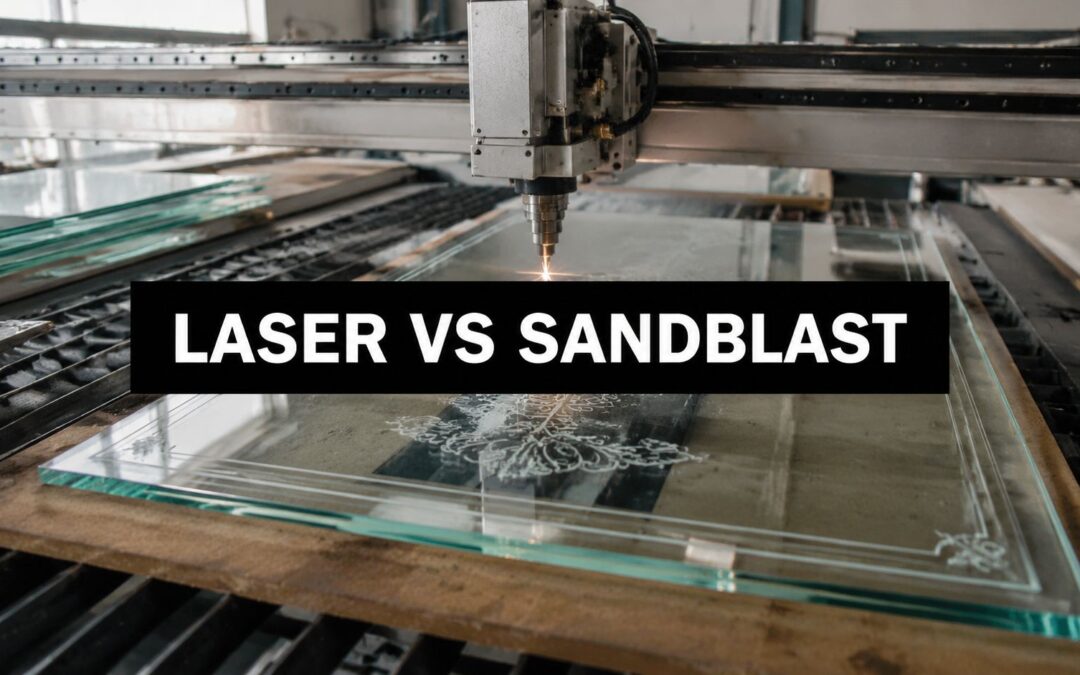
A Trotec Laser setup is the clearest reference point for modern laser work because it reflects how many professional operators approach controlled, repeatable engraving on glass.

Laser engraving on glass
Glass laser engraving in Australia uses CO2 lasers with a 10.6-micron wavelength to create a permanent frosted effect. The process relies on localised heating that induces micro-cracks without compromising structural integrity, and it can produce detail as fine as 0.1mm, as outlined in this technical explanation of CO2 laser interaction with glass.
That matters for control labels, symbols, and dense layouts where line fidelity is everything. A laser can reproduce fine vector detail and maintain consistent spacing across repeat jobs. For procurement teams managing multiple signs or equipment panels, that consistency often outweighs any small variation in setup cost.
For buyers comparing services, a specialist in laser etching for industrial applications should be able to explain not just the machine brand, but how they manage heat, focus, artwork, and glass handling.
Trotec Laser process details that affect results
Good laser engraving on glass isn't only about wattage. It's about heat control. One widely used best practice is covering the workpiece with a dampened single-layer paper towel to reduce surface temperature and lower the risk of splintering. For photo engraving, guidance also points to a grayscale matrix of 70% black and 500 dpi or higher with ordered dithering for better clarity, based on Gravotech's application guidance for crystal and glass engraving.
On a Trotec Laser machine, there's another operational detail that matters. Air Assist must be turned OFF so the paper towel doesn't dry too quickly during engraving, as noted in Trotec's material usage guidance for glass engraving.
Leave Air Assist on and the setup can work against you. The towel dries, heat builds faster, and the finish becomes less predictable.
Later in the process, machine imagery should reflect that actual laser workflow. For technical content, Trotec Laser machine imagery is the right visual language. Mechanical engraving visuals suggest a different process entirely.
A short process view helps:
Sandblasting and chemical etching
Sandblasting uses abrasive media propelled against masked glass. It can produce a strong frosted look with a slightly more textured surface than laser. It's useful where a broad, uniform etched field is acceptable, and where intricate internal detail is less critical than overall visual impact.
Chemical etching relies on surface chemistry rather than beam energy or abrasive impact. It can suit some batch applications, but for industrial identification work it's usually less attractive when buyers need crisp variable data, exact logo reproduction, or close control over fine features.
Comparison of Glass Engraving Methods
| Attribute | Laser Engraving (Trotec) | Sandblasting | Chemical Etching |
|---|---|---|---|
| Precision | High | High | Moderate |
| Material compatibility | Most glass types | Most glass types | Specific glass types |
| Speed | Fast | Moderate | Slow |
| Cost | Moderate | Moderate | Low for bulk |
| Finish | Frosted, smooth | Frosted, textured | Smooth, non-frosted |
If your specification depends on small text, repeatability, and clean vector reproduction, laser usually gives the strongest control. If you want a broader frosted field with a traditional etched appearance, sandblasting still has a place. Chemical etching tends to be the most limited choice for mission-critical industrial marking.
Key Material and Design Considerations
The word “glass” hides a lot of variation. Some panes engrave cleanly. Some react unpredictably to heat. Some tolerate detailed marking well, while others demand conservative settings and careful testing. A provider who treats every glass panel the same will eventually ruin a job.

Start with the substrate
Soda-lime glass is common and usually straightforward for engraving when settings are dialled in correctly. Borosilicate behaves differently because of its thermal properties. Toughened or tempered glass needs added care because any process choice must respect the fact that the panel has already been engineered for safety performance.
That's why experienced suppliers ask for the exact glass type, thickness, finish, and intended orientation before they discuss artwork. They're not slowing the job down. They're preventing cracking, edge stress, distorted frosting, and poor contrast.
For shaped architectural components, it helps to look at how the final object is designed and used. If your project involves custom interior glazing, reviewing how others design your custom shower door can be useful because it highlights the practical impact of panel size, hardware cut-outs, visibility, and finished appearance before any marking is specified.
Design choices that hold up in use
A file that looks sharp on screen can fail on glass. Fine lines may appear too faint. Small reversed text may lose readability. Dense filled areas can put more thermal load into the surface than expected.
A better approach is to design for legibility under real conditions:
- Prioritise contrast: Frosted marks need enough area and spacing to stay readable against reflections and background clutter.
- Use vector artwork where possible: Clean vectors give the operator tighter control over line edges, symbol clarity, and repeatability.
- Avoid tiny decorative details: What looks elegant in a proof can disappear once installed on a busy plant floor.
- Flag variable data early: Serial numbers, asset codes, and room identifiers often need a different layout discipline from one-off decorative artwork.
Ask these questions before approval
Before production starts, a careful buyer should confirm:
- Is the artwork scaled to the final viewing distance? A panel read at arm's length can carry different detail from a sign read across a corridor.
- Will the engraving sit on the front or reverse surface? Installation method changes how the artwork should be prepared.
- Are there edge clearances or hardware zones? Handles, brackets, hinges, and cut-outs can interfere with both placement and readability.
- Has the supplier tested on the same glass type? Similar is not the same.
Good glass engraving starts long before the laser fires. Most failures trace back to a mismatch between material, artwork, and use conditions.
Round items add another layer. If a handled vessel or curved panel is involved, positioning becomes part of the engineering. The artwork must land where the machine can track it safely and where the finished mark remains visible in service.
Common Industrial and Institutional Applications
Industrial buyers don't purchase glass engraving services for the process alone. They purchase them to solve a very specific problem. The application decides the right method, the right finish, and how tight the tolerances need to be.
Asset identification on glass-fronted equipment
A common example is equipment with viewing windows, inspection doors, or glazed control sections. Adhesive labels often look fine on installation day, then start to fail after cleaning cycles, heat fluctuation, or routine handling. In those settings, engraved asset IDs stay aligned with the equipment instead of becoming another maintenance item.
Where multiple assets need a unified format, buyers often choose a standard hierarchy. Equipment name first. Asset code second. Safety or access instruction third. That structure reduces clutter and keeps the most important information visible.
Safety signage in healthcare and controlled facilities
Glass partitions are everywhere in healthcare, laboratories, and administration spaces. They carry wayfinding, access information, privacy indicators, and hazard messaging. These aren't decorative graphics. Staff and visitors rely on them to move correctly through the building.
The challenge is balancing readability with a clean environment. Overly dense artwork can disappear in reflections. Understated signage can miss the mark altogether. Engraving works well here because it produces a stable, professional finish that doesn't peel at the corners or react badly to frequent wipe-downs.
For projects that need a local specialist view on this type of work, buyers often look at examples of glass engraving in Adelaide for industrial and signage applications to understand how permanent marking is being used in Australian facilities rather than retail giftware settings.
Memorial plaques and institutional recognition
Memorial work is often treated as a separate category, but the specification issues are similar. The plaque may be commemorative, yet the environment can be punishing. Outdoor placement introduces moisture, sun, airborne contamination, and cleaning wear. A method that looks acceptable indoors may lose clarity too quickly outside.
Buyers often underestimate method selection. A plaque that must remain legible year after year should be specified with the exposure conditions in mind, not only the visual style approved at sign-off.
Government and infrastructure glass signage
Public buildings, transport sites, and civic spaces need markings that handle constant contact and long service intervals. These jobs usually involve:
- Entry and directional panels: information that needs stable contrast and a tidy finish
- Security and access markings: permanent identifiers on doors, screens, and partitions
- Operational instructions: fixed information where replacement shouldn't become routine
- Commemorative installations: plaques or donor acknowledgements expected to endure outdoors
In institutional work, the best engraving is often the one nobody has to think about again after installation.
That's the benchmark. If a sign needs regular replacement, or if staff start working around a failed label with temporary fixes, the original method wasn't fit for purpose.
Understanding Durability Testing and Long Term Performance
Durability claims matter only if they match the environment. Indoor office glazing faces a different risk profile from a coastal memorial plaque or a machine panel in a wash-down area. Buyers need to think in terms of exposure, not just appearance.
What actually wears a glass marking down
Long-term performance is shaped by a small group of recurring stressors:
- Abrasion: repeated wiping, contact, and general handling
- Cleaning chemistry: detergents, disinfectants, and solvent exposure
- UV and weather: sunlight, moisture, temperature cycling
- Salt exposure: a major issue in coastal installations
Some failures are obvious. The mark loses contrast or surface texture. Others are slower. Edges soften, clarity drops, and readability becomes inconsistent depending on light and viewing angle.
Why method choice shows up years later
A key practical distinction between laser and sandblasting arises. A 2025 study by the AU National Science Agency found that sandblast-etched glass signage in coastal AU regions degrades 40% faster due to salt corrosion compared to laser-engraved equivalents, which maintain clarity for 15+ years without fading, according to this report on engraving longevity in Australian conditions.
That's highly relevant for outdoor signage, memorial plaques, and infrastructure work near the coast. Salt doesn't attack every finish the same way. Surface texture, porosity, and how the mark interacts with contamination all influence how quickly the panel loses readability.
In facilities where cleaning agents are part of daily operations, the same logic applies. Buyers already familiar with chemical-resistant labels for harsh environments will recognise the principle. The surface treatment has to match the exposure profile.
Durability isn't a marketing phrase. It's the result of matching the process to the environment the glass will actually face.
Questions worth asking a supplier
A vendor who understands long-term performance should be able to answer a few direct questions without vague language:
| Question | Why it matters |
|---|---|
| What engraving method do you recommend for this environment? | It reveals whether they connect process choice to actual use conditions |
| Have you produced work for outdoor or coastal installation? | Exposure history is different from indoor decorative work |
| How does the finish behave under repeated cleaning? | Critical for healthcare, hospitality, and public sites |
| Can this design keep its readability over time? | Fine detail may not age as well as simpler layouts |
The strongest specifications usually come from buyers who treat durability as part of procurement, not as an afterthought once the artwork is approved.
How to Specify and Procure Glass Engraving Services
Buying glass engraving services well isn't mainly about getting the lowest quote. It's about writing a specification that leaves less room for avoidable errors. That includes process selection, artwork preparation, substrate details, and acceptance criteria.
In Australia and New Zealand, buyers aren't choosing from an endless field of specialists. As of April 1, 2026, there are exactly 63 registered glass engraving services operating across Australia and New Zealand, with the majority concentrated in Australia, according to this business listing analysis. That's a workable market, but still narrow enough that expertise becomes a serious differentiator.

What to put in the brief
A useful project brief should identify the glass, the message, the environment, and the finish expectations. If any one of those is missing, quotes become hard to compare and rework becomes more likely.
Include these points:
- Glass specification: type, thickness, dimensions, and whether it is flat, curved, toughened, laminated, or already installed
- Artwork format: vector files where possible, plus any variable data schedule
- Placement details: exact position, orientation, edge clearances, and visible face
- Operating environment: indoor, outdoor, coastal, public-facing, wash-down, or chemically cleaned
- Acceptance standard: what counts as readable, aligned, and visually acceptable on delivery
Vendor selection criteria that actually matter
Many buyers ask for samples and price. Both matter, but they're only part of the decision.
A stronger checklist looks like this:
Machine capability
Ask whether the supplier uses equipment suited to precision glass work, including Trotec Laser systems where fine control and repeatability are required.Material handling knowledge
They should ask questions about the glass itself before they commit to a process.Proofing discipline
A reliable vendor should confirm artwork orientation, layout scale, and placement method before production.Process transparency
They should be able to explain why laser, sandblasting, or another method is the best fit.Consistency across repeat orders
This matters for multi-site rollouts and staged installations.Communication speed
Delays often start with vague answers, not with the machine.
How the wider Evright workflow helps
For buyers who want a simpler path from concept to finished marking, it helps to understand how evright.com works. The broader business supports custom engraving through a consultative workflow that turns an application need into a production-ready job. You provide the use case, artwork, and substrate details. The team reviews feasibility, confirms the marking method, prepares the layout, and moves to production with quality checks built into the process.
That matters because many glass jobs fail before production. They fail in briefing, file prep, or method selection.
The best procurement outcome is boring in the right way. The artwork is approved once, the finish is correct, and the installed result behaves exactly as expected.
Cost drivers buyers should expect
Precise pricing varies by job, but the same factors usually shape the quote:
| Cost driver | What changes the price |
|---|---|
| Setup complexity | One-off artwork, jigs, curved items, and positioning requirements |
| Glass type | Some substrates need more testing and slower processing |
| Design density | Filled areas and detailed graphics can increase production time |
| Quantity and repeatability | Batch consistency can improve efficiency |
| Handling and packing | Fragile finished glass needs careful protection and transport |
A good supplier won't just send a number. They'll explain what is driving it.
Conclusion Your Partner in Precision and Permanence
Industrial glass engraving isn't a novelty process dressed up for compliance work. It's a specialised service that has to match the glass, the design, and the environment. If any one of those elements is wrong, the result may still look acceptable at handover and fail later in use.
The strongest outcomes usually come from a disciplined sequence. Choose the right method. Confirm the glass type. Prepare artwork for real-world readability. Test where needed. Specify the environment clearly. Then select a supplier who can explain the process without hand-waving.
Trotec Laser capability matters because control matters. Fine detail, heat management, repeatability, and finish consistency aren't abstract technical points. They're what separate a durable mark from one that becomes a replacement issue. For industrial buyers, that difference shows up in maintenance effort, visual consistency, and how confidently a site can rely on the information carried on the glass.

There's also a straightforward procurement reality. In a specialised field, not every supplier who offers glass engraving services is equipped for industrial and institutional work. Decorative output and mission-critical marking are not the same category. Buyers who understand that tend to write better briefs, ask better questions, and get better results.
For safety signage, asset identification, healthcare environments, infrastructure projects, and memorial plaques, permanence isn't optional. It's the job.
If you need a supplier that understands industrial glass engraving from specification through production, talk to Evright Industrial. The team combines advanced Trotec Laser capability with decades of engraving experience to deliver durable, precise marking for equipment identification, safety signage, and long-life glass applications across Australia.
Recent Comments