
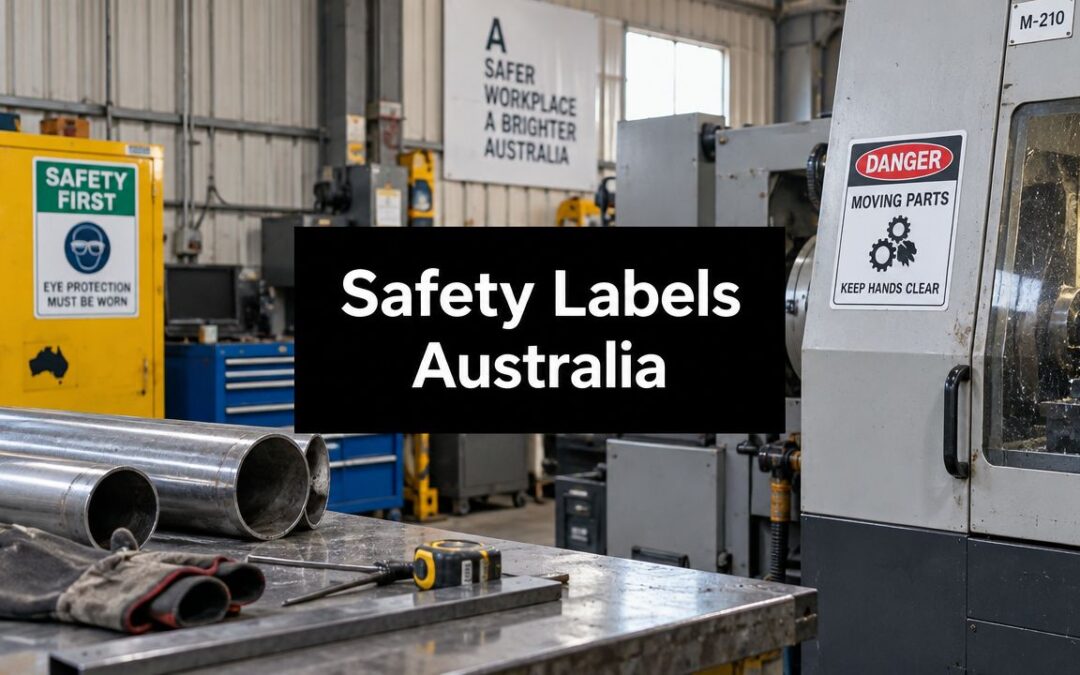
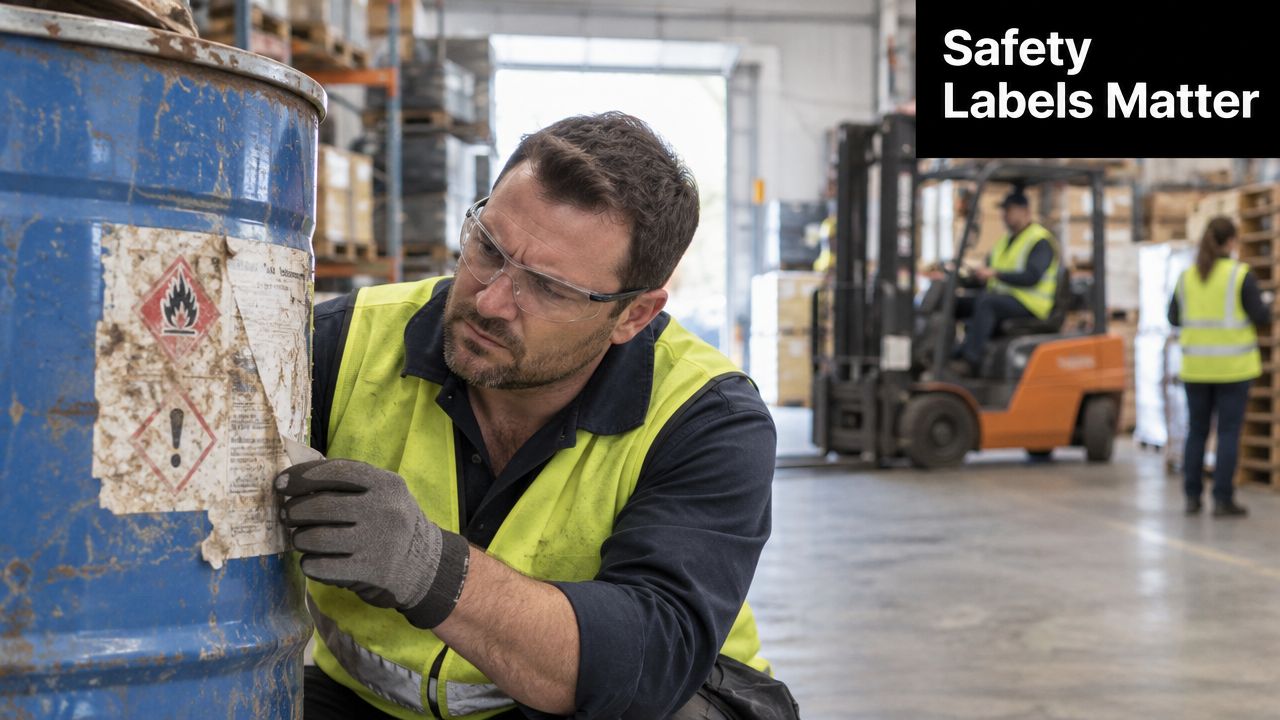
A shift supervisor walks into a busy plant and finds a faded label on a blue chemical drum. The product is familiar, but the hazard pictogram has nearly disappeared, the supplier details are hard to read, and the secondary container beside it has no label at all. Work pauses while someone checks the SDS and asks what the drum contains.
That delay is frustrating, but the larger issue is miscommunication at the point of use. A safety label has to remain readable when the container is wet, dusty, sun-exposed, handled by contractors, or needed during an emergency. For Australian workplaces, the right solution depends on whether you're identifying a chemical container, marking a fixed workplace hazard, or placarding a bulk installation.
This guide uses plain language to separate those jobs, explain the relevant Australian requirements, and show how material selection affects service life. It also covers practical specification decisions for manufacturing floors, electrical work, healthcare maintenance, utilities, and infrastructure sites.
Evright Industrial is the specialist industrial division of evright.com, bringing nearly six decades of engraving experience to equipment identification, safety signage, and durable asset marking. Its Trotec Laser machinery supports precise engraving on suitable metal and plastic materials, while the production process is planned around legibility, site conditions, and repeatable results.
If you're sorting out a mixed inventory of supplier labels, in-house labels, wall signs, pipe markers, and bulk storage placards, this practical guide to safety signage provides useful context. The important point is simple: the label must match the hazard, the location, and the way people interact with the site.
Introduction to Safety Labels in Australian Workplaces
Australian workplaces rarely fail because nobody understands that safety matters. They struggle because information disappears into the background. A warning label curls away from a painted panel, a contractor can't identify a pipe, or a faded equipment plate forces a worker to guess which isolator controls a machine.
That's why safety labels Australia projects should start with the task, not the material. Ask what a person needs to know at the moment they approach the container, open the cabinet, cross the restricted area, or respond to an incident. The answer determines whether you need a chemical label, a fixed safety sign, an equipment plate, or a placard.
The problem with one-size-fits-all labelling
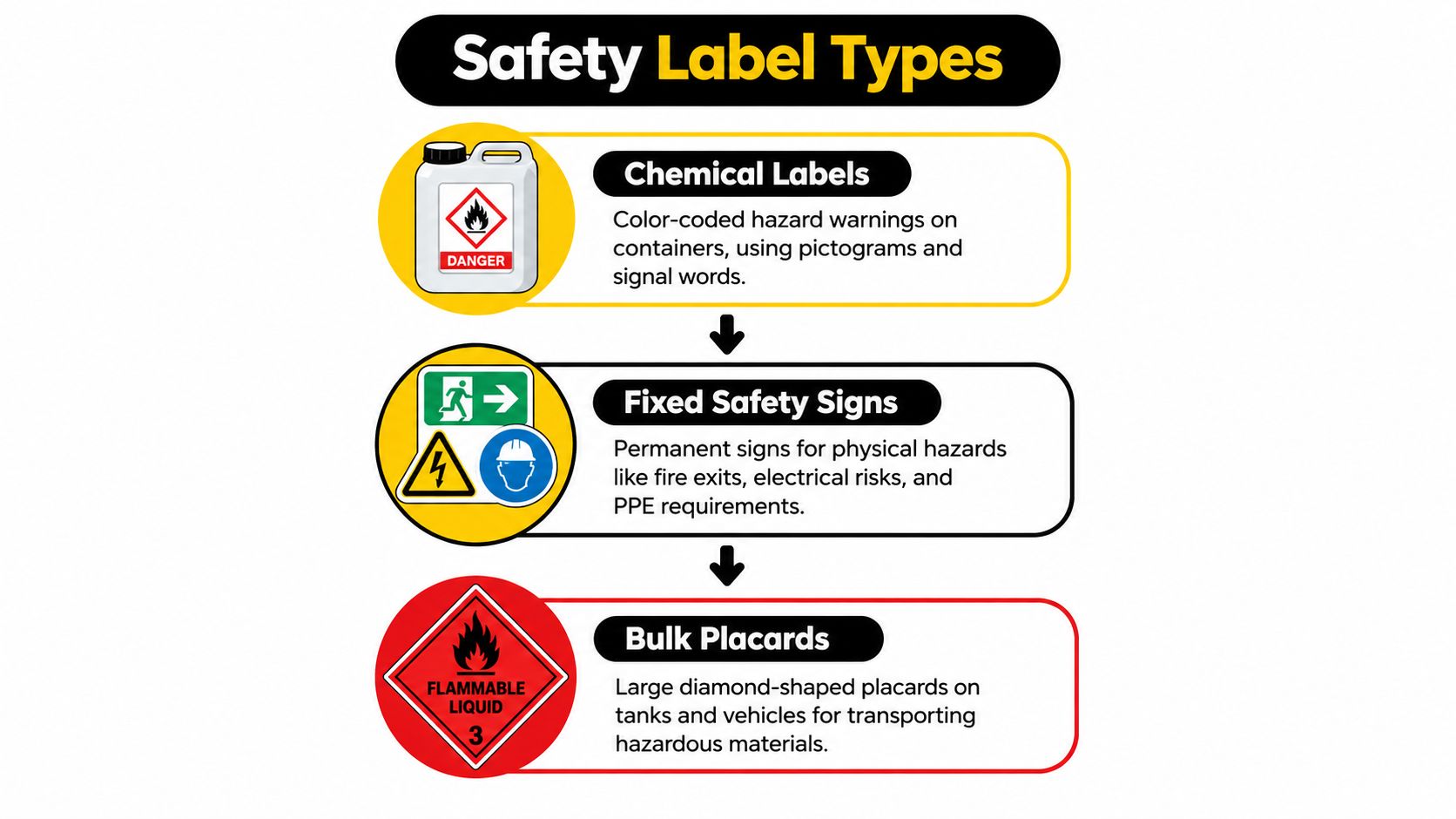
A chemical label travels with the container. It identifies the product and communicates hazards, handling precautions, and emergency information. A fixed sign stays on a wall, door, machine, fence, or structure and tells people about a permanent condition, such as required PPE, an electrical risk, an emergency exit, or a prohibited action.
A placard serves a different visual purpose again. It gives prominent identification to a bulk container, vehicle, installation, or other location where a larger sign is needed. Treating all three as interchangeable can leave gaps. A small container label won't necessarily provide the visibility required at a bulk storage area, while a generic wall sign won't provide the chemical information required on a container.
Practical rule: Start at the point where the worker makes a decision. Label the object they handle, sign the hazard they approach, and placard the larger installation that must be recognised from a distance.
Evright Industrial works with organisations that need equipment plates, hazard labels, and durable signage for demanding environments. A Trotec Laser machine can produce fine, consistent detail, but the finished result still depends on accurate artwork, suitable substrate, correct fixing, and a clear understanding of the site.
The sections that follow are designed for site managers who need a repeatable way to identify the right label type and order a solution that remains legible through ordinary Australian working conditions.
Understanding Safety Label Types and How They Work
Think of workplace labelling like a traffic system. Drivers recognise a red light, a warning triangle, or a directional sign before reading a paragraph. Safety communication works in much the same way. Colour, shape, symbol, and wording work together so a person can understand the message quickly, even when they're wearing gloves, moving between tasks, or working in an unfamiliar area.
Chemical labels belong on the container
A chemical label identifies what's inside and explains the associated risk. Under Australia's workplace hazardous-chemical framework, the label can include the product identifier, supplier details, ingredient identity and proportion, hazard pictograms, hazard statements, a signal word, precautionary statements, and relevant first-aid or emergency information. An expiry date may also apply.
The label needs to travel with the chemical. If a worker decants a product into a smaller bottle or spray container, the new container can't rely on the original drum sitting elsewhere in the store. The receiving container needs information that lets users identify and handle its contents safely.
Fixed safety signs describe the workplace
A fixed sign communicates a condition that remains in a particular place. Examples include:
- Mandatory action signs, such as requirements to wear eye protection or hearing protection.
- Warning signs, which draw attention to hazards such as moving machinery, electricity, or vehicle movement.
- Prohibition signs, which restrict an action or entry.
- Danger signs, used for serious hazards requiring immediate attention.
- Emergency and safe-condition signs, including exits, first-aid locations, and emergency equipment.
- Fire-related signs, which identify firefighting equipment or fire services information.
AS 1319-1994 is the Australian Standard used for occupational safety signs. WorkSafe ACT describes six standardised sign classes, including warning, mandatory action, prohibition, danger, emergency or safe condition, and fire-related information. The colour and shape coding gives each class a visual identity. Mandatory signs use a blue circle with a white symbol, warning signs use a yellow triangle, and fire signs use a red rectangle with white symbols. Monash University's signage guideline also groups signs by regulatory, hazard, and emergency information functions.
Bulk placards operate at installation scale
A placard is not a large label. It identifies a bulk storage location or transport-related hazard where people need recognition from farther away. Safe Work Australia guidance says bulk containers over 500 litres or 500 kilograms require placards, with the applicable requirement depending on the situation and hazardous chemical involved. Hazardous chemicals in pipework must also be identified by a label, sign, or another reasonably practicable means.
A useful site test is to stand where a worker or emergency responder will first encounter the hazard. If the message must be seen before anyone reaches the container, cabinet, tank, or pipe, a fixed sign or placard may be needed in addition to the container label.
Australian Standards and Regulations You Need to Know
Australian labelling compliance has several layers, and confusion usually starts when those layers get mixed together. Workplace hazardous-chemical labelling sits within the WHS system. Product safety labelling sits within mandatory standards and category-specific schemes. A workplace can need to manage both, but they don't perform the same job.
Workplace chemicals and GHS 7
The national foundation is the Model Code of Practice for Labelling of Workplace Hazardous Chemicals. Safe Work Australia says the code applies nationally and connects with the WHS regulatory system used by Australian states and territories.
The ACT rules show the practical information expected on a hazardous-chemical label. That includes:
- Product identification, so workers can match the container to the correct chemical and SDS.
- Australian supplier details, including the manufacturer's or importer's address and business telephone number.
- Ingredient information, including identity and proportion where required.
- Hazard communication, using pictograms, hazard statements, and the appropriate signal word.
- Precautionary information, covering prevention, response, storage, and disposal.
- Emergency information, including relevant first-aid instructions.
- Expiry information, where applicable.
Labels must be written in English and sized so information is easily visible and legible. Larger containers need larger labels. The model code also expects durable print, firm attachment to an outside face, and strong contrast between lettering and background. Those requirements address real site problems. A label that fades, lifts, or blends into its container can slow identification and increase the chance of incorrect handling.
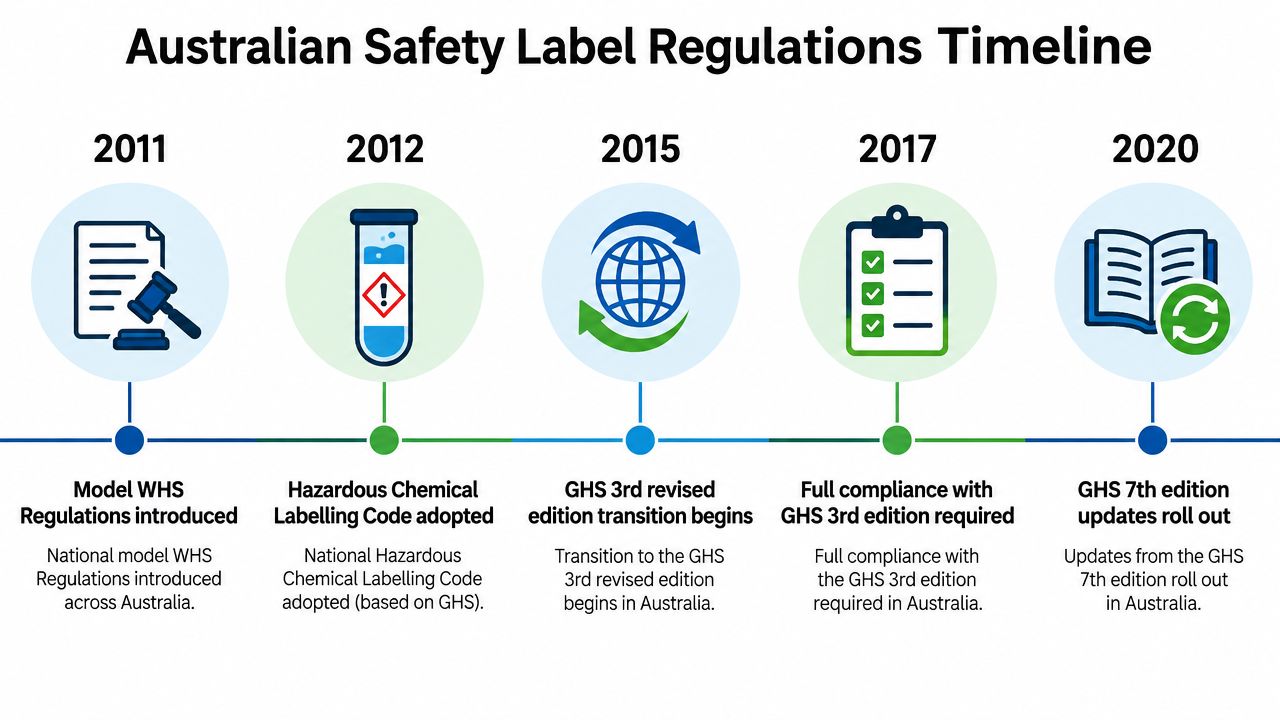
Australia's transition to GHS 7 is another important checkpoint. Safe Work Australia states that manufacturers and importers must classify, label, and prepare SDS under GHS 7 from 1 January 2023, while workplace users must ensure newly accepted stock from that date is compliant. A model code for labelling workplace hazardous chemicals is described as becoming legally binding from 1 July 2026 under section 26A, so site managers should review how the rules affect secondary containers, decanted products, and older stock already held on site. See the GHS 7 transition information for the national position.
Product schemes are a separate compliance track
The ACCC explains that mandatory standards make safety or information features compulsory for legal supply in Australia. Business.gov.au identifies schemes that operate across product categories, including the Energy Rating Label, the Water Efficiency Labelling and Standards scheme for products such as dishwashers and washing machines, and fuel-consumption labelling under ADR81/02 for new vehicles up to 3.5 tonnes gross vehicle mass, including electric vehicles. These are product information requirements, not replacements for workplace hazard signs.
Compliance takeaway: A product label tells the market what a product is required to communicate. A workplace safety label tells people how to recognise and manage a hazard where work occurs. Check both tracks when the product enters a regulated workplace.
Chemical labelling also sits beside broader safeguarding controls. If a label identifies a machine hazard but the guarding, isolation, or access control is inadequate, the label can't solve the underlying risk. For a broader view of practical machine safeguarding compliance, consider the engineering controls alongside the sign.
Australian sites can also use safety signage for industrial workplaces as part of a planned system, provided the wording, symbols, dimensions, placement, and material suit the relevant hazard and environment.
Choosing Materials and Adhesives for Australian Conditions
A compliant message can still fail if the physical label can't survive the site. Outdoor electrical equipment faces UV and weather. A food or healthcare maintenance area may involve repeated cleaning. A manufacturing floor can add oil, abrasion, vibration, heat, and impact. Chemical stores introduce another layer of exposure because the label may sit near vapours, splashes, or residue.
The Australian model code's requirements for durable print, firm fixing, contrast, and legibility should be treated as performance criteria, not decorative preferences. The substrate and adhesive need to keep the information attached and readable for the expected service life.
Compare the material options
| Material Option | Best For | Adhesive Consideration | Durability Strength |
|---|---|---|---|
| Anodised aluminium | Equipment plates, control panels, indoor or sheltered assets | Select an adhesive that bonds to clean metal, painted metal, or powder-coated surfaces | Engraved detail can remain clear because the mark is formed into the surface |
| Stainless steel | Harsh industrial areas, washdown zones, outdoor infrastructure | Surface preparation matters, especially where moisture or contamination is present | Strong resistance to corrosion, impact, and demanding cleaning conditions |
| Acrylic | Fixed signs, indoor equipment identification, visual notices | Use a compatible adhesive for the backing surface and avoid relying on adhesion alone where impact is likely | Rigid and clean-looking, with good visual contrast when correctly produced |
| UV-stable polymers | Outdoor labels, pipe identification, cabinets, and areas needing flexibility | Choose a formulation and adhesive suited to UV, temperature, and the surface energy of the substrate | Lightweight and adaptable, with performance dependent on grade and exposure |
| Vinyl or polyester | Shorter-term or flexible identification where the environment is controlled | Match adhesive to painted, powder-coated, smooth, or low-energy surfaces | Practical and economical, but exposure and abrasion limits must be checked |
| Polycarbonate | Durable guards, panels, overlays, and equipment interfaces | Confirm bond compatibility with the panel and surrounding finish | Tough and impact-resistant, suitable where handling is frequent |
The table is a starting point, not a substitute for testing. A smooth stainless-steel cabinet and a textured powder-coated enclosure may need different adhesive systems even when they sit in the same room. Low-energy plastics can be especially difficult because some standard adhesives don't wet out or hold effectively.
Match the label to the environment
For a shaded plant room, anodised aluminium or a suitable polymer may provide the right balance of readability and cost. For a utility asset exposed to sun and rain, UV-stable material, strong contrast, and reliable edge adhesion matter more than a thin decorative label. For a washdown zone, stainless steel or a chemically resistant polymer can be a safer starting point than a basic paper-backed product.
Evright Industrial's chemical-resistant labels are relevant where routine exposure could damage ordinary print or adhesive. Its production approach includes premium materials and energy-efficient laser processes, which can support durable identification while reducing unnecessary replacement and waste.
When a project includes unfamiliar plastics or composite panels, an industrial polymers and composites catalog can help teams compare substrate families before finalising artwork and adhesive selection.
A label's useful life is determined by the weakest part of the system. A durable face won't help if the adhesive peels, and a strong adhesive won't help if the printed message disappears.
How to Specify and Order Safety Labels That Last
Most ordering problems begin before production. The requester sends a logo, a rough phrase, and a photo of the equipment, then expects the supplier to infer the hazard, viewing distance, substrate, and fixing method. A better brief makes the finished label easier to approve and more reliable in use.
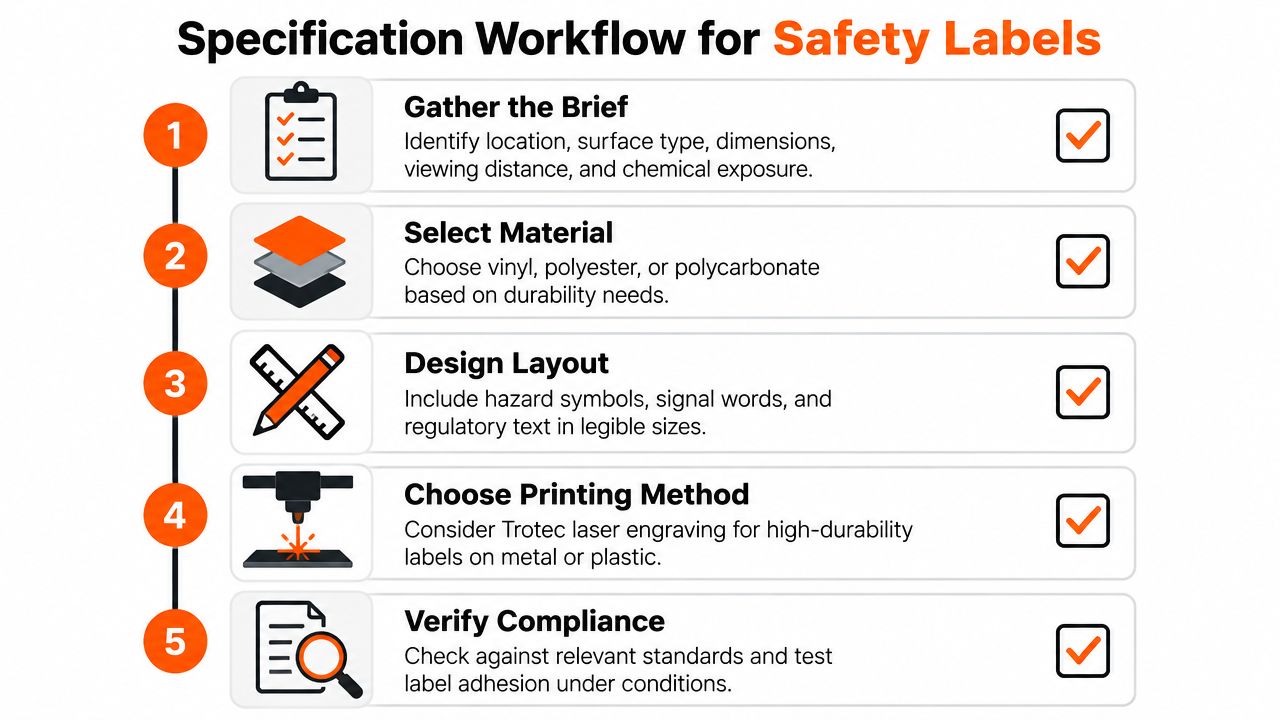
Build the specification in five passes
Gather the brief. Record the exact location, surface type, available dimensions, viewing distance, cleaning routine, chemical exposure, temperature, UV exposure, and likely handling. A label on a forklift battery cabinet has a different job from one on a remote outdoor switchboard.
Choose the communication type. Decide whether the item needs a chemical label, fixed AS 1319 sign, equipment plate, pipe marker, or bulk placard. Include the product identifier, hazard information, or instruction that workers need, rather than filling the space with unnecessary text.
Set the visual hierarchy. Put the key warning where it can be recognised first. Use the applicable pictogram, signal word, colour, and shape. Keep lettering large enough for the viewing distance, and check that the foreground contrasts strongly with the background.
Prepare artwork for production. Trotec Laser machine imagery can be useful when reviewing how engraved detail, cut lines, and material thickness will translate into a finished plate. Artwork should identify dimensions, holes, corners, mounting requirements, and any variable data such as asset numbers or chemical identifiers.
Proof before quantity production. Confirm spelling, pictograms, signal words, supplier information, contrast, fixing method, and placement. Test adhesion on the actual surface where practical, especially if it's painted, powder-coated, textured, damp, or made from a low-energy polymer.
A Trotec Laser process can suit high-durability engraving on selected metal or plastic materials, particularly where the message needs to resist ordinary surface wear. The correct result still depends on choosing the right substrate and confirming that the design remains legible at the intended distance.
The Trotec Laser YouTube video can help teams understand the type of machine process used for precision cutting and engraving. Use machine imagery and production examples to discuss the finish, rather than assuming every laser-marked material performs the same way.
Ordering details that prevent rework
Give the supplier the batch quantity, required delivery timing, installation method, and budget range at the start. Keep a controlled master artwork file so replacements match the original, particularly across multiple sites or contractor teams.
Evright Industrial works through evright.com as a specialised industrial division. A typical project moves from the client's site brief to material and artwork review, proofing, Trotec Laser production, quality checking, and delivery of labels or signs ready for installation. That workflow gives the site manager a clear point for checking compliance before the labels reach the floor.
Real World Applications Across Industrial and Essential Services
A manufacturing supervisor notices that asset plates on older machinery are becoming difficult to read. The practical fix isn't to place a warning sticker over every plate. A durable engraved equipment identifier can give the maintenance team a stable reference for the machine, asset number, isolation information, or service record. The plate belongs on the equipment, while a separate fixed sign can identify the wider machine hazard or required PPE.
An electrical contractor may mark switchboards, cabinets, cables, and service vehicles. The label must remain visible after handling, cleaning, and routine access. Where the sign communicates a permanent electrical danger or mandatory control, use a fixed safety sign with the appropriate visual class. Where it identifies a particular asset or circuit, an equipment plate is usually the more direct tool.
Healthcare facilities need signs that remain legible through frequent cleaning and busy circulation areas. A door sign for an electrical plant room, a label on a maintenance chemical container, and a fixed emergency-direction sign each have different jobs. Selecting a smooth, cleanable substrate and securing it firmly helps prevent edges lifting during repeated cleaning.
Infrastructure teams face another distinction. Safe Work Australia guidance says bulk containers over 500 litres or 500 kilograms require placards, and pipework containing hazardous chemicals needs identification by a label, sign, or other reasonably practicable means. A small label on a valve may identify the line locally, while a fixed sign or placard may be needed to communicate the hazard at an access point or bulk storage area.
For broader site controls, these construction site safety tips provide useful background on signage, access, and worker awareness. The same principle applies across depots, hospitals, plants, and utilities: place the message where the decision occurs, use materials suited to the environment, and inspect labels as part of routine maintenance.
Responsible sourcing also matters. Durable labels reduce avoidable replacement when the original survives the conditions it was designed for, while accurate batch production helps limit waste from incorrect or inconsistent artwork.
Bringing Your Safety Labelling Together
A reliable safety labelling system connects four decisions. First, identify the communication job. Is it a chemical container label, a fixed AS 1319 sign, an equipment plate, pipe identification, or a bulk placard? Second, verify the information, pictograms, colours, and legibility against the applicable Australian requirements.
Third, select a substrate and adhesive that suit heat, UV, moisture, chemicals, abrasion, cleaning, and the mounting surface. Finally, proof the artwork and installation plan before ordering the full batch. Trotec Laser engraving can provide a precise, durable marking method for suitable materials, but the result depends on the complete specification.
Audit secondary containers, decanted chemicals, older stock, pipework, bulk storage areas, and faded fixed signs. The GHS 7 transition and the model-code development described for 1 July 2026 make this a sensible time to identify gaps rather than wait for an incident or failed inspection.
Evright Industrial supplies precision laser-engraved equipment labels, chemical-resistant labels, safety signs, and durable placards for Australian industrial, healthcare, electrical, and infrastructure environments. Visit Evright Industrial with your site conditions, artwork, and labelling requirements to discuss a practical solution built around clear communication and long service life.
Recent Comments