

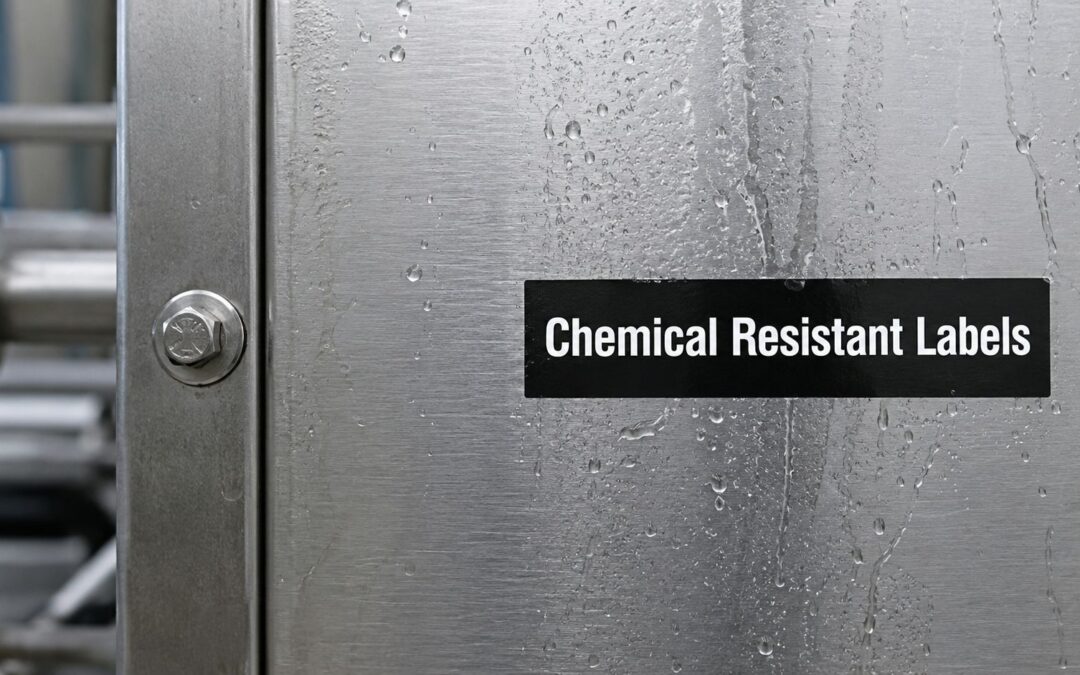
A routine washdown finishes. The machine looks clean, the line is ready to restart, and then someone tries to scan the asset label. The barcode won't read. The text has softened, the edges have lifted, and the ID that tied that equipment to maintenance history, calibration records, or hazardous contents is no longer trustworthy.
That's the point where standard labels stop being a stationery choice and become an operations problem. In Australian industrial settings, the actual failure often isn't that a label falls off on day one. It's that it stays in place just long enough to create false confidence, then loses legibility after contact with solvents, alcohols, oils, acids, or aggressive cleaning chemicals.
Most buyers focus on stickiness first. In practice, long-term scannability and data integrity matter just as much. A label that remains attached but can't be read by a scanner has already failed.
Why Your Standard Labels Fail in Harsh Environments
On paper, many labels look acceptable. In service, they break down quickly because the environment is doing more than one type of damage at once. A maintenance tag on a pump might face solvent wipe-downs, oil mist, heat, abrasion from gloves, and repeated contact with cleaning cloths. A lab container label may survive light handling but lose print definition after routine chemical contact. A hospital asset tag can stay physically attached while the barcode degrades enough to slow every scan.

What usually goes wrong first
The weak point depends on the label construction. Sometimes the adhesive softens. Sometimes the ink smears. Sometimes the face material cracks at the edge and starts lifting after repeated wipe-downs. The common thread is that standard office-grade and general-purpose labels weren't built for chemical exposure.
Three failure patterns show up repeatedly in harsh sites:
- Print loss before adhesive failure: The label still looks attached, but key text or barcode elements blur or transfer.
- Edge lift after cleaning cycles: Corners catch, dirt gets underneath, and the label starts peeling progressively.
- Surface attack from solvents or caustics: The top layer hazes, softens, or cracks, and machine readability drops.
A label can fail long before it falls off. If the operator can't read it or the scanner can't capture it, the label is already out of service.
Why this matters beyond convenience
In Australia, labels on hazardous chemical containers carry a safety function. The issue isn't cosmetic. If the label degrades, people lose access to the information they rely on during handling, storage, maintenance, and emergency response. That's why chemical resistant labels belong in the same conversation as safety, traceability, and compliance.
Operations managers also feel the knock-on effects immediately. Teams waste time keying in faded serial numbers manually. Assets get misidentified. Replacement labels are ordered in a hurry. Record accuracy slips. None of that is visible when the label is first applied, which is why poor label selection often survives procurement and fails later on the floor.
The Anatomy of a Chemical Resistant Label
A durable label works as a system, not a single miracle material. That's the part many buyers miss. One strong adhesive won't save a poor print method. A tough face stock won't fix an ink system that dissolves on contact. A laminate won't compensate for the wrong substrate choice.

As Computype's guidance on chemical-resistant labels notes, chemical resistance in industrial labels is a tested system of face stock, adhesive, coatings, and print method, commonly validated by solvent wipe testing and immersion testing.
Think of it like a weatherproof structure
The simplest way to assess chemical resistant labels is to think of them like a building exposed to bad weather.
- Face stock is the structure itself. It has to tolerate the environment without distorting, cracking, or becoming brittle.
- Adhesive is the foundation. If it doesn't suit the surface and exposure conditions, the entire assembly starts moving.
- Print method is the information layer. That's where readability lives or dies.
- Coating or laminate is the outer defence. In some builds it helps a lot. In others it introduces another possible failure point.
If one layer is poorly matched, the whole label is compromised.
What each layer is really doing
The face stock carries the physical load. In industrial work, common high-performance choices include polyester constructions, rigid laminates, and specialised engravable materials. For some applications, metal tags or layered industrial plastics are better than flexible film labels because the identification has to outlast aggressive handling, not just chemical splash.
The adhesive needs to be chosen for both the surface and the cleaning regime. Stainless steel, powder-coated panels, textured housings, and low surface energy plastics all behave differently. So do indoor dry areas versus washdown zones. The wrong adhesive can look fine at installation and still release after exposure.
The marking method is where many standard labels fail. Printed surface graphics are vulnerable because the information sits on or near the top layer. Once chemicals attack that layer, the data goes with it.
Practical rule: Don't ask whether the material is “chemical resistant” in the abstract. Ask which part of the construction holds the data, and what protects that data after repeated exposure.
What works better than a single-spec mindset
Procurement sheets often reduce labels to one headline spec, usually adhesive strength or material type. That's not enough. A label can be made from a respectable base film and still fail because the ribbon, resin, coating, or laminate wasn't matched to the site conditions.
A better evaluation looks at the whole stack:
- Surface type: bare metal, coated metal, plastic, textured casing.
- Chemical exposure: solvent splash, immersion risk, alcohol wipe, caustic wash.
- Cleaning pattern: occasional maintenance, daily sanitation, repeated rub-downs.
- Readability requirement: human-readable only, barcode scanning, long-term asset traceability.
That last point matters more than most guides admit. A label isn't durable just because it remains attached. It's durable when the data remains accurate and usable.
Matching Materials to Specific Chemical Threats
Material selection gets easier when you stop asking for a “heavy-duty label” and start asking what the chemical is doing to the construction. Solvents and oils often attack inks and adhesives first. Acids, caustics, and repeated wipe-downs more often show up as edge lift, facestock cracking, or print loss. That's why label specification has to match the chemical class and exposure mode. Datagraphics also points to a practical qualification benchmark of a 24-hour immersion test in the target chemical in its guide to chemical resistance for industrial labels.
Use the chemical first, not the material first
A lot of bad buying decisions start with “we always use vinyl” or “we usually order polyester”. That habit works until the cleaning chemistry changes, the asset moves to another area, or a contractor starts using a stronger solvent than before.
This quick comparison is best treated as a decision aid, not a substitute for testing on your exact application.
| Material | Acids | Bases/Caustics | Solvents (e.g., Acetone, MEK) | Oils & Fuels | Cleaning Agents/Alcohols |
|---|---|---|---|---|---|
| Paper labels | Poor | Poor | Poor | Poor | Poor |
| Vinyl labels | Fair in mild exposure | Fair | Often weak where strong solvents are involved | Fair | Fair |
| Polyester film labels | Good in many industrial environments | Good in many industrial environments | Often a stronger option than general-purpose films when paired with the right print system | Good | Good |
| Laminated industrial labels | Good if the laminate and adhesive suit the chemistry | Good if properly specified | Mixed, because the top layer can still be attacked by aggressive solvents | Good | Good |
| Engraved laminates | Strong option where surface print vulnerability is a concern | Strong | Strong, especially where the mark is formed into the material rather than printed on top | Strong | Strong |
| Metal nameplates and tags | Strong in demanding environments when the grade and fixing method are correct | Strong | Strong | Strong | Strong |
What that table means in practice
If the site uses acetone, MEK, xylene, ethanol, methanol, bleach, or hydrochloric acid, you need to ask how often the label is exposed, whether it's being wiped or splashed, and whether the data must still scan afterwards. Some materials survive occasional incidental contact but degrade under repeated cleaning. Others handle wipe-downs but not full immersion or pooling.
For teams comparing substrates in detail, this overview of material resistance to chemicals is useful for understanding how different material families respond to chemical classes.
A rigid engraved laminate or traffolyte-style construction often makes more sense than a conventional printed sticker when the label has to remain legible for years in maintenance-heavy conditions. For buyers weighing that path, industrial traffolyte label options are worth reviewing because they sit in a different performance category than general adhesive print labels.
The trade-off buyers should acknowledge
Flexible films can be excellent when the surface is curved, small, or cost-sensitive. But they rely heavily on the integrity of the printed layer and adhesive bond. Engraved laminates and metal tags are less forgiving on conformability and sometimes take more planning to install, yet they remove some of the usual failure modes entirely.
That's often the better trade in harsh environments. You're not buying for appearance on day one. You're buying for readability after months of handling and cleaning.
How to Verify True Chemical Resistance
“Chemical resistant” shouldn't be treated as a marketing adjective. It should be verified against the exact chemistry and handling pattern in your plant, lab, workshop, or facility.
Start with the tests that reflect real exposure
Two methods matter because they reproduce common failure conditions.
Solvent wipe testing checks whether the print smears, transfers, or breaks down when a cloth soaked in a target chemical is rubbed across the label. This matters in areas where equipment is cleaned rather than submerged.
Immersion testing checks whether the label remains readable and adhered after being placed in the target solvent, acid, or cleaning agent for a defined period. This matters where splash, soak, pooling, or process contact can occur.
A practical benchmark often used in qualification is a saturated-cloth rub test that shows no visible colour transfer after 10 strokes, and for more severe applications, a 24-hour immersion test followed by inspection for fading, edge lift, or distortion. Those benchmarks are outlined in the same Datagraphics reference already noted earlier.
What a pass actually looks like
A pass is not “the label is still there”. A useful pass means the label remains:
- Legible by eye
- Attached without edge failure
- Stable in shape and surface
- Fit for barcode scanning if tracking depends on it
If your acceptance check doesn't include scan performance after testing, you're only validating half the problem.
Why durability is also a compliance issue in Australia
Australian chemical labelling follows the nationally adopted Globally Harmonized System (GHS). A chemical label must carry six core elements: product identifier, hazard pictogram, signal word, hazard statement, precautionary statement, and supplier information, as outlined in this guide to chemical labels and GHS requirements.
That matters because those elements only work if people can still read them. If solvents, acids, oils, or harsh cleaners damage the label, the hazard communication system fails. In practice, that makes label durability a compliance question, not just a purchasing preference.
Questions worth asking a supplier
Before approving a label specification, ask for clear answers on these points:
- Which chemicals was the construction tested against?
- Was the test a wipe test, immersion test, or both?
- What surface was used during testing?
- Was readability checked after exposure, not just adhesion?
- Was barcode performance assessed where traceability matters?
A confident supplier should be able to discuss failure modes plainly. If the response stays vague, the product probably hasn't been matched to your environment properly.
Choosing the Right Label for Your Industry
The right label in one sector can be the wrong label in another. The chemistry, cleaning routine, and recordkeeping burden all change the answer.
A point that doesn't get enough attention is scan reliability after repeated washdowns. Camcode notes that chemical-resistant label materials should remain scannable after prolonged chemical exposure in its discussion of labels for chemical environments. That's the operational test many buyers only discover after rollout.
Manufacturing and processing
Factory floors are rough on labels because exposure tends to be mixed. Degreasers, oils, fuels, hand contact, rag wipe-downs, and abrasive grime often happen together. In these settings, a surface-printed label may hold on physically while the barcode starts failing.
For manufacturing assets, the best approach usually includes:
- Use a construction matched to the cleaning agent rather than a generic “industrial” grade.
- Prioritise machine readability if your maintenance system depends on barcodes or serial tracking.
- Choose rigid engraved laminates or metal tags when solvent contact and handling are routine.
Where equipment housings also need broader environmental defence, this overview of protective coatings for critical assets is a useful companion resource because surface coatings and label performance often interact.
Healthcare and medical environments
Healthcare sites present a different challenge. The issue isn't usually one dramatic chemical event. It's frequent sanitation. Alcohols, cleaners, and strict wipe-down routines can degrade labels gradually until staff begin re-scanning, re-entering, or replacing them.
That makes readability over time the core requirement. Asset tags and identification labels in healthcare should be selected around the actual disinfectant regime, not just around adhesion to carts or devices. Teams working through compliance concerns in this area should also review medical device labelling requirements in Australia, because identification durability has direct recordkeeping implications.
Electrical, utilities, and infrastructure
Electrical contractors and infrastructure operators often deal with an awkward combination of indoor and outdoor exposure. Chemicals may come from cleaning agents, fuels, or maintenance products, while the environment adds UV, dirt, moisture, and physical abrasion.
For these sites:
- Avoid paper and lightly protected print labels on long-life assets.
- Use materials that keep text sharp after maintenance handling, not just after installation.
- Consider engraved or mechanically fixed identification where failure would disrupt inspections or servicing.
What works when records matter
A label succeeds when it preserves identity through the full service life of the asset or container. In real operations, that means three things have to survive together:
- the bond,
- the visible text,
- and the barcode or tracking code.
If one drops out, your system becomes slower and less reliable. That's why the cheapest label on the quote often becomes the most expensive label in use. The replacement effort is only part of the cost. The true cost is lost confidence in the data.
Why Laser Engraving Is the Ultimate Solution
Printed labels fail because the critical information sits in a vulnerable layer. Strong adhesive helps, and high-grade films help, but the weak point remains the same. The print is exposed.
Laser engraving changes that by creating the mark in the material itself rather than relying on a surface-applied ink layer.

Why engraved identification behaves differently
When a laser engraves a laminate, acrylic, coated metal, or similar industrial material, it alters the surface permanently to create contrast. That means there's no printed pigment to smear under solvent wipe-downs in the same way a conventional label can. In demanding environments, that removes one of the most common causes of failure.
For chemical resistant labels and tags, that difference matters most where long-term readability is essential:
- Asset registers that depend on barcode or ID consistency
- Electrical and plant labels exposed to maintenance chemicals
- Safety and equipment identifiers that can't afford print loss
- Medical or technical environments with repeated cleaning cycles
Why Trotec Laser matters
Not all engraving systems produce the same result. Trotec Laser machines are widely respected because they deliver precise, repeatable marking on a broad range of industrial materials. That precision matters when labels carry fine text, dense data fields, or barcodes that still need clean edge definition.
A rough or inconsistent mark can create its own readability problems. A well-controlled laser process avoids that by producing crisp contrast and consistent depth across batches.
A short example of the process is worth seeing in motion:
Where engraved labels outperform printed ones
Engraved labels aren't the answer to every application. If you need a highly flexible wraparound label on a small vial, a film construction may still be the better choice. But where the environment is hostile and the identification has to last, engraving solves problems that coatings and laminates only partly manage.
It's particularly strong when the risk profile includes:
- Repeated solvent contact
- Aggressive wipe-downs
- Heavy handling
- Long asset life
- Need for permanent identification
For more demanding applications, engraved metal labels for industrial use show the kind of construction that moves beyond standard sticker logic altogether.
There's also a practical sustainability advantage. Laser marking doesn't depend on disposable ink layers in the same way printed systems do, and durable identification reduces the churn of reprinting and replacing failed labels. For operations teams, that means less waste and fewer interruptions.
A useful background point on capability comes from the broader business behind this work. Evright has built its reputation over nearly six decades through precision engraving and long-life identification across demanding applications. The process works by matching durable materials to high-accuracy laser marking so the information becomes part of the label structure, not a fragile surface addition.
Ensuring Your Labels Last a Lifetime
Even the best label can be undermined by poor installation. Surface preparation, placement, and routine inspection make the difference between a label that reaches service life and one that starts failing early.

Start with surface preparation
Most adhesive problems begin before the backing is removed. Dust, oil film, release agents, moisture, and textured contamination all interfere with bond formation. If the substrate isn't properly prepared, a premium label will perform like a cheap one.
Use this checklist before application:
- Clean the surface thoroughly: Remove oil, dust, residue, and any old adhesive.
- Dry it completely: Trapped moisture weakens early bond strength.
- Check the surface finish: Powder coat, texture, or low-energy plastic may need a different construction.
- Apply firm pressure: The adhesive needs proper contact across the full area.
- Avoid rushed installation in dirty maintenance windows: Labels applied over contamination rarely recover later.
Place the label where the environment is slightly kinder
Sometimes the best improvement is a small relocation. If chemical pooling occurs on the lower edge of a panel, move the label higher. If operators always grip one corner of a housing, don't place the barcode there. If a tag sits directly in the wipe path of a saturated cloth, expect faster wear.
Place labels for real use, not for a neat drawing. The most visible location on a schematic may be the worst location in service.
Inspect for the early warning signs
Long-life labels still benefit from checks during planned maintenance. You don't need a complicated program. You just need to look for the signs that predict failure before the data is lost.
Watch for:
- Edge lift or corner curl
- Surface haze or cracking
- Reduced contrast in text or barcodes
- Smearing after cleaning
- Repeated scanner misreads on the same asset
If any of those appear, don't just replace the label with the same specification. Review the chemical, cleaning method, and placement. Label failure is often a specification problem disguised as a consumables problem.
Chemical resistant labels last when the material, marking method, adhesive, surface, and maintenance routine all line up. That's the whole job.
If your equipment labels need to stay readable after chemical exposure, repeated cleaning, and years of service, Evright Industrial can help you specify a more durable solution. Their team combines industrial materials knowledge with precision Trotec Laser production to create engraved tags, asset labels, safety signage, and identification systems built for real Australian operating conditions.
Recent Comments