

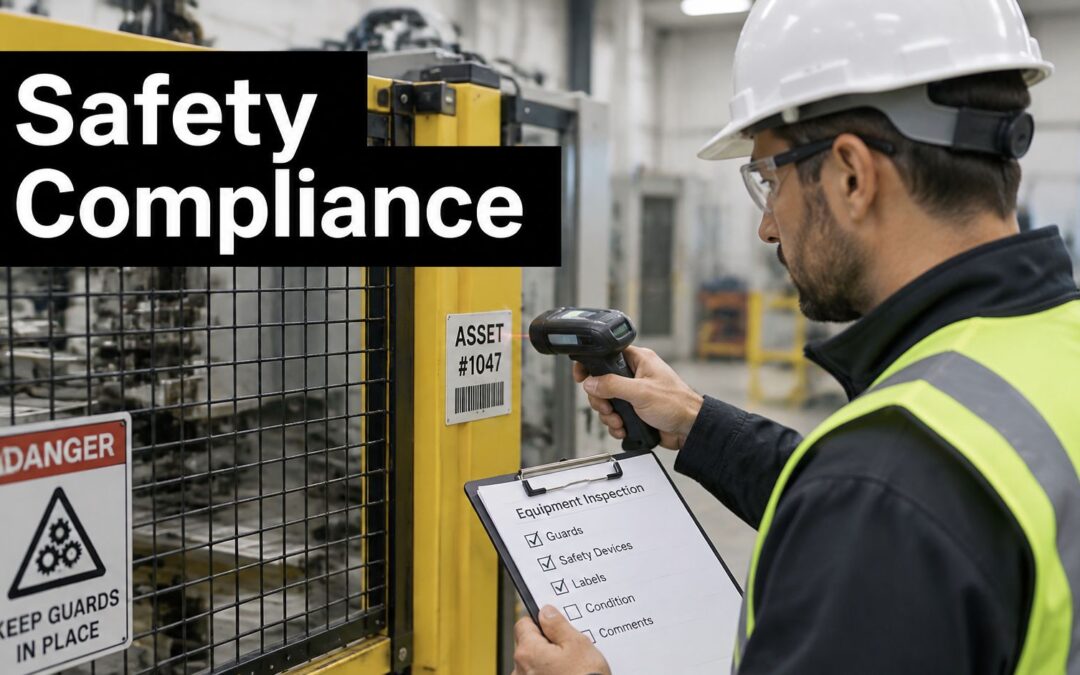
Australia recorded 146,700 serious workers' compensation claims involving at least one week of lost work in 2023–24, according to Safe Work Australia's 2025 report. That's a stronger reason to examine your safety controls than a tidy audit score. Effective safety compliance management means being able to show what protects workers, who maintains it and what evidence proves it works.
Safety Compliance Management in Plain Terms
A fire extinguisher hanging on a wall isn't the same as an extinguisher that's been serviced, remains accessible and is known to work when smoke appears. The bracket proves someone installed it. The service record and physical inspection establish something more useful.
Apply that distinction across an industrial workplace. A conveyor guard recorded as installed may have been removed for maintenance. A completed induction doesn't establish that a contractor understands the isolation points for the equipment they're about to open.
Safety compliance management is the ongoing work of keeping hazard controls effective. It applies to Australian businesses and undertakings organising work across employees, contractors, equipment and sites, not just organisations large enough to employ a dedicated WHS manager.
Follow the work through to evidence
The operating sequence is straightforward:
- Identify hazards: Establish what could hurt people during normal work, maintenance, cleaning and foreseeable disruptions.
- Assess the risk: Consider who could be harmed, how seriously and under what conditions.
- Apply controls: Change the equipment, environment or work arrangement to prevent exposure.
- Verify performance: Check that workers can and do use the controls.
- Record and review: Retain dated evidence and reassess when conditions change.
This isn't a one-off certificate, a binder on a shelf or a software purchase. Each may support the system, but none replaces decisions about actual work.
Keep local requirements clear
The Safe Work Australia explanation of model WHS laws confirms that model laws have no legal effect until implemented by the relevant jurisdiction. Check the Act, regulations and regulator requirements applying at each operating location while maintaining a consistent internal process.
The inspection-day test: Can the business show the right control, in the right place, working now, with a dated record?
A useful record connects the hazard to the control and the person who checked it. A signed form that doesn't identify what was inspected leaves the most important question unanswered.
Who Holds Which Duty in a Compliance System
The person conducting a business or undertaking, usually shortened to PCBU, holds the primary duty. Safe Work Australia's WHS principles overview explains that the PCBU must ensure health and safety so far as is reasonably practicable, and that duty holders sharing a safety matter must consult, cooperate and coordinate.
Reasonably practicable means considering the likelihood and seriousness of harm, what's known about the hazard, available controls and whether the cost of a control is grossly disproportionate to the risk. It isn't permission to choose the cheapest option without examining what could happen.
Who owns which compliance duty and the evidence they hold
| Role | Core Duty | Evidence They Should Hold |
|---|---|---|
| Person conducting a business or undertaking (PCBU) | Ensure health and safety so far as reasonably practicable | Risk register, control reviews and consultation records |
| Officers | Exercise due diligence over the PCBU's safety systems | Management reports on hazards, controls and incidents |
| Workers | Take reasonable care, follow procedures and report hazards | Training and competency records, incident reports |
| Workplace controllers | Control access, sites and shared work areas | Site induction and access records |
| Designers, manufacturers, importers and suppliers | Design out risks and supply safety information | Design risk assessments and supplier safety information |
| Contractors and host employers | Coordinate duties on shared sites | Coordination plan and contractor sign-off |
These are practical evidence expectations, not a claim that every record title is prescribed by legislation. Allocate custody clearly: workers may complete a competency assessment, while their employer maintains the controlled record.
Shared duties need shared arrangements
Say a manufacturer engages a maintenance contractor to repair a pump. The host controls the installation and production schedule; the contractor controls how its technicians undertake the repair. Neither should assume the other has checked every energy source.
The isolation procedure should identify both parties' responsibilities. The permit should name who verifies isolation, who authorises work and who approves return to service, with each business retaining an accessible record.
Use a safety compliance standards reference to organise applicable requirements, but assign implementation to operational roles rather than leaving every action with the WHS adviser.
Remote maintenance needs additional coordination around communications and emergency response. The steps for protecting lone workers from 3rd-i provide a useful prompt for developing those arrangements, alongside local WHS requirements.
Ask the team: For each control, who holds the evidence, and can they produce it within a day? Treat that retrieval period as an internal service standard, not a statutory deadline.
How to Run the Compliance Cycle Step by Step
Start with a task workers perform, such as clearing a conveyor blockage. Build the controls around access, stored energy, restart conditions and supervision rather than copying a generic machinery assessment.
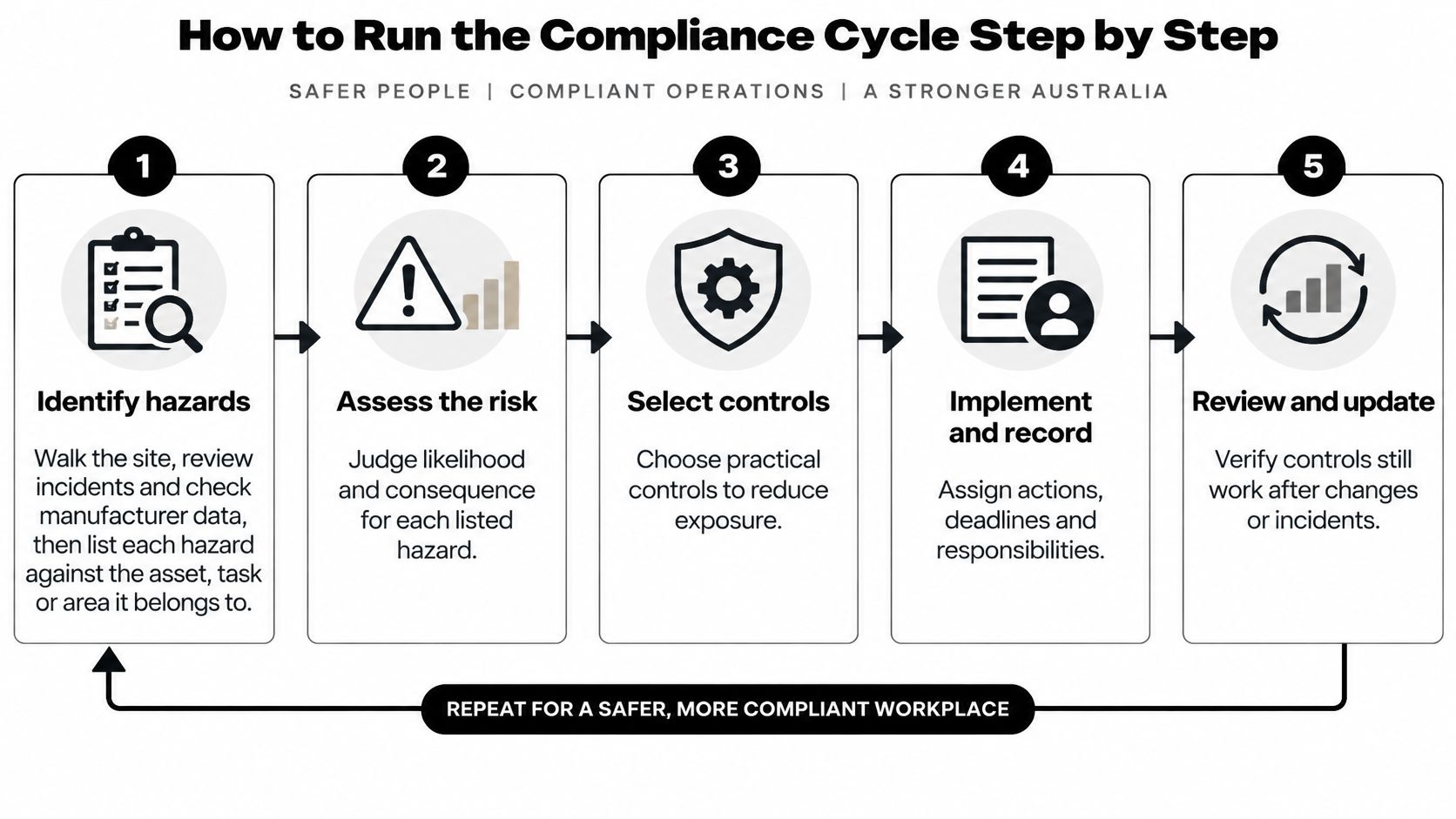
The process diagram groups the work into broad phases.
Turn each phase into an assigned action
The model WHS regulations establish a risk-management framework covering control selection, maintenance and review, supported by practical arrangements such as procedures, permits and safety signs.
Identify hazards at the task. Walk the site, review incidents and manufacturer information, and attach each hazard to an asset, task or area so it has a clear operational location. The common slip is recording normal operation but overlooking cleaning, breakdowns and maintenance.
Assess likelihood and consequence. Record who could be harmed and how existing controls affect the risk, so managers can prioritise effort. Don't let a low numerical rating conceal a credible fatal consequence.
Apply the hierarchy of controls. Eliminate first, then consider substitution, isolation and engineering before relying on administrative controls or personal protective equipment. A fitted conveyor guard provides protection that a stay-clear sign cannot, so don't select signage merely because it's easier to install.
Document how the control operates. Prepare procedures, permits, isolation steps and point-of-work instructions that match the equipment and task. Avoid copying equipment names or isolation references from another installation.
Verify in the field. Inspect the guard, interlock, barrier or identifier itself and ask the worker to demonstrate the relevant safe action. Checking a register without looking at the physical label only verifies that someone entered information.
Review when conditions change. Set triggers for new equipment, incidents, layout changes, new contractors and deteriorating indicators, because the original assumptions may no longer hold. Waiting for the scheduled policy review leaves changed work running under outdated controls.
Record for retrieval. Store findings, photographs and approvals against the asset and inspection date so another person can reconstruct the decision. Don't rely on an individual supervisor's inbox as the only record location.
Check the cycle against a real job
Use a safety compliance checklist as a field prompt, not as permission to tick items without examining them. The cycle is functioning when every registered hazard has a control, an owner and a verification date.
Use this video as a discussion aid, then test the relevant arrangements on your own site.
Where to Focus When Compliance Resources Are Limited
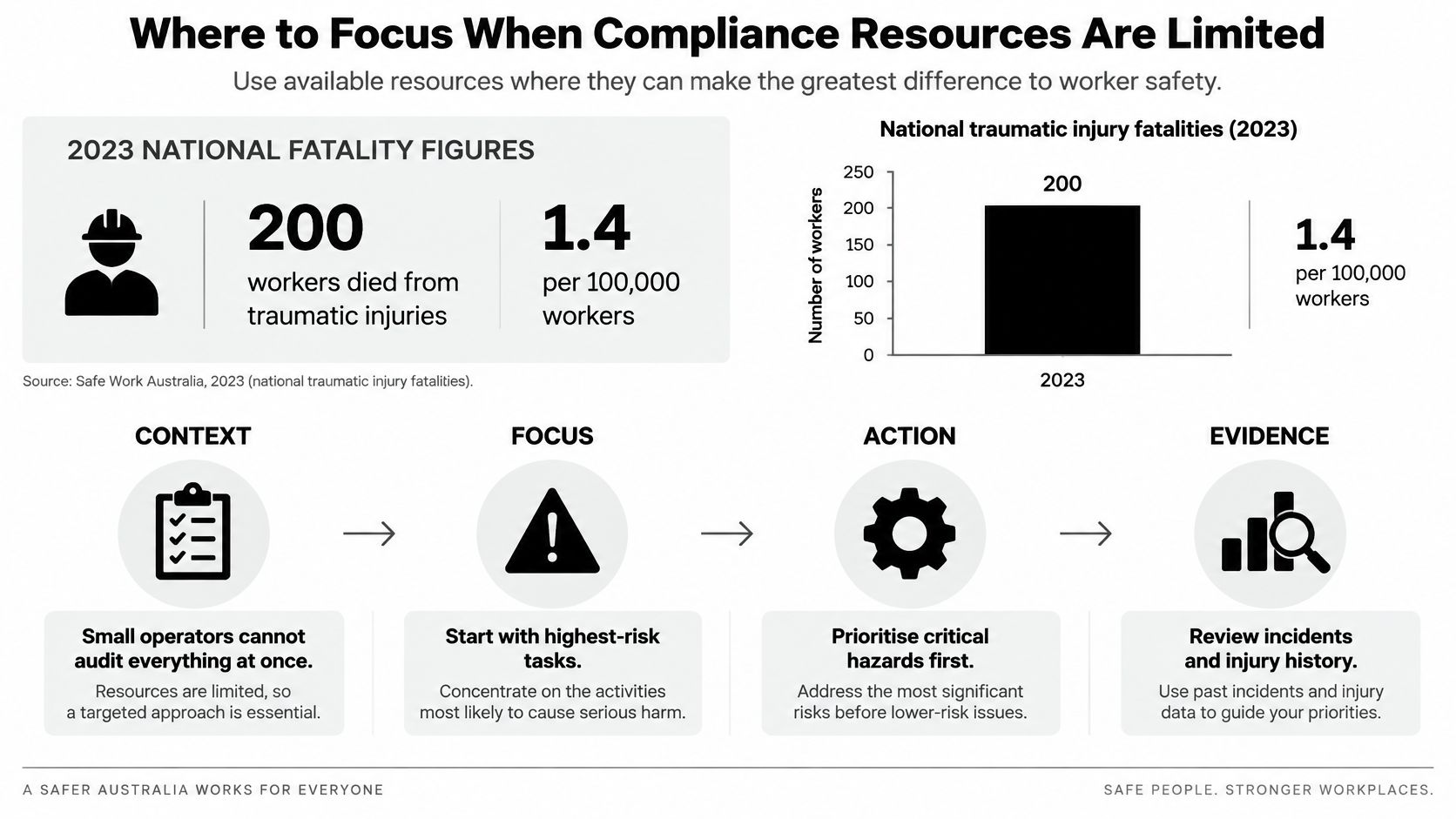
In 2023, Australia recorded 200 worker deaths from traumatic injuries, a rate of 1.4 per 100,000 workers. Safe Work Australia's national fatality figures record 84 deaths involving vehicles, 24 involving moving objects and 29 from falls from height.
Worker fatalities by cause, Australia 2023
| Cause | Deaths | Share of Total | Compliance Focus |
|---|---|---|---|
| Vehicle incidents | 84 | 42% | Traffic separation, vehicle isolation and marked routes |
| Falls from height | 29 | 15% | Fall prevention, edge protection and permits for work at height |
| Struck by moving objects | 24 | 12% | Guarding, exclusion zones and warning signs |
| All other causes | 63 | 31.5% | Risk assessment for each task and hazard |
The remaining category is calculated from the national total. Percentages are rounded, so the displayed shares may not sum precisely.
Use the figures to prioritise discussion by potential consequence, then check whether each control can be demonstrated and its evidence retrieved. A marked route, for example, matters only if it separates people and vehicles in practice.
Prioritise exposure, not paperwork volume
Safe Work Australia's figures also record deaths across industries and worker groups. Use those patterns as prompts to examine your own work, not as a reason to assume a different task or workforce is safe. Check reversing areas, loading interfaces, raised maintenance access and machinery intervention before spending scarce audit time polishing low-risk administrative records.
Safe Work Australia's WHS prosecutions release reports 317 prosecutions in 2024, with manufacturing accounting for 21% of cases and 97% resulting in a financial penalty. Traceable plant, isolation-point and emergency-equipment identification can support decisions at consequential work interfaces. The register should identify the asset and its control; inspection records should show that the control was checked in the field.
If internal capacity is stretched, Opus Safety's explanation of outsourced health and safety offers a service-model comparison. External support does not replace internal ownership or local legal competence.
Spend the first compliance effort on traffic separation, fall prevention and moving-machinery controls. Match the evidence you keep to the potential harm and make sure someone can retrieve it on inspection day.
The Indicators Regulators and Auditors Check
National safety targets set direction, but inspectors assess how a business controls its own risks. The Safe Work Australia Work Health and Safety Strategy 2023–2033 targets include reducing worker fatalities caused by traumatic injuries by at least 30% over the strategy period, bringing work-related injury or illness incidence below 3.5%, and achieving no new cases of accelerated silicosis by 2033. These are national goals, not compliance thresholds for an individual business.
On inspection day, managers need to retrieve a clear chain: the duty, the control, the person responsible, the check that confirms the control is working, and the record of any action taken. Inspection counts alone do not establish compliance. The evidence must show what inspectors or internal reviewers found, who addressed it, and whether the control remained effective.
Compliance indicators, what they show and evidence to keep
| Indicator | What It Shows | Evidence to Keep | Warning Sign |
|---|---|---|---|
| Corrective-action closure | Whether findings get fixed | Action log with closure dates and verification | Actions open past their due date |
| Inspection findings | Whether controls hold in the field | Inspection checklists and dated photos | The same finding repeated across inspections |
| Training completion | Whether workers have received relevant instruction | Training records tied to role and task, supported by competency checks | Untrained staff on high-risk tasks |
| Exposure controls | Whether workers are protected from contaminants | Monitoring results and control maintenance records | Readings close to applicable limits without a documented review |
| Incident and near-miss trend | Whether reporting and risk patterns are changing | Incident register with root cause notes | Near-misses rising while incidents stay flat, requiring investigation |
| Asset label condition | Whether hazard information is still readable | Dated field sample of label condition | Faded, damaged or relocated labels |
A closure entry needs an owner and verification. If maintenance records a barrier repair, the record should identify who checked the repair and confirm it restored the required separation. A completed form without a field check proves paperwork was completed, not that the hazard was controlled.
Training records need the same test. Attendance shows that instruction took place; a task demonstration provides evidence that a worker can perform a safe isolation. Match the check to the consequence of failure.
Read trends before judging performance
- Choose a manageable set: Start with three to five indicators tied to the highest-risk work.
- Record a baseline: Define the population, reporting period and what counts as completion.
- Review monthly: Assign an operational manager to explain deterioration and allocate corrective actions.
- Check source records: Sample the permits, observations and photographs behind the dashboard.
A rising near-miss count can reflect stronger reporting. If near-misses rise while incident numbers stay flat, check whether exposure, reporting practice or event classification has changed. The pattern warrants investigation, but does not prove under-reporting.
Ask what changed in staffing, workload and work practices before judging performance. A graph cannot explain its own trend, and pressure to improve a metric can discourage useful reporting.
Prohibition notices are one enforcement response where an inspector reasonably believes a serious health and safety risk exists. A damaged warning label alone does not automatically require work to stop. If workers cannot identify a hazardous service or safe isolation point, assess the resulting risk and act before the task proceeds.
Psychosocial Risks Beside Physical Controls
Stress, fatigue, violence and poor work organisation belong in operational risk management, not in a separate awareness folder. A manager needs evidence of how workloads, staffing, communications and emergency arrangements protect people during the work itself.
Consider a crane used during a demanding shutdown. Its asset record can identify the restricted zone, emergency information and any fatigue-related operating limit established through the site's assessment, while linked rostering and handover records show how supervisors applied that limit.
Connect the task to the control
List the psychosocial exposure beside the task. Include excessive demands, isolated work, aggressive interactions or unclear responsibilities where relevant. Consult the workers doing the job rather than guessing from a desk.
Separate procedural and physical controls. Record staffing arrangements, breaks and escalation procedures alongside restricted areas, communication equipment and emergency information. Name an owner for each rather than assigning everything to human resources.
Make point-of-work information visible. Where a worker needs an instruction at an asset or area, connect the procedure to a suitable sign, label or accessible instruction. Don't post confidential health or personnel information on equipment.
Retain implementation evidence. Link the applicable procedure to rosters, handovers, consultation outcomes and review records by task, asset or date. A written fatigue rule without evidence of workable scheduling doesn't establish that supervisors followed it.
Recognise what a sign cannot fix
A marker can direct a worker to an emergency contact or identify an operating restriction. It can't compensate for understaffing, unreasonable production demands or a supervisor who penalises workers for stopping.
Treat a missing physical marker as a gap when workers need that information at the point of work. Not every procedural control needs a sign, and adding signs indiscriminately makes important instructions harder to distinguish.
Control boundary: Use physical identification to support psychosocial controls, never as a substitute for changing harmful work arrangements.
Labels, Registers and a Quarterly Audit
A label only supports compliance when its identifier matches the asset register and the records a worker needs. On inspection day, an unfamiliar person should be able to trace the equipment to its current maintenance history and isolation procedure without relying on verbal directions.
For pipework containing hazardous chemicals, check the applicable jurisdictional requirements and identify what information workers need at or near the pipework. Specify labels or other identification suited to the operating environment, and include legibility in routine checks.

Build a record that resolves to the right asset
Give each critical asset record these fields:
- Asset ID: The exact identifier displayed on the equipment.
- Hazard classification: The relevant energy, substance or operational hazard.
- Location: A description precise enough to distinguish nearby equipment.
- Inspection status: The latest verified condition and outstanding defects.
- Responsible role: The position accountable for maintaining identification.
- Replacement trigger: Conditions requiring repair or replacement.
For example, a pump marked PMP-07-LV should have the same identifier in the register, drawing and isolation procedure. If paint obscures its plate, record a corrective action against the replacement trigger rather than leaving the next technician to infer the asset's identity.
Use a controlled naming convention. Avoid abbreviations that different trades could interpret differently. Shared-site identification arrangements also benefit from accessible information and coordinated responsibilities, principles addressed in the model regulations for construction WHS management plans.
Run a risk-weighted quarterly check
Use this as a proposed internal audit routine, not a prescribed inspection frequency:
- Select critical assets. Choose a manageable sample, such as high-voltage switchboards, isolation points and vehicle-route signs.
- Inspect identification condition. Log faded, damaged, contaminated or relocated labels, then record replacement and completion.
- Confirm ownership. Check that the responsible role still exists, is staffed and has authority to arrange repairs.
- Test change triggers. Check whether new equipment, incidents, layout changes or contractor changes required an update.
- Review selected indicators. Choose three relevant measures and assign a monthly operational review.
A safety compliance audit framework can help structure the check. Include a retrieval test: ask someone unfamiliar with an asset to locate its current isolation and maintenance records using the register.
Laser engraving creates a permanent identifying mark. Evright Industrial provides asset labels and safety signage, and can supply samples for approval before production. Each customer has a dedicated project manager working to the project schedule and budget. For customer-supplied items, a full sampling and testing program is carried out before full production.
Evright Industrial also marks medical items for Unique Device Identification (UDI) traceability. Its identifying markers support defence and essential services items. Visit Evright Industrial to discuss an asset label, then check the identifier, readability and suitability against a live register entry before approving production.
Recent Comments