
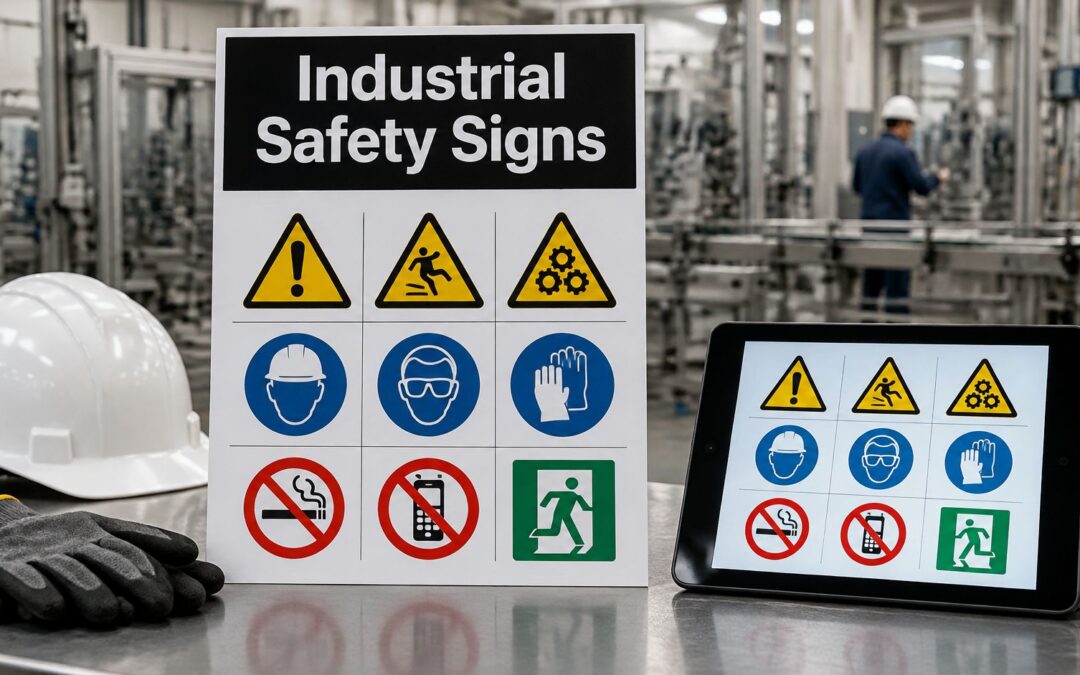
Manufacturing accounted for 13,800 serious workers' compensation claims in 2022–23, representing 10.0% of all serious claims, according to Safe Work Australia's key WHS statistics. That's the environment your signs sit in: noisy, fast-moving, full of contractors who've never walked the floor before. A printed sheet of symbols won't change those numbers on its own, but a sign that names the right hazard, sits where people approach it, and matches the current chemical register is a control you can point to during an audit.
Australia's framework treats signage that way. Safe Work Australia's asbestos guidance identifies AS 1319-1994, Safety Signs for the Occupational Environment, as the applicable standard for warning signs where asbestos is present, and recommends placing signs at all main entrances to affected work areas. Entrances, plural. The duty follows the risk, not the graphic.
So an industrial safety signs PDF has two jobs. It gives workers, contractors and inspectors one consistent reference for what each sign means, and it records the revision, location and owner that prove the sign still matches the hazard it was bought for.
What an Industrial Safety Signs PDF Should Cover
Say a contractor arrives to service a dosing pump beside a solvent store. Before they touch a valve, they need to know three things: what's in the tanks, what they must wear, and who's responsible for isolating the line. A useful PDF answers all three in one place, covering prohibition, warning, mandatory, emergency and fire-equipment signs across the site.
The legal anchor is specific. Under Australia's model Work Health and Safety Regulations, a workplace must display a safety sign where a sign is required to control an identified risk associated with using, handling, generating or storing hazardous chemicals, and the sign must either warn people about a particular chemical hazard or state a specific person's responsibility in relation to those chemicals. The same regulation requires the sign to be positioned so workers and visitors can identify the relevant danger or responsibility at the workplace.
A sign's purpose is legally defined. It's a risk-control measure tied to a hazardous-chemical activity, not decoration and not general information.
That's why durability and legibility matter around chemical storage and handling areas, and why a template pack needs more than artwork. Read the category table first to fix the shape and colour, then check the record fields before you print anything. A PDF is only as reliable as the revision, location and owner recorded in it.
Industrial Safety Sign Categories at a Glance
Start with the lookup table. Six categories cover almost everything an industrial site needs, and each one is recognisable from shape and colour before a single word is read.
| Category | Shape and colour | Purpose | Typical example |
|---|---|---|---|
| Prohibition | Red circle with red slash on white | Stops a prohibited activity | No entry or no smoking |
| Warning | Yellow triangle with black border | Flags a hazard | Electrical hazard or slip risk |
| Mandatory | Blue circle with white symbol | Requires personal protective equipment | Hard hat or eye protection must be worn |
| Hazardous chemical | Red and white diamond | Identifies a chemical hazard | Flammable or corrosive substance store |
| Emergency and safe condition | Green square or rectangle | Shows exits, first aid and safety information | Emergency exit or eyewash station |
| Fire equipment | Red square or rectangle with white symbol | Locates fire-fighting equipment | Fire extinguisher or hose reel |
Prohibition, warning and mandatory rows
Prohibition signs stop an action. The red circle and slash reads as "don't", which is why it suits gate access, ignition sources and unauthorised entry to a switchroom. Keep the prohibited activity pictorial so the message survives a language barrier.
Warning signs flag a hazard without banning anything. The yellow triangle with black border tells people to change their behaviour, not to stop work: slow down, watch the edge, expect live equipment. Pair the symbol with two or three words, not a paragraph.
Mandatory signs invert the logic. A blue circle with a white symbol states what must be worn or done, so it belongs at the threshold where the requirement begins, not halfway into the area. Our safety signage meaning guide walks through how these conventions read on the floor.
Chemical, emergency and fire rows
Hazardous chemical signs use the red and white diamond and identify a chemical hazard class in stores and process areas. They work alongside labels and placards, not instead of them.
Emergency and safe condition signs are green squares or rectangles pointing to exits, first aid and eyewash stations. Green means "go here", which is the opposite instruction to red, so never mix the two on one panel.
Fire equipment signs are red squares or rectangles with a white symbol, locating extinguishers and hose reels. Red here means location, not prohibition, and the shape is what separates the two meanings.
The table reflects conventions summarised by the South Australian regulator and must be checked against the current controlled edition of AS 1319 before production.
Practical test: stand at the normal viewing distance and ask a worker to name the category from shape and colour alone. If they can, the sign is doing its job.
Standards That Shape Every Sign Design
AS 1319:1994 is the core design reference for Australian industrial sign templates. The South Australian regulator's safety signs guidance describes the standard as covering occupational signs used to regulate safety-related behaviour, warn about hazards, and provide emergency or fire-protection information, and notes that it excludes internal building exit signs covered by AS 2293.1.
Scope, and where the standard stops
That exclusion catches people out. A green running-figure panel wired into an emergency lighting system is a different product with a different standard behind it, so don't specify it from the same PDF entry as a laser-marked plant-room warning. Keep the two families in separate sections of your document, each naming the standard it was built to.
The same regulator guidance summarises the principal conventions as red circle-and-slash for prohibited activities, yellow triangles for hazards, blue circles for mandatory personal protective equipment, red-and-white diamonds for hazardous chemicals, and green squares for emergency safety information. Those conventions are the grammar. Your wording is the sentence.
Four specification steps for every PDF entry
- State the function. Prohibition, warning, mandatory, chemical, emergency or fire. Write it in the entry header so the reviewer knows which convention applies.
- Apply the standard colour and shape. Match the category exactly, including border and symbol colour, rather than a house palette.
- Use a symbol where one exists. A recognised pictogram carries the message faster than text and survives poor light and distance.
- Cut the wording to the viewing distance. For a corridor sign read from a few metres away, a few words is the whole budget. Test it by printing at final size and walking back to the approach point.
A worked example, and the limit of a generic warning
Picture a chemical store door. A compliant entry combines the diamond for the hazard class, the hazard name in short form, and a responsibility line naming who controls access or issues the permit. Three elements, one panel, no ambiguity about who does what.
A generic warning triangle can't do that work. Chemical warnings must be coordinated with the Globally Harmonised System, and a "Danger" header is not a substitute for chemical labelling. Before production, verify the current controlled edition of AS 1319 and record the edition used in the PDF header, so the next reviewer knows exactly what the artwork was built against.
Hazard Data Behind Sign Priorities
National fatality data tells you where sign effort earns its keep. The infographic below sets the baseline.
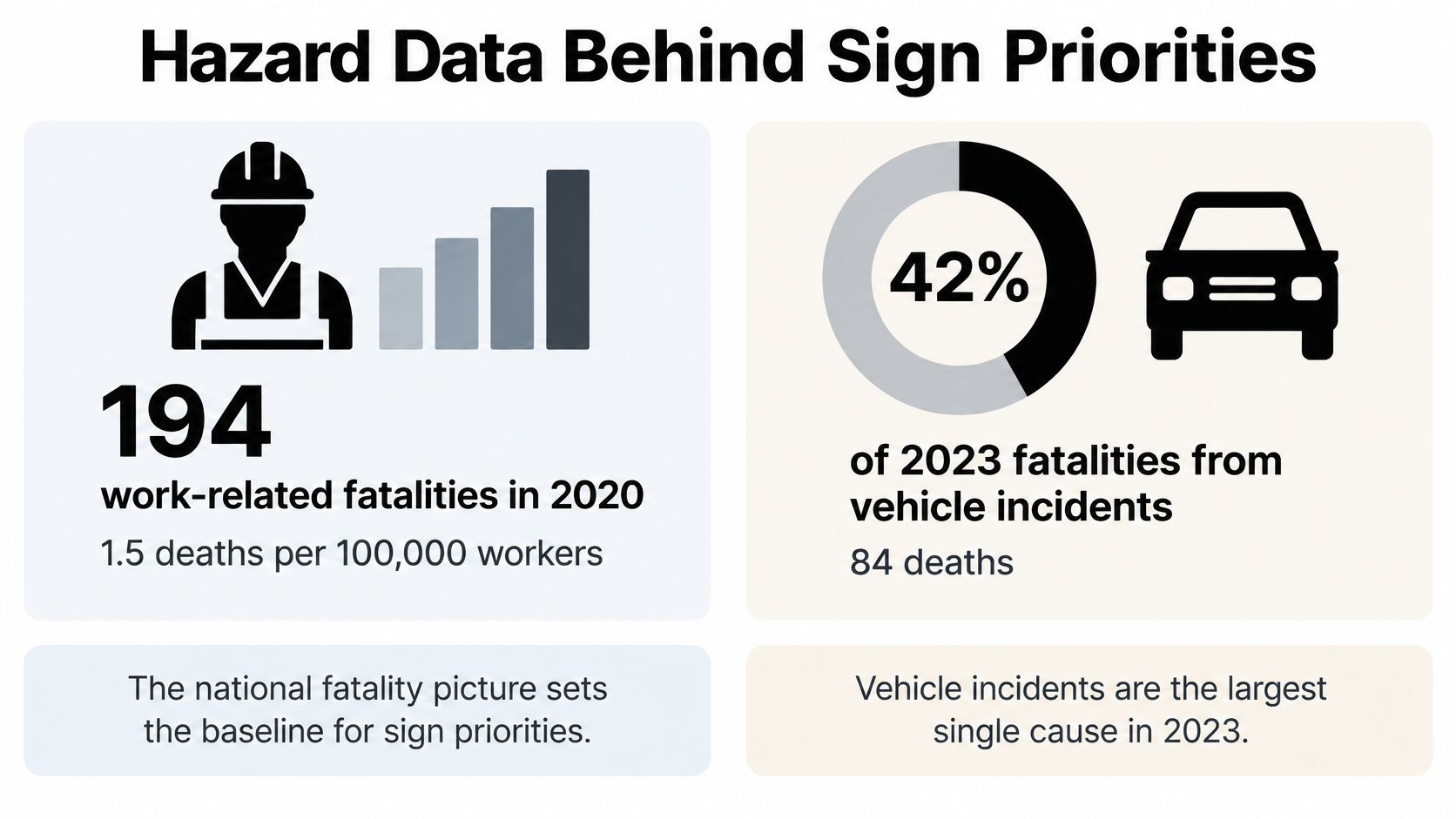
Safe Work Australia's Key Work Health and Safety Statistics Australia 2021 recorded 194 fatalities in 2020, equal to 1.5 deaths per 100,000 workers. Separately, Safe Work Australia's 2024 statistics release reported that in 2023 vehicle incidents caused 42% of Australian workplace fatalities, or 84 deaths. Keep those years apart when you brief a sign plan: the 2020 breakdown gives you the cause mix, the 2023 figure gives you the current headline.
| 2020 cause | Deaths and share | Sign decision it supports |
|---|---|---|
| Vehicle collisions | 80 deaths, 41% | Traffic separation, pedestrian crossing and give-way signs |
| Hit by moving objects | 25 deaths, 13% | Machinery exclusion zones and moving-plant warnings |
| Falls from height | 22 deaths, 11% | Edge, opening and fall-hazard warnings |
| Hit by falling objects | 17 deaths, 9% | Overhead-load warnings and mandatory hard hat signs |
Turning each cause into a sign decision
Vehicle collisions dominated the 2020 breakdown, so pedestrian routes, crossing points and forklift give-way lines are the first place a manufacturing site should spend signage effort. Moving-object deaths point to exclusion zones around machinery and plant travel paths, marked where a person would otherwise step in.
Falls from height need warnings at edges, hatches and open penetrations, and falling-object deaths need overhead-load warnings plus mandatory head protection at the boundary of the lift zone. Gas-fired plant deserves the same treatment: if your site runs natural gas equipment, the natural gas safety data sheet from Blue Gas Express is a useful reference for the hazard wording and emergency actions your gas-area signs should reflect.
Where signage isn't the control
A sign informs. It doesn't stop a forklift or catch a falling load. Where the outcome is fatal and exposure is frequent, a barrier, interlock or engineered separation does the work and the sign labels the control. Treat signage as the visible layer of a hierarchy, never the whole of it.
Rank your site hazards by how many workers are exposed and how severe the outcome would be, then place signs for the top three first. Everything else can follow in the next production run.
Placement and Visibility Rules for Chemical Signs
A sign that cannot be seen at the point of exposure has failed as a control. Safe Work Australia's hazardous chemicals signs and placards guidance states that hazardous-chemical signs must be placed next to the hazard and clearly visible to people approaching it, and that a business storing, handling or using hazardous chemicals must put up signs to inform workers and visitors about the dangers involved. That makes placement part of the documented chemical-control system, linked to the register, the SDS set and the current site layout.
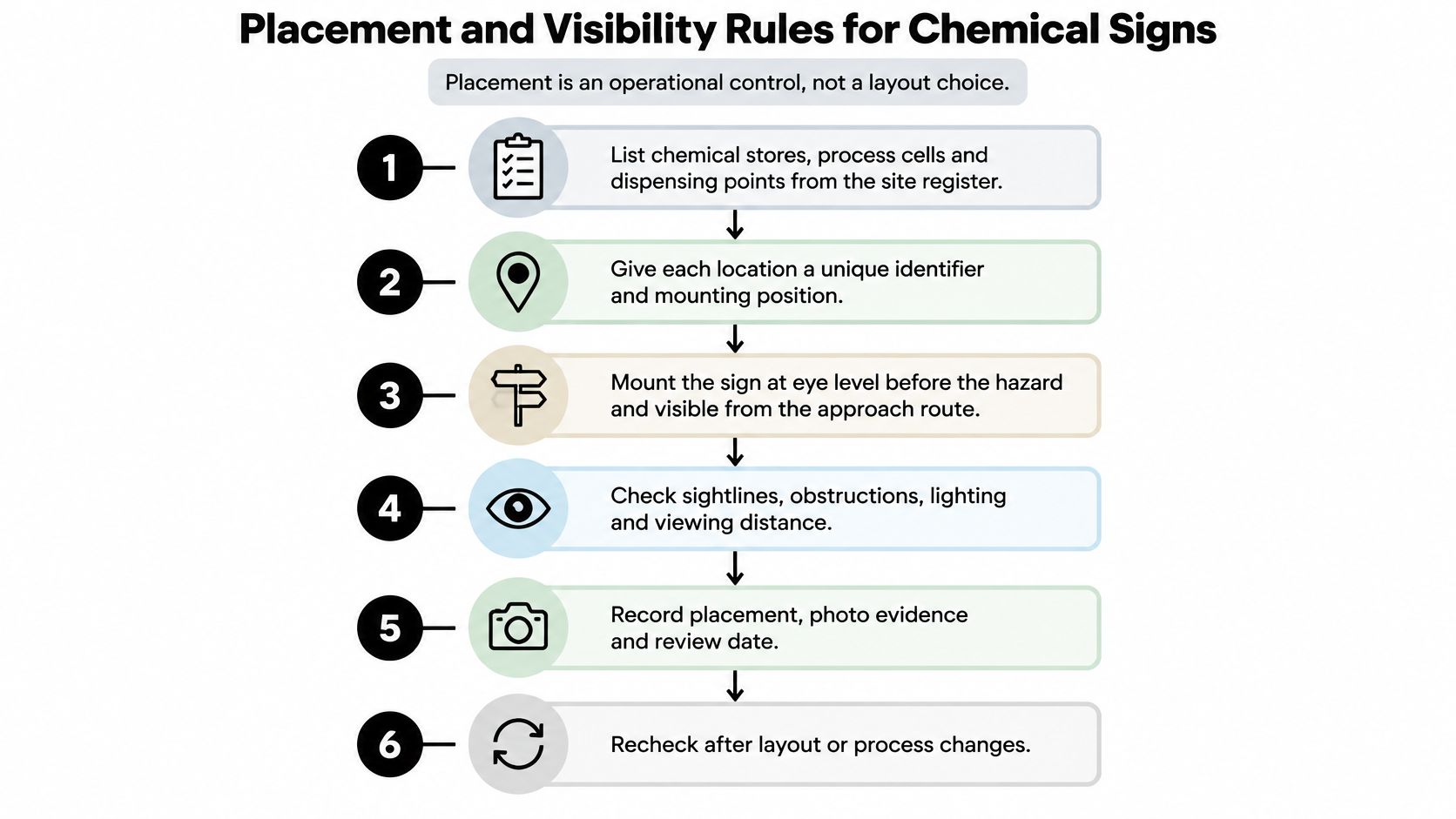
A six-step placement routine
- List every location from the chemical register. Include stores, process cells, dispensing points and the small decanting bench that is easy to leave out.
- Map the approach direction. Walk the route a worker or visitor takes, because that sightline determines where the message must be picked up.
- Mount next to the hazard at eye level, before the approach point. The warning has to arrive before the exposure, not after someone has entered the area.
- Check sightlines against stock and equipment. Pallets grow, trolleys park and doors swing, so a clear sign today can become an obscured sign tomorrow.
- Confirm readability from the normal approach path. Stand where people stand and read the sign at final size, with the wording and pictograms used on the released artwork.
- Record the location identifier and mounting position in the PDF. Without that link, the next inspection cannot tell a missing sign from a moved one.
The quantity trigger sits in the register
Placarding has a separate trigger from room or container labelling. Additional placards become mandatory when quantities exceed the threshold amounts listed in Schedule 11 of the model WHS Regulations, so the chemical register and the sign plan need to be updated together. A purchasing decision that doubles a solvent holding can create a placarding duty that maintenance or purchasing does not recognise from the old sign map.
Fuel storage is a common blind spot on regional and mixed-use sites. Cylinder enclosures need warnings that address storage conditions, ignition sources and access, with the wording matched to the hazards recorded for that location. For general propane equipment safety context, readers may also consult keeping farm propane equipment safe, while the Australian sign decision still rests on the site's chemical records and approach paths.
A correct diamond sign fixed behind a cabinet door that stays closed is a compliant artwork and a failed control.
At each routine inspection, check every chemical sign for obstruction, fading and damage. Re-walk the approach path after any layout or process change, then update the PDF record so the sign, the register and the current duty remain aligned.
Emergency and Wayfinding Signs for Exits and First Aid
Emergency signs do two jobs at once: they name a destination and show the direction to reach it. Australian workplace guidance in the model code of practice for managing the work environment and facilities recommends that exits be clearly marked and that directional signs show the route to exit doors, and says first-aid signs should be well recognised and standardised so workers can readily locate first-aid equipment and facilities, with AS 1319 identified as the relevant source for sign design and use.
Walk a manufacturing hall and the logic becomes concrete:
- At each junction: a green exit sign with a directional arrow, so nobody has to guess which aisle leads out.
- At the intersection nearest the first-aid room: a first-aid sign that turns people toward the facility rather than past it.
- At each hose reel and extinguisher: a fire-equipment sign visible above the height of stored stock.
Position these along access routes, not just at the destination, and maintain them so they stay visible during normal operations and during an emergency when lighting is reduced. Our emergency exit signage requirements article covers the marking detail for exit routes.
Keep the industrial emergency sign separate from the internal building exit sign covered by AS 2293.1. They look similar and serve different systems, so specify them on different lines of the schedule.
Finish with a walk test. Start at the furthest work point in the hall and follow the route out, confirming that every junction shows both the destination and the direction. If you hesitate anywhere, add a sign there.
Choosing Durable Materials and Laser Marking for Harsh Sites
The environment decides the material, not the artwork. A sign that survives an office corridor for a decade can fail in eighteen months beside a washdown bay, so specify exposure before you specify substrate.
| Material | Best environment | Marking approach | Main trade-off |
|---|---|---|---|
| Stainless steel | Wet, corrosive or outdoor plant areas | Laser marking gives a permanent contrast mark | Higher upfront cost |
| Anodised aluminium | Outdoor and general industrial areas | Laser removes anodising to reveal contrast | Only works on anodised surfaces |
| Engraving-grade polycarbonate or plastic | Indoor, impact-prone areas | Laser engraving with contrast fill | Scratches under heavy abrasion |
| Vinyl or adhesive film | Temporary or low-cost labels | Printed or cut and applied to surface | Adhesion and wear limit outdoor life |
Why laser marking suits high-wear locations
Trotec Laser machines are one common option for this kind of work. The beam alters or removes the surface layer, so the mark doesn't rely on ink that can fade, peel or wash off. On stainless steel you get a permanent contrast mark; on anodised aluminium the laser removes the anodised layer to reveal the metal beneath. Confirm the process with the supplier for each material, because the same settings won't suit both.
The clip below shows the marking process in practice.
Record material, finish and exposure together
A sign specification should name the substrate, the finish and the expected exposure in the same entry. "Aluminium, anodised, outdoor, washdown chemicals present" tells the production team more than "metal sign". Where caustic cleaning agents are involved, our chemical-resistant labels guide explains which constructions hold up.
Fixings, sun exposure and cleaning chemicals change the outcome as much as the base material does. Stainless fixings on a stainless panel avoid galvanic staining; a shaded north-facing wall and an unshaded western one age the same film differently. Polycarbonate takes knocks better than acrylic in impact-prone indoor areas, which is why it suits machine guards and trolley routes.
Match the material to the worst week the sign will face, not the average one.
Cross-Checking Signs Against Chemical Records and Reviews
A sign PDF that carries only pictograms is artwork without a context. The context sits in three records: the chemical inventory, the safety data sheet for each substance, and the risk assessment that justifies the control. A sign only counts as a control while all three agree with it.
Run the cross-check in one direction, then the other.
- Sign to register: every chemical sign on the wall matches a current register entry, with the same substance name and hazard class.
- Register to SDS: every register entry has a current safety data sheet, not one downloaded when the store was built.
- SDS to sign: each sign links back to that sheet by QR code or document reference, so a worker reaches the detail in seconds.
A failed check usually surfaces in the middle step. A reformulated product arrives with a new SDS, the register entry is updated, and the wall sign still shows the old hazard class. The register is right, the sheet is right, and the sign is wrong.
Review triggers, and one date to diarise
Four events should force a review: a changed substance, a changed exposure limit, a new process, or a moved store. Safe Work Australia states on its model WHS regulations page that changes relating to workplace exposure limits commence on 1 December 2026, which gives sites a fixed deadline: schedule the signage and exposure-control review before that date, not after it.
Printable sign collections leave this gap open. They treat a sign as a static object, while the legal duty stays tied to controlling the identified risk, and the risk changes when the chemistry does.
Pictograms recognise, instructions direct
A diamond speeds recognition. It does not tell a contractor which responsibility applies, what emergency action to take, or who holds the access key. Site-specific text carries that detail, and it is the part that goes stale first.
Set one rule and enforce it: the PDF's revision date changes whenever any linked record changes. If an SDS is reissued in March and the sign still shows last year's date, the document is telling inspectors something untrue.
Sign PDF Fields and Pre-Release Checklist
Every sign entry needs a record, not just a picture. The fields below turn the PDF into something a site manager can maintain and an inspector can follow.
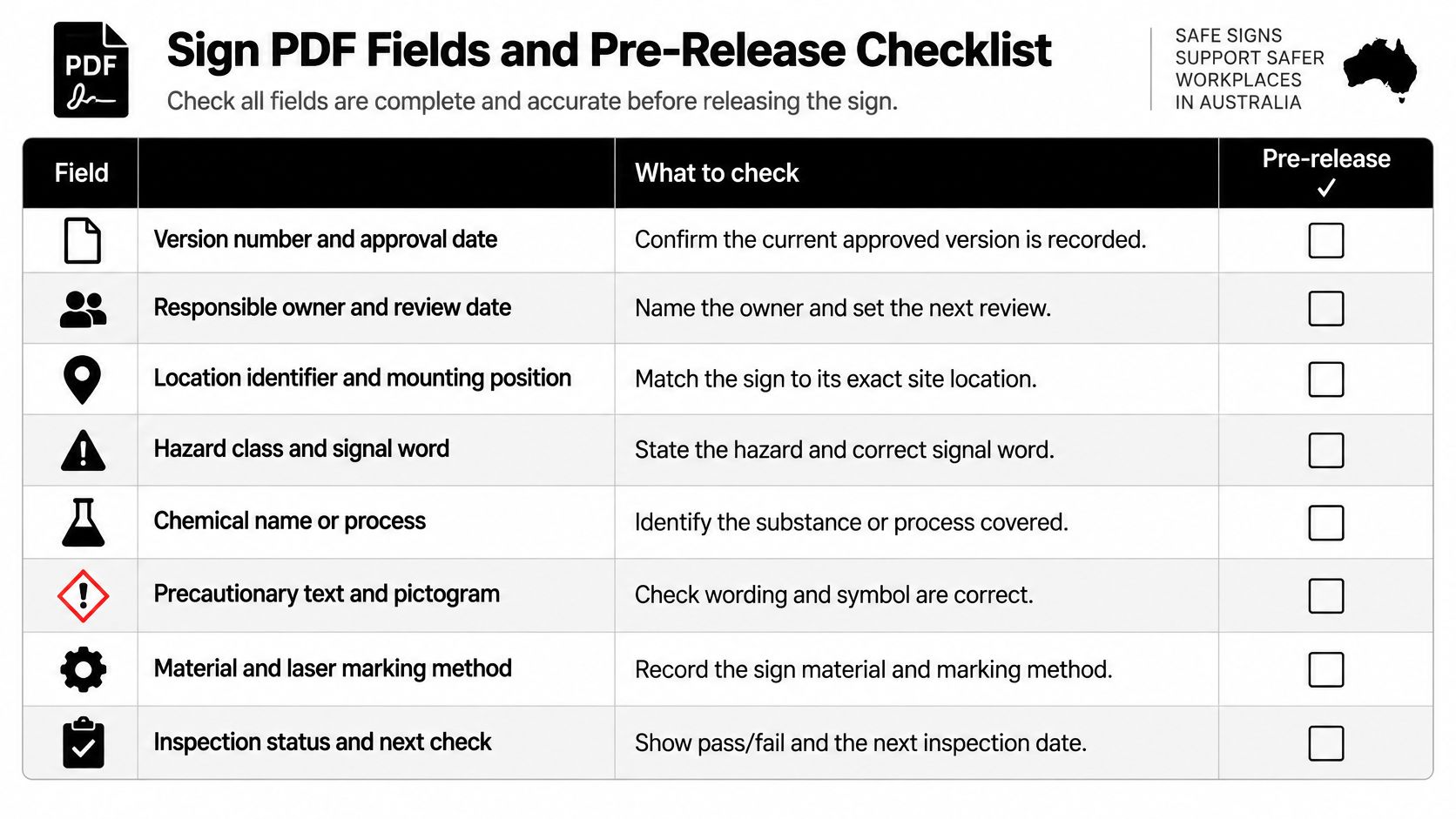
| Field | What it records | Check before release |
|---|---|---|
| Version number and approval date | Current revision of the sign | Matches the register and superseded copies are withdrawn |
| Responsible owner and review date | Who maintains the sign and when it is reviewed | Owner is named and the next review date is set |
| Location identifier and mounting position | Where and at what height the sign sits | Visible from the normal approach path |
| Hazard assessment reference | The risk control the sign supports | Linked to the matching risk register entry |
| SDS or document reference (QR code) | Link to the chemical safety data sheet | Scans to the current SDS |
| Standard and colour convention | AS 1319 shape and colour used | Matches the category table |
Why each field earns its place
The model WHS Regulations require a hazardous-chemical sign to sit next to the hazard and be clearly visible to a person approaching it, which is exactly what the location and mounting fields let you verify later. Practical sign-control records should carry revision date, location identifier, hazard assessment reference, mounting height or position, and periodic checks for obstruction, fading, damage and changed plant conditions.
Fields also need rules, not just headings. If you're deciding what counts as a valid entry (date formats, mandatory owner, identifier patterns), Matil's explanation of data validation rules is a useful primer for writing checks that catch bad records before release.
The pre-release run
- Category check. Confirm the sign matches its category in the table at the start of this guide, shape and colour included.
- Legibility check. Read it at the intended viewing distance, printed at final size.
- Position check. Confirm the recorded position is visible from the normal approach path.
- Version check. Withdraw superseded copies and confirm the version number matches the register.
Run this once for each sign group before printing, then again at every scheduled review, and record the reviewer's date and initials in the PDF header.
Get Your Sign Pack Quoted Before the Next Audit
A sign pack should be quoted as a controlled batch, tied to the chemical register, SDS links and current document revisions. Turn the analysis into a production list. Take the categories your site needs, mark which entries are chemical, emergency or fire signs, and note the environment beside each one: washdown, outdoor UV, impact-prone or indoor corridor. Send that list with the material exposure attached, and the quote can reflect the site rather than a generic catalogue.
Evright Industrial produces asset labels, safety signage, steel plaques, panels, switch plates, electrical switchboards, stencils, branding and laser cut architectural designs, so a sign schedule and its matching asset tags can be handled together. Laser marking uses a focused beam to alter or remove the surface layer and leave a permanent, contrasting mark. That makes it suitable for signs exposed to wear, washdowns or sunlight. Laser marking is part of that process in the workshop.
The full service range sits on evright.com, where an order moves from a category list to a materials sample, then to approval for the full run. The sampling service lets customers test different materials and marking finishes before committing, and customers can be invited onsite to see the production facility. Production can be scaled up or down for large and small runs, from facilities in Adelaide and South East Queensland.
Ask whether a materials sample is available for your environment before quoting. Contact details are on the company website, or reach the team on 08 8231 2746 or sales@evright.com. Three next steps: build the category list, test one sample in the harshest location, and send one enquiry.
We mark durable safety signage, asset labels and steel plaques for manufacturing, electrical, essential services, health services, mining, construction and machines sites. Send us your sign category list with the environment noted against each entry and we'll advise on materials, supply a sample to test on site, and quote the full run. Visit Evright Industrial to start the conversation before your next audit.
Recent Comments