

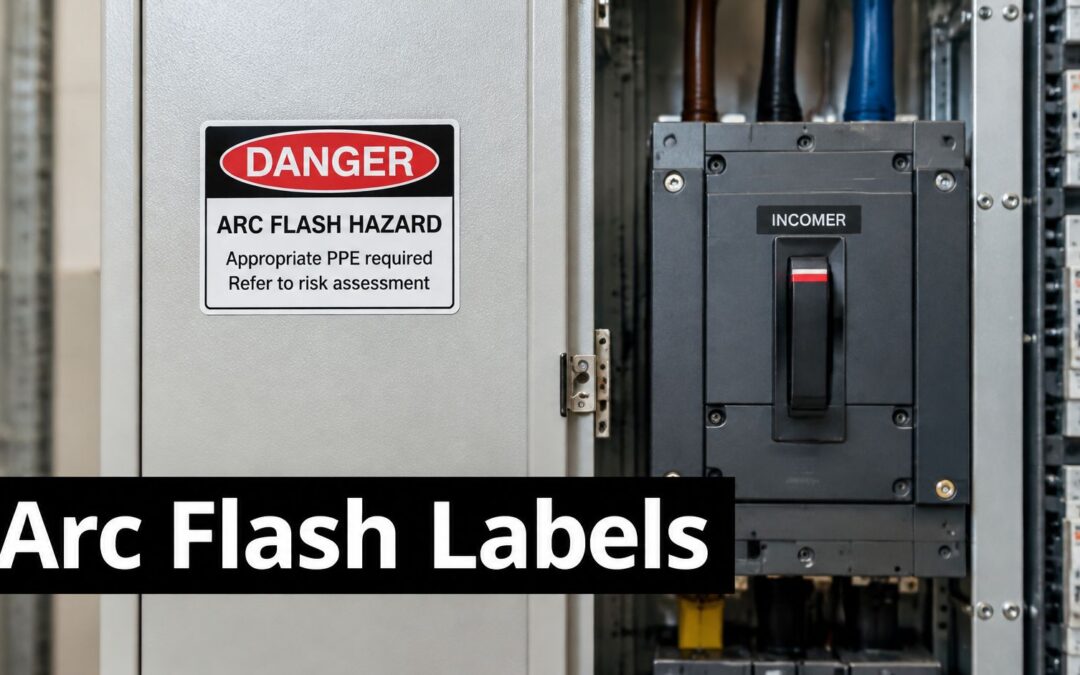
Australian practice puts one durable, equipment-specific arc-flash label on the exterior front of each switchboard, preferably near the incomer, so it can be read before any cover is opened. The worker should encounter the warning while identifying the equipment, not discover it after gaining access.
You might have a finished arc-flash study, a bundle of replacement labels and a maintenance shutdown approaching. The practical question is where each label belongs, especially when the board has several compartments, an outdoor enclosure or a mobile-generator connection.
Arc flash label placement is part of the safe system of work. The position must connect the assessment to the exact equipment and task, without obscuring isolation controls. Equally important, a spotless, firmly attached label can become unsafe to rely on when the installation no longer matches the study that produced it.
Where to Place the Label by Asset and Access Category
A label belongs where a worker can connect it to the equipment and operating condition it describes. The right location depends on how the asset is accessed, whether its configuration can change, and what the owner's specification requires. A durable label can still mislead if transformers, protection settings, generators, solar, batteries or work methods change the study behind it.
Arc flash label placement by equipment
| Equipment or case | Fix the label | Quantity | Also required |
|---|---|---|---|
| Switchboard or enclosure with internal access | Exterior front or door, preferably near the incomer | One per switchboard | Worst-case incident energy and PPE for relevant locations |
| Mobile-generator connection | Generator connection point and generator circuit-breaker panel | A separate label at each point | Recalculated hazard for generator operation |
| Outdoor electrical enclosure | Central, eye-level position, using UV-resistant material | One prominent label | Benchmark size 237 mm by 182 mm |
| Category 3 or higher outside a dedicated switchroom | Equipment label remains on the enclosure | One equipment label plus a boundary mark | Cordon, fence or painted floor zone where practical |
The Sydney Water technical specification for arc flash specifies one warning label per switchboard, preferably near the incomer, with additional labels at a mobile-generator connection and its associated circuit-breaker panel. For outdoor equipment, Western Australia's Water Corporation design standard gives a 237 mm by 182 mm benchmark and calls for UV-resistant material and prominent, central, eye-level positioning.
Use the table as a starting point, then check the asset against the owner's specification. A board-wide warning should not suggest that every compartment has the same incident energy or PPE requirement. Where hazards differ by location, the information needs to identify the relevant locations clearly.
Sort the assets by access
Group equipment by how workers encounter it, not by the label material ordered. That makes it easier to check whether each warning is associated with the correct asset and configuration.
- Normal enclosure access: Identify the front or door a worker approaches to identify the equipment. Keep the warning visible while the enclosure is closed.
- Changed-configuration access: Record generator connections and their associated breaker panels separately. Each warning must correspond to the operating configuration behind its values.
- Outdoor and shared-space access: Check sunlight exposure, visibility and the space people use around the equipment. The enclosure label identifies the asset; an approach-boundary mark communicates a different limit.
- Obstructed access: Check for warnings hidden in manuals, behind normally closed doors or beneath temporary notices. Keep labels clear of isolation handles, so the warning does not interfere with controls.
For a workshop with an outdoor distribution board supplying a proposed vehicle-charging area, charger selection does not establish the supplying board's arc-flash hazard. A team may compare 22 kW wallboxes, but the board assessment and labelling review remain part of electrical design and commissioning. The relevant study must reflect the installation and configuration being assessed.
Apply the identification test
Stand where a worker would first identify the installation. Can they connect the warning to that exact board, read the relevant information and distinguish it from neighbouring equipment? If several enclosures look alike, the label's position should make the association clear without relying on a worker opening a door.
Check the usual approach with nearby doors, guards and access arrangements in their operating positions. A label hidden by an obstruction, or visible only after moving one, cannot support identification and planning. Nor should a convenient patch of enclosure surface decide placement if it obscures an isolation control.
Placement test: If a worker can't connect the warning to the exact installation during identification and planning, the placement is wrong even if a label exists somewhere on site.
The baseline is durable, equipment-specific and positioned for clear identification. Review it again when the installation or work conditions change, because physical legibility alone cannot keep outdated study information safe to rely on.
Why the Label Must Be Read Before Access
A maintenance crew arrives to work at a closed switchboard. They can see its nameplate and operating handles, but not the internal busbars. The arc-flash warning needs to be readable at this point, while the crew is identifying the equipment and planning the task. Opening the cover first reverses that sequence.
In its November 2018 alert, WorkSafe Queensland reported 32 arc-flash incidents in Queensland since 2013, with 20 causing injuries requiring hospitalisation and seven notices issued in connection with arc-flash events. The regulator also reported approximately 48 accepted workers' compensation claims each year involving contact with electricity and an electrical burn. Roughly one-quarter involved serious injury requiring at least five days away from work.
Reports from Western Australian mining operations and NSW critical-burn units also describe workers suffering serious arc-flash injuries. These reports involve different groups and periods, so they do not represent a single national incident rate. They do, however, show why crews need to recognise the hazard before committing to an access task.
What the injury figures establish
A label does not prevent an incident by itself. It makes equipment-specific hazard information available before work begins, so the crew can check whether the warning applies to the equipment and conditions at hand.
Before proceeding, workers need to establish:
- Equipment identity: Does the installation match the equipment named in the work instructions?
- Assessment conditions: Does the operating configuration match the one used for the study?
- Exposure controls: Which incident energy, boundary and PPE requirements apply to the planned activity?
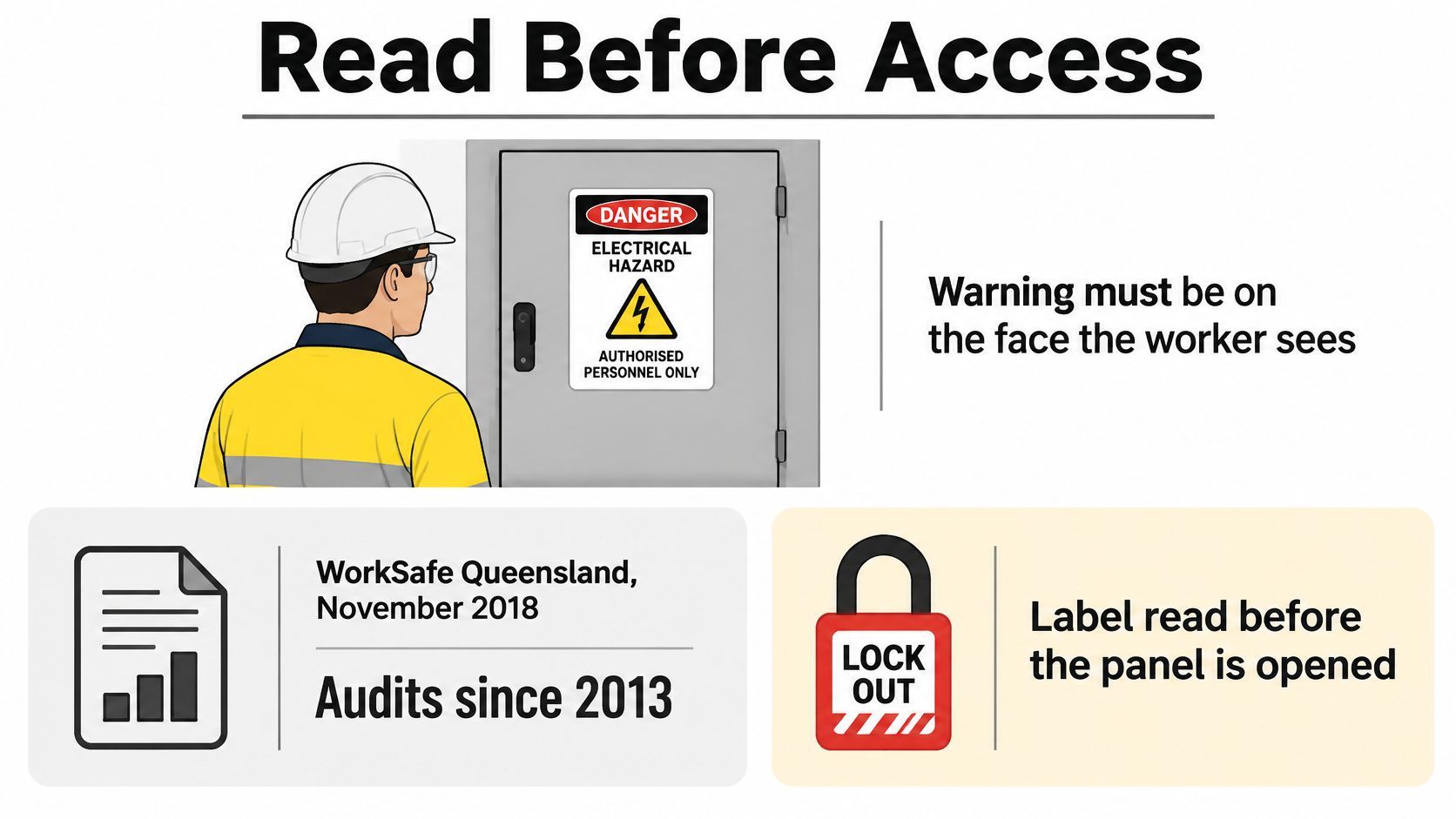
Read before committing to the task
Suppose a maintenance crew receives instructions based on normal mains operation, but the site is running on a generator. The label may be physically intact and easy to read, yet its displayed PPE information may no longer describe the conditions in front of the crew.
The same problem can arise after transformers, protection settings, solar or battery systems, or work methods change. These changes can alter the study that produced the label. Read the warning before access, then confirm that the assessment still matches the installation's current configuration and the planned task. A label communicates study results; it does not replace isolation or safe work procedures.
For context on electrical safety standards in Australia, consult the relevant requirements alongside the equipment's assessment.
Height Signal Word and Boundary Marks
A label can be mounted securely and still fail its purpose if its signal word or approach boundary is unclear. SA Water's engineering standard specifies a mounting height of at least 1,500 mm from floor level, uses Warning for ratings not exceeding Category 1, and uses Danger for Category 2 and above. The same SA Water engineering standard requires labels to remain visible, securely attached and legible.
These are SA Water owner-specific requirements, not a universal Australian mounting-height rule. Check whether the specification applies to the asset before treating its height and signal-word categories as acceptance criteria.
Signal word and boundary mark by category
| Rating | Label signal word | Boundary mark |
|---|---|---|
| Not exceeding Category 1 | Warning | Equipment label only, unless the study sets a boundary |
| Category 2 | Danger | Equipment label; apply any study boundary |
| Category 3 or higher inside a dedicated switchroom | Danger | Equipment label; room already limits access, but study controls still apply |
| Category 3 or higher outside a dedicated switchroom | Danger | Cordon, fence or painted floor zone where practical |
Make the approach limit visible
For Category 3 or higher equipment outside a dedicated switchroom, SA Water's engineering standard calls for the arc-flash boundary to be cordoned, fenced or marked with a painted floor zone where practical.
A floor mark shows where people should not approach without the applicable controls. It may be visible before a worker is close enough to read the equipment label. The label identifies the hazard associated with the asset, while the floor marking communicates the boundary's location.
A dedicated switchroom limits access, but it does not remove the assessed boundary or PPE requirements. Room access controls are part of the arrangement around the equipment, not a replacement for the study's controls.
Resolve low-board conflicts deliberately
A low switchboard may have a door that cannot accommodate the specified mounting height. Keep the warning on the exterior face, as high as the door permits while remaining readable, and seek the asset owner's approval for the alternative. A lower position isn't automatically compliant with a minimum-height requirement. Record the conflict and accepted solution; practicality alone does not grant an exemption.
Confirm that attachment will not interfere with door operation or the enclosure's intended function. Treat the position as an installation decision, and get approval before drilling or modifying equipment.
A durable label can still become unsafe if the study behind it no longer matches the installation. Changes to transformers, protection settings, generators, solar, batteries or work methods can alter the assessed conditions. Recheck that the label and boundary markings remain applicable after such changes.
The label identifies the equipment hazard. The cordon, fence or painted zone shows where the approach restriction applies.
Study Fields the Placed Label Must Show
Finding the label is only useful if the worker can interpret it. The information should connect the equipment, assessment conditions and protective measures without asking the reader to infer missing values.
Read the fields as linked information, not independent entries. Incident energy belongs with a stated working distance; PPE belongs with the assessed task and conditions; the assessment date belongs with the installation history.
Read the assessment as a connected set
- Incident energy: The calculated exposure for the assessed location and conditions.
- Working distance: The distance used for that incident-energy calculation.
- Arc-flash boundary: The assessed distance used to establish the applicable approach controls.
- Minimum arc-rated PPE: The protective clothing and equipment specified for the assessed activity.
- Doors-open and doors-closed requirements: Separate instructions where the study distinguishes those activities.
- Voltage: The installation voltage relevant to the warning.
- Assessment date: The date associated with the hazard assessment, not merely label production.
- Relevant protection device: The device associated with the assessment assumptions and clearing behaviour.
Use the applicable AS 1319 safety symbols to identify the hazard. Symbols help recognition, but they don't replace the study fields or make an otherwise generic warning equipment-specific.
Work through an incomer label
Say the main incomer warning gives incident energy at a stated working distance, a boundary expressed in metres, an applicable PPE category or arc rating, and an assessment date. The crew first matches that warning to the board and protective device, then checks whether the planned task uses the stated conditions.
If the task involves working closer than the assessed distance, the crew can't assume the displayed energy remains applicable. Likewise, clothing selected for a doors-closed activity mustn't automatically be treated as suitable for doors-open access.
A board-wide label should communicate the potential incident-energy level and PPE requirements for different parts of the board when those parts differ. Clear location descriptions prevent a worker from applying an incomer value to an unrelated compartment.
The Queensland guide for safe working on or near energised electrical equipment directs workers to check available arc-flash labelling and ensure controls match the calculated incident energy and boundary. If no rating is available, incident energy must be assessed before controls are selected. An empty label position isn't permission to guess PPE.
When a Legible Label Is No Longer Valid
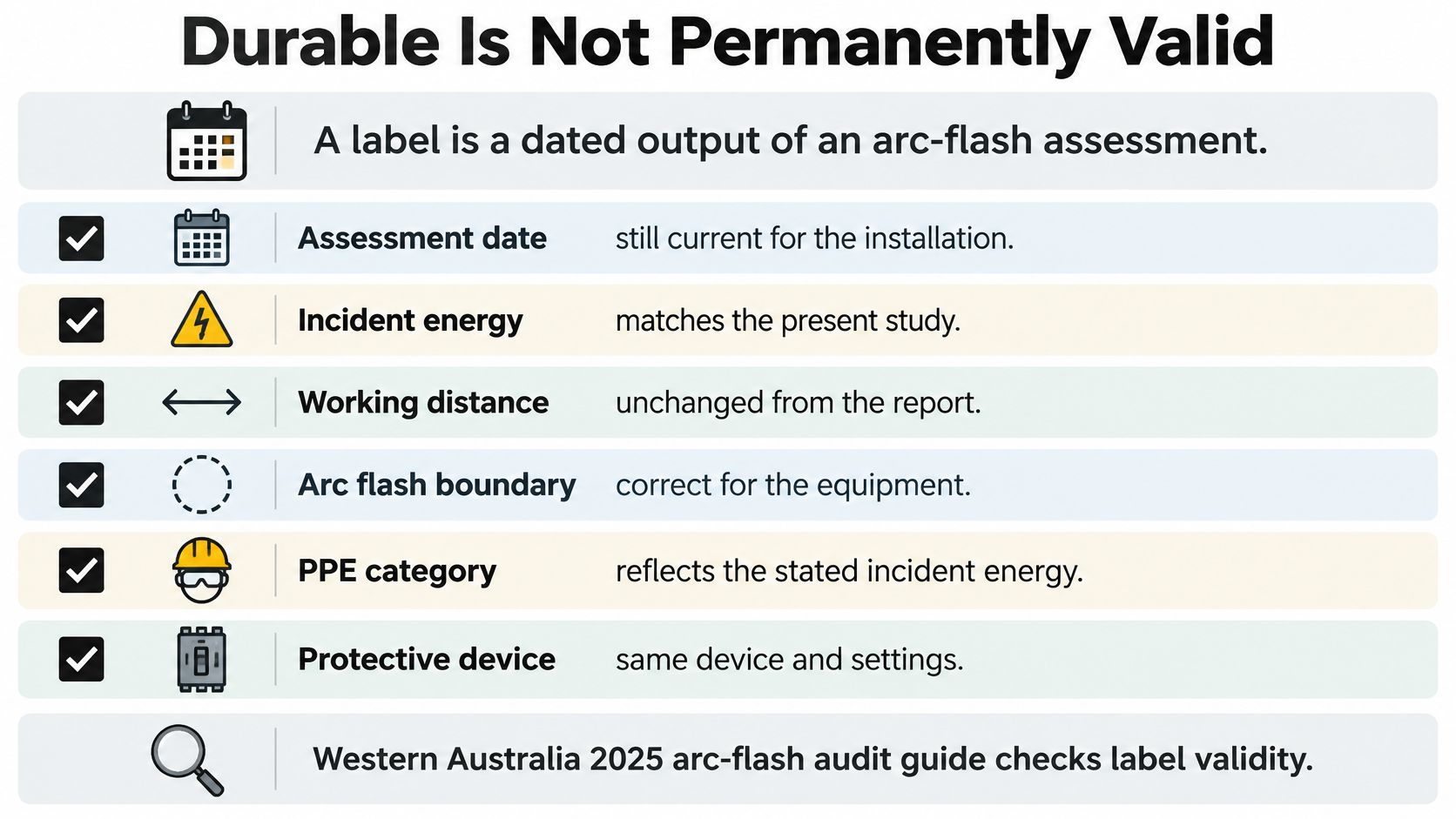
A label can remain clean, readable and firmly attached while its hazard information is out of date. It records the result of an arc-flash assessment under specific electrical conditions, so changes to the system or work method can make that result inapplicable.
The Western Australia's 2025 arc-flash audit guide checks whether labels are clearly displayed, provide sufficient hazard information and are updated after electrical-installation changes. Electrical incidents continue to cause fatalities across Australia and New Zealand. The guide's label checks help keep equipment warnings aligned with the installation they describe.
Changes that trigger relabelling
| Change | Why the old label fails | Action |
|---|---|---|
| New transformer | Source fault level and incident energy can change | Reassess and replace the equipment label |
| Protection setting change | Clearing time assumed in the study may no longer apply | Reassess and replace the label for the affected device |
| Mobile generator connected | Operating configuration can produce a different hazard | Add or replace labels at the connection and generator breaker |
| Solar or battery system added | Fault-current contributions and operating modes change | Reassess affected boards before relying on old PPE |
| Cable length altered | Impedance and incident-energy assumptions change | Reassess the downstream label |
| Switchboard extended | New compartments may have a different worst case | Provide an updated label for that board |
| Work method changed | Doors-open or working-distance assumptions no longer match the task | Update the stated PPE and working distance |
Review assumptions before replacing the sign
These changes call for an engineering review, not guessed replacement values. Reassessment identifies which labels need changing and whether an existing value still applies.
For example, a generator arrangement may need configuration-specific warnings at both relevant access points. Writing a note on an old label does not establish the incident energy for an alternative supply. The underlying study must support the information workers rely on.
A physically sound label can therefore become unsafe through changes to transformers, protection settings, generators, solar or batteries, or work methods. The label is only as current as the assumptions behind its study.
Use this checklist to distinguish physical condition from technical validity.
Put the review into change control
- Flag the modification before energisation. Include the arc-flash assessment in the modification review, rather than leaving label replacement until handover.
- Withdraw superseded information from operational reliance. Retain the old assessment as historical documentation, but clearly manage any label whose assumptions no longer apply. Don't leave an unmarked blank face.
- Reassess the affected outputs. Confirm incident energy, working distance, boundary, PPE and protection-device information.
- Update the physical warnings. Replace affected labels and adjust any floor zone changed by the revised boundary.
Assign responsibility for closing out the review. Keep outstanding label actions visible in the asset-management process until the approved information is installed. Information on electrical equipment labels provides further context for managing identification alongside the equipment lifecycle.
Placement Beside Isolation and Testing
The label supports the safe system of work. It doesn't replace lockout, isolation or testing. A clear warning can tell the worker what assessment applies, but it cannot prove that conductors are de-energised.
WorkSafe Queensland's arc-flash incident guidance pairs warning measures with isolation, prevention of reconnection, insulated or non-conductive barriers, exclusion zones, training, permits and testing to prove equipment is de-energised. Workers must test before touching rather than assume electrical parts are dead.
Keep the operating information usable
Say an installer places a large warning across the main-switch legend and wraps its edge around the handle recess. The arc-flash text is conspicuous, but the worker can no longer identify the isolator clearly or operate it without disturbing the label.
The corrected arrangement puts the warning on a clear exterior surface beside the incomer, leaving the switch legend, handle movement and verification arrangements unobstructed. Don't trade one safety communication for another.
Before approving the position, check:
- Isolation access: Handles, locking provisions and equipment identification remain clear.
- Operating instructions: Switching text and other necessary instructions are readable.
- Verification controls: The warning doesn't cover or obstruct the approved testing arrangements.
- Work-area controls: The enclosure warning and exclusion-zone marking can both be understood.
Match the permit to the equipment
The permit, task instructions and PPE selection should refer to the same equipment and operating conditions as the assessment. If the crew discovers a different protective device or an unexpected supply configuration, resolve that discrepancy before relying on the warning.
Before touching: Read the warning, verify the applicable conditions and follow the isolation and prove-dead procedure. Seeing a label isn't evidence that the equipment is safe to access.
At the pre-work check, read any available label and confirm that PPE and boundary controls match its stated incident energy. Where a rating is missing, arrange the incident-energy assessment before choosing controls, rather than substituting a familiar clothing set or copying information from the neighbouring board.
Standards and Owner Specifications to Cross Check
Australian arc flash label placement is governed mainly through electrical-safety practice and asset-owner specifications, rather than a single nationally prescribed label design. The Australian Institute of Health and Safety's Electricity and Arc Flash discussion provides context for this approach and the role of equipment-level hazard communication.
WorkSafe Queensland identifies AS/NZS 3000, the Wiring Rules, and AS/NZS 4836:2011, addressing safe work on or near low-voltage installations and equipment, as relevant references in its electrical arc-flash guidance. Confirm the editions applicable to the project rather than assuming a reference in older guidance settles the current contractual requirements.
The document map below separates placement decisions from the assessment values printed on the warning.
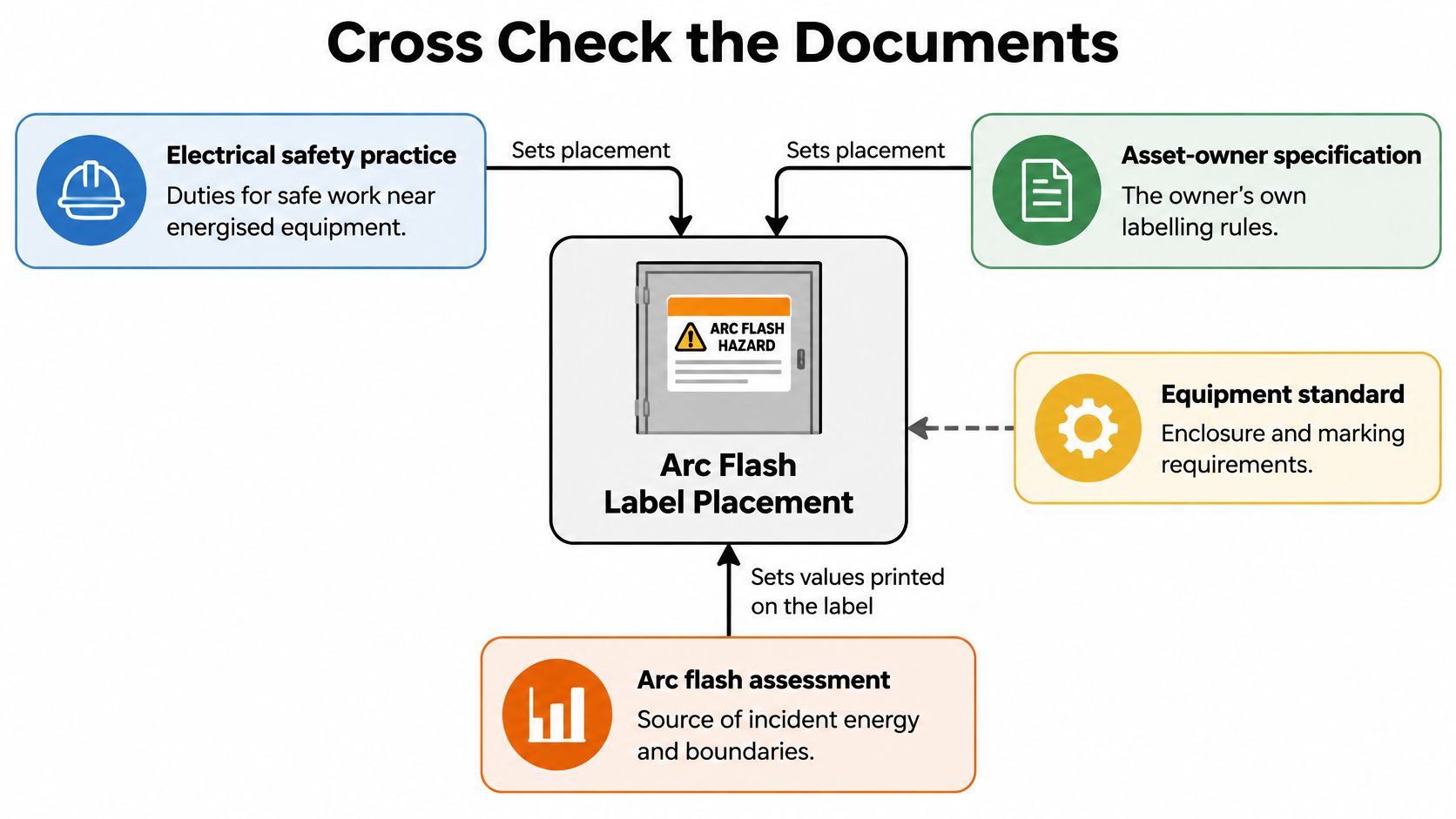
Give each document a defined job
| Document or specification | What to cross-check |
|---|---|
| Electrical-safety standards and procedures | Installation requirements, safe work, isolation and protective measures |
| AS 1319 | Applicable safety symbols for hazard identification |
| Sydney Water technical specification | Board-level warnings, incomer placement, location-specific information and generator warnings |
| SA Water engineering standard | Mounting height, signal-word distinctions and boundary-marking arrangements |
| Western Australia Water Corporation design standard | Outdoor durability, prominent positioning and the label-size benchmark |
| Western Australian arc-flash audit guide | Clear display, sufficient information and updates after installation changes |
| Approved arc-flash assessment | Equipment-specific incident energy, working distance, boundaries and PPE |
The owner's specification translates the general safety approach into an installation detail. The assessment supplies the values. The safe-work procedure governs how personnel identify, isolate, test and work on the equipment.
Check the project documents together
For a refurbishment, compare the existing warning schedule with the owner's current project requirements and the approved assessment. Don't assume that matching an old label's dimensions reproduces an acceptable installation.
Our overview of switchboard labelling requirements helps place hazard warnings alongside the other identification needed on a board.
A compliant-looking label isn't proof of a compliant work system. Meeting a size benchmark or using the right symbol doesn't satisfy the separate safe-work obligations associated with the Wiring Rules and low-voltage work practices. An asset-owner specification can also be stricter than general guidance.
Quick Placement Checks Before Work
Walk up to the equipment in the same order you'll identify and prepare it for work. Use the placement, signal-word and change-trigger tables as acceptance references, rather than relying on whether the enclosure looks familiar.
- Identify the correct board. Confirm the exterior-front or door warning belongs to the equipment in the work instructions and is visible before access.
- Check alternative supplies. At generator-equipped assets, confirm the connection point and generator circuit-breaker panel carry the applicable separate warnings.
- Check mounting height. Apply the owner's height requirement. For a low door, confirm that an alternative exterior position has been approved rather than assumed acceptable.
- Read the signal word. Match Warning or Danger to the applicable owner-specified rating distinction.
- Inspect the approach controls. Where the category and location call for them, look for the cordon, fence or painted boundary zone.
- Read the study fields together. Check incident energy, working distance, boundary, PPE, voltage, assessment date and protective device against the intended task.
- Keep isolation and testing accessible. Confirm the warning doesn't obscure the isolator, operating text, locking provisions or verification arrangements.
- Look for changes. Treat the displayed information as unconfirmed if the installation or work method has changed without an assessment review.
- Resolve a missing rating. Stop the selection of arc-flash controls until incident energy has been assessed.
Record exceptions before proceeding
A failed check needs a named action, not a verbal assumption that somebody else has reviewed it. Record the equipment identity, the discrepancy and who will confirm the assessment or correct the installation.
This walk-up check doesn't authorise energised work. It helps the crew identify whether the warning information is usable before applying the approved work procedure.
Decide Keep or Replace the Label
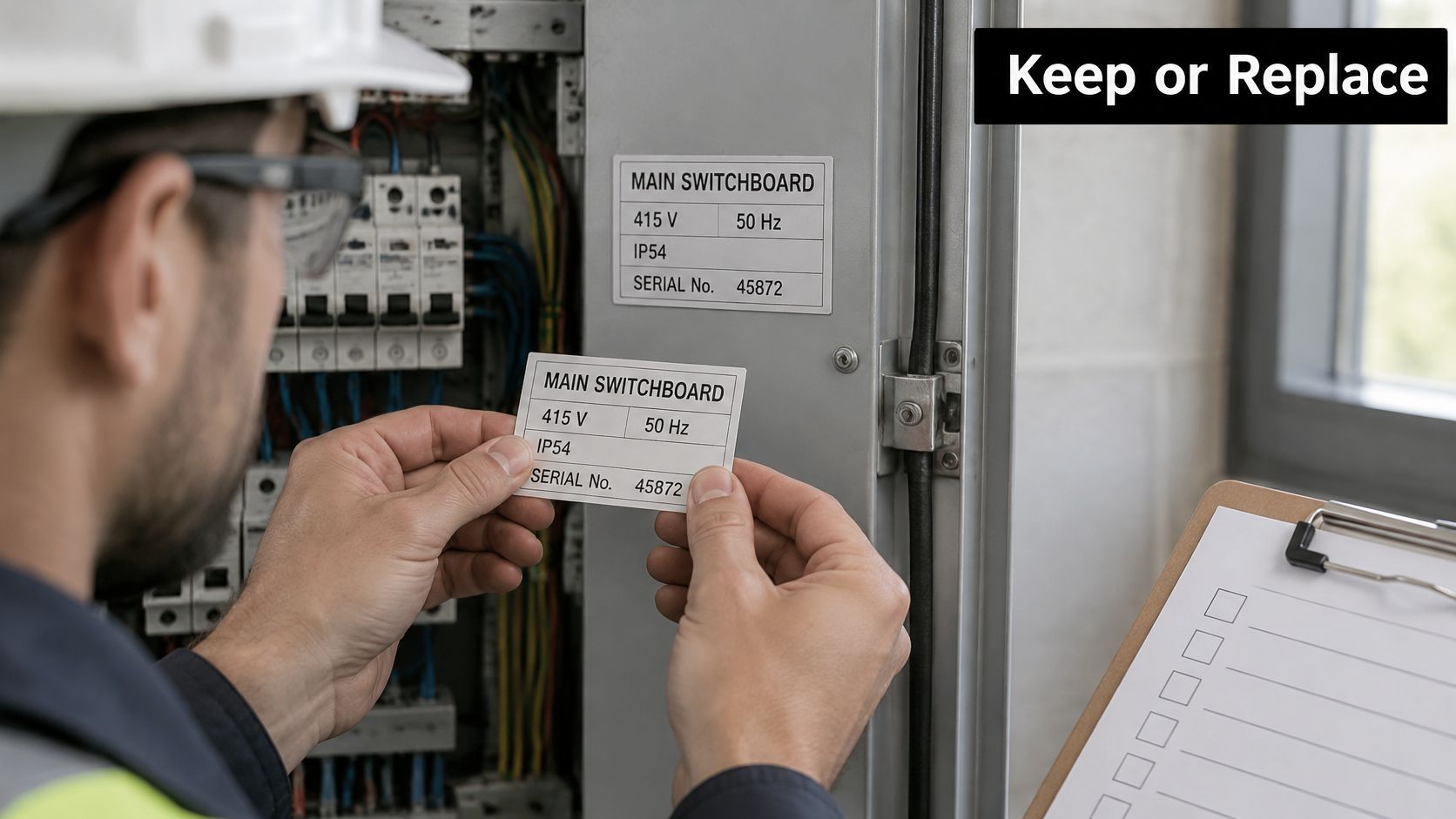
A label can look flawless and still be unsafe. Keep it only while its information matches the installation and its face remains secure and readable. Treat its study fields like a snapshot: changes to transformers, protection settings, generators, solar, batteries or work methods can make that snapshot outdated.
Inspect the warning during the equipment review, not as a cosmetic task.
Approve the information before production
Replace a faded, cracked or detached label. If a modification affects the assessment, confirm the revised study outputs before ordering a replacement, and update any affected boundary marking.
For suitable metal and industrial laminate labels carrying equipment identity and safety text, specify laser marking rather than mechanical engraving. Check material compatibility, contrast and the approved finish before production.
The video provides a laser-production reference.
Confirm the finish and installation detail
evright.com is the parent laser-engraving business. Evright Industrial focuses on laser engraving for asset labelling and industrial engraving, and can mark on almost any material.
Each customer has a dedicated project manager who works to the project's implementation schedule and budget. Required samples are delivered for approval before production starts, so the finish can be checked before installation.
Approve the study content first, then the sample finish and attachment arrangement. Install the replacement at the approved access point, not wherever space remains.
Evright Industrial produces laser-engraved asset labels and safety signage using approved equipment information. Bring the arc-flash label schedule, owner specification and installation requirements to Evright Industrial to discuss suitable materials, sample finishes and production with a dedicated project manager.
Recent Comments