

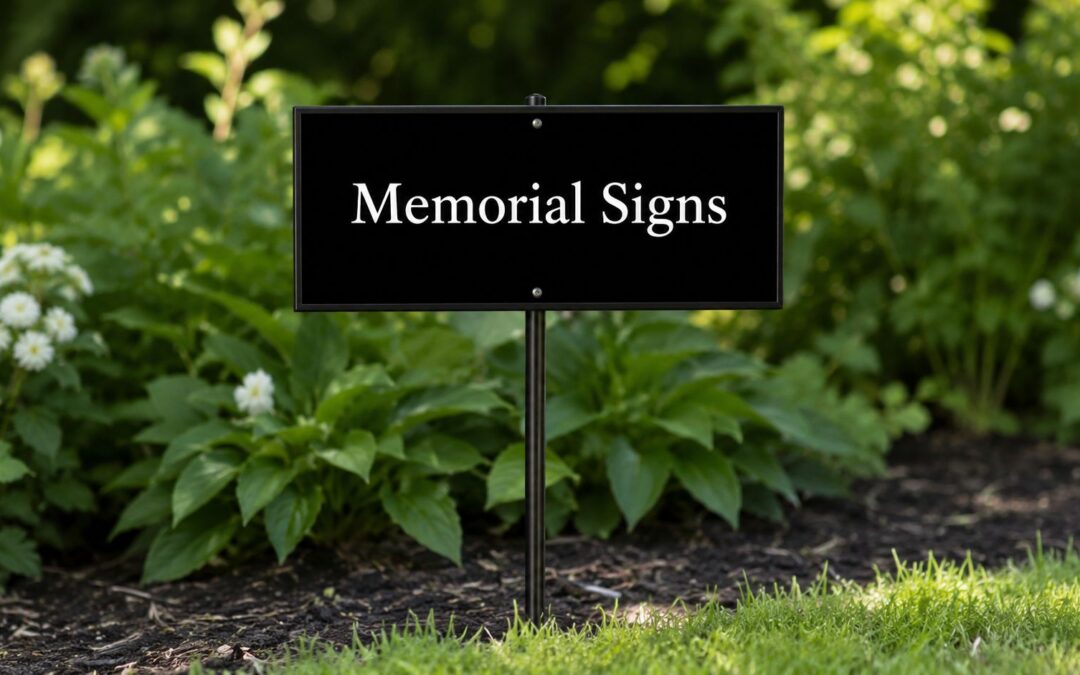
You're usually not starting with a blank slate. You're standing in a garden, a cemetery office, or a funeral home meeting room, trying to decide whether the tribute should feel private, visible, formal, or tucked away. That first call matters more than the wording does, because a memorial sign that looks right on day one but fails in weather, fades in sun, or reads awkwardly from a few metres away is a bad result, no matter how elegant the layout looked on screen.
The smart way to treat personalized memorial garden signs is as a long-term outdoor specification, not a decorative impulse buy. In Australia, that means thinking about UV, corrosion, mounting, readability, and approval pathways before anyone starts approving artwork. It also means being honest about trade-offs, because the cheapest option is rarely the one that still looks respectful after years of exposure.
A Real Garden, A Real Decision
A family rings late in the week and asks for a sign for a rose bed in a home garden. They want the tribute to feel warm, but they also need it to survive irrigation spray, strong sun, and the occasional gusty day that pushes light fixtures and stakes off line. That's the core job, choosing something that belongs in the garden without disappearing into it.
The first decision isn't the font or the flourish. It's whether the sign needs to be read by visitors from across a path, whether it should feel discreet, and whether it has to fit into a broader garden plan. If the memorial sits inside a designed outdoor space, even the planting and drainage around it matter, which is why resources on water-saving outdoor space plans can be useful when families are shaping a remembrance corner that still has to function like a normal garden.
What buyers usually get wrong
They focus on the inscription too early. The better sequence is site first, material second, wording third, then mounting.
Practical rule: if the sign can't be seen clearly from the intended viewing distance, the tribute has failed, no matter how beautiful the engraving is.
A family memorial, a pet tribute, and a donor sign all live in different environments, but they share the same constraint, the sign has to sit upright, stay legible, and feel intentional. Councils and funeral homes know this well, because once the sign is installed, the questions change from “does it look good?” to “will it still look right next summer?”
The other thing people underestimate is permanence. A garden tribute sounds soft and temporary, but the best examples are built like serious outdoor hardware, with materials and fixing methods chosen for weather, maintenance access, and the kind of respect the site deserves.
What a Personalized Memorial Garden Sign Actually Is
A personalized memorial garden sign is a weather-resistant marker made for an outdoor remembrance setting, not an indoor display. It can sit in a garden bed, by a cemetery plot, in a rose garden, near a memorial tree, or along a remembrance walkway. The “personalized” part means the wording, size, layout, and sometimes the shape are made for one person, one pet, one family, or one donor tribute.
Like a letterbox name plate, but built for outdoor service over many seasons. A letterbox plate only needs to survive daily handling and weather. A memorial garden sign has to do that while still carrying emotional weight and staying readable when it's half-buried in planting, seen through shrubs, or mounted on a stake near foot traffic.

Common formats used here
Stake-mounted signs suit gardens and soft ground because the support is built in. Wall or fence-mounted plaques work when the memorial needs a fixed vertical plane. Flat ground-set markers are better when the site has low visibility or a more understated look. Donor-style tribute signs show up in public gardens and remembrance walkways where the message needs to be formal, compact, and durable.
| Format | Typical Use | Installation Method |
|---|---|---|
| Stake-mounted sign | Garden beds, memorial corners, pet tributes | Driven or fixed into soil |
| Wall-mounted plaque | Fences, retaining walls, memorial shelters | Screws, anchors, or brackets |
| Flat ground marker | Cemetery-adjacent spaces, lawn edges | Set into ground or mounted low |
| Donor tribute sign | Public gardens, walkways, council sites | Fixed to posts, walls, or rails |
The practical point is simple. The format controls the fixing, the fixing controls the stability, and the stability controls how dignified the sign looks after a wet winter or a windy summer.
Materials and Finishes Built for Australian Conditions
Material choice is where most buyers either save money wisely or buy trouble. In Australia, the sign has to handle UV, heat, rain, and in some places salt air or constant sprinkler overspray. That's why I treat the substrate, finish, and engraving method as one decision, not three separate ones.
Metal choices that make sense
Anodised aluminium is the first material I'd look at for a lot of outdoor memorial work. It's light, handles outdoor use well, and pairs cleanly with laser marking. Stainless steel is the premium durability play when you want a harder, more substantial feel and low maintenance. Powder-coated steel is common because the coating adds protection and gives a clean finished look, but the base metal still matters if the site is harsh.
Copper, brass, and bronze can look beautiful, but they need more care. They'll tarnish, which some families like, but others read as neglect. Raw or weathering steel is a different decision again, because the patina can be intentional, not a defect, but only if everyone understands the visual effect from the start. Acrylic can work in protected settings, timber suits a natural aesthetic, and natural stone has strong presence, but each has different behaviour under sun, water, and cleaning.
In coastal or high-UV sites, I'd rather specify a simpler, tougher material than rely on a delicate finish to do the heavy lifting.
The finish is not cosmetic. Powder coating and anodising are the protective layers that keep the sign looking finished, especially where colour contrast matters for readability. Without that protection, you're asking the substrate itself to do a job it wasn't designed for.
For a supplier example that sits squarely in this production space, see Evright Industrial's custom outdoor memorial plaques, which are made for outdoor use rather than indoor display.

The smart budget move is not always the cheapest substrate. It's the one that avoids replacement, re-engraving, or constant cleaning. If the sign is for a coastal fence line or a full-sun memorial bed, spend on corrosion resistance first and decoration second.
Sizing, Layout and Wording That Still Reads in Five Years
Good memorial wording starts with restraint. If you overload a small plaque, you don't get more meaning, you get smaller lettering and poorer reading distance. One common memorial garden format uses a 15.75" × 10" slate panel with a 36.5" lawn stake, and allows up to 16 characters per line with a maximum of 5 lines. Another common marker format uses two 17-character lines on a 17" × 8.25" marker Pacific Rock Engravers memorial garden sign.
Plan the message before the panel
Start with the essential words, then decide whether the sign has enough face area to carry them. Short names, a date range, and one brief line of tribute usually work better than a long paragraph. If the tribute must be seen from a path, go with fewer lines, larger letters, and strong contrast.
The reason is plain. As text density goes up, letter height drops, and legibility drops with it. That's not a design preference, it's a physical limitation of small-format signage.
The best-performing wording patterns are usually straightforward:
- Name first: the person, pet, or family name carries the tribute.
- Dates second: birth and passing dates, if the family wants them included.
- Short sentiment last: a brief phrase, not a speech.
- Shared memorial wording: inclusive language for family spaces or donor areas.
- One clear hierarchy: the eye should know what to read first.
For wording examples and layout ideas, memorial plaque wording examples are a better starting point than trying to write from scratch on the day.
Working rule: if the inscription has to be read from several metres away, keep the language short and the contrast strong.
A sign that reads cleanly after five years is usually the one that was designed to breathe from the start. Leave room around the text. Don't cram the border. Don't chase every available character just because the layout software allows it.
How Laser Engraving Actually Works on Memorial Signs
Laser engraving is the method I trust for durable outdoor memorial work because it changes the surface itself, not just the appearance. A focused beam removes, marks, or alters material in a way that stands up far better than applied vinyl or surface print when the sign lives outside. That matters on memorial signage, because weather does not negotiate with adhesive.
On metals, anodised aluminium, powder-coated steel, acrylic, slate, and timber, the laser creates contrast by altering the surface layer or exposing a different layer beneath. On coated materials, the marking can reveal the base colour cleanly. On stone and timber, the beam creates a permanent mark that doesn't peel or bubble.
Trotec Laser machinery is a serious production tool here, not a branding exercise. A Trotec setup is used to produce consistent cuts and marks with the kind of repeatability funeral homes and councils need when a memorial has to match approved artwork exactly. Evright Industrial works with that same kind of laser infrastructure through its engraving and marking services, including laser etching services, which is where a lot of durable memorial detailing gets done in practice.
The useful distinction is this. Laser marking changes the surface appearance. Laser engraving removes material or creates a deeper permanent recess. Laser etching sits between the two, often producing a lighter surface effect. For outdoor memorial signs, I prefer the deepest practical mark the material can take, because depth and contrast usually age better than a shallow decorative pass.

Why this matters to buyers
Printed graphics can fade, lift, or scratch. Vinyl can fail at the edges. Laser work is cleaner for long-term memorial use because the information is physically embedded in the sign's finish or substrate. That's the difference between a tribute that looks crisp in the proof and one that still looks deliberate after years of weather.
If you're briefing a supplier, ask what the laser is doing to the surface, not just what the sample looks like on a desk. The answer tells you a lot about durability.
Mounting, Installation, Durability and Care
The fixing method should match the site, not the sales brochure. A stake-mounted sign works in soft garden soil, but a cemetery edge, a public walkway, or a theft-prone site needs a more deliberate fixing system. I've seen too many memorials look fine in the workshop and crooked in the ground because nobody checked the soil, the slope, or the irrigation line.
Pick the fixing for the location
Ground stakes suit home gardens and light memorial beds. Welded legs offer more rigidity for plaques that need a stronger visual stance. Butterfly stakes spread load in softer ground. Rod-and-sleeve systems make sense where the sign may need removal for maintenance or where security matters. Wall and fence mounting is the right call when the memorial should sit above planting or keep clear of mowing equipment. Boulder and stone-set fixing suit heavier, permanent settings.
The service-life question is site-specific. High UV punishes coatings and plastics. Coastal air attacks poor metal choices. Irrigation spray can mark finishes if the material is cheap or the coating is thin. Heat near bushfire-adjacent sites puts extra pressure on timber and softer plastics. You don't need drama, you need the right substrate and a realistic maintenance plan.
Maintenance rule: if the sign needs frequent polishing to look respectful, the material choice was wrong for the site.
A practical handover checklist for funeral homes and planners should cover these points:
- Confirm ground conditions: check whether the site is compacted, sandy, sloped, or watered by irrigation.
- Check drainage: standing water shortens the life of many fixes.
- Verify fixing security: choose the stake or bracket for the actual risk level.
- Inspect sight lines: make sure planting won't hide the name plate in six months.
- Plan cleaning access: a sign you can't reach is a sign you can't maintain.
- Schedule follow-up: re-check alignment after installation and after the first weather cycle.

Australia's outdoor conditions reward boring discipline. If the fixing is overbuilt, the sign stays respectful. If the fixing is flimsy, the whole tribute starts looking neglected much sooner than anyone planned.
Ordering, Pricing, Sustainability and Evright Industrial's Edge
A memorial sign order should start with artwork approval. The usual sequence is straightforward, brief the supplier, review the proof, revise if needed, sign off, then move into manufacture and delivery. Delays usually come from wording or artwork, so funeral homes and councils should gather the inscription, dimensions, material preference, and fixing method before they ask for a quote.
Pricing moves with material, size, engraving complexity, finish, quantity, and turnaround. A compact plaque in a standard finish is easier to quote than a larger custom piece with a specialty substrate, multiple lines, or mixed fixing hardware. If you need to hold the budget down, strip back complexity before you start adding cosmetic extras.
Sustainability choices that are worth asking about
Ask direct questions about sourcing and waste. Recycled-content metals, FSC-certified timber, and low-waste laser workflows are sensible options for buyers who want the memorial to reflect care beyond the inscription itself. For a useful parallel on planning budgets and sequencing work, the Pool & Landscaping of Vistancia planning advice is a decent reminder that outdoor projects go smoother when the scope is set before the spending starts.
Evright Industrial is the Australian production option I'd put on the shortlist when the job needs laser engraving, durable materials, and a disciplined proof process. It sits on nearly six decades of evright.com experience, uses Trotec laser machinery, and works across industrial signage, asset labelling, and commemorative plaques. That matters because the same production discipline that helps with asset ID also helps with memorial work, where consistency and legibility are essential.
If you're briefing any supplier, ask for the substrate, finish, fixing method, proof workflow, and care advice in writing before you approve the order.
A clean buying brief should always include these items:
- Site type: garden, cemetery, walkway, wall, or memorial bed.
- Material preference: metal, stone, timber, or acrylic.
- Finish expectation: coated, anodised, raw, or natural.
- Wording limit: name, dates, tribute line, and any symbol.
- Mounting method: stake, bracket, wall fix, or ground set.
- Maintenance plan: who cleans it, and how often.
If you want a sign that still looks right in ten years, brief it as an outdoor product specification, not a keepsake. That is the standard that holds up in council gardens, cemetery settings, and funeral-home presentations.
Recent Comments