
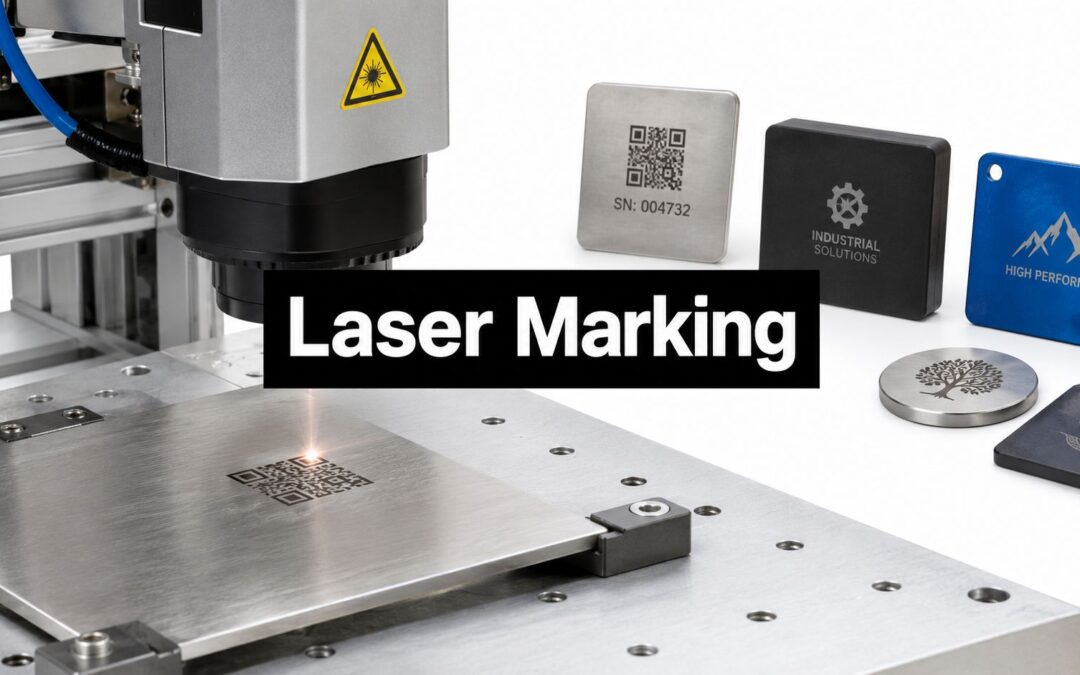
A stainless-steel asset plate can look perfect when it leaves the workshop and become difficult to read after months of washdown, abrasion and outdoor exposure. A polymer label may adhere well inside a plant but curl, fade or lose contrast on equipment exposed to Australian sun. When that identifier carries a serial number, hazard warning or maintenance reference, a failed mark creates more than an untidy appearance. It can interrupt traceability and complicate compliance work.
The right laser marking materials depend on three connected decisions: the substrate, the marking process and the environment. Fibre, CO₂ and UV lasers interact with materials in different ways, so a machine that produces a clean mark on stainless steel may burn acrylic or leave no useful contrast on another plastic. Australian industrial practice also places a high value on durable identification, from pipe contents and product labels to chemical containers and equipment data plates.
This guide approaches material selection as a production decision rather than a catalogue exercise. The useful question isn't just whether a material can be marked. It's whether the finished mark will remain legible through the asset's service life, cleaning routine, temperature range and regulatory obligations.
Introduction to Industrial Laser Marking Materials
A maintenance supervisor discovers that a chemical drum's label has washed off. Elsewhere on the same site, an equipment tag is still physically attached but the printed text has faded enough that an operator can't confirm the asset number. Both failures often begin with a reasonable-looking purchasing decision, such as choosing a low-cost label without considering UV exposure, solvent contact or the replacement cycle.
Laser marking reduces some of those risks because the identifier can become part of the surface rather than a separate printed layer. That advantage only appears when the laser process suits the material. A fibre laser can directly mark common metals, while plastics, glass and wood generally need a CO₂ or UV process, or a coating that changes how the surface absorbs energy. Trotec Laser Australia's guidance on data plates and tags reflects this substrate-specific approach and also covers 1D and 2D codes for traceability applications.
Three material groups
Metals remain the preferred choice for harsh-duty data plates, asset tags and equipment identification. Stainless steel, anodised aluminium, brass, copper and titanium each respond differently to heat and reflectivity, so the operator must adjust the process rather than rely on one standard file.
Engineered plastics are useful where low weight, electrical insulation, colour coding or shaped components matter. ABS, polycarbonate, acrylic and specialist laser-markable laminates can produce excellent results, but their resistance to chemicals, heat and UV varies considerably.
Coated and treated surfaces give the laser a controlled layer to remove, change or darken. Anodised aluminium is a familiar example. The laser removes the coloured anodised layer and exposes the lighter base, producing strong contrast without cutting far into the plate.
A useful specification names the material, finish, required contrast, mark depth and service environment. It should also identify whether the mark must survive abrasion, cleaning chemicals, outdoor exposure, heat or repeated handling. That information prevents the common mistake of approving a sample based only on appearance at the time of manufacture.
Categorising Metals for Fibre Laser Applications
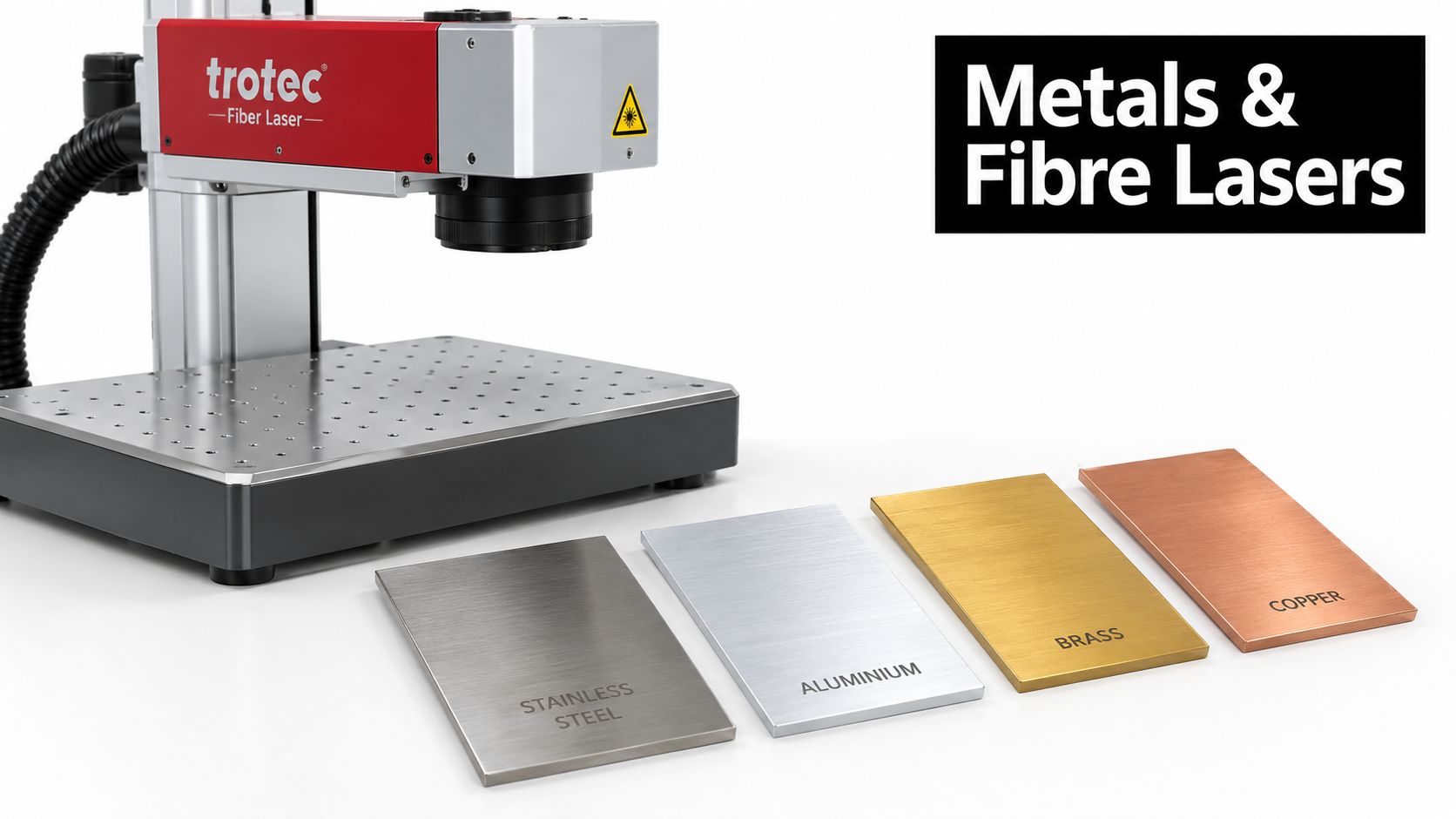
Fibre lasers are the practical benchmark for direct marking on industrial metals. The finished appearance depends on whether the process changes the surface colour, removes a coating or physically removes material. Stainless steel, anodised aluminium and bare aluminium may all be marked with the same broad equipment category, but they need different parameter strategies.
Stainless steel and titanium
On stainless steel, the usual high-contrast approach is annealing. The laser changes the surface condition and creates a dark oxide-related appearance without removing substantial metal. That suits equipment plates, medical identification and parts where a smooth surface is preferable to a deep recess.
Stainless steel also handles cleaning and general industrial contact well, but a mark that only changes colour has limits. If the surface is later ground, heavily blasted or repeatedly abraded, the contrast may be lost. Specify the finish and service conditions before choosing between annealing and engraving.
Titanium also responds well to fibre laser processing, although its colour result depends strongly on the alloy, finish and energy delivered. Test pieces are essential where the final requirement is a precise shade, not merely readable contrast.
Anodised and bare aluminium
Anodised aluminium is one of the more forgiving industrial substrates because the coloured surface acts as a sacrificial marking layer. The laser ablates that top layer to reveal the lighter aluminium beneath it. The result is usually a clean, bright mark against the surrounding colour.
Bare aluminium is less straightforward. Its reflectivity and thermal behaviour can produce a weak mark, excess melting or inconsistent edges if the operator uses settings intended for anodised stock. Lower heat accumulation, suitable pulse control and careful focus help preserve plate flatness and edge quality.
For a production job involving metal asset labels, laser engraving on metal from Evright Industrial is one route for testing the actual grade and finish before committing to a batch.
Brass and copper
Brass and copper conduct heat rapidly and reflect laser energy strongly. Those properties can make the mark less efficient and can increase the risk of inconsistent contrast across a large area. Short test runs should check the centre of the mark, its edges and any fine code elements.
Deep engraving may be appropriate where the surface will face wear, but it takes more energy and can create burr-like residue or heat distortion on thin stock. For essential services equipment, a shallow, high-contrast mark on a durable plate may be more reliable than forcing depth into the component itself.
Detailed Entries for Polymer and Plastic Substrates
Plastic selection starts with the operating environment, not the colour on the sample board. A polymer used for an indoor electrical panel has a different job from one mounted on an outdoor pump, even if both need a black serial number. Chemical exposure, flexibility, optical appearance and heat sensitivity all affect the choice of laser marking materials.
Polycarbonate, ABS and specialist laminates
Polycarbonate offers useful toughness and impact resistance, making it suitable for guards, enclosures and certain asset-label applications. It can respond to CO₂ processing, but excessive energy may soften, warp or discolour the surface. The operator must control heat accumulation, extraction and travel speed rather than treating it like acrylic.
ABS is common in housings and industrial components. Its marking response depends on the grade and additives, and poorly controlled processing can leave a melted edge or unwanted residue. A sample from the actual supplier is more useful than a generic material name because pigments and flame-retardant additives can change the result.
Specialist laser-markable plastics contain additives designed to react to a particular laser source. They can produce a dark, high-contrast mark while preserving the surrounding surface more effectively than an untreated plastic. Australian engraving guidance on compatible metals and plastics highlights the need to match the process to materials such as acrylic, ABS, PET and layered traffic-label products.
Acrylic and layered label materials
Acrylic is valuable for signage because it can provide optical clarity, colour flexibility and a clean frosted effect under a suitable CO₂ process. It's a good option for indoor directional or illuminated signs, but the chosen grade still needs to suit the exposure. Outdoor colour stability and mounting method matter as much as the engraved face.
Layered traffic-label materials can create strong visual contrast when the laser removes one coloured layer to expose another. They're useful for safety signs and coded panels where colour separation improves recognition. They aren't automatically the right choice for long-term outdoor assets, particularly where heat, UV and repeated cleaning attack the face film or adhesive.
For production work involving polymer plates or plastic components, plastic engraving services from Evright Industrial can be used to assess the actual substrate before a full run.
What fails in practice
Untested recycled or filled plastics can produce variable colour, odour or edge quality. Clear plastics can also show stress whitening or internal damage if the process generates too much heat. If the part is safety-critical, approve a sample after exposure to the actual cleaning chemical and handling routine, not only after visual inspection under workshop lighting.
Coatings and Surface Treatments for Enhanced Contrast
A raw substrate doesn't always provide enough contrast for a readable mark. Surface treatments solve that problem by giving the laser a layer that can be removed, darkened or chemically changed. This approach is especially useful when the base material is reflective, pale or difficult to process directly.
Use the surface as part of the design
Anodisation gives aluminium a coloured layer that the fibre laser can remove selectively. The underlying silver tone becomes the mark, while the remaining anodised area provides the background. This is why anodised aluminium works well for data plates, switch plates and equipment tags where a crisp two-tone result is required.
Painted or powder-coated metal can work in a similar way, provided the coating is compatible with the process and the exposed base remains readable. The operator should check adhesion, coating thickness and whether the exposed area will corrode in service. A mark that looks sharp but exposes an unsuitable metal surface may become a maintenance problem later.
Add a marking layer when necessary
Laser-sensitive sprays and marking compounds can create a dark, bonded mark on materials that otherwise produce little contrast. They're useful for some bare metals, glass and difficult alloys when direct marking doesn't deliver the required appearance. The finished surface should be tested for adhesion and resistance to the actual cleaning agents used by the customer.
UV-stable colour foils and hard-laminated overlays provide another route for signage and labels. They protect printed or engraved information from handling, but the overlay becomes part of the durability calculation. Edges, corners and adhesive lines are common failure points in outdoor installations.
A practical surface-preparation sequence is:
- Clean the substrate: Remove oil, coolant, dust and fingerprints before marking.
- Confirm the coating: Identify whether the surface is anodised, painted, laminated or untreated.
- Run a controlled sample: Compare contrast, edge definition and residue using the intended artwork.
- Test the finished piece: Apply the relevant chemical, abrasion and exposure conditions before approval.
Guidance on surface preparation methods for engraving is useful when the raw material needs preparation before a consistent result is possible.
Matching Laser Wavelengths to Material Types
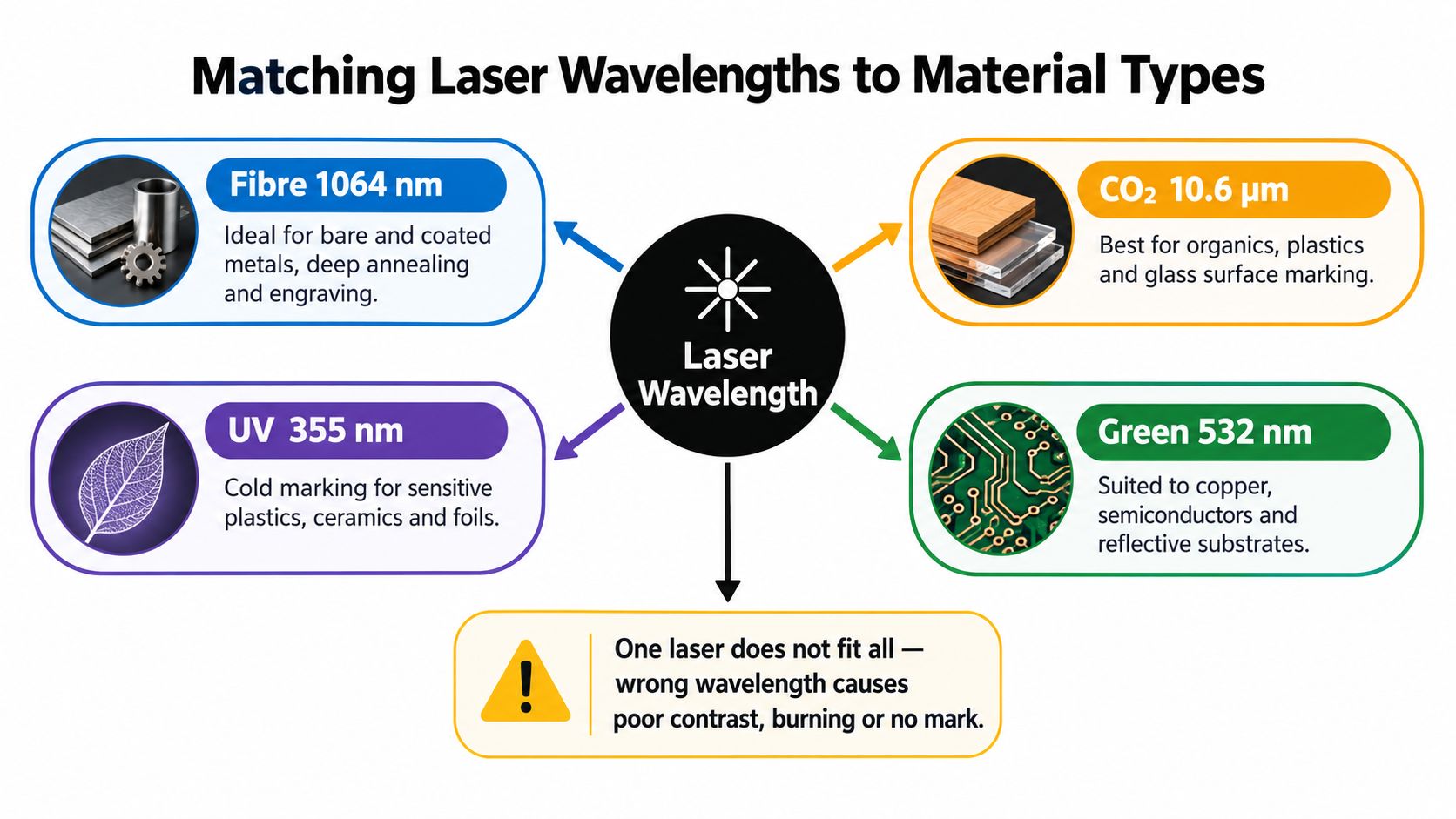
A laser source is defined by more than its power. Its wavelength determines how efficiently the material absorbs the beam, which affects whether the process creates a clean colour change, controlled ablation, melting or no visible response. That's why a plant trying to process every component on one machine often ends up with burnt plastics, weak metal contrast or unnecessary rework.
Fibre for metals and selected plastics
Fibre systems typically operate at 1064 nm and are the standard choice for direct marking on stainless steel, aluminium, brass, copper, titanium and steel. They can anneal, ablate coatings or engrave, depending on the material and settings. Some engineered plastics are also formulated for fibre marking, particularly those containing laser-sensitive additives.
The fibre process is not automatically ideal for every metal. Copper and brass may need special attention because reflectivity and heat conduction reduce the process margin. A green source can be useful for some reflective substrates, although the final choice depends on the part, required speed and mark type.
CO₂ for organic materials and common acrylics
CO₂ systems typically operate at 10,600 nm. They're well suited to wood, leather, paper, many standard plastics, glass surface marking and acrylic. On glass, the process creates a frosted appearance by controlled surface interaction, while acrylic can produce a bright engraved or frosted result.
CO₂ isn't the default for bare industrial metal. It may work with a suitable marking compound or coating, but that adds preparation and another potential failure point.
UV for sensitive surfaces
UV systems operate at 355 nm and are used where heat must be limited. The shorter wavelength supports precise surface changes on sensitive plastics, foils, ceramics, glass and medical components. UV marking can protect small features and reduce the thermal damage that would occur with a more heat-driven process.
The correct specification therefore links four items: substrate, wavelength, mark type and environment. If the job includes stainless data plates, acrylic signs and heat-sensitive polymer components, outsourcing to a partner with access to more than one laser source may be more practical than forcing one system to handle incompatible work.
Durability and Environmental Performance Standards
A readable mark has to survive the environment in which people will use it. Australian conditions can combine intense sunlight, heat, dust, rain, chemical washdown and abrasive handling. A material that performs well indoors may fail quickly outdoors, particularly when the label relies on an exposed adhesive or a thin printed surface.
A local Australian supplier guide rates photo-anodised aluminium asset tags at 20 years or more, while hard-laminated polycarbonate and polyester labels are typically rated at around 5 years outdoors. The Australian asset-tag comparison presents that gap as a practical durability benchmark. It doesn't mean every aluminium tag will last indefinitely, or every polymer label will fail at the same point. It does show why material choice should follow the maintenance cycle and replacement consequences.
Material Lifespan and Environmental Resistance
| Material Substrate | Expected Outdoor Lifespan | Primary Environmental Resistance |
|---|---|---|
| Photo-anodised aluminium | 20 years or more | Long-term outdoor readability, abrasion and exposure |
| Hard-laminated polycarbonate | Around 5 years outdoors | Lightweight identification with protective lamination |
| Polyester labels | Around 5 years outdoors | Flexible labelling for suitable outdoor applications |
| Silver mylar | 5 to 10 years | Chemical, oil and abrasion resistance |
| Aluminium composite panel | 15 to 25 years | Durable signage and demanding outdoor applications |
| Sealed anodised aluminium barcode | 20-year life span | Traceability in elevated-temperature conditions |
The same Australian guidance reports that silver mylar is widely used for harsh-use labels because it resists chemicals, oil and abrasion, with a typical life of 5 to 10 years. Premium aluminium composite panel applications can last 15 to 25 years, while sealed metal barcodes in anodised aluminium can withstand temperatures up to 350°C and carry a 20-year life span, according to Australian asset-tracking label guidance.
Compliance changes the specification
AS 1345:1995 covers identification of pipe, conduit and duct contents, including eleven base colours, placement rules and minimum text sizing. The AS 1345 reference supports the broader point that industrial identification must remain visible and legible in service. A laser-marked plate isn't compliant merely because it's permanent. It must also present the required information clearly in its installed position.
ACMA states that product labels must be visible and legible to the unaided eye, applied by suitable means such as printing, moulding, etching or engraving, and durable enough not to fall off, wash off or fade. It also specifies that the label must be at least 3 millimetres in height and placed on an easily accessible surface. The Australian Government product-labelling guidance should be checked when specifying regulated products.
Hazardous chemical labels have additional content requirements. ACT legislation requires the product identifier, Australian manufacturer or importer contact details, hazard pictograms, hazard statements, signal word and precautionary statements in English, with the elements determined by the hazard classification. The ACT hazardous-chemical labelling legislation is a useful reference for that content framework.
Troubleshooting Common Marking Defects
Most marking defects come from a mismatch between material behaviour and process settings. Changing power alone rarely fixes the problem. The operator needs to identify whether the defect comes from heat, focus, motion, frequency, hatch spacing, contamination or the wrong material choice.
Low contrast on stainless steel
A pale or uneven stainless mark often indicates insufficient surface reaction, poor focus or unsuitable pulse and speed settings. Check the surface finish first, then run a small matrix that varies speed, power, frequency and hatch spacing independently. Slowing the scan or increasing energy may deepen the colour response, but excess heat can create a brown edge or distort the appearance.
If the mark must remain smooth and corrosion-resistant, don't jump immediately to deep engraving. Annealing may be the better process, provided the part won't face aggressive abrasion.
Warping on thin plastic
Warping usually means the surface has absorbed more heat than it can dissipate. Reduce heat per pass, increase travel speed or use multiple lighter passes rather than one heavy pass. Wider hatch spacing can also reduce overlapping heat, although it may weaken fill uniformity.
Secure the part on a flat support and check extraction. A plastic that looks acceptable on a thick sample may deform on a thin production component because the thinner section has less thermal mass.
Incomplete ablation on anodised aluminium
A patchy mark on anodised aluminium commonly results from insufficient energy, incorrect focal distance or a coating that isn't uniform. Confirm focus at the actual marking surface, clean the plate and test a small power and speed range. If the coating varies between batches, keep a reference sample and approve the mark against the relevant production finish.
Soot or residue on the mark often points to poor extraction or airflow. Clean the part before inspection, then repeat the test with controlled airflow so debris doesn't settle back onto the exposed area.
Practical rule: Change one variable at a time. A controlled test matrix tells you whether the defect comes from power, speed, frequency, focus or the substrate itself.
Record the approved settings with the material grade, coating, lens and artwork version. That record turns a successful sample into a repeatable production process instead of a result that depends on one technician's memory.
Quick Reference Matrix for Material Selection
The fastest material decision combines the surface, laser source, expected mark and operating environment. The matrix below is a starting point for sampling, not a substitute for testing the actual grade, finish and thickness.
| Material | Preferred laser | Typical result | Suitable application |
|---|---|---|---|
| 316 stainless steel | Fibre | Dark annealed or engraved mark | Heavy asset tracking and medical identification |
| Anodised aluminium | Fibre | Bright exposed aluminium | Data plates, switch plates and equipment tags |
| Brass and copper | Green or fibre | Controlled contrast with reflectivity managed | Decorative or industrial component marking |
| Carbon steel | Fibre | Deeper engraved mark where required | Tooling and machinery identification |
| Black acrylic | CO₂ | Frosted or light engraved mark | Indoor safety and directional signage |
| Wood and leather | CO₂ | Natural burnt-tone engraving | Plaques and non-metal identification |
| Hard plastics | UV | Precise, low-heat contrast | Sensitive components and device identification |
| Glass | UV or CO₂ | Frosted surface result | Signage and component marking |
Trotec Laser equipment is frequently used as a reference point for industrial marking because direct marking can cover stainless steel, anodised aluminium, steel, brass, titanium, plastics and organic materials. The suitability of the final mark still depends on the material and process. Trotec's industrial GS1 marking information emphasises longevity and legibility in demanding environments.
The following video provides a visual reference for industrial laser marking equipment and workflow:
Partnering for Precision Industrial Engraving
Material selection is only half of the job. The production team must also hold focus consistently, select the correct wavelength, manage extraction, verify code readability and inspect the finished mark against the service environment. A supplier that skips sample testing can deliver a visually attractive plate that fails once it meets sunlight, chemicals or routine abrasion.
Evright Industrial operates as a specialist division of evright.com, with nearly six decades of experience behind its engraving and awards work. Its industrial services use Trotec laser machinery for equipment identification, safety signage, asset labels, switch plates, data plates and custom memorial plaques. The available material range includes stainless steel, anodised aluminium, titanium, brass, plastics, glass and other compatible substrates.
A competent production partner should ask practical questions before quoting:
- What is the substrate and finish? Grade, coating and supplier batch can change the result.
- Where will the item be installed? Indoor, outdoor, washdown and chemical environments need different specifications.
- What must the mark contain? Serial numbers, barcodes, pictograms and small text have different readability demands.
- How will it be tested? Samples should face the relevant cleaning, handling and exposure conditions.
- What happens at replacement time? The material should align with the asset's maintenance cycle and expected service life.
Trotec machine imagery is appropriate for illustrating this work because the equipment reflects the process being discussed. Mechanical engraving imagery would suggest a different toolset and could mislead readers about the way fibre, CO₂ and UV systems interact with the substrate.
Evright Industrial produces durable laser-marked asset labels, data plates, safety signage and equipment identification across compatible metal, plastic and coated substrates. Visit Evright Industrial to discuss your material, operating environment and marking requirements, and arrange a practical production assessment before committing to a full run.
Recent Comments