

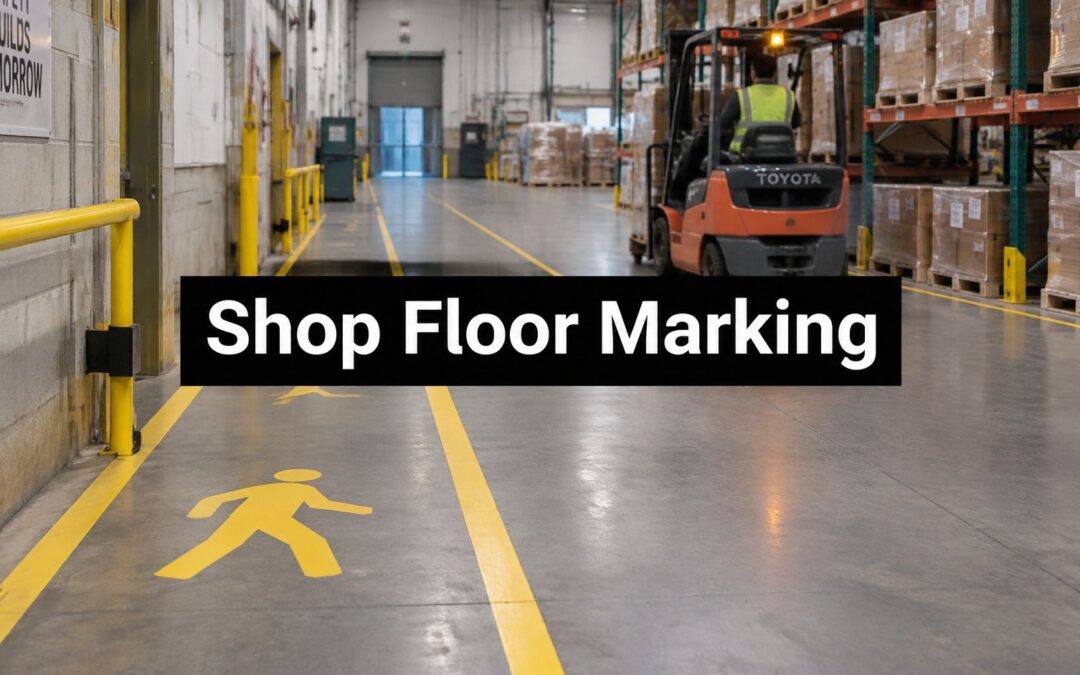
Falls, trips and slips account for 22.2% of serious workers' compensation claims nationally, and a typical serious claim carries a median of 8.8 weeks lost and about $19,100 in compensation, according to Safe Work Australia figures summarised in Line Marking Australia's guide to AS 1318 safety colours. That's the pair of numbers I'd put in front of anyone who still treats a painted or taped line as a cosmetic touch.
The floor is the first surface a worker reads when they walk into a warehouse, and the last thing anyone thinks to inspect. Tape is the cheapest way to make that surface speak: pedestrian lanes, exclusion zones, storage bays, dock edges, keep-clear strips. It's also the easiest traffic control to get wrong, because tape fails at the edges long before anyone notices the boundary has gone.
What follows is how I'd specify shop floor marking tape in an Australian facility: which type belongs in which zone, the colour legend worth adopting, the widths and sightlines that decide whether a route functions, and the inspection cycle that catches a dying line before a person does.
Shop Floor Marking Tape Types at a Glance
The buying decision comes down to one question. What's the heaviest load this line will ever carry? Answer that and the rest falls into place. Standard PVC vinyl handles dry indoor floors and foot traffic; anything a forklift, pallet jack or wash-down hose touches needs a heavier tape.
Tape type and colour are separate decisions. The table below is about type, which is a durability question. Colour is a legend question, and it belongs to the risk assessment, not the catalogue.
| Tape type | Best zone | Surface and traffic fit | Watch out for |
|---|---|---|---|
| Standard PVC vinyl | Offices, storage bays, light pedestrian aisles | Dry, smooth indoor floors with foot traffic and light trolley wheels | Lifts at edges on dusty or oily floors |
| Heavy-duty reinforced vinyl | Forklift lanes, dock areas, high-traffic walkways | Concrete and sealed floors under pallet jacks and forklifts | Higher cost per metre; still needs regular checks |
| Anti-slip grip tape | Ramps, stair nosings, wash-down bays | Wet or oily floors where slip resistance matters | Textured surface can trap dirt; clean it regularly |
| Textile-backed tape | Rough surfaces and temporary layouts | Uneven or porous surfaces where adhesive alone struggles to hold | Limits to confirm with the supplier before ordering |
Standard PVC vinyl covers offices, storage bays and light pedestrian aisles on dry, smooth indoor floors. It's the cheapest per metre and the easiest to re-lay after a layout change. On dusty or oily concrete the edges lift first, and once an edge is up the line stops reading as a boundary.
Heavy-duty reinforced vinyl is the tape for forklift lanes, dock aprons and high-traffic walkways over concrete and sealed floors. The reinforced backing resists the scrubbing and turning that destroys a standard roll, which is why it costs more per metre. It still needs the inspection schedule covered below.
Anti-slip grip tape belongs on ramps, stair nosings and wash-down bays, where the floor itself is the hazard. The grit finish is both the control and the maintenance item, because it traps dirt and needs cleaning to keep its grip.
Textile-backed tape suits rough or temporary layouts on uneven, porous surfaces where a flat adhesive can't get enough contact to hold. Confirm its limits with your supplier before committing an aisle to it.
The rule I'd apply: match the tape to the heaviest traffic the line will ever carry, not the average it sees on a quiet Tuesday.
Get that right, and the durability and colour sections decide the rest.
Why Floor Marking Carries Real Safety Weight
Safe Work Australia has reported 32,000 serious workers' compensation claims from slips, trips and falls in 2024-25, after 28,100 serious claims in 2021-22, when the category made up 22.0% of serious claims in the published mechanism breakdown. The category stays near the top because the failures are ordinary: a pallet parked two deep, a shortcut across a forklift lane, a walkway that vanished when a new bay went in.
Start checks at the same four zones every time: pedestrian walkways, forklift lanes, dock edges and storage bays. In each one, visible demarcation lets a worker read the movement route without being told it and keeps materials out of the access path. A line that survives scrubbing, turning wheels and wet shoes does that job longer; a line laid for light foot traffic will not.
Say a dock where pallets creep from staging into the walkway by mid-morning. A tape boundary at the walkway edge makes the clear path visible from the aisle mouth, so a supervisor can spot encroachment without measuring anything. The marking does the reminding between audits.
A tape line tells someone where to walk. It doesn't tell them why. That's the job of mandatory and warning safety signs, and the pairing works best when both are specified together: the floor sets the route, the sign at the entrance sets the rule.
Treat tape as one traffic-control measure in a documented risk assessment, alongside housekeeping, lighting, guarding and the rules for pedestrians and vehicles. Re-check it after every layout change, because a route that was right last quarter can be wrong after one relocated rack.
Colour Codes That Keep Floor Markings Readable
A colour works only if every worker reads it the same way in every part of the site. That's the entire test.
Australian safety-sign practice draws its meanings from AS 1319, Safety Signs for the Occupational Environment, published in 1994 and still the reference more than 30 years later. The traffic and storage colour assignments most sites use come through that same sign tradition, and Safe Work Australia's traffic management guide for warehousing treats clear road markings and signs as controls for traffic hazards.
| Colour | Meaning | Typical floor use |
|---|---|---|
| Yellow | Caution and traffic boundaries | Forklift lanes, vehicle crossings, caution edges |
| Red | Danger, prohibition or fire-related equipment | Prohibited zones and fire equipment access |
| Green | Safety or first-aid equipment | First-aid stations and emergency equipment |
| Blue | Mandatory action | Zones where PPE must be worn |
| White | General delineation with no warning meaning | Storage bays and non-hazardous layout lines |
No standard hands you a legally mandated colour chart for floor tape. What binds you is the WHS duty to identify risks and control them, so the legend becomes a documented decision inside your risk assessment rather than a wheel copied from a catalogue. Write it down, train it, and post it where the whole site can see it.
Recognition is fragile, which is why the reasoning matters. Mark a real hazard in the same white you've used for storage bays and the hazard reads as ordinary layout control. Run red along a picking aisle for decoration and the one prohibited zone loses its weight. A colour keeps working at a glance only while it means one thing everywhere it appears.
White needs its own rule. It carries no warning meaning, so it should never sit on a hazard. I treat it as the default for storage positions, non-hazardous layout lines and general delineation, and nothing beyond that. The moment a white line edges a restricted corner, every other white line on the floor becomes ambiguous.
From there the discipline is simple to state and easy to break. Apply one legend across tape, signs and floor labels, and after every layout change check that new markings don't collide with a meaning already in use. When the same colours and symbols need to work off the floor as well as on it, this explainer on safety signage meaning is a sensible cross-check.
Then audit it. Walk the site with a notebook, list every colour doing two different jobs, and fix one on each shift until the list is empty. That half hour of walking prevents more confusion than any amount of retraining.
Setting Up Forklift and Pedestrian Routes
Start with the dimensions, because you can't draw a route you can't fit. A walkway sized for a single file of walkers fails the moment two people pass or someone pushes a trolley, and a lane sized for the forklift alone fails the first time a pallet overhangs the forks. Set clear widths to suit one-way or two-way pedestrian traffic, then test every figure against the actual people, forklifts, pallets and emergency access on the site. I'd rather over-specify a walkway and lose a strip of floor than discover the pinch point during a night shift.
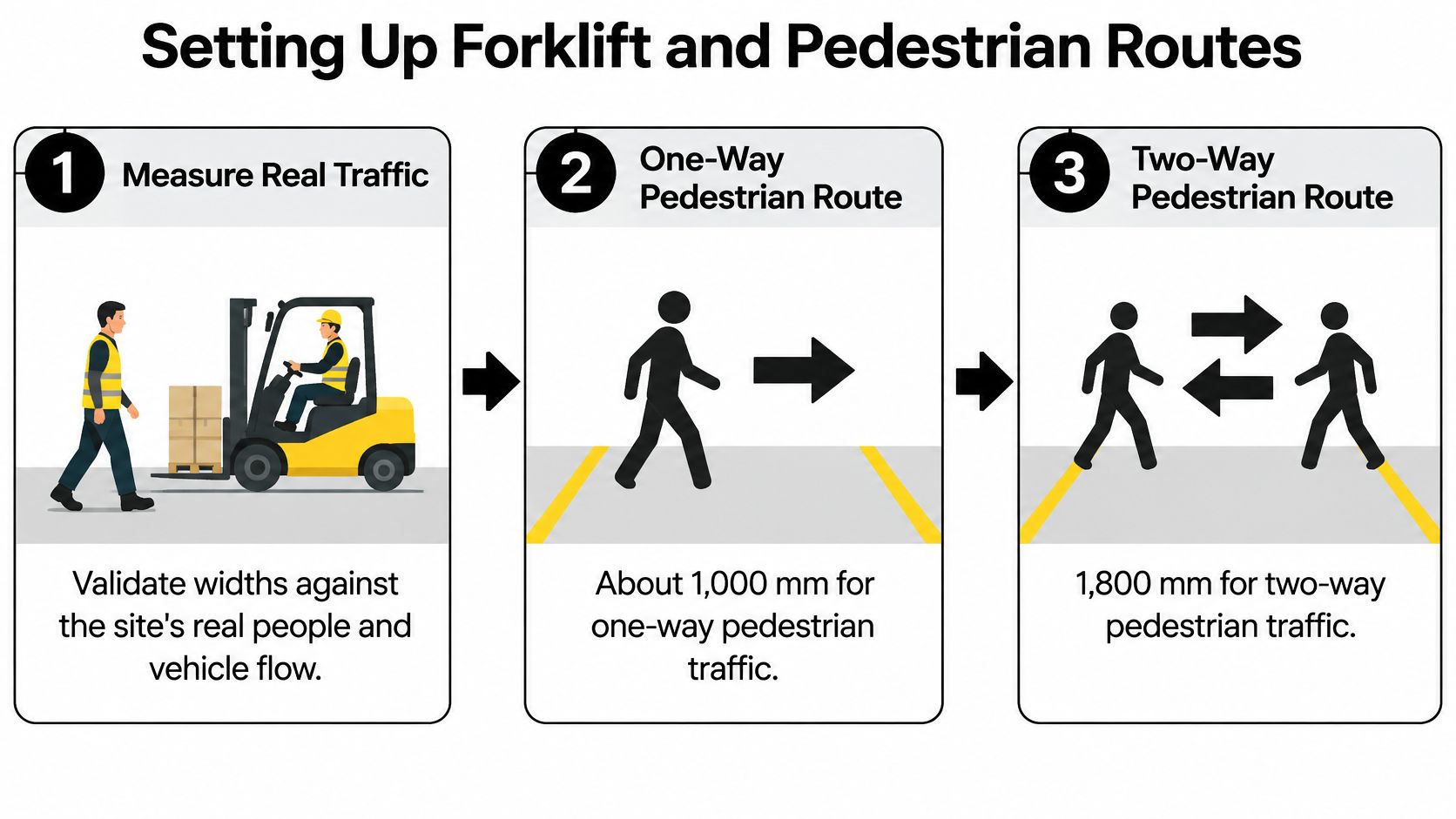
Safe Work Australia treats floor markings as an engineered traffic control rather than visual housekeeping, and its workplace traffic guidance asks sites to mark pedestrian walkways, traffic flow, powered mobile plant areas, exclusion zones, equipment parking bays, keep-clear areas and vehicle crossings (Safe Work Australia). That list is the drawing order.
- Map every zone on a plan. Pedestrian walkways, traffic flow paths, plant areas, exclusion zones, parking bays, keep-clear strips and vehicle crossings. Drawing it first means the tape follows a decision rather than creating one in the aisle.
- Run continuous lines for people and boundaries for plant. High-contrast continuous tape marks the walkway, and a contrasting boundary tape wraps the forklift lane and exclusion zone. Continuous matters: a broken line reads as an opening.
- Add physical barriers where interaction risk is real. Where forklift speed, stopping distance and workflow intersect, tape is not enough. Markings support separation, they don't create it.
- Install before operations begin. If the first shift works from the same layout the lines describe, the marking becomes the baseline. Retrofitting a route around habits is harder than starting with it.
- Check sightlines from the operator's approach direction. A line that reads beautifully from standing height can vanish behind a load or at a blind corner. Kneel, look along the lane, and see what the driver sees.
Take a packing area where a new racking bay blocks what used to be the walkway. The lines get redrawn before the next shift, and the plan gets updated at the same time so the map and the floor never disagree. That's the low-disruption advantage tape has over painted or coated systems: a layout change costs a morning, not a shutdown.
The video below walks through how floor markings sit inside a broader traffic-management layout.
Finish with the walk-through. Walk the route once as a pedestrian and once from the forklift driver's position, and confirm the tape stays visible under pallet movement, cleaning and daily traffic. Where the two journeys disagree, the layout needs changing. The workplace safety signage you pair with the route should settle any remaining ambiguity about who has right of way.
What Wears Tape Out and How to Specify Against It
The most common failure isn't a faded colour. It's a lifted edge. A line that peels up a few millimetres along its length stops being a warning and becomes a trip hazard in the aisle where forklifts run.
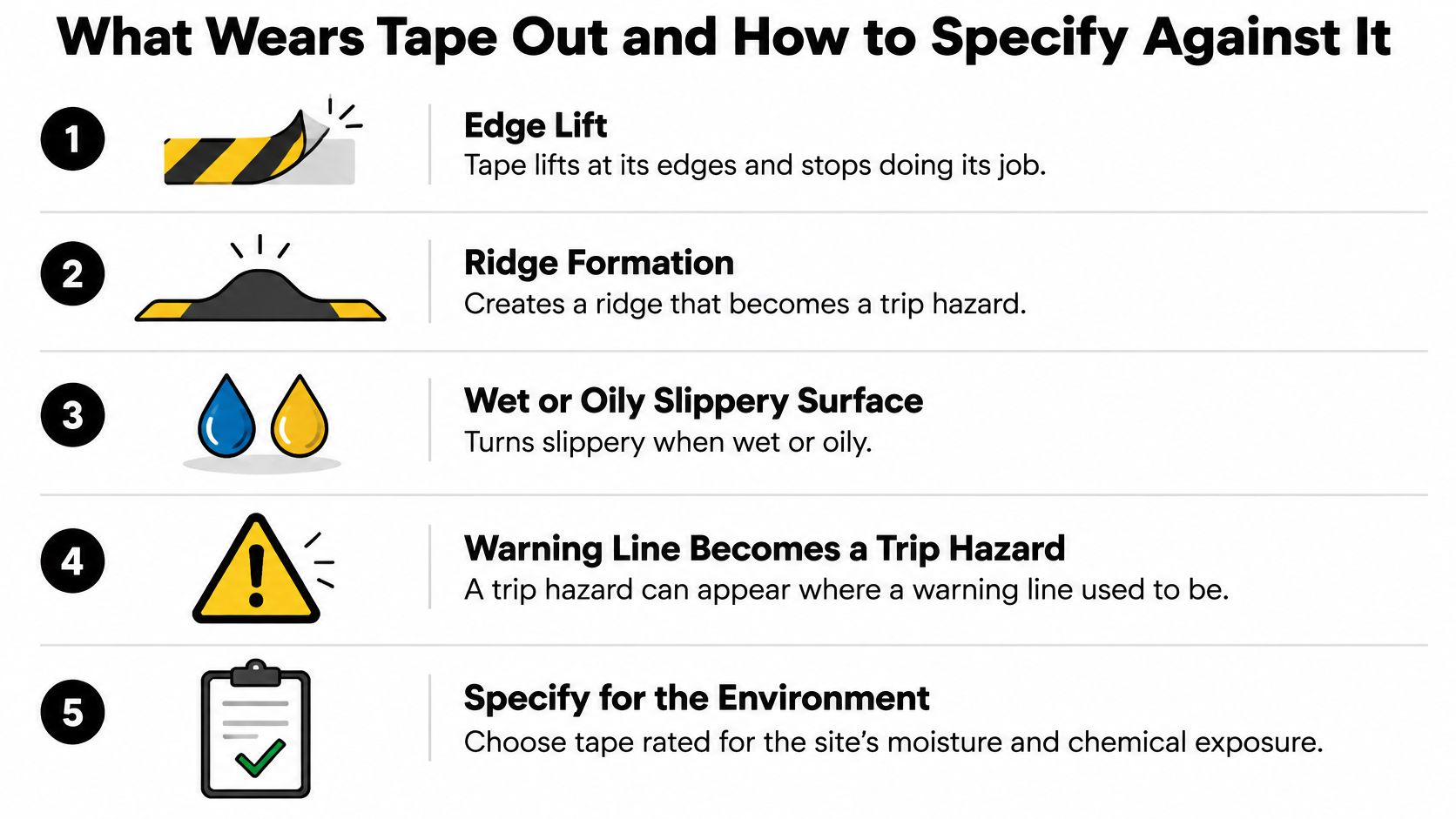
Once a ridge forms, or the surface turns slick under water or oil, the control has inverted. It's now producing the hazard it was installed to prevent.
Start with the substrate, not the colour
Adhesion is a surface question before it's a product question. Test a short length on dusty concrete, on sealed or painted floors, and on any surface that sees oil before you commit to a full run. Degrease and dry the floor first, because dust and oil cause most of the edge lift you'll ever see, and press each edge down firmly on install rather than relying on a roller pass.
Then check it again after a week. The first seven days tell you more about a tape's fit than any datasheet.
Specify for traffic, chemicals and water
Pallet jacks and forklifts scrub and turn edges, so reinforce the lanes and use wider tape through turning zones where the twist is worst. Cleaning chemicals matter just as much, because an aggressive wash-down routine can soften adhesive faster than traffic can wear the surface. Where floors get wet, choose an anti-slip finish and check its wet slip performance rather than assuming grip.
| Symptom | Likely cause | Fix at specification |
|---|---|---|
| Edges lifting | Dusty, oily or unprepared substrate | Degrease the floor, press edges, test adhesion first |
| Ridge or trip edge | Standard tape under pallet jacks and forklifts | Specify reinforced tape for lanes and turning zones |
| Slippery when wet | Standard finish on wash-down floors | Anti-slip finish with a wet slip check |
| Adhesive softened | Aggressive cleaning chemicals | Confirm chemical and wash-down tolerance with the supplier |
| Faded or illegible line | Abrasion and cleaning wear | Schedule inspection and re-mark the route |
Say a wash-down bay chews through standard tape in a couple of months. That's not a bad batch, it's the wrong finish for a wet, chemically cleaned floor, and an anti-slip reinforced product is the answer. Where a lane is scrubbed so hard that re-taping becomes a quarterly ritual, a coated line may cost less over five years than repeated rolls, so it's worth understanding the finish options. This comparison of garage epoxy coating options sets out how epoxy and other coatings perform under that kind of wear.
Build a specification sheet for the zone before you order anything: substrate, traffic type, cleaning method, wet conditions and expected wear. Where the floor carries equipment stopping points and stock locations rather than traffic lanes, durable floor marking labels hold their legend better than a hand-cut tape rectangle.
Inspecting and Re-marking After Layout Changes
A marking installed for last year's layout can point people straight into a racking bay. Most tape guides skip that part.
Transport, postal and warehousing sits at or near the top of Australia's work-related fatality table year after year. That ranking says nothing about tape, and no honest reading claims it does. It does raise the fairer question: is the marking on your floor still describing the layout you run?
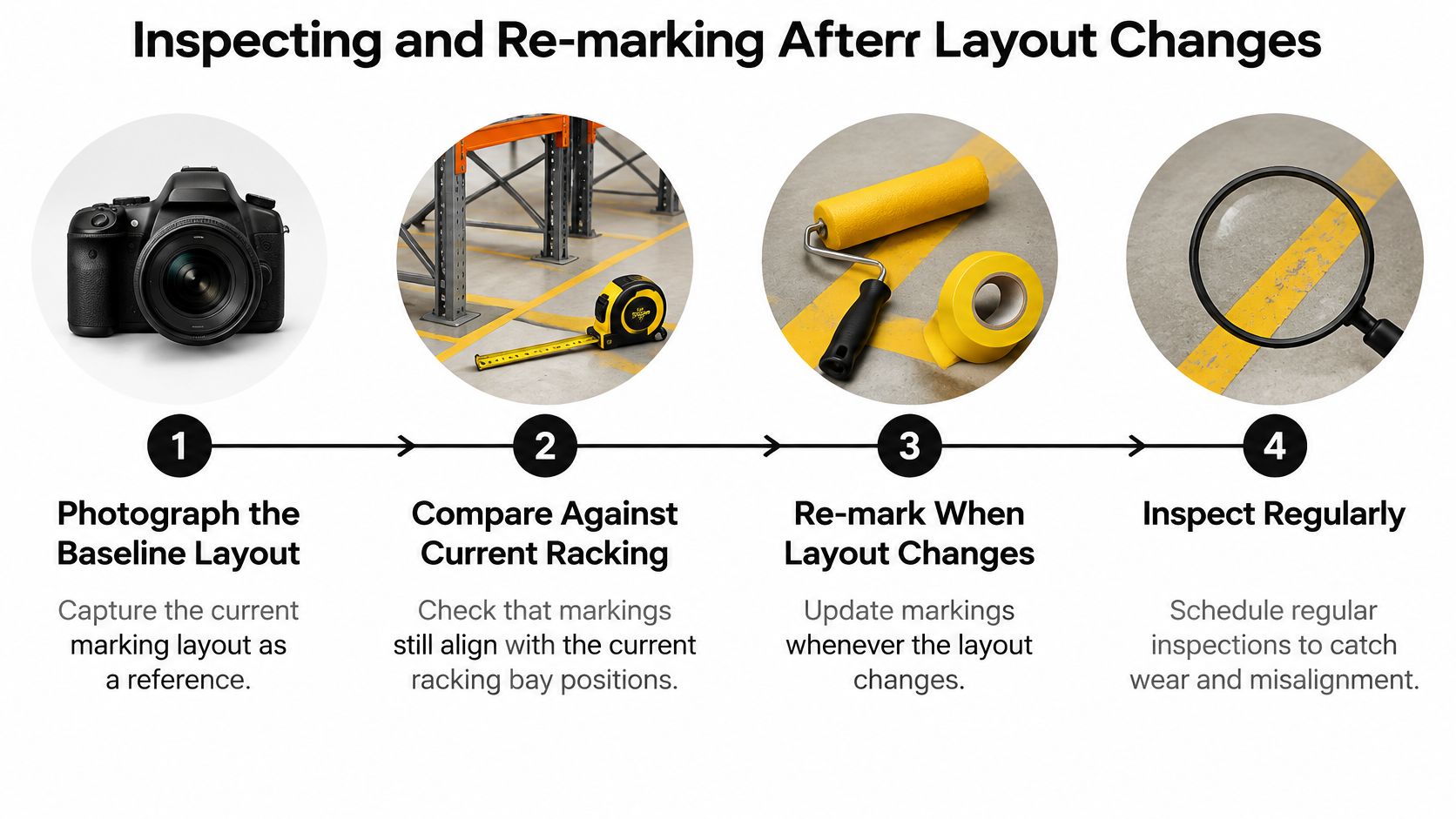
Treat floor markings as a control with a lifecycle, not a one-time installation.
- Photograph the baseline. Capture the layout as installed, from the plan view and from the operator's sightline. It is the only honest record to compare against in eighteen months.
- Inspect on a fixed schedule. Check adhesion, colour and legibility in the traffic lanes first, since wear concentrates there, then work outward. I'd put turning zones and dock entries at the top of that list, because they wear faster than straight runs.
- Reassess after every trigger. A near miss, new racking, an altered forklift route or an automation change all invalidate the old geometry. The review happens then, not at the next annual audit.
- Update the site plan the same day. A marking that no longer matches the plan is worse than no marking, because it creates a false sense of security and invites risky shortcuts.
Separate permanent from temporary. Project and maintenance markings need to come off when the job ends. Leave them up and you create competing instructions in the same aisle, which is how people learn to ignore lines generally. Pull old tape fully rather than cutting it at the new boundary, because a residue shadow or a stray stub reads as a ghost line and confuses the route again.
A bay of pallets moves into a walkway after a process change. A scheduled inspection finds it, the route gets re-marked before the next shift, and the plan gets dated. That is the whole framework: find it early, fix it fast, record it. Give the review a named owner and it happens. Leave it to whoever notices, and the floor drifts back to describing a layout that no longer exists.
Confirm Your Tape Specification Before the Next Layout Change
The next step takes an afternoon, not a budget line. Walk the site this week with the colour legend and the specification checklist, and mark the three worst routes first. Those three tell you where the rest of the roll should go.

Not every identification job belongs on the floor. Equipment stopping points, switchboards and panels hold up better with a rigid engraved label than a taped rectangle, and that's where Evright Industrial does its work. Our production runs on Trotec Laser machines that mark the material directly rather than printing onto it, so the legend sits in the surface and survives the cleaning, abrasion and chemicals that strip a sticker.
The process is built for approval before commitment. Every customer gets a dedicated project manager as their key contact, working to the project's implementation schedule and budget and supplying any required samples for approval before production starts. We also run a sampling service so you can test materials and marking finishes first, and you're welcome onsite to see the production facility. Start by calling, filling in the contact form or dropping into the office. The full detail sits on evright.com.
Evright Industrial engraves the identification that tape can't hold: asset labels, safety signage, switchboard panels and equipment tags, marked in-house with a dedicated project manager on every job and samples signed off before production begins. If a layout change is coming, send us the site plan and the zones you're marking, and we'll tell you which elements are better engraved than taped. Visit Evright Industrial to see the materials and finishes available before you order.
Recent Comments