

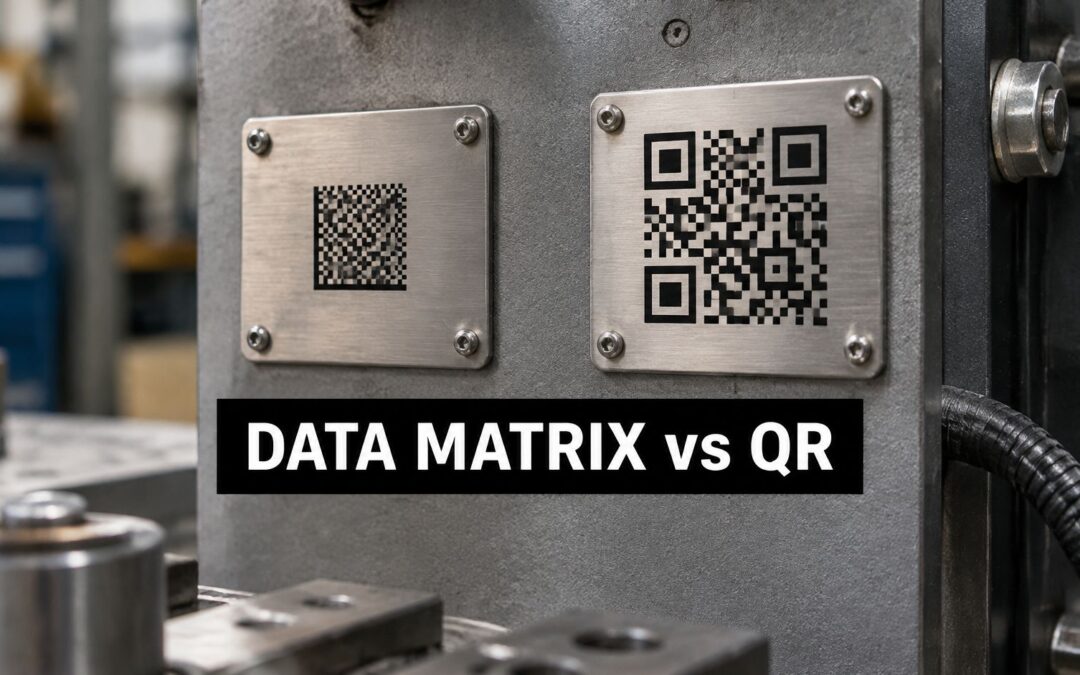
The most repeated piece of advice in this comparison is that you should pick a QR code because every phone camera reads one. For a poster, a menu or a business card, that's true. For the label on a pump, a switchboard or a surgical instrument tray, it's the wrong place to start, because the phone in a visitor's hand is almost never the reader that matters.
The code is decided by four things at once: what the regulator names, what the reader in the field can decode, what the substrate will hold, and what survives the wear test. Get those four in agreement and the format picks itself. Ignore any one of them and you end up with a reprint, a rejected batch, or a plate nobody can scan once the asset is in service.
So here's the working rule before any capacity chart: if the label carries an identifier that a machine reads in a controlled process, start with Data Matrix. If it carries a link a person opens on a phone, start with QR. Most industrial sites end up running both, and this data matrix code vs qr code comparison is about getting the split right rather than crowning a winner.
Data Matrix and QR Code at a Glance
For a small asset label the answer is usually Data Matrix. For anything a person points a phone at, it's QR. That split runs right through Australian industry, and it comes from what each format was built to do rather than from which one is newer.
| Feature | Data Matrix | QR Code |
|---|---|---|
| Largest payload | Up to 2,335 characters (GS1 DataMatrix figure) | Up to 7,089 numeric characters at the largest version |
| Typical use | Compact product, batch and component identifiers | Web links, instructions and public access |
| Size for the same GS1 link data | Smaller symbol | About 2.5 times larger (GS1 Digital Link) |
| Native phone scanning | Often needs an app for GS1 formats | Read by standard phone cameras |
| Error correction | Reed-Solomon ECC 200, fixed by symbol size | Four selectable levels, L, M, Q and H |
| Standards example | GS1 DataMatrix for medicine and product identification | GS1 Digital Link for web-linked product information |
Up to 2,335 characters is the figure GS1 Australia publishes for GS1 DataMatrix, and the same guidance puts a GS1 Digital Link QR code at roughly 2.5 times larger than a comparable DataMatrix because of the URL information it carries. Both numbers describe one trade. Data Matrix spends its area on dense, machine-readable identity and can hold product, batch, date, weight and traceability data in a single compact block. QR spends its area on a web address, which is why a symbol carrying the same product identifier ends up bigger.
Treat those ceilings as specification limits, not design targets. Raw capacity shifts with symbol version, and the largest version of either format is rarely the one you want bolted to a machine frame. The number that matters on a shop floor is how many characters your identifier needs.
The operational difference sits in the two models. GS1 Digital Link is built to connect a product to web-based information and consumer engagement, which is why QR dominates public-facing work. GS1 DataMatrix is built to cram identification keys and traceability fields into limited space.
Australia's retail transition shows both formats in production rather than in theory. By early 2024, a 2D barcode progress update from Matthews Australasia reported that approximately 30 to 40 per cent of fresh produce sold by Woolworths carried a 2D barcode, with Data Matrix named as the GS1 format being adopted for meat suppliers. Both formats are live in Australian supply chains. Which one belongs on your label still depends on whether the primary requirement is compact controlled identification or consumer-facing digital access.
Size and Capacity on Engraved Parts
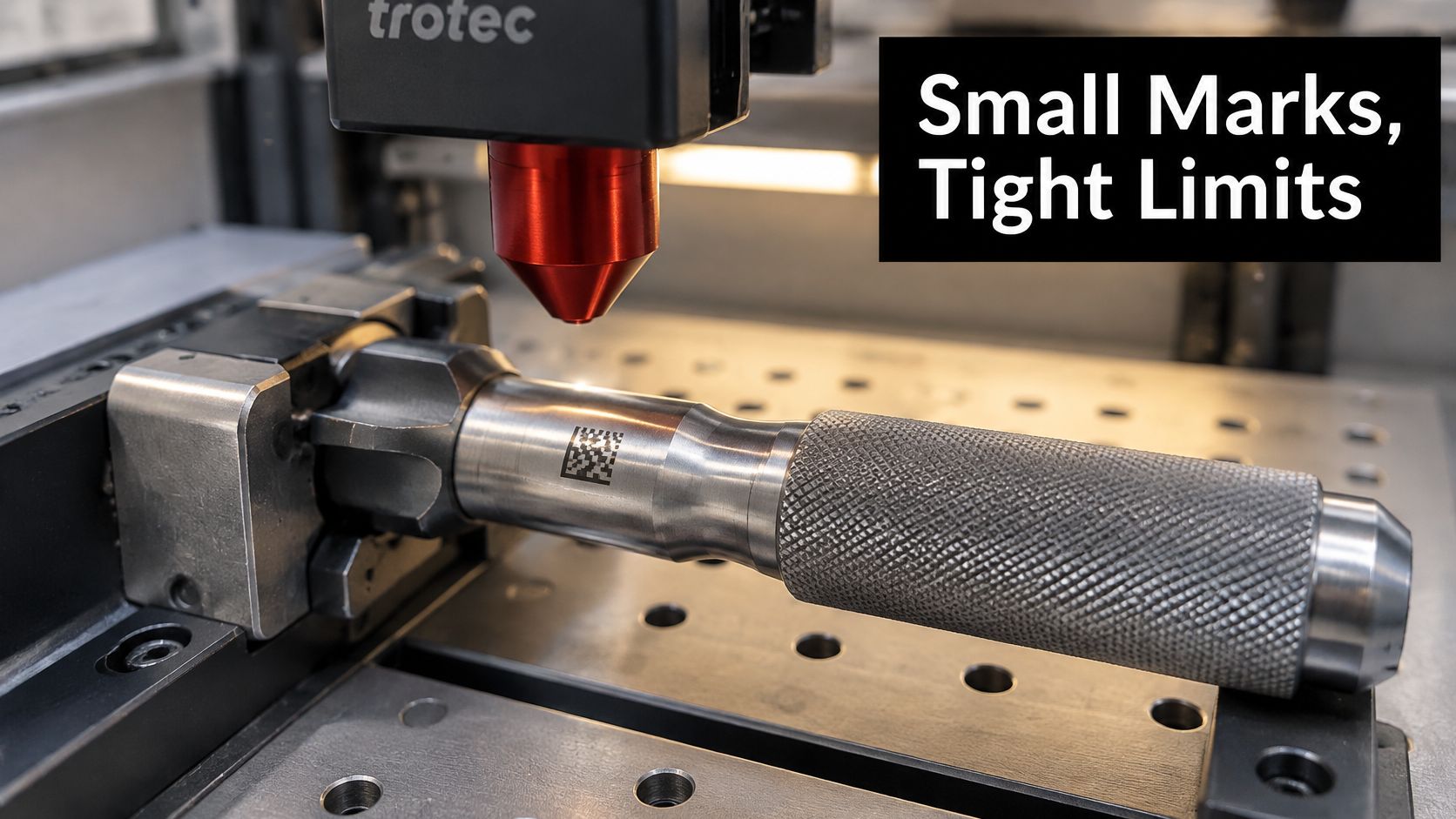
Say a stainless tool handle gives you a flat 8 mm wide and nothing more. That's the constraint people skip: they choose a format first and measure the marking area second, then discover the symbol won't fit.
The payload drives the symbol size, so count your characters before you choose anything. Take a ten-character identifier such as EV-4471-A2. At a 0.5 mm module size, a Data Matrix holding ten characters fits a 14 by 14 module format, so the symbol measures roughly 7 mm across, plus a single module of quiet zone. It sits inside the 8 mm flat with room for a human-readable line beside it.
A QR code carrying the same ten characters needs a 21 by 21 module version at its lowest error-correction level. Add the four-module quiet zone that QR requires on every side and you're at 29 modules, which is about 14.5 mm at the same module size. It doesn't fit. Shrink the module to 0.25 mm to force it into the space and you're asking both the laser and the reader to resolve marks a quarter of a millimetre wide on a curved, polished surface. That's where read rates fall over.
Why module size decides whether the part is markable
Every dark or light square has to be large enough for the laser to mark cleanly and for the scanner to resolve it as a distinct cell. Polished stainless, anodised aluminium and curved shafts all work against that. Heat from the beam spreads slightly into the surrounding material, so a module that looks crisp under a loupe can bleed into its neighbour and drag a symbol grade down.
A Trotec Laser machine marks the surface with a focused beam, and its control over power, speed and focus is what determines how cleanly those small modules form. That control matters more as the module shrinks.
The test part before the production run
Practical rule: engrave one sample on the real substrate at the real module size, then scan it under the lighting it will face in service. A symbol that reads on a bench under office light and fails under a sodium lamp in a plant room was never a good design.
The workflow is short. Measure the usable marking area, set the symbol size from the character count, engrave a test part, and scan that part with the reader you plan to deploy.
If the part is small and the data is an identifier, Data Matrix usually fits and QR usually doesn't. If the code has to carry a long web link on a larger surface, QR becomes practical and the space argument disappears.
Scanning With Phones and Industrial Readers
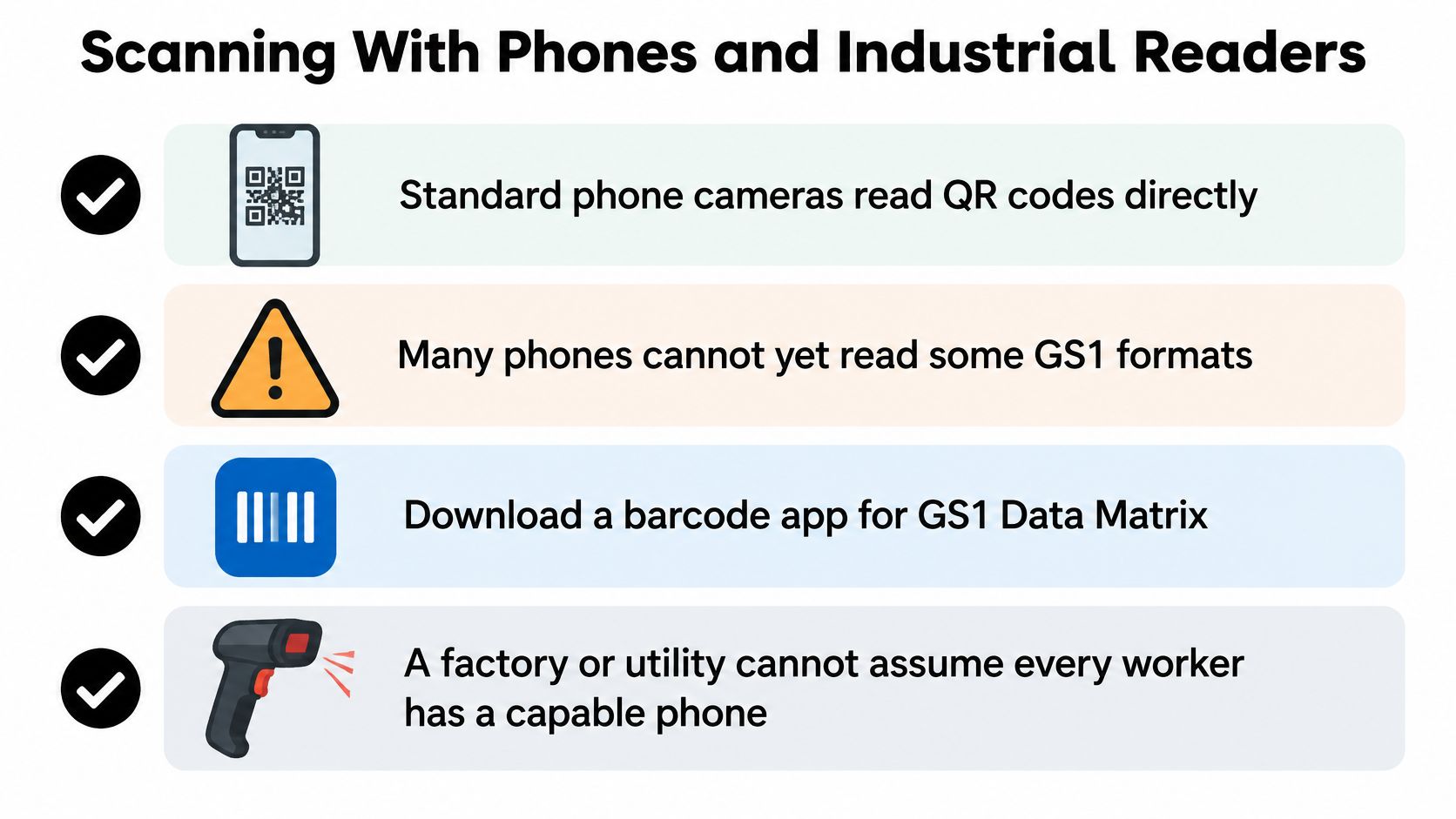
Standard phone cameras read QR codes directly. Many native phone cameras cannot yet read some GS1 formats and may require an app, which GS1 Australia's 2D barcode guidance states plainly. That single fact undercuts the assumption that a QR code is automatically the most accessible industrial choice.
A factory or utility cannot assume every worker has a capable phone to hand, charged, ready for use and loaded with the right app. The scanner plan matters more than the code shape. Fixed-mount imagers handle small Data Matrix symbols well in a set position on a line. Handheld readers and phones suit mobile inspection rounds. What defeats both formats is the same list: abrasion, contamination, poor lighting, glare off metal, curved surfaces and locations with no signal.
The checklist before you order
- Scanner model and format support: check the data sheet for the exact symbologies your label carries, not just "2D capable".
- Contrast between mark and substrate: a pale annealed mark on stainless reads differently from a dark mark on anodised aluminium, and both behave differently again under a torch at an angle.
- Quiet zone: one module for Data Matrix, four for QR. On a small tag the quiet zone is the first thing a designer clips to save room.
- Test scans on the actual part under shop lighting, not on a paper proof under office downlights.
- Offline operation: a handheld that needs a server lookup is a paperweight in a basement plant room.
- A fallback process: manual entry of the identifier, with a named person responsible and a place the entry is recorded.
A code that fails one scan in twenty and has no fallback isn't a labelling problem. It's a maintenance backlog forming quietly behind the asset register.
Where each reader type earns its place
Dedicated imagers are the right tool where an asset passes a fixed point, because the lighting and working distance are controlled. Handhelds and phones win on inspection rounds, where the operator is reading one plate at a time, and where the code is a QR linking to a manual or a test record.
If the QR is carrying a service record or a digital product passport rather than a simple identifier, the page behind the code becomes part of the system. Publishing that page is a separate job from marking it, and QR code passport publishing tools from DPPWare handle the publishing side while the laser handles the durable mark on the part.
QR is usually better for public-facing instructions and smartphone access. Data Matrix is usually better for dense machine-read identity. Neither choice delivers field performance on its own without a workflow that's been tested on the actual part, in actual light, with the actual reader.
Durability and Error Correction on Engraved Labels
Laser engraving puts the mark into the material, so the question changes. It's no longer whether the ink will rub off, but how much of the symbol can be lost before decoding stops.
| Code and level | Approximate damage recovery | Trade-off |
|---|---|---|
| QR level L | About 7 per cent of codewords | Smallest symbol for the data |
| QR level M | About 15 per cent of codewords | Balanced size and recovery |
| QR level Q | About 25 per cent of codewords | Larger symbol, better for abrasion |
| QR level H | About 30 per cent of codewords | Largest symbol, highest recovery |
| Data Matrix ECC 200 | Fixed by symbol size | Not a selectable level |
QR lets the generator choose the strength, so a code built for minimum size runs at level L with the least recovery of any option. Data Matrix doesn't offer that menu. Its Reed-Solomon ECC 200 correction is set by the symbol format, and the result is a fixed floor that suits parts exposed to wear.
What wear actually does to a mark
Industrial assets meet four things that matter: abrasion from handling, solvents and cleaning agents, heat cycles, and oil or dust that fills the light modules and flattens contrast. A code can be structurally intact and still unreadable because the contrast dropped below what the imager needs to separate dark from light.
That's the failure people misdiagnose. They blame the symbol when the problem is mark depth and surface finish. We mark medical items for Unique Device Identification (UDI) traceability, including glass beakers and test tubes, medical instruments, orthopaedic and trauma surgery implants, plastic cannulas and surgical instruments, and those marks have to hold through acids, cleaners, bodily fluids and repeated sterilisation. The mark survives because it's in the material, not on it.
Check the contrast, not just the code. If a scuffed plate reads at 60 per cent of its original contrast, the error-correction level was never the limiting factor.
Running the wear test
Engrave a sample on the production substrate, then put it through the regime the asset will face. Wipe it with the solvent the cleaners use. Abrade it the way a part bin abrades it. Run the heat cycle if it's going near a process. Scan after every cycle and record what passes and what doesn't.
Our engraved metal labels are marked for exactly this kind of service, and the test is what tells you whether the design holds.
The trade-off doesn't disappear. A higher QR level, or a Data Matrix sized for more correction, usually means a larger symbol. Durability and marking area pull against each other, and the test is how you find the point where they balance.
Regulated Medical Labelling in Australia
Here's the part most comparisons leave out. In Australia the format can be decided by regulation rather than by technical preference, and a visually similar QR code can still fail the requirement.
Under TGO 106, the Therapeutic Goods Administration requires a code carrying a Global Trade Item Number to use GS1 DataMatrix when the product is serialised or includes that GTIN, as set out in the TGA's guidance on serialisation and Data Matrix codes for medicines. Data Matrix suits that job because its error correction keeps marks readable when packaging is irregular or damaged, and the TGA notes it can be printed at high production speeds.
| Case | Carrier required | Role of QR code |
|---|---|---|
| Serialised medicine under TGO 106 | GS1 DataMatrix carrying the serial number | QR may sit alongside as an additional carrier |
| Medicine carrying a GTIN | GS1 DataMatrix | Optional additional carrier |
| Web link or instructions only | Not a regulated carrier | Suitable for this purpose |
| Medical device marked for UDI traceability | Check the applicable device rules | No mandated role under TGO 106 |
Where a QR code fails the requirement
The TGA is explicit that a QR code is not considered a Data Matrix code, and the TGA guidance on understanding serialisation and data matrix codes spells out the consequence. If a QR code uniquely serialises an individual medicine unit, a GS1 DataMatrix containing the serial number must also appear on the label. The QR can stay as an extra carrier. It cannot substitute.
TGO 106 applies to medicines supplied in Australia when they are serialised or when a Data Matrix containing a GTIN is used, and it commenced for relevant medicines released from 1 January 2023. That date matters because it moved the requirement from guidance into force.
The mismatch that breaks traceability
Two codes, one truth. Whatever the DataMatrix says, any other machine-readable information on that label or pack has to agree with it. A mismatch is a traceability failure regardless of which carrier holds the wrong data.
Device UDI is a separate framework from TGO 106, and the rules that apply to a device's marking aren't the same rules that apply to a medicine's carton. Medical items we mark for UDI traceability sit in that world, and we work from the customer's drawing and their notified body's expectation rather than assuming the medicine rule transfers across.
For a label carrying both codes, the split is straightforward. DataMatrix carries structured identification. QR carries a webpage, instructions or electronic product information. Both can live on one durable plate, provided the encoded data agrees.
This describes the framework, not legal advice. Check the current TGA guidance and take your own regulatory advice before you sign off on a label, and use our medical device labelling requirements page as a starting point for the marking side of the question.
Use Cases Across Australian Industries
Asset labelling is routine work in most of the sectors we serve, and the format question resolves quickly once you name the reader. Manufacturing, electrical, essential services, health services, mining, construction and machines all land somewhere on the same map.
| Sector | Recommended code | Reason |
|---|---|---|
| Manufacturing machine frames | Data Matrix | Serial or part number in a small area |
| Electrical and switchboard components | Data Matrix plus QR | Identifier on the part, QR linking to the maintenance record |
| Mining and construction parts | Data Matrix | Abrasion and solvent resistance tested before use |
| Essential services and infrastructure assets | Data Matrix for identity, QR for signage | Traceable asset ID and public access to information |
| Meat and fresh-produce supply chain | Data Matrix (GS1 format) | Adopted by meat suppliers in the GS1 transition |
Where each sector lands
On a manufacturing floor, a machine frame or a component gets a Data Matrix holding a serial or part number, because the surface area is small and the reader is fixed or handheld in the operator's hand. Nothing about that job needs a web address.
A switchboard is the clearest hybrid case. The component identifier goes into a Data Matrix on the device, and a QR on the panel door or the equipment schedule opens the maintenance history and test records on a technician's phone. Two codes, two readers, one asset.
Mining and construction parts go the other way. Abrasion, dust and solvents mean the marking survives or it doesn't, so Data Matrix plus a wear test is the default. A QR only earns its place where a web link adds something a technician can't get from the identifier.
For essential services and infrastructure, identity and public access are separate jobs. Data Matrix gives traceable identity on the asset itself. QR suits signage that directs a member of the public or a contractor to information. We supply identifying markers for defence and essential services items, and the split between identity and information is what drives the design.
Why staff now expect a QR somewhere
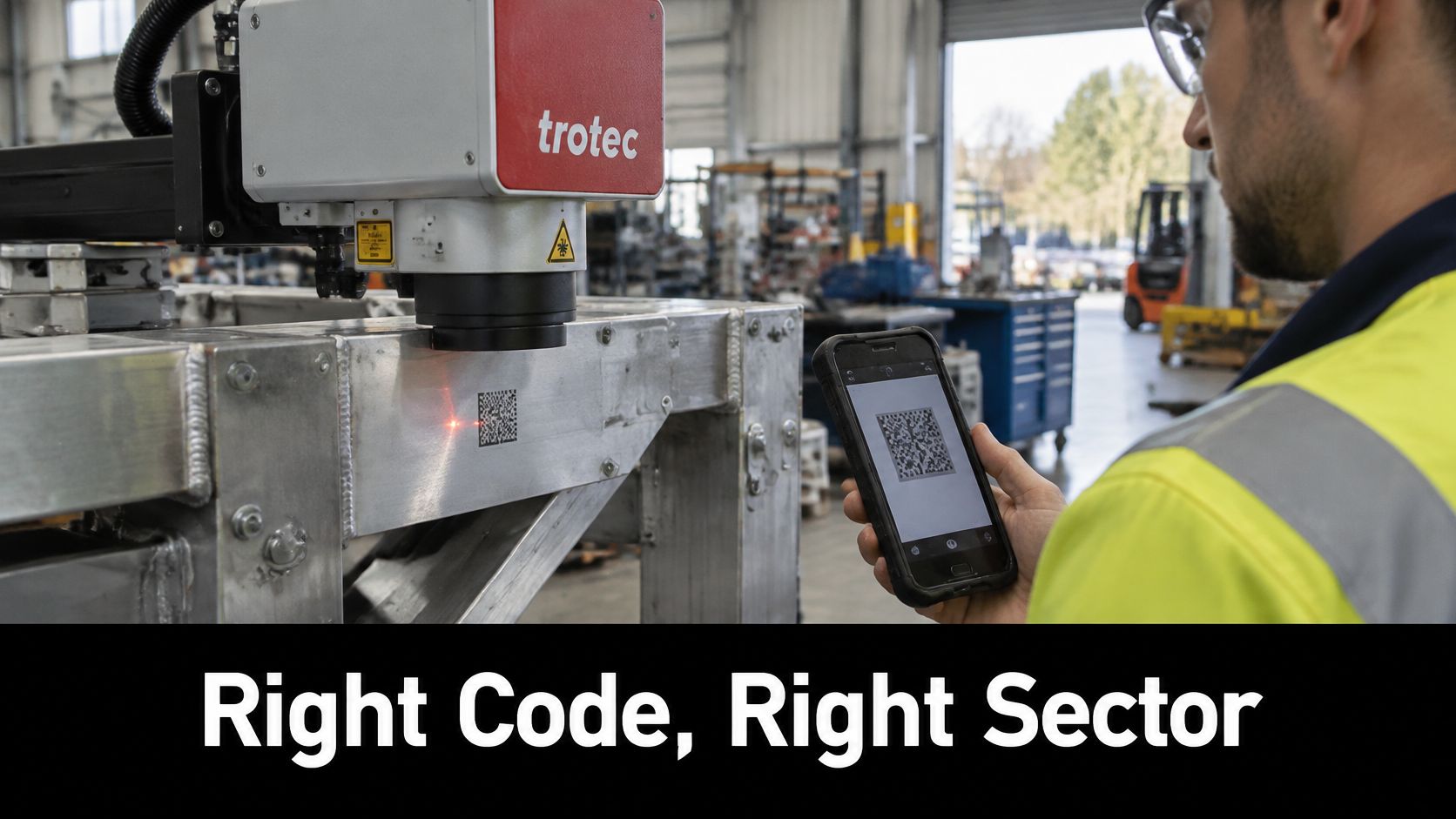
Adoption has moved fast. A 2024 Australian QR code industry report stated that more than 70 per cent of Australian businesses had implemented QR codes in some capacity, compared with 40 per cent in 2021. Your technicians and contractors are now conditioned to point a phone at a code and get a page.
That expectation shapes design, not just marking. If a maintenance team is generating codes in bulk for a register of assets, QR code ideas for marketing teams from APITemplate.io covers batch generation and templating, which is the same mechanical problem whether the code ends up on a brochure or a switchboard schedule.
The supermarket transition has already pushed 2D symbols onto meat and produce lines, so the scanning hardware and the staff habits exist. The remaining decision is per asset, and it comes down to what the code has to do.
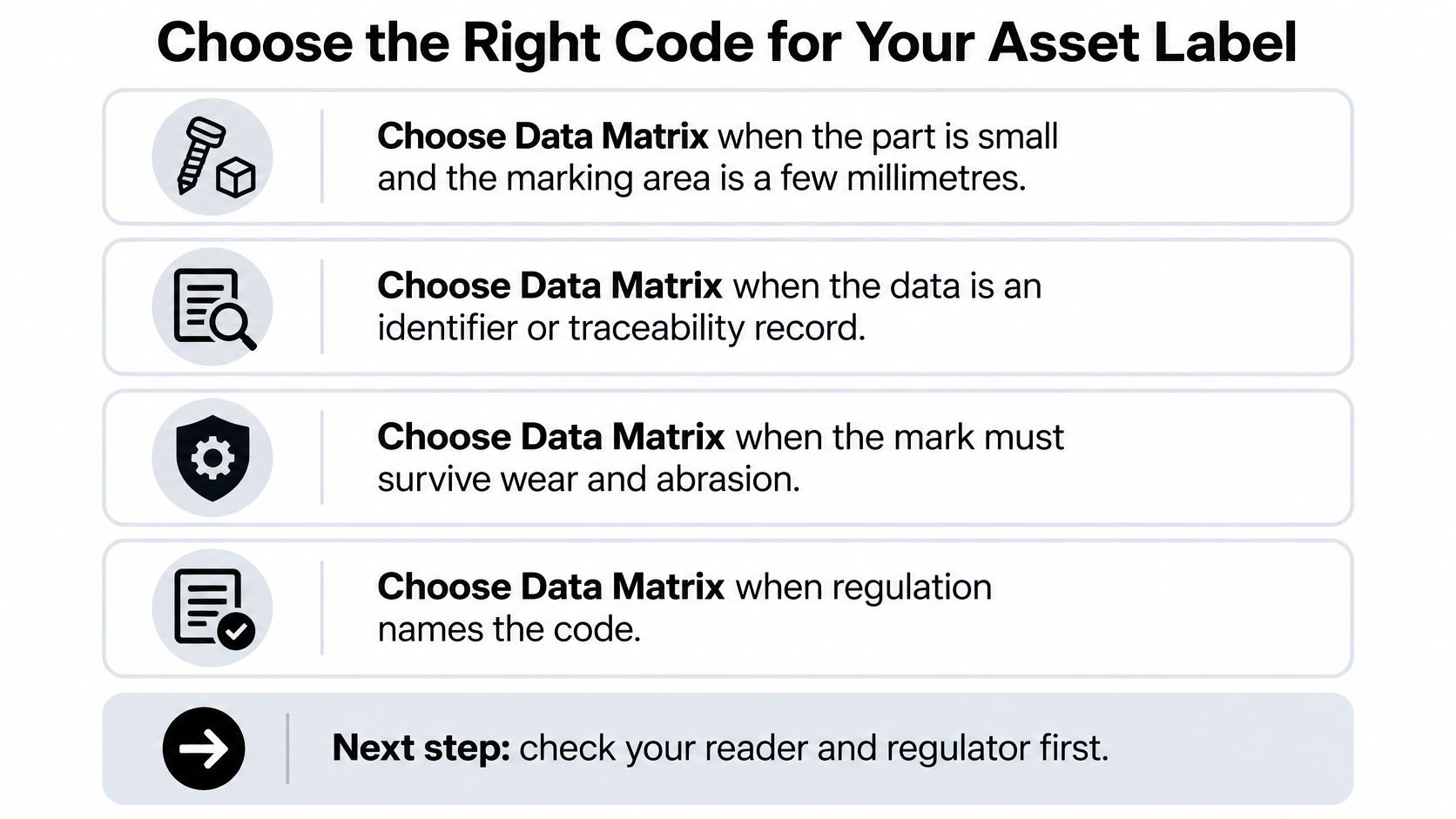
Choose the Right Code for Your Asset Label
Four verdicts cover most of the ground, and each one points back to a check you can run before you spend anything.
- Choose Data Matrix when the part is small. If the marking area is a few millimetres, the QR quiet zone alone will eat the space.
- Choose Data Matrix when the data is an identifier or a traceability record, because that's what the format is built to carry densely.
- Choose Data Matrix when the mark must survive wear, since ECC 200 gives you a fixed correction floor rather than a level someone forgot to set.
- Choose Data Matrix when regulation names the code, and TGO 106 names it for serialised medicines and GTIN-carrying medicine labels.
Go the other way for QR when the label has to open instructions, a service page or a record on a phone, and the marking area is generous enough to hold the symbol at a readable module size. Choose both when identity and information both matter, provided both codes carry consistent data. That hybrid is where most sites end up.
The checks before you order
Confirm the regulatory requirement first, because it overrides everything else. Measure the usable marking area and count the characters you need to encode. Test the scanner on the actual substrate under the actual lighting. Run the wear test on a sample before the production run. Four checks, none of them expensive, and each one kills a decision that would otherwise fail in service.
How laser marking produces the label
Evright Industrial is a division of Evright, the Australian laser engraving and awards business, and our focus is laser engraving for asset labelling and industrial engraving. A focused beam marks the material surface to create a permanent, high-contrast mark, and a Trotec Laser machine controls power, speed and focus so small modules engrave consistently across a batch. Because the mark is in the material rather than printed on top of it, it doesn't lift, fade or peel when a part is cleaned, handled or put through a process.
We produce asset labels for manufacturing, electrical, essential services, health, mining and construction work. Send us the marking area, the material and the identifier you need to carry, and we'll tell you which format fits the space and what module size will read reliably.
Evright Industrial laser-engraves asset labels, tags and plates carrying a Data Matrix, a QR code or both, with the mark set into the substrate instead of printed over it. If you're weighing the reader, regulator, substrate and wear test for one specific part, send through the marking area and the identifier you need to encode and we'll tell you which format fits. Visit Evright Industrial to talk through label size, material and scanning conditions for your project.
Recent Comments