
February in Townsville: 33°C, humidity you can feel through a shirt, and someone standing in a plant room with a torch, trying to read an asset number that was engraved five years ago. The text has gone chalky. Most of the characters are still there. The last four digits aren't.
Or the plate itself is fine and the adhesive isn't, so it's curled off the tank and into the drain channel. The engraving didn't fail. The specification did, and it failed about three years before anyone noticed.
That's the question behind most laser engraving Townsville enquiries, and it isn't answered by a material name alone. It's answered by matching an application to a material, an exposure type and a set of evidence you demand before you place the order. Here's the version of that I'd hand a maintenance planner on day one.
Matching Material to Application and Tropical Exposure
Start with the application, not the substrate. A pump label inside a wet well and a plaque on a memorial wall are both described as "engraved", and that single word tells you nothing about whether either will still be readable in eight years.
| Application | Typical material | Main durability demand | Mark type |
|---|---|---|---|
| Asset labels for plant and switchboards | Anodised aluminium or stainless steel | Abrasion, cleaning and heat | Engraved, high-contrast mark |
| Safety signage | Plastic or acrylic | UV exposure, handling and visibility | Engraved or colour-changed mark |
| Switch plates and panels | Plastic or acrylic | Daily handling and cleaning | Engraved mark |
| Memorial plaques | Brass or stainless steel | Long-term outdoor display | Engraved mark |
| Stamping stencils | Rubber | Repeated ink contact | Engraved mark |
| Branding | Leather | Handling wear | Engraved mark |
| Medical equipment | Stainless steel, grade confirmed with the supplier | Sterilisation and bodily fluids | Permanent engraved mark |
Townsville writes the durability spec for you. The Bureau of Meteorology's Queensland annual climate summary records Townsville Aero's 2025 annual rainfall at 2,950.8 mm, which is 258% of its average, with an annual mean maximum temperature of 30.0°C, 1.0°C above average. Heat and water attack a label from opposite directions: thermal cycling and UV go for the substrate and any applied colour, while constant moisture and flood events go for the adhesive and every unsealed edge.
Five exposure types to sort every asset into
Most failures trace back to one mistake: treating an entire site as "outdoor" and buying one material for all of it. Split the site into five groups instead.
- Indoor switchboard labels. Anodised aluminium or a rigid engraving laminate in a matt finish, screwed or riveted wherever the panel allows it. Switchboards cycle through heat under load, and an adhesive that creeps at 40°C lets go long before the engraving fades.
- Permanent external asset plates. 1.5 mm stainless steel, or anodised aluminium at the same gauge, marked to a real depth rather than a surface colour change, with stainless rivets or fasteners. Thin plate bows at the corners when it's pulled down hard.
- Coastal or chemical-service locations. 316-grade stainless steel, or a laminate confirmed against the specific chemical on site. Salt spray and caustic splash are different problems and they don't take the same answer.
- Washdown areas. Sealed edges, mechanical fixings, no paper-faced laminate, and an inspection point in the commissioning checklist after the first few washdown cycles.
- UV-exposed signage. A mark that comes from the substrate rather than an applied colour. Colour change on stainless steel holds where a printed or dyed surface chalks out.
Where the asset gives you nothing flat to fix to, such as a lagged pipe, a rolled cladding sheet or a valve with an awkward stem, the label problem becomes a bracket problem. Reading the 3D printing material options from American Additive Manufacturing before choosing a filament is worth ten minutes, because ASA and PETG behave very differently after a North Queensland summer.
The evidence to request before you order
A workable benchmark comes from Queensland Health's laser and IPL labelling guidance, which requires equipment labels to remain durable, permanently attached, legible and visible during operation. Strip out the radiation context and it's a fair test for any industrial plate: the mark has to keep doing its job after the environment has spent a few years on it.
Ask for five things in writing.
- A sample on your actual substrate and finish, not a generic demo plate.
- An abrasion test on that sample, using the cleaning method your team really uses.
- A chemical-cleaning check against the solvents and washdown agents on site.
- Dimensional verification of text height, symbol size and hole positions.
- A barcode or serial-number readability test at the mark's full service depth, not at maximum contrast.
Before you order, write three lines per asset: the application, the environment and the required service life. Match each asset to one exposure type, then order against that. The discipline behind asset tracking labels is exactly this, and it's the discipline to ask any supplier to demonstrate.
How Laser Engraving Works on Industrial Parts
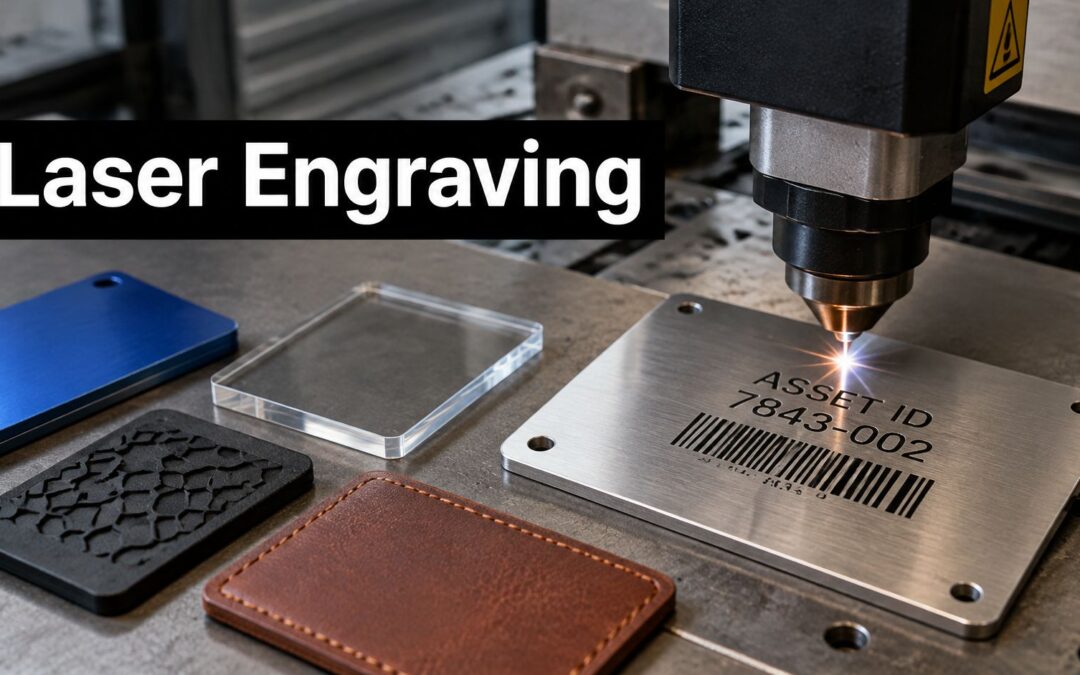
A compliance plate on a Townsville pump skid gets hosed, scrubbed and left in salt air. The mark has to sit in the surface, not on a sticker that peels off after the first wet season.
Trotec Laser's explanation of how laser engraving works sets out the mechanism: depending on exposure time, the beam either changes the material's colour to create contrast or vaporises and burns a microscopic surface layer. That mark is permanent and highly resistant to abrasion, so it stays readable on plates that get scrubbed, kicked and hosed.
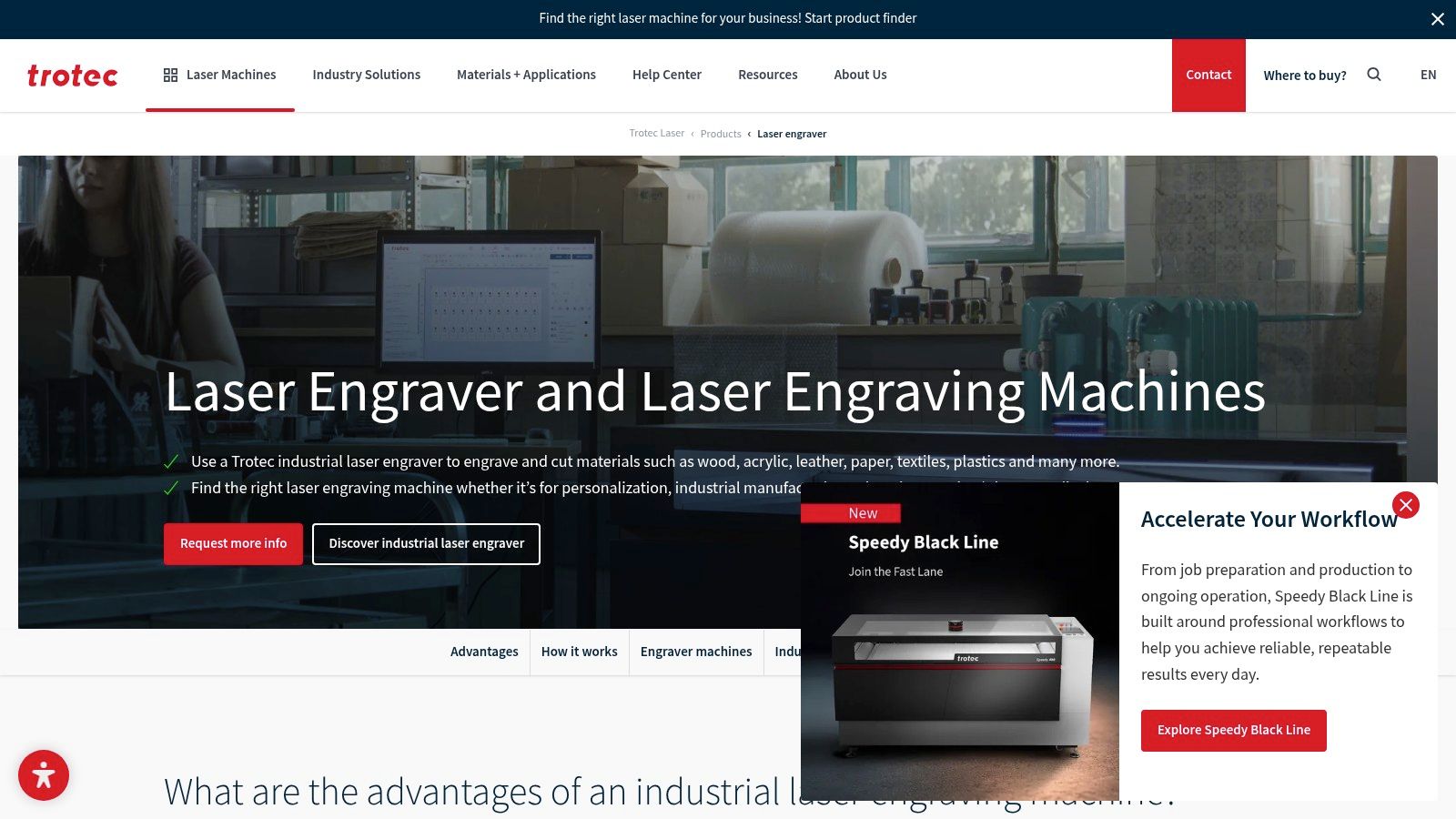
The machine class behind those marks looks like this.
The workflow, step by step
- Supply or approve a digital design. Usually a vector file, carrying line thickness, patterns and power settings. Everything downstream is a translation of this file, so an error here is a permanent error on the part.
- Convert artwork into machine instructions. Design software turns the file into movement and pulse commands the laser head can follow. An unclosed vector path or a stray hairline becomes a stray mark on the plate.
- Place and position the material on the Trotec Laser bed. Focussing and alignment happen here. Focus sets both contrast and how much of the surface the beam changes.
- Let the head follow the file. The beam pulses across the surface in a controlled pattern, removing, carbonising, oxidising or colour-changing the material depending on what it is.
- Inspect before release. Check contrast against the approved sample, verify text height and symbol size, and test the barcode or serial number. Nothing leaves until it passes.
Non-contact processing changes the economics and the finish. In most cases there is no clamping or vacuum fixation, no chips, comparatively little dust, and no cutter or drill that wears out partway through a batch. Mark five hundred tags and the five-hundredth looks like the first, because the tool never dulled.
Evright Industrial's published laser engraving workflow runs on this logic: artwork is received or prepared, the component is positioned, and computer-controlled Trotec Laser equipment applies the approved identification. Fibre laser marking is used for permanent, high-contrast asset tags, compliance plates and part marking without compromising the material's strength. Trotec's industrial systems mark anodised aluminium, coated metals, plastics, acrylic, wood, glass, rubber and textiles. One listed configuration provides a 1,248 × 624 mm work area with speeds up to 4.3 m/s and sources from 50 W fibre to 80–120 W CO₂, per Trotec Laser's industrial engraver range.
Gauge still catches people out, but cutting settings are the wrong reference. Matching thickness to laser cutting speed is about severing stainless in a pass. Engraving does not do that. Exposure time and focus decide whether you get a colour change or a thin removed layer. I treat extra depth on thin stock as a heat risk: chase a groove and you can distort the plate, while a shallow, high-contrast mark is what stays legible after washdown.
Check your artwork file and line weights before you send it. The machine follows the file exactly, including the mistakes.
Why Townsville Industry Needs Durable Engraved Labels
The demand here isn't speculative. It's counted.
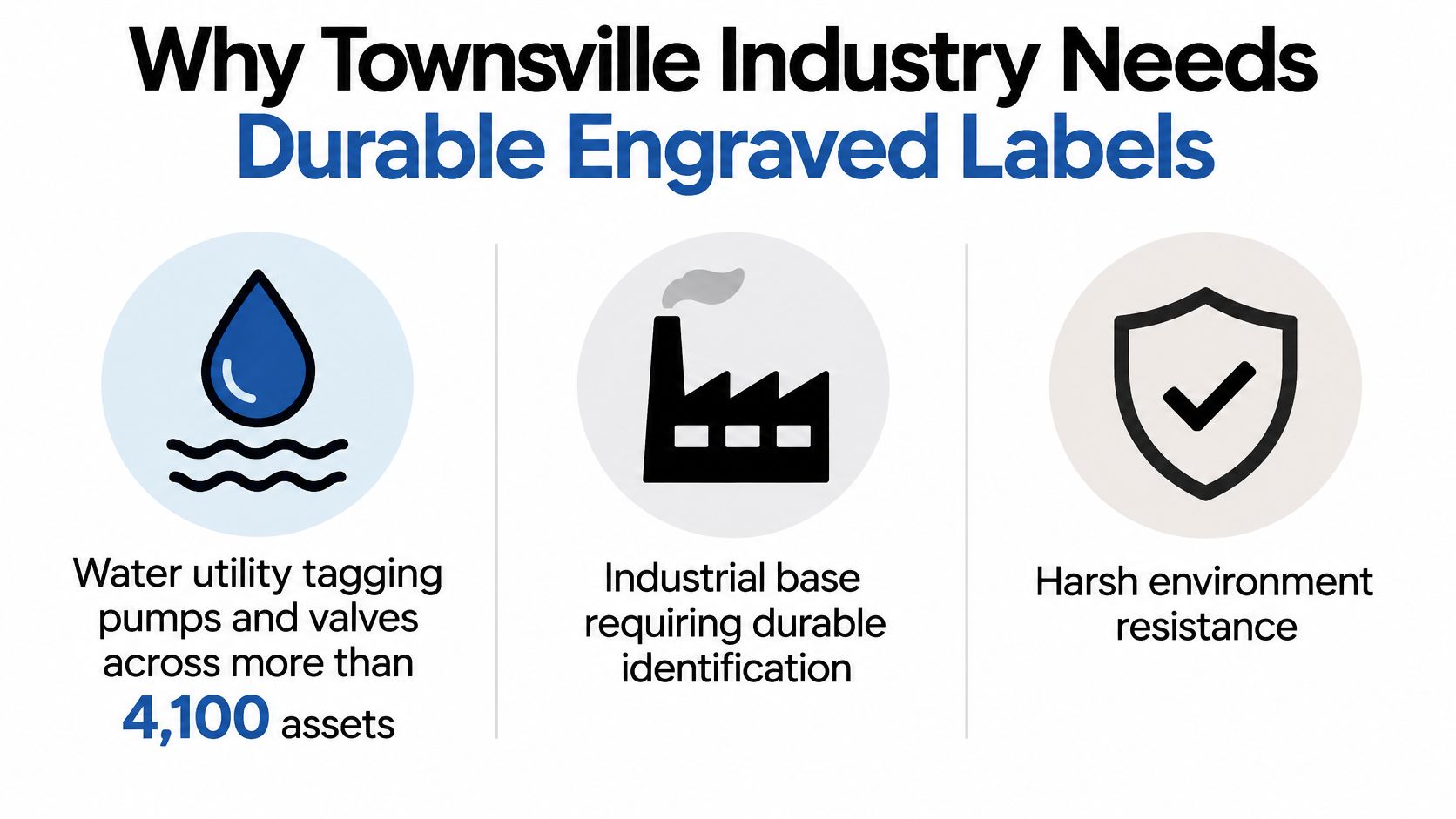
Townsville City Council's corporate plan reports an official population of 204,541, projected to reach 264,899 by 2046, growth of roughly 29.5%, alongside more than 4,100 kilometres of water and wastewater mains, 1,100 kilometres of stormwater networks, 2,221 kilometres of kerb and channel, over 600 kilometres of footpaths and 984 bus stops. Every one of those assets eventually needs an identifier a person can read in the rain, at night, with wet hands.
Three programmes that carry most of that load:
- A water utility tagging pumps, valves and isolation points across the mains network, where a misread tag means the wrong line gets shut or drained.
- A council marking street furniture, bus stops and depot plant, where labels are exposed continuously and replaced on a maintenance cycle rather than a project schedule.
- A healthcare or aged-care site identifying equipment and hazard zones, where the label has to survive repeated cleaning rather than weather.
Manufacturing and resource processing add the harder cases. The Townsville economic scorecard identifies manufacturing as 6.4% of the city's economic activity and names three minerals-processing operations, the Yabulu nickel operation, the Sun Metals zinc refinery and the Glencore copper refinery, plus the JB Swift Townsville Meatworks with capacity for approximately 900 head of beef cattle per day. Refineries and meatworks are full of pipes, control panels, isolation points and maintenance assets that all need to be identified the same way in year ten as in year one. Australia's Jobs and Skills Atlas put Townsville at approximately 5,400 manufacturing jobs in November 2024, 4.6% of regional employment, so the people maintaining those assets are a substantial local workforce.
Asset marking also has a security function. Protecting tradie tools from theft from ABCO Security Services Australia covers why a permanent, recorded identifier raises the odds of recovery, and the same principle applies to plant that walks off a site.
Run this test before you buy anything. List the five assets on your site that most need a permanent label, then ask which of them would be lost, misread or shut down incorrectly if the marking faded in heat, rain or washdown. That list is your specification. Evright Industrial serves companies across Australia from its manufacturing facilities in Adelaide and South East Queensland, so that list travels well.
Laser Safety and Compliance Checks Before You Buy
A fitter in a Townsville shed lines up two engravers, reads the wattage stickers and takes the bigger number. That choice misses the hazard the person at the machine encounters.
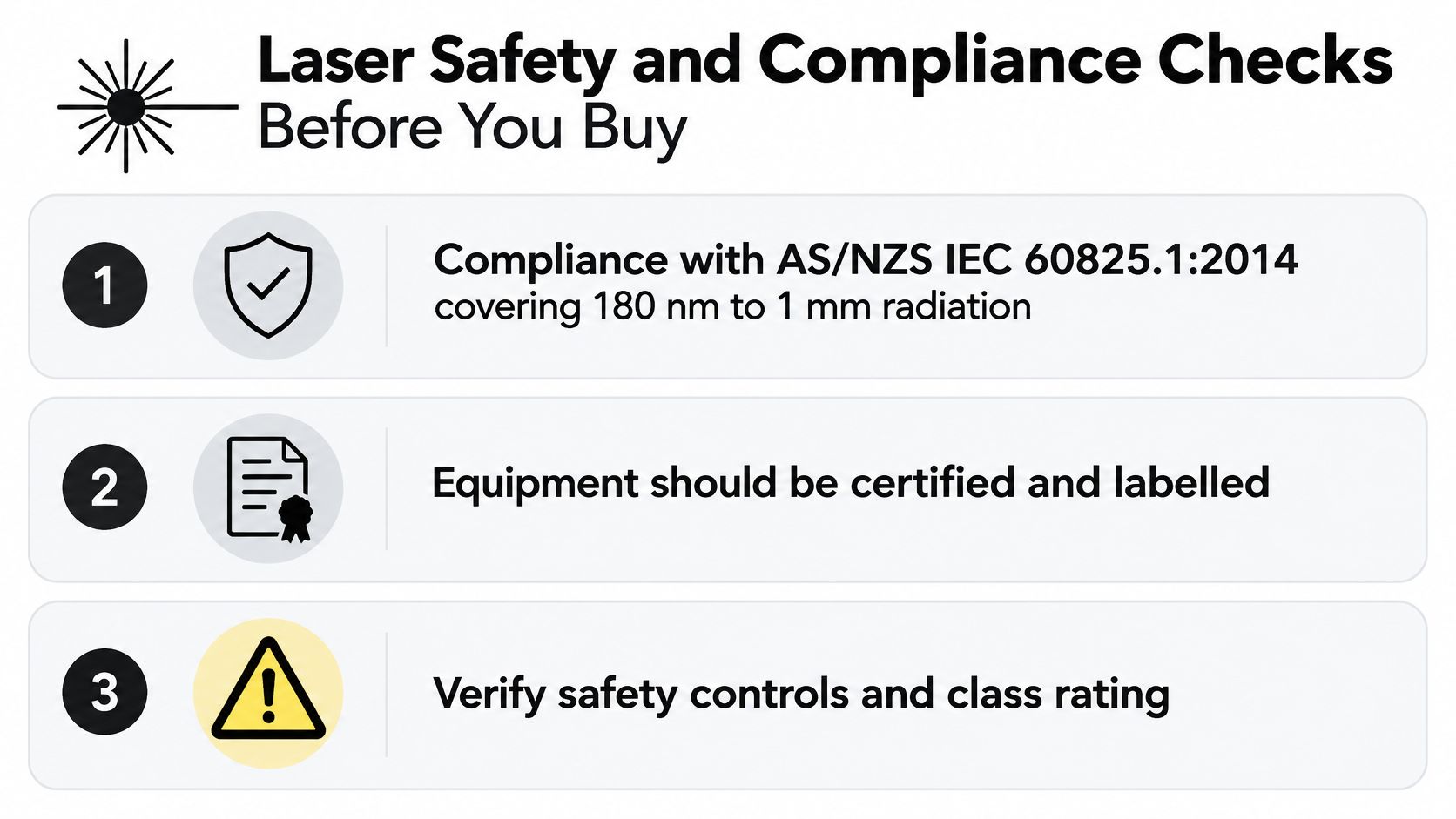
Class is the buying specification. Wattage only says how fast the beam works. Australia's framework is AS/NZS IEC 60825.1:2014, which covers laser products emitting radiation from 180 nm to 1 mm and classifies equipment by accessible optical-radiation hazard, as set out in ARPANSA's laser guidance. Classification drives the engineering controls, operating procedures, warnings and user information the supplier must provide. Higher accessible emission raises the risk of eye or skin injury, and it can ignite combustible material while the mark is being made.
Match three things before you order: the material the job needs, the exposure an operator will face, and the paperwork that proves the machine is controlled. Trotec lists the Speedy 100 laser engraver as a Class 2 system with a 610 × 305 mm working area, a 170 mm maximum workpiece height and CO₂ power from 30–80 W. An enclosed Class 1 production system reduces operator exposure under reasonably foreseeable operation even when the source inside is far more powerful. Service, alignment and maintenance modes on either machine still need controlled procedures and competent people. Evright Industrial's production uses laser machines from Trotec Laser, so pin the class of the machine that will run the job.
Ask for this evidence in writing, and attach it to the tender rather than the invoice:
- Laser classification of the equipment used for your job.
- Operating wavelength, because it determines what the beam will mark and what it will not.
- Interlocked enclosure details, including what happens when a panel is opened mid-cycle.
- Maintenance controls, including who is authorised to align or service the source.
- The full safety documentation, not a one-page datasheet.
Place safety-critical information where it can be inspected without putting anyone in the beam. A permanent plate screwed inside a guarded panel is a plate nobody can read safely, so put the same information on the external face. Evright Industrial's laser safety standards follow that paperwork discipline on every job.
What to Put on an Industrial Label
A stainless tag can stay readable after six Queensland wet seasons and still be useless. The usual failure is a clean engraving that carries only a plant number retired two years earlier. Settle the wording before you argue about gauge, fixing or finish.
| Label field | Where it should sit | Why it matters |
|---|---|---|
| Asset ID | Engraved on the plate | Links the label to the asset register |
| Equipment description | Engraved on the plate | Identifies the item at a glance |
| Hazard or isolation warning | Engraved, human-readable | Must be readable without a phone or connection |
| Responsible department | Engraved or held on the register | Shows who owns the asset |
| Inspection status | Register or replaceable tag | Changes over the asset's life |
| QR code to SOPs and service history | Secondary to the engraved warning, linked to the register | Needs version control when procedures change |
Treat that table as the specification, not a menu. For each row, match the field to the plate material, name the exposure (switchboard, washdown, coastal sun, chemical service), and ask for a sample on the actual substrate before you order a batch. A mark that looks sharp on a showroom coupon can lose contrast once the plate sits in salt air or under a UV-exposed sign.
Fields that must survive a power cut
The engraved plate should carry the fixed facts. Asset ID, equipment description, and the hazard or isolation warning belong in the metal. A contractor in an emergency needs them with wet gloves and no signal. Australian guidance in the AIMS industrial safety tag guide points to AS 1319 as the workplace safety-sign standard, alongside requirements spanning electrical test-and-tag, lockout/tagout, confined spaces, lifting equipment and chemical hazards. None of those obligations pause because a QR link has expired.
I would put the isolation point on the plate itself. A plate that carries everything except that point is a plate that gets walked past. Department names can sit on the register when they change with every restructure. If the name is stable and someone must see it without a login, engrave it.
What belongs on the register instead
Inspection status changes. So does the procedure a technician needs at the point of work. That is the case for a QR code, and for its limits.
A code earns its place on a site with reliable coverage, where it opens service history, SOPs, commissioning documents and certificates. It fails in dusty processing areas, wet plant rooms, basements, and any emergency where the reader has no working phone or no time to scan. Assets get relocated, procedures get revised, and links get retired. Each of those leaves a plate that resolves to nothing or, worse, to an old document someone now treats as current.
The workable model is hybrid. Permanent human-readable engraving covers everything safety-critical. The register owns the changing data, and it controls the QR destination rather than leaving a printed link to go stale. Custom equipment ID tags are the fixed half of that split: the asset ID, the description and the warning stay on the plate after the paperwork has moved on. Before you approve a run, ask to see that sample under the exposure the plate will face.
Request a Tailored Engraving Quote from Evright
A quote is only as good as the information behind it. Send these six items and the reply will be a specification rather than a price guess:
- The artwork file, vector where possible, with line thickness, patterns and power settings if you know them.
- The material or application, matched against the table earlier in this article.
- The exposure type, indoor switchboard, external plate, coastal or chemical service, washdown or UV-exposed signage.
- The required service life, in years, because that drives gauge and fixing choices.
- The standard it must satisfy, whether that's a labelling requirement, AS 1319 signage or an internal asset register scheme.
- The quantity, including how many spares you'll want for replacements and new assets.
Our engraving runs on Trotec Laser machinery, so you can ask for the workflow already described: an approved design file, machine instructions generated from it, a beam that follows the file precisely, and an inspection gate before anything is released. Start a project by calling 08 8231 2746, emailing sales@evright.com, completing the contact form, or dropping in to the office at 28 Blenheim Street, Adelaide. Those details are also listed on the Evright website if your procurement team needs them in writing.
Ask two more questions before you commit. Can a sample be produced on the actual substrate, and can you test marking finishes against it? We run a sampling service for exactly that, and customers can be invited onsite to see the production facility and how the mark is applied.
No full batch order until the sample passes the abrasion and readability checks for its exposure type. That single rule prevents the majority of long-term label failures.
Evright Industrial produces laser-engraved asset labels, equipment ID tags, safety signage and plaques for manufacturing, utilities, healthcare and memorial work, running Trotec Laser machinery from facilities in Adelaide and South East Queensland and shipping across Australia. The team can mark a sample on your own substrate so you can test the mark against abrasion, cleaning and UV before you commit to a batch. Send your artwork, exposure type and service life through Evright Industrial and ask for a material and marking specification in return.
Recent Comments