
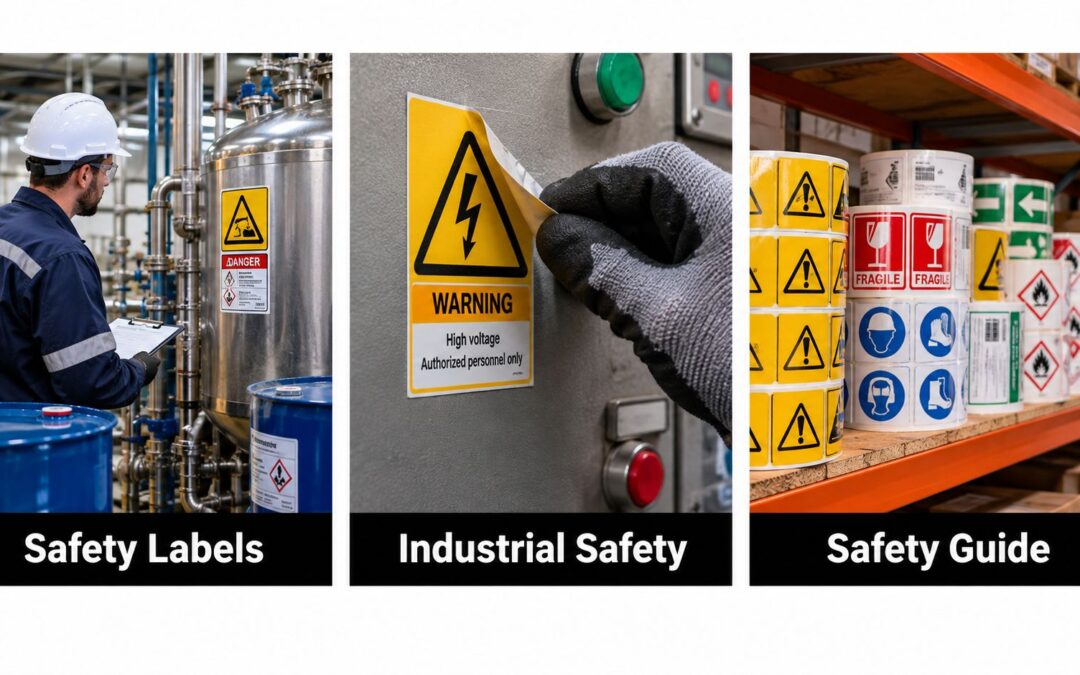
AS 1319 is Australia's foundational workplace safety-sign standard, published in 1994. Durable industrial safety labels have to match the specific hazard and environment, not just look tough.
A maintenance tech can walk into a plant room, see faded drum markings, a pipe tag that contradicts the drum label, and an emergency sign that's half-hidden behind a trolley. That's usually when people realise the problem isn't the label's age, it's that the label stopped communicating clearly before anyone replaced it.
Why Industrial Safety Labels Matter More Than You Think
A bad label rarely fails loudly. It fails the first time someone makes a fast decision under pressure and trusts the wrong sign. In a busy workshop, that might mean a fitter reaches for the wrong drum, or a contractor follows an old pipe tag into the wrong aisle because the information looked familiar enough to be trusted.
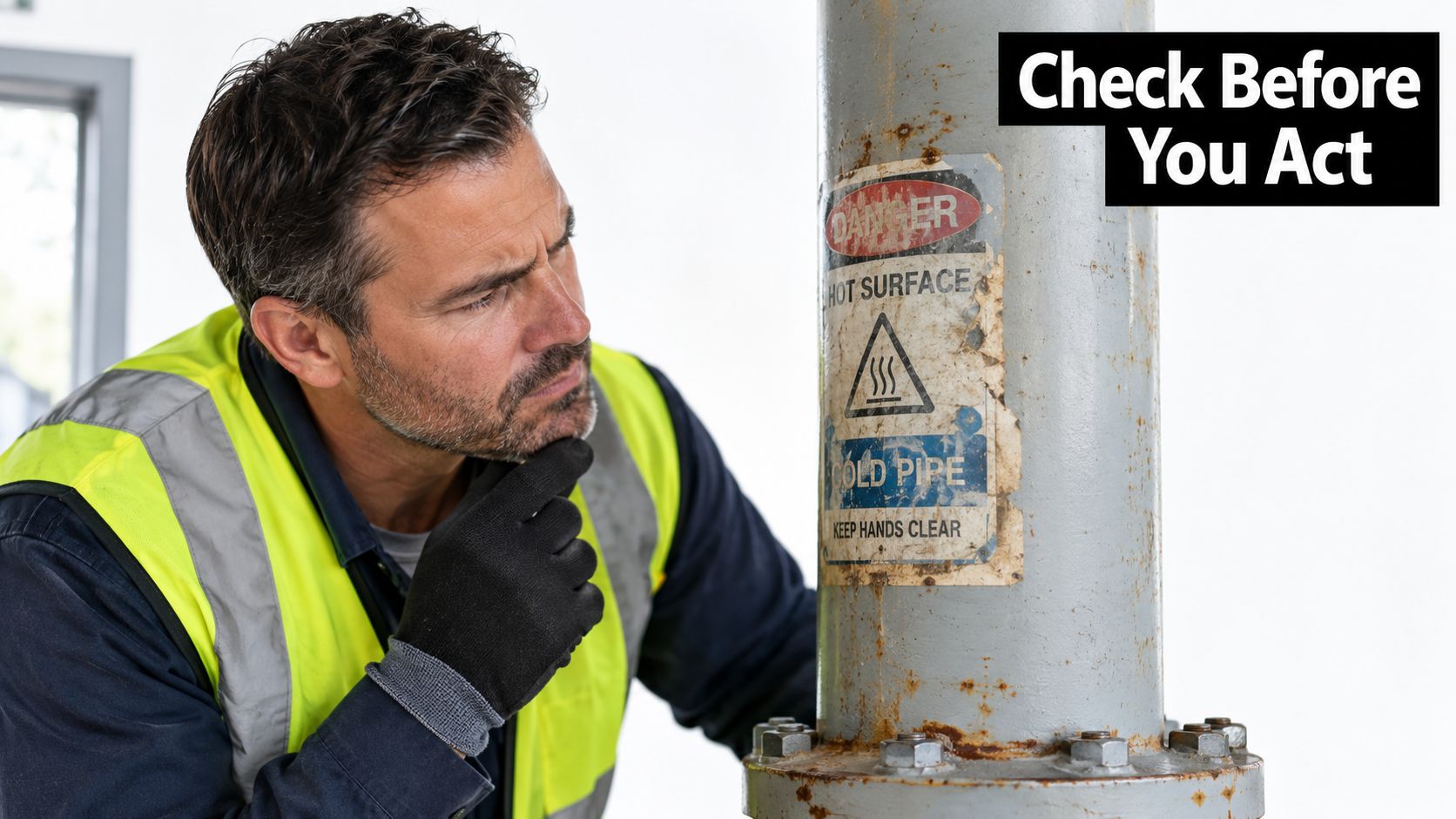
Industrial safety labels are not decoration, and they're not branding. AS 1319, Australia's foundational workplace safety-sign standard, is titled Safety signs for the occupational environment. Standards Australia records that it was published on 18 April 1994 and remains current, and its purpose is to specify requirements for the design and use of safety signs that regulate or control safety-related behaviour, warn people about hazards, and provide emergency information, including fire-protection information. AS 1319 product record
What the sign is actually doing
In plant rooms, workshops, and service corridors, a label is doing three jobs at once. It warns, it directs, and it supports emergency response. That's why treating a label as a durable sticker misses the point, because the actual requirement is communication under operating conditions, not shelf life in a drawer.
The practical responsibility chain runs from specification to installation to replacement. If the wording is vague, the symbol is wrong, or the label is placed where people don't naturally look, the system fails even if the substrate survives the weather.
A useful manufacturer-side reference for broader site practice is manufacturing workplace safety guidance, especially if you're trying to align labels with housekeeping, access control, and contractor movement.
A label that survives the washdown cycle but no longer tells the truth is still a bad label.
People often think in terms of identification plates versus warning signs, but the line isn't that simple. A plant nameplate can be purely informational, while a hazard label may affect how someone approaches, touches, isolates, or evacuates an area. Once the sign informs behaviour, it becomes a compliance-critical control, not a visual accessory.
Understanding the Types of Industrial Safety Labels and When to Use Them
Australian operations get into trouble when they apply one labelling logic everywhere. A chemical drum, a confined-space access point, a healthcare emergency route, and a lift installation don't need the same regime just because they're all “safety labels”. They each sit in a different compliance lane.
Match the label to the regime
AS 1319 governs workplace safety-sign design and use, but workplace hazardous-chemical labels follow GHS 7 requirements. Bulk-storage and entry placards sit separately again, and they may use ADG classifications rather than GHS pictograms. That distinction matters because a label can look tidy and still be wrong for the task.
Standards Australia's records show that AS 1319-1994 is cited by AS 4083 for emergency planning in healthcare facilities, AS/NZS 2865 for confined spaces, and AS 4431 for safe working on new lift installations. The confined-space record identifies AS/NZS 2865:2009 and a 2025 amendment in the current content history, while the lift standard was published on 5 March 2019. AS 4083 product record
For site teams, the audit workflow should be blunt and physical:
- Inventory the zone. List each container, decant vessel, pipework section, store, and entrance.
- Identify the regime. Decide whether it's workplace labelling, transport marking, or placarding.
- Check the duty holder. Manufacturer, importer, supplier, and PCBU duties aren't the same.
- Verify the SDS link. If the chemical or classification has changed, the label may be obsolete.
- Confirm thresholds and review date. Placards and labels don't live in the same rule set.
The most expensive label is the one that looks consistent while quietly crossing regimes.
| Site Zone | Primary Regime | Key Requirement |
|---|---|---|
| Chemical drum | Workplace hazardous chemical labelling | GHS 7 identity, hazards, pictograms, signal words, statements, supplier details |
| Pipework section | Workplace chemical identification | Identify the chemical, hazards, and necessary precautions |
| Site entrance | Placarding or outer warning rules | Use the placard system that applies to the storage quantity and entry control |
| Healthcare emergency area | Sector-specific safety signage | Follow the relevant emergency planning and sign-design context |
| Confined space access | Confined-space controls | Use the sign system that suits the hazard and entry procedure |
A practical reference point for workplace sign selection is this industrial safety labels guide. For more specialised container-facing options, This Way Up Warning Labels, 500 labels per roll is a useful example of how handling labels are sold in roll format for repetitive use, though it shouldn't be confused with a chemical compliance label or placard regime.
Choosing Durable Materials for Harsh Industrial Environments
Durability only matters if the message stays readable in the actual operating environment. A label that looks excellent in a sample box can fail in a plant room because of solvent wiping, UV exposure, abrasion, or repeated temperature cycling. In those settings, material choice is a safety decision.
What different substrates are good at
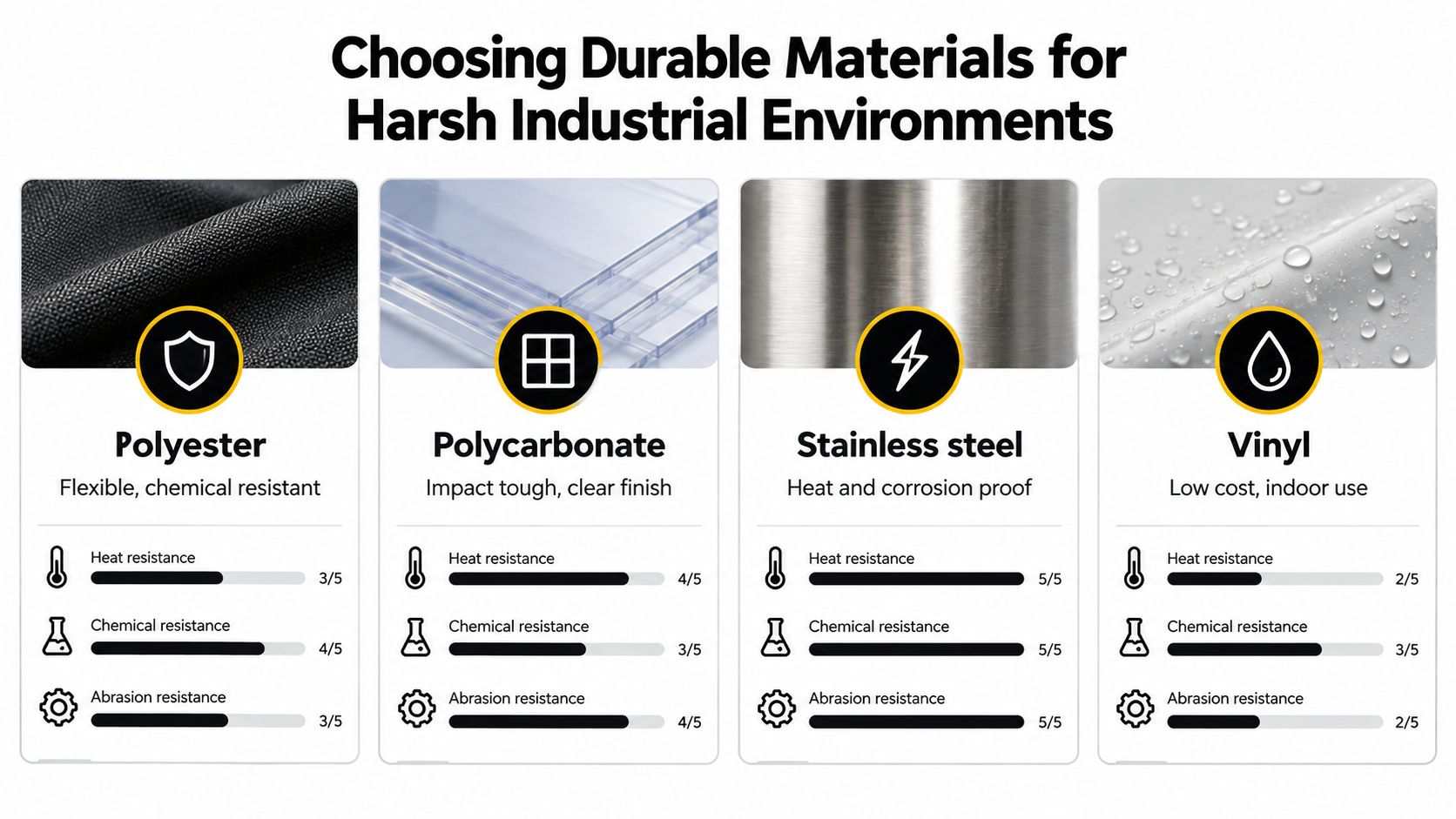
A good starting point is to separate substrate performance from label content. The substrate keeps the information alive, while the content does the compliance work. In harsh environments, you're choosing for chemical resistance, abrasion resistance, adhesive integrity, and visibility at the required viewing distance.
The ACT Government notes that AS 1319 does not prescribe a universal material or nominal size. The sign must suit its intended environment, and workers must be informed of its purpose. That creates a real gap for teams trying to choose between print, engraving, viewing distance, and cleaning resistance. ACT Government signage guidance
| Material | UV Resistance | Chemical Resistance | Abrasion Resistance | Typical Use Case |
|---|---|---|---|---|
| Polyester | Good | Good | Good | Indoor and semi-harsh equipment labels |
| Polycarbonate | Good | Good | Very good | Control panels and impact-prone areas |
| Stainless steel | Excellent | Excellent | Excellent | High-heat, washdown, and outdoor industrial tags |
| Vinyl | Fair | Fair | Fair | Shorter-life indoor identification |
For chemistry-heavy sites, a dedicated chemical resistant labels page is worth checking because the adhesive and face stock matter as much as the print method.
What usually goes wrong
The common failure isn't that a label tears. It's that the colour fades enough to kill contrast, the adhesive edge lifts after cleaning, or the lettering becomes too small to read from the approach path. A physically intact label can still be unsafe if it's illegible at the distance people stand, or if the information no longer matches the substance on site.
Material longevity alone doesn't equal compliance. A durable label with obsolete content is still a defect.
In practice, the best site decisions balance surface resilience with legibility, cleaning regime, and replacement discipline. If you're choosing for plant rooms, outdoor switchgear, or chemical stores, treat the material as part of the control system, not the finishing touch.
Manufacturing Methods and the Value of Laser Engraving
Label production method changes the risk profile. A printed face can be acceptable in the right setting, but once a site is wet, abraded, or cleaned with chemicals, the gap between surface ink and permanent marking becomes obvious quickly.
Where each method fits
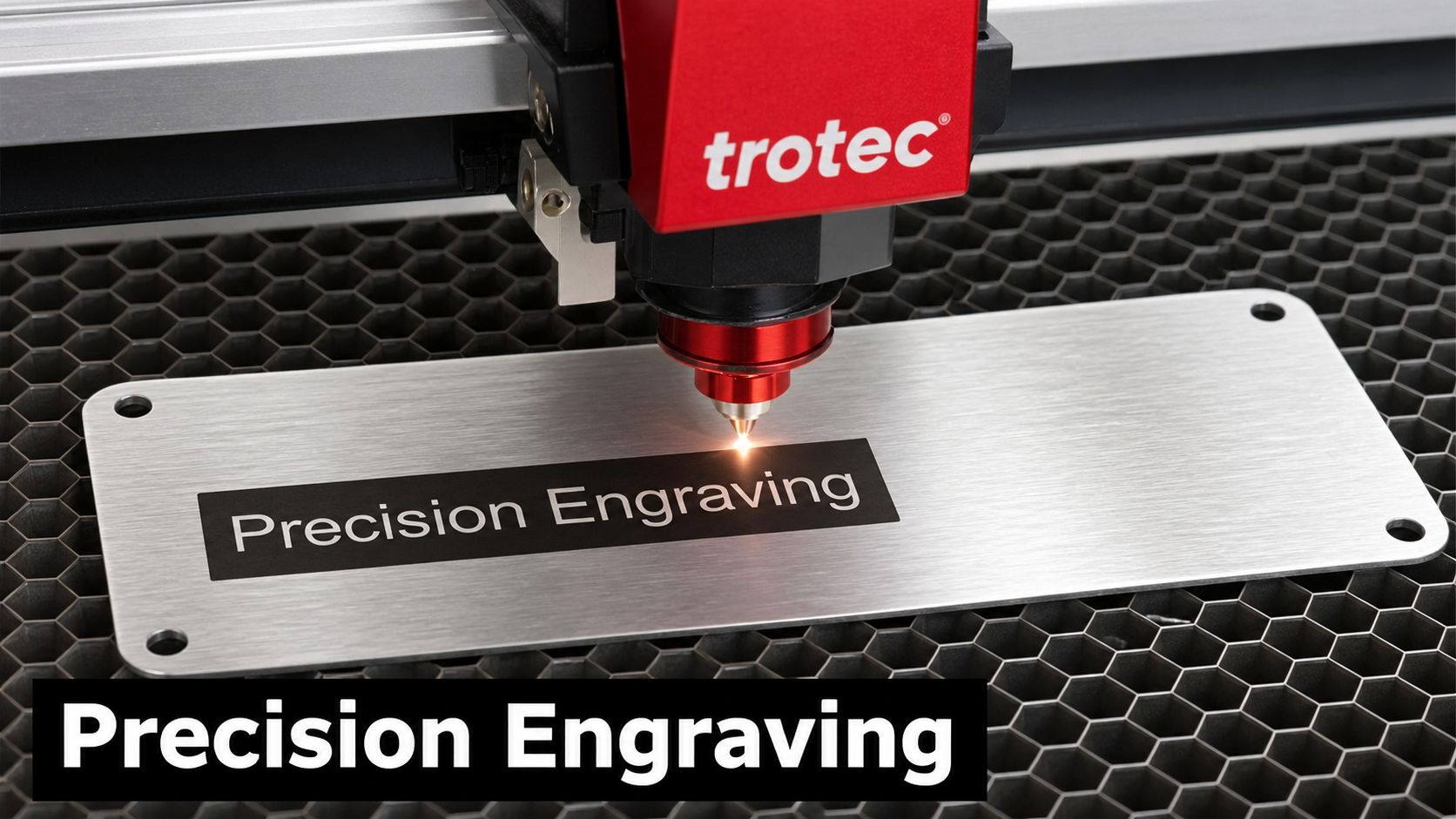
Screen printing works well when repeatable colour and a clean visual field matter. Digital printing suits short runs, variable data, and quick turnaround. Embossing can help with tactile identification, while laser engraving creates a mark inside the substrate rather than sitting on top of it.
Laser engraving is the preferred choice for asset identification, equipment plates, and durable warning signs that must outlast cleaning, contact, and weathering. Trotec laser machines are a practical example of the kind of industrial equipment used for this workflow, because they support precise marking on compatible long-life substrates.
For buyers comparing production methods, this laser marking vs engraving reference helps because the terms are often mixed up in procurement. The difference matters when a site needs permanence, contrast, and consistent replication across multiple locations.
What a good production workflow looks like
Start with the file, not the machine. Artwork should be set up with the right contrast, symbol proportion, and reading order before it reaches production. Then match the substrate to the environment, and confirm that the finished label still reads clearly after cutting, mounting, and installation.
A sensible quality control pass includes three checks:
- Legibility check. Read it from the actual approach distance, not from a bench.
- Content check. Confirm the wording, pictogram, and supplier data against the current classification.
- Attachment check. Make sure fasteners or adhesive suit the surface, vibration, and cleaning routine.
For chemical containers, Safe Work Australia says labels must communicate the chemical identity, hazard classifications, pictograms, signal words, hazard statements, precautionary statements, and supplier information. Since 1 January 2023, manufacturers and importers must use GHS 7 for newly manufactured or imported hazardous chemicals, and artwork, symbols, wording, and SDS data should be version-controlled because a formulation change can make a durable label technically obsolete. Safe Work Australia hazardous chemical labels
A laser-engraved plate is only as good as the data behind it. If the file is stale, the mark preserves the mistake more permanently.
Regulatory Considerations and Compliance Checkpoints
Compliance usually breaks at the boring edges. The sign is mounted, the container is labelled, and the site file says everything is done, but the signal word is wrong, the pictogram geometry is off, or the label no longer matches the current SDS. That's how physically sound labels still fail audits.
The checks that matter
Australian GHS practice uses the signal words Danger and Warning to communicate relative hazard severity on chemical labels. Danger is reserved for more severe or significant hazards, while Warning identifies less severe hazards, and only one signal word should appear on a label. Hazard pictograms generally use a square rotated 45 degrees into a diamond, with a black symbol on a white background and a red border or frame that stays clearly visible. Safe Work Australia GHS labelling code
Safe Work Australia also requires a person conducting a business or undertaking that stores, handles, or uses hazardous chemicals to display signs informing workers and visitors about the chemical dangers. Those signs must sit next to the hazard and be clearly visible to people approaching it, and where emergency services may enter a workplace, an outer warning placard must be at each relevant workplace entrance. Hazardous chemical signs and placards
Where audits usually miss
The most common misses are mundane but costly. Teams keep an old label after the SDS changes, use a signal word that doesn't match the hazard severity, or choose a pictogram that looks close enough but isn't arranged correctly. Another common failure is assuming an intact label is compliant even when it's placed where no one can read it on approach.
A useful way to review an existing program is to ask three questions for every label group:
- Is the regime correct? Workplace labelling, placarding, and general signage are not interchangeable.
- Is the content current? The substrate can survive, but the classification may have changed.
- Is the label usable in place? Readability, placement, and visibility beat neatness every time.
For teams who also manage work at height or access equipment, work at height edge protection rules is a practical reminder that visible controls only work when they're placed and maintained for the actual task environment.
Implementing Best Practices for Long-Lasting Safety Labelling
Good labelling programs don't start with printing. They start with responsibility. Somebody has to decide which regime applies, somebody has to own the content, and somebody has to keep labels aligned with changes in process, chemical inventory, and maintenance practice.

Make the rollout site-led, not supplier-led
One-size-fits-all templates are where many programs start slipping. A plant room, a loading dock, and a healthcare service corridor need different label hierarchies, different attachment methods, and different review rhythms. The right rollout maps the site first, then picks the marking method that fits each zone.
For Australian operations, the biggest hidden risk is still choosing the wrong regime for the job. Workplace hazardous-chemical labels follow GHS 7, while bulk-storage and entry placards use separate Australian requirements and may rely on ADG classifications instead of GHS pictograms. SafeWork NSW notes that workplaces above prescribed chemical quantities may need outer warning, tank, or package placards. GHS 7 transition and placards
What holds up over time
A good maintenance cadence is simple. Review labels when chemicals change, when equipment is relocated, when cleaning regimes change, and when a label stops being easy to read at the original viewing distance. Contractor communication matters too, because the person replacing a valve or moving a hose reel may be the first one to notice the label no longer matches the physical setup.
Evright Industrial supplies custom safety signage, equipment identification plates, and asset labels using laser engraving on long-life substrates, so one practical option is to build a site standard around a permanent engraving method for fixed assets and a separate content-control process for chemical information. That separation keeps durability and compliance from being treated as the same problem.
If you want a partner that works through the label regime, substrate choice, and production method with site-specific detail, Evright Industrial can help you shape a durable labelling system around the hazard, the environment, and the review cycle.
If you need industrial safety labels that stay legible in plant rooms, workshops, and chemical storage areas, Evright Industrial can build them around the right regime and the right substrate. Visit Evright Industrial to discuss laser-engraved labels, safety signage, and site-specific asset marking for Australian operations.
Recent Comments