
You've probably seen it already, a switchboard label that's gone dull, a safety sign that now looks faint under plant lighting, or a plaque that's started to oxidise long before anyone expected it to. The machine didn't fail first in those jobs. The specification did.
That's why design consultation services in industrial work aren't really about creative ideas or prettier mock-ups. They're about making sure the right substrate, fixing method, contrast, and standards mapping survive the actual environment. In a factory, hospital, utility yard, or memorial setting, the cost of getting that wrong shows up later as rework, downtime, and avoidable compliance pain.
When a Label Fails on the Factory Floor
The call usually comes in after someone has already fought the problem once. A maintenance lead notices a faded asset tag on a switchboard, the audit team flags a sign that no longer reads cleanly, or a facilities manager realises a door label has become unreadable after repeated cleaning. By then, the site has already absorbed the cost of poor specification.
That's the part many buyers miss. The failure wasn't just a bad print run or a rushed install. It was a label or sign designed without enough regard for exposure, legibility, and the way the site gets used.
A good consultant starts by asking what the asset is, where it sits, what it will be exposed to, and who needs to read it. That's the difference between “we need labels for the plant” and a deliverable that holds up in service. If the issue is chemical attack, you're into a very different conversation from a dry indoor panel, and the wrong answer can be expensive fast. For harsh-service environments, see the practical scope of chemical-resistant labels.
Practical rule: if the site can abrade it, wash it, bake it, or fog it, the consultation has to treat the environment as a design input, not a footnote.
This is why labelling failures often come back to the consultation stage. Production can only make what's been specified. If the substrate, adhesive, or marking method was wrong at the beginning, the finished item may look fine on day one and still fail the moment the site starts behaving like a real site.
What Design Consultation Services Actually Cover
At a practical level, design consultation services turn a vague request into a documented brief that production can work from. The consultant isn't there to “do design” in the decorative sense. The consultant is there to define what must survive, what must be read, and what the label or sign must prove when someone audits the site.
A proper consultation begins with the brief. That brief should capture the asset type, the operating context, the regulatory setting, the service expectations, and the budget reality. The nationally endorsed Australian unit CPPBDN5006A makes that kind of clarification explicit, including the client's vision, service-level requirements, preferences, budget, relevant research, applied materials knowledge, and a client-approved design brief for the project, within its scope for BCA-covered building design work excluding Type A buildings (training.gov.au unit PDF).
From there, the consultant maps the site's exposure conditions against material behaviour. That means substrate choice, fixation method, contrast performance, placement, and maintenance intervals all get considered before artwork is signed off. In Australia, safety sign durability is tied to UV, moisture, chemicals, abrasion, and temperature cycling, so a sign that looks right at install can still fail compliance later if the material can't survive the site conditions (Australian standards guidance on sign durability).
What a real deliverable looks like
A real consultation should hand back a client-approved design brief, not just a picture. Depending on the project, that brief may include:
- Site notes, including line of sight, cleaning method, and exposure risks.
- Substrate recommendations, tied to the environment, not just appearance.
- Placement guidance, so the sign or label is visible in the actual task area.
- Standards mapping, showing the compliance basis for the selected approach.
- Maintenance expectations, so the label isn't treated as a one-time install and forgotten.
A useful benchmark for buyers is whether the consultant can explain how the brief will move into production. A contract can even be structured around an explicit fee model before the work begins, as seen in the NKBA consultation agreement format, which starts by identifying key decisions and establishing the fee type before the client signs (NKBA consultation agreement).
For a broader sense of how structured industrial planning gets turned into real layouts and service decisions, browse warehouse layout ideas and notice how the useful materials are specific, not stylistic. If you want the same discipline for industrial marking, industrial engravers in Australia should be judged on what they document, not just what they show.

The best consultations don't end with a mock-up. They end with a brief that another competent team could manufacture from without guessing.
The Step-by-Step Consultation Workflow
A job can look straightforward at the quote stage and still fail once it reaches a plant, ward, or yard. The workflow exists to stop that happening by turning site conditions, compliance needs, and wear expectations into a specification that can be built and checked.
It starts with the discovery brief. The consultant gathers the client's goals, asset types, site risks, cleaning methods, and compliance expectations before any artwork is touched. If that brief is thin, every later decision rests on guesswork.
The next step is the site or asset audit. That might mean walking a factory floor, reviewing switchboards, checking medical device bays, or assessing exposed plaques and external signage. The point is to see line of sight, lighting, contamination, cleaning practice, and physical wear, because those are the conditions that strip labels, fade markings, and make information hard to read in the field.
Then comes substrate and environment specification. A consultant decides whether the job needs anodised aluminium, stainless, traffolyte, ceramic, or a premium laminate, and whether the fixing method should be adhesive, riveted, recessed, or mechanical. If stainless is the right call for the application, a practical starting point is stainless steel equipment tags, because material choice, fixing method, and surface exposure need to be considered together, not as separate decisions.
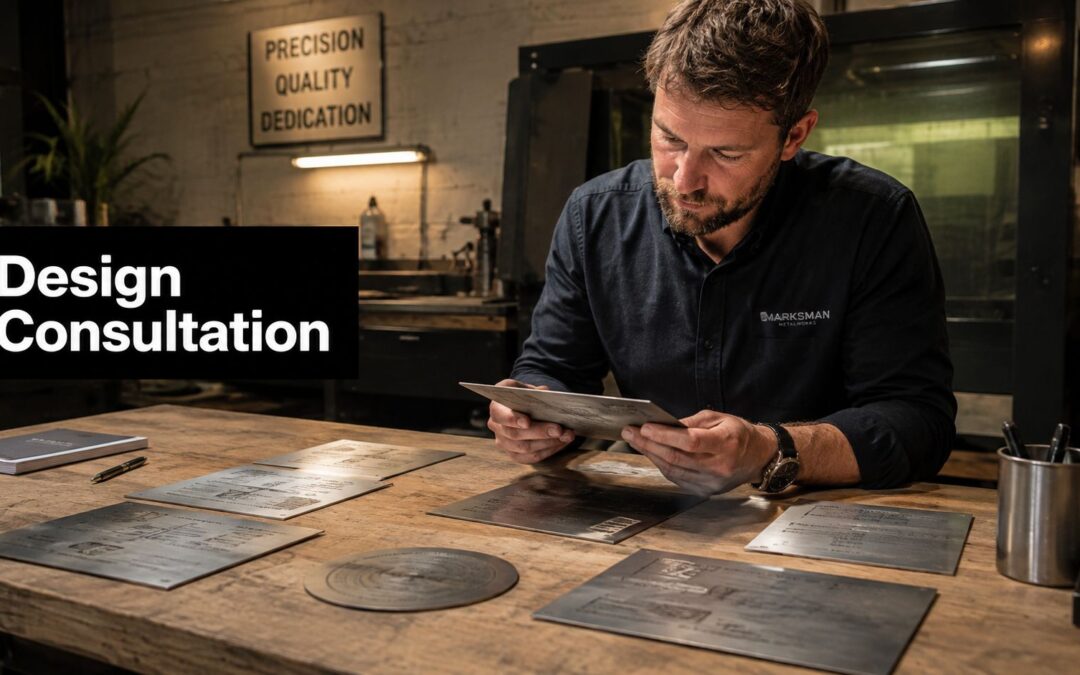
After that comes artwork and prototype. Trotec Laser machine imagery belongs here, not as decoration, but as evidence that the production path can hold the chosen detail, edge quality, and repeatability. The consultation should produce a sample or prototype, because the job isn't really approved until somebody has checked the actual sample under the actual site lighting.

The last steps are the client-approved design brief and the production handoff with installation guidance. That handoff should include placement notes, orientation, surface prep instructions, and maintenance intervals so the install team does not improvise on site. If a supplier cannot hand over that level of clarity, they are not running a proper consultation workflow, they are just making a file and hoping the installation will sort itself out.
A useful way to judge the process is simple. If the supplier can show the audit, the substrate reasoning, the prototype, and the approved brief, they are consulting. If they only show a polished render, they are selling a picture.
Key Decisions That Drive Durability and Compliance
Durability comes down to four decisions, and each one has consequences in the field. The first is substrate selection. The second is fixation method. The third is contrast and legibility under the site's actual lighting. The fourth is maintenance interval. Leave any one of those vague, and the label becomes a future problem.

Substrate selection by environment
| Operating Environment | Recommended Substrate | Primary Durability Driver |
|---|---|---|
| Harsh chemical cleaning | Stainless or chemically resistant laminate | Resistance to solvent and washdown exposure |
| Outdoor UV exposure | Anodised aluminium or UV-stable laminate | Resistance to fading and surface breakdown |
| High-abrasion plant areas | Metal or hard-wearing engraved stock | Resistance to scuffing and impact |
| Frequent relocation or replacement | Mechanically fixed, serviceable tags | Ease of maintenance without damage |
The point of that table isn't to box every job into a neat category. It's to show how the environment drives the material, not the other way around. A switchboard label in an essential-services plant needs to survive wipe-downs and remain legible after repeated handling, while healthcare signage has to stand up to cleaning chemicals without losing contrast.
The questions that separate good from weak specification
- What will the substrate face daily? UV, solvent, abrasion, heat, or moisture all change the answer.
- How will it be fixed? Adhesive can be fine in the right place, but not where surfaces are rough, oily, or repeatedly cleaned.
- Will the wording still read under the site lighting? A label that works in the office may fail under glare or shadow.
- What's the replacement expectation? If the maintenance interval isn't defined, someone will assume it's “set and forget”.
If the site uses aggressive cleaners, the label has to be specified for the cleaner, not just for the room.
For buyers who want a sensible benchmark, look for a consultant who talks about the finish, the adhesive system, and the service life together, not as separate discussions. That's where compliance and durability meet.
Industry Use Cases That Shape the Brief
Manufacturing floors need one kind of answer, and memorial work needs another. The framework stays the same, but the deliverables change because the operational stakes change.
Manufacturing and process plants
On a factory floor, the brief often centres on asset tracking tags, valve labels, line-of-sight equipment IDs, and machine identification that can survive grime and repeated cleaning. The consultant's job is to make sure the identification stays readable when the floor is busy, noisy, and visually crowded. That's also where buyers start asking about total service life, because a cheap tag that needs replacing every time a line is cleaned is no bargain.
Electrical contractors and essential services
Electrical work pushes the consultation toward switchboard labels, danger signs, warning signs, and lock-out identifiers. The deliverable needs to align with site safety practice and support unambiguous identification under audit conditions. A good consultant thinks in terms of placement, contrast, and local visibility first, then artwork second.
Healthcare, memorial, and government settings
Healthcare requires compliant signage, wayfinding, and device labels that survive cleaning regimes and remain readable in busy corridors. Memorial and funeral work leans toward commemorative plaques and weather durability, where the finish has to age well outdoors and still read cleanly years later. Government and infrastructure projects usually call for public-asset marking, security signage, and long-life identification where maintenance access may be limited.
For industrial buyers comparing material performance across sectors, industrial coating suppliers offer a useful reminder that surface behaviour is always tied to exposure, not appearance alone. The same principle applies to signage and marking, even if the final output looks simple.
A well-run consultation translates each sector into a different sign-off package. That's the part that matters most. The consultant isn't selling a generic label. They're defining the evidence that the label will do its job in that environment.
Pricing Models, Timelines and Questions to Ask
The cleanest way to price design consultation services is to match the fee model to the scope. A narrow advisory task can work on an hourly-rate basis, which is exactly how some consultation services are structured when the client doesn't need full delivery. A more defined scope suits a fixed-fee package, and a complete design-to-production engagement sits in full project delivery territory.
That distinction matters because a consultation isn't supposed to be an open-ended chat. The NKBA form makes the fee model part of the contract decision before the substantive work begins, and Lee Calisti's consultation model also frames advisory work as an hourly-rate service for clients who don't need the complete professional design delivery (Lee Calisti consultation PDF). If your supplier can't tell you which model you're buying, the scope is already soft.

What to ask before you sign
- Who owns the design brief? You want that answer in writing.
- What deliverables are included? Ask for the audit, brief, artwork pack, and any prototype notes.
- How many revision rounds are built in? If it's undefined, it'll become a dispute later.
- What happens if the label fails in service? Good suppliers can describe their process, not just their policy.
- Is installation included or excluded? That affects liability, timing, and access planning.
- Who checks standards alignment? The answer should name the person or role.
- Do you receive maintenance guidance? Without it, the asset ages badly.
- Are site visits included? Remote works for some jobs, but not all.
- What surfaces are being assumed? Unsaid assumptions are where jobs go wrong.
- What does final handoff look like? You need files, notes, and sign-off evidence.
Timelines vary with complexity. A simple advisory consultation can move quickly, while a multi-site industrial audit naturally takes longer because the site evidence has to be gathered, checked, and signed off. The key is not speed alone, it's whether the final brief can survive production and installation without guesswork.
For pricing comparisons in a different service category, find laser treatment costs and you'll see the same buying principle at work. Clear scope is what keeps “cheap” from becoming expensive.
Why the Cheapest Consultation Often Costs More
A low-cost mock-up looks attractive until the first replacement job lands on someone's maintenance calendar. If the sign or label was chosen for appearance instead of UV, chemical, or abrasion resistance, it can fail early and force repeat labour, re-marking downtime, and another round of procurement. That's not savings, it's deferred cost.
The deeper issue is compliance exposure. If a failed sign contributes to confusion, an incident, or an audit finding, the original consultation fee is trivial beside the follow-on risk. In harsh Australian industrial settings, the cheapest specification is often the one that makes the most expensive mess later.
There's also a sustainability angle that matters to public-sector and infrastructure buyers. Durable specification reduces waste, reduces replacement frequency, and supports responsible procurement because fewer failed items need to be scrapped and remade. That's the part procurement teams can take upstairs without sounding sentimental.
The strongest argument is simple. Consultation is not overhead when it prevents rework. It's the stage that determines whether the item survives the site.
Frequently Asked Questions About Industrial Design Consultations
How long does a consultation take? A focused review can be handled quickly, but a site-heavy industrial brief takes longer because the consultant needs enough evidence to specify the right material and fixing method.
Can the audit be remote? Sometimes, yes. Remote works when the site conditions are already well documented, but on-site review is better when lighting, cleaning, or line of sight will affect compliance.
What evidence do I get at the end? You should expect a brief, the specification basis, and enough notes for production or installation to follow without guessing. That's the value.
Do consultation fees roll into production? Sometimes they do, sometimes they don't. Ask that before signing so you know whether the fee is a stand-alone advisory cost or part of a larger package.
If your site needs a properly scoped conversation about industrial marking, labels, signage, or plaques, start with Evright Industrial and ask for a consultation that treats durability, compliance, and lifecycle cost as part of the same job. Evright Industrial supports Australian industrial buyers through the parent company's laser engraving capability, so the first discussion can stay practical, specific, and geared to the conditions your assets face.
Recent Comments