
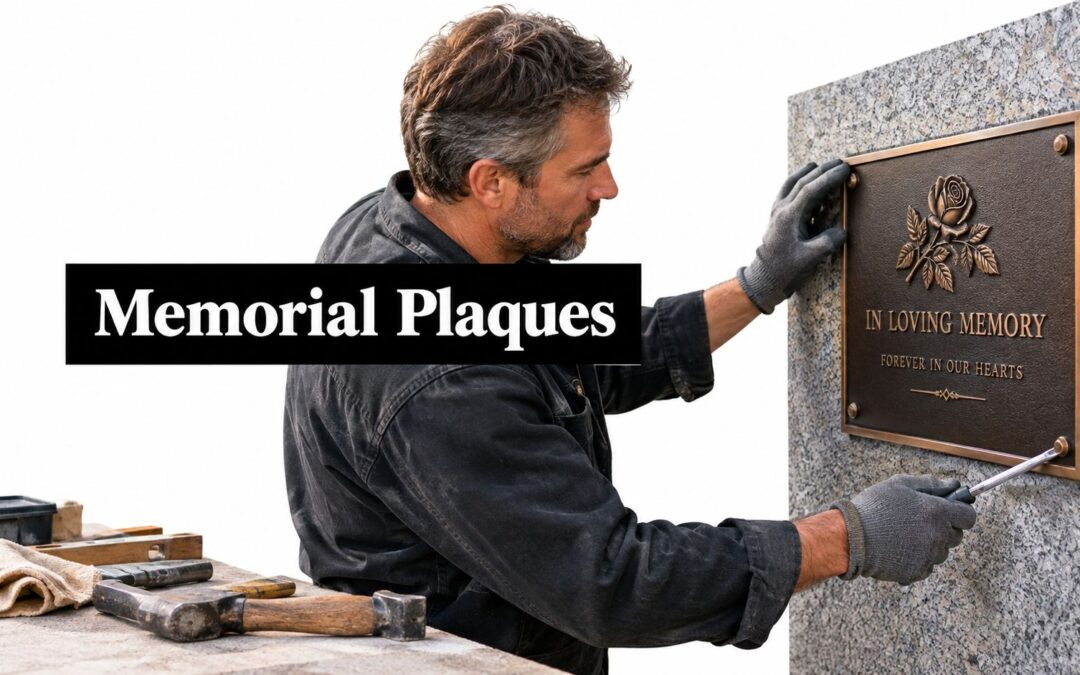
You've agreed the wording, chosen a photograph, and picked a finish that feels right. Then the cemetery office asks who holds the burial rights, whether that size is permitted in that section, and who is approved to install it. That moment is where many custom memorial plaques projects stall. The engraving itself is rarely the hard part. Getting the site rules, material, and mounting right before production is what decides whether a plaque can be installed at all.
Why Approval Comes Before the Engraving
A family can settle the inscription quickly and still have no installable memorial. Cemeteries don't just host plaques. They control the ground, the niche wall, the beam, and the records that stay with that place long after the service.
Approval isn't paperwork after the fact. It determines the plaque's size, material, thickness, fixing method, and sometimes whether a photograph or coloured element is allowed. Commission production first and you may own a well made plaque that the site won't accept.
Who can actually authorise the work
Start with the burial-rights holder, not the nearest relative. That person, or another authorised person, usually gives consent for memorial work. A funeral director can coordinate the application, and some cemeteries require a council approved contractor to do the installation, but neither role replaces the rights holder's authority.
Australian cemetery rules commonly require written approval, consent from the burial-rights holder, an approved application form and the applicable fee before any memorial or inscription work begins, and Frankston Memorial Park limits bronze plaque locations and permits only three standard plaques at some sites. That's a useful reminder that personalisation is often limited less by engraving technology than by site governance.
Pre-Production Compliance Checklist
| Check | Why it matters | Who confirms |
|---|---|---|
| Cemetery and section | Rules change between lawn, niche, and garden areas | Cemetery operator |
| Burial-rights holder | Sets who can legally order and approve | Family and cemetery records |
| Dimensions and thickness | Prevents rejection at installation | Cemetery operator in writing |
| Material and finish | Some sections specify bronze, stone, or enamelled metal | Cemetery operator |
| Wording, photo, and artwork | Inscriptions and images may need consent | Rights holder and operator |
| Fixing and installer | Work may need an approved contractor | Operator and installer |
| Fees and lead time | Approval sits ahead of manufacture | Applicant |
Practical rule: Don't release artwork for production until the operator confirms size, material, and mounting in writing. Verbal assurance leaves the family exposed if staff or interpretation changes.
For outdoor family memorials outside a formal cemetery, the same discipline applies. Land owner consent, local rules, and future access matter just as much. Reviewing the constraints for memorial plaques designed for outside installation before choosing a substrate helps separate a durable specification from a nice sample that won't suit the site.
Matching Materials to the Site and Climate
Appearance is a poor starting point outdoors. Chloride exposure, moisture, ultraviolet radiation, and cleaning access will act on the plaque every day. A finish that looks calm in a showroom can stain, pit, or lose contrast near the coast or under irrigation.
Bronze remains common for a reason. It has visual weight, suits traditional sections, and many cemetery policies name it directly. It isn't maintenance free, though. Its surface changes over time, and families should understand patina before they expect a permanently bright finish.
Stainless steel suits contemporary walls, columbaria, schools, and public buildings where a cleaner line fits the setting. The grade matters more than the generic label. 316 stainless steel is preferable to 304 in coastal and high moisture environments because its typical molybdenum content of approximately 2 to 3% improves resistance to chloride induced pitting and crevice corrosion. Chlorides in sea spray and salt laden rain can break down the passive surface film, so the added resistance helps protect both the metal and the legibility of the mark.
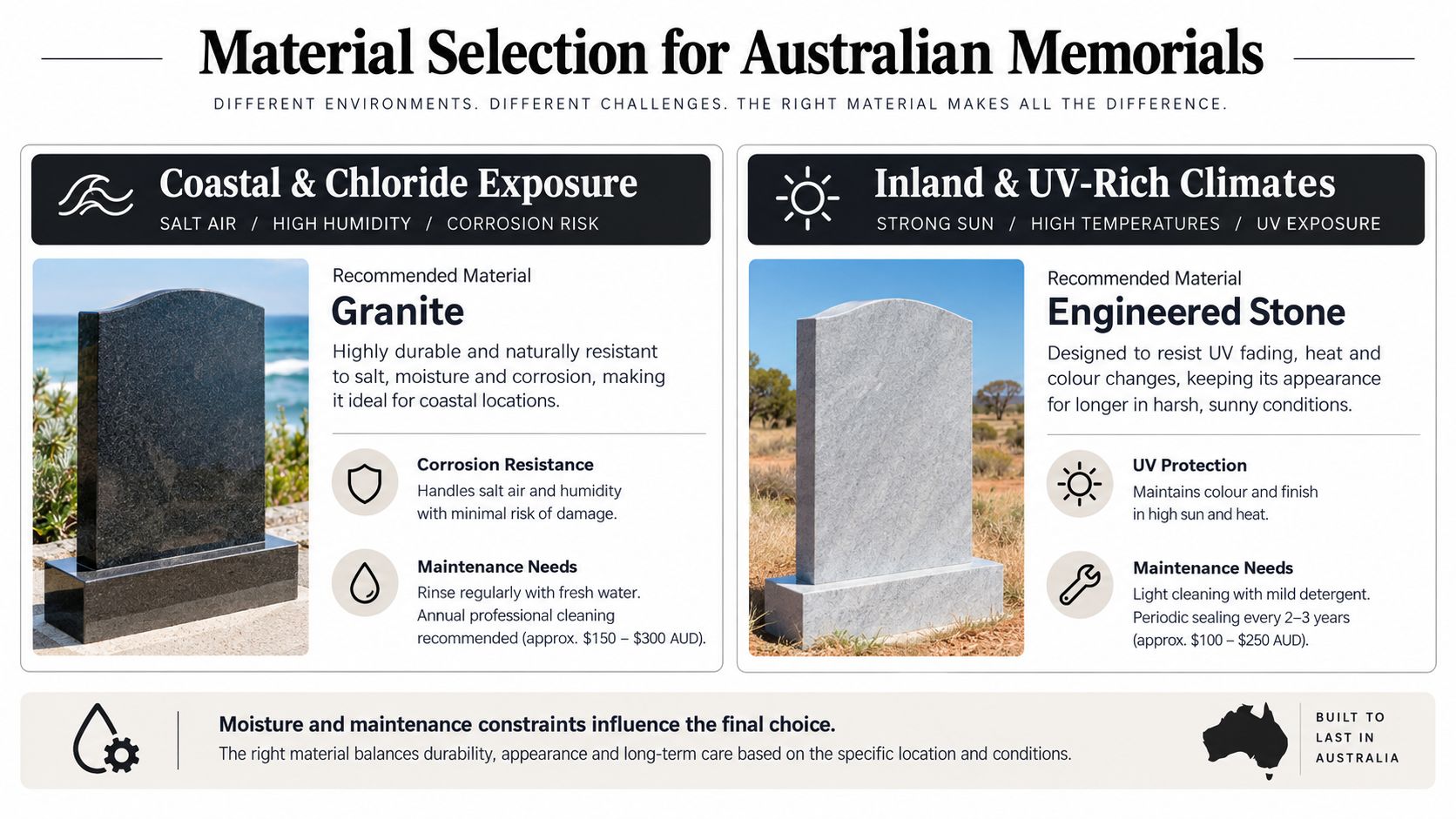
Anodised aluminium offers a lighter plaque and strong colour contrast for laser work, which makes it practical for modern institutional memorials. It's less suited where impact, abrasion, or a traditional cemetery material rule governs the choice. Granite and stone carry permanence and fit established memorial grounds, but weight, thickness rules, and fixing design need closer attention. Glass can work in protected, specified applications, yet glare, breakage risk, and cleaning make it a poor default for exposed public sites.
Material Comparison for Australian Memorial Sites
| Material | Durability | Coastal Performance | Typical Use | Cost (relative) |
|---|---|---|---|---|
| Admiralty bronze | Very high | Strong, patina expected | Cemetery and civic memorials | Higher |
| 316 stainless steel | Very high | Strong chloride resistance | Walls, niches, public sites | Mid to higher |
| 304 stainless steel | High inland | Weaker in chloride exposure | Sheltered or inland sites | Mid |
| Anodised aluminium | Moderate to high | Depends on coating and detailing | Contemporary plaques | Lower to mid |
| Granite and stone | Very high | Strong, detailing dependent | Traditional graves and bases | Mid to higher |
| Glass | Site dependent | Surface holds up, edges vulnerable | Protected specified settings | Varies |
A plaque can stay structurally sound and still fail as a memorial if glare, staining, or shallow marking makes the name hard to read.
Choose for the environment first, then the finish. Agree lettering depth or contrast fill before manufacture, avoid crevices and standing water behind the plaque, and use fixings compatible with the chosen grade. Those details decide long term readability more reliably than a polished sample viewed indoors.
How Laser Engraving Shapes the Finished Plaque
Laser engraving is a non-contact process. A focused beam changes or removes the surface in controlled passes, so there's no cutting tool pressing into the work. That produces repeatable lettering, fine borders, emblems, and photographic detail across metal, anodised surfaces, and suitable stone.
The screenshot below shows the production context for this kind of work.

At Evright Industrial, plaques are produced using Trotec Laser machinery, not mechanical engraving. In practical terms, the artwork is prepared as a controlled digital file, proofed at final size, then run on the Trotec system with settings matched to the substrate. That consistency matters when a council or funeral home needs several plaques to sit together without visible variation in letter weight or spacing.
Depth, contrast, and photographs
Fine detail alone doesn't guarantee readability. A shallow mark on stainless steel can look sharp under workshop light and disappear in outdoor glare. Ask how depth, surface finish, and fill will work together on the actual material, not on a different sample. Colour outcomes on stainless also depend on the laser interaction with the surface, which is why it's worth reviewing how laser mark colours behave on stainless steel before promising a family a particular tone.
Photographs need honest preparation. A low contrast phone photo may need tonal work, cropping, and simplification before it will reproduce cleanly at niche plaque size. Faces, uniforms, and detailed backgrounds don't scale equally. The proof should be checked at actual finished size, because a portrait that reads on a large screen can turn muddy when reduced.
You can see the laser process in motion here.
This production pathway sits within the broader service at evright.com, where the underlying model is straightforward. You supply approved dimensions, substrate, wording, and artwork, the team prepares and proofs the laser file, and production proceeds only after that proof is signed off. For memorial work, that proof is your last low cost chance to catch a date, spelling, or hierarchy error.
Sizing Rules That Vary by Cemetery and Memorial Type
Generic templates fail because Australian cemeteries specify size by memorial location, not by what a supplier prefers to stock. A niche plaque, a grave foundation plaque, and a memorial tree plaque in the same cemetery can carry different dimensions, thickness limits, and approved materials.
Western Australia gives clear examples. The Shire of Plantagenet specifies niche wall plaques generally at 145 mm by 120 mm for single niches, while grave foundation plaques may be 380 mm by 280 mm and must not exceed 20 mm in thickness. The same policy framework allows different sizes again for memorial shrubs and trees, and permits materials such as admiralty bronze, granite, glass, and vitreous enamelled stainless steel in specified applications.
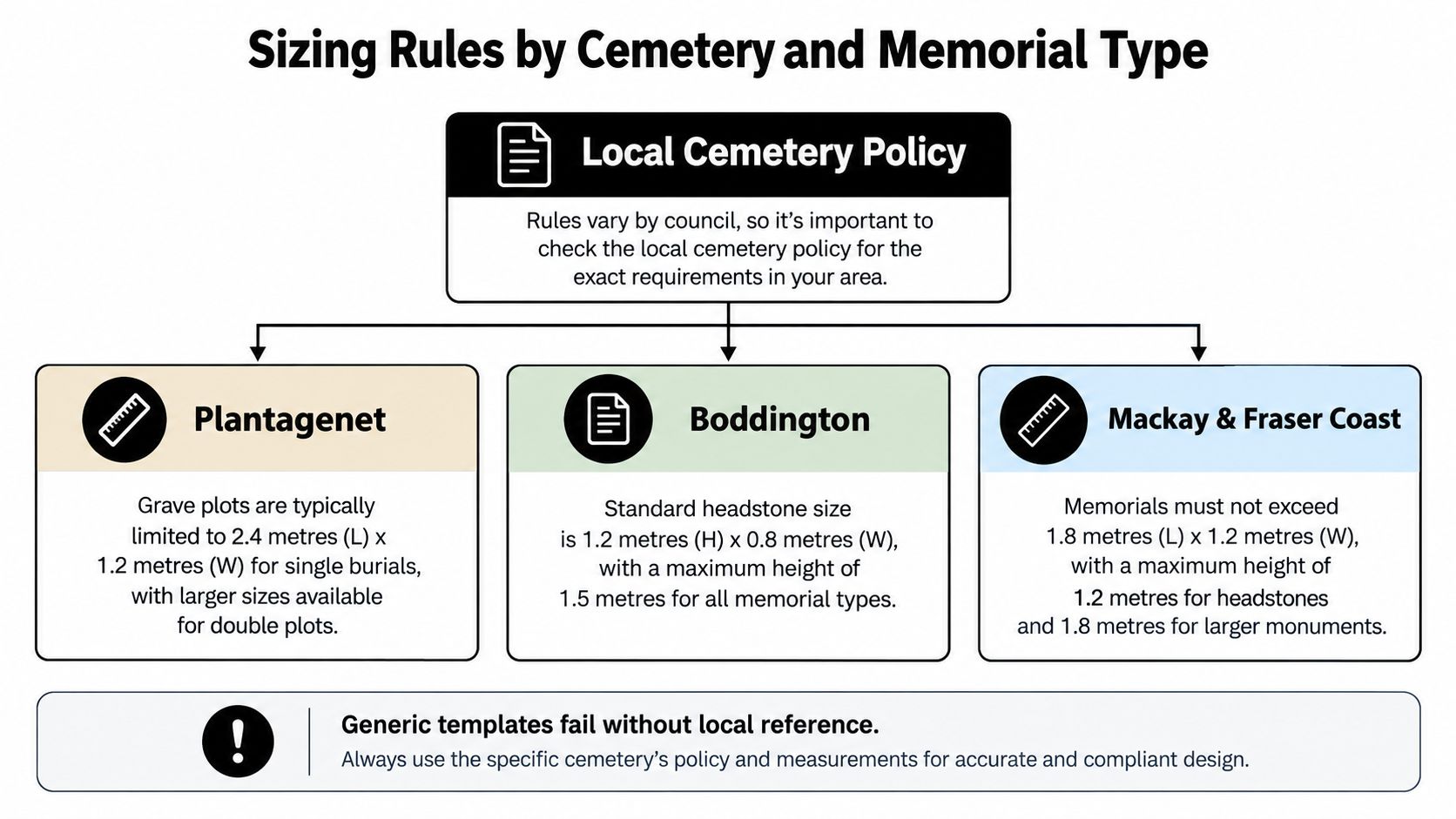
Boddington takes a different approach for its memorial plaque section. Its local law requires plaques of at least 380 mm by 280 mm and no more than 560 mm by 305 mm, made from admiralty bronze or another board approved material. Bronze thickness, stone thickness, and the approved base are also controlled. A plaque that's compliant in Plantagenet could therefore be undersized, oversized, or incorrectly mounted in Boddington.
Standards sit behind local rules
Queensland adds a construction and installer layer. Fraser Coast Regional Council requires cemetery monuments and memorials to comply with AS 4204-2019 and AS 4425-1996, with work completed by a council approved contractor after the authorised applicant submits the form and fee. It also reserves control over inscriptions that could cause offence or are disputed.
That means sizing isn't only a rectangle on a proof. It includes:
- Overall dimensions: Measured against the niche, beam, foundation, or plaque section, not the engraving area alone.
- Thickness and base: A compliant face size can still fail if the plaque or backing plate sits proud of the allowed limit.
- Fixing position: Holes and mounts must suit the existing structure and leave room for drainage and removal.
- Artwork area: Borders, screws, and edge margins reduce the usable space for names, dates, and photographs.
Mackay and Fraser Coast both put approval ahead of construction, so the sensible workflow is fixed. Obtain the site specification, design within it, confirm it in writing, then produce. If a supplier asks you to pick a standard size before asking which cemetery and section you're dealing with, that order is backwards.
Designing a Plaque That Reads for Decades
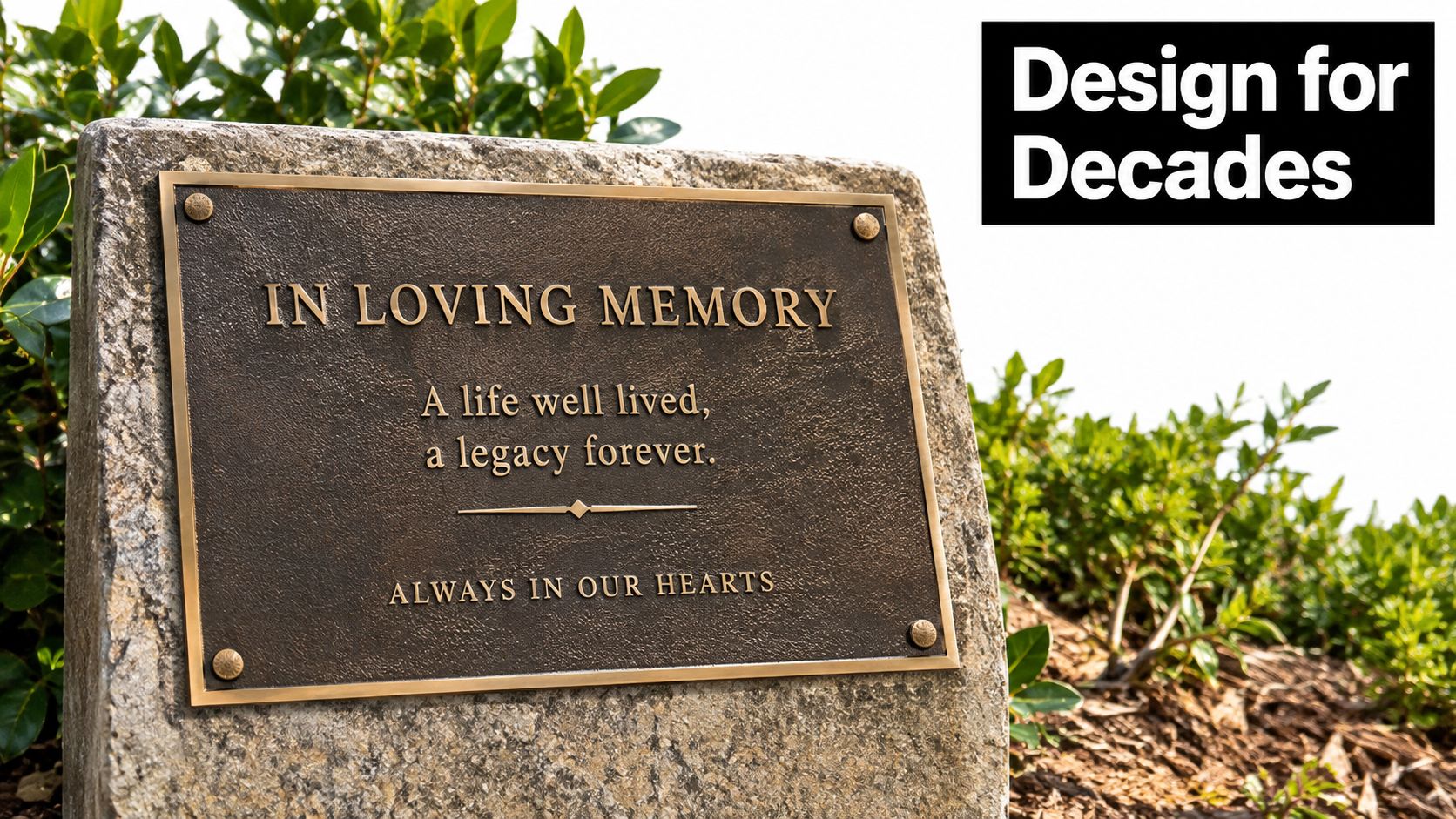
Design for the visitor who arrives in bright sun, rain, or late afternoon glare and doesn't know where to look. The name must read first, dates second, and the dedication after that. If every line has the same weight, nothing leads the eye.
Australia has a long precedent for disciplined inscription. The 1917 commemorative plaque design competition attracted 800 entries, and E. Carter Preston's winning design carried each person's full name generally without rank or honours, with approximately 60,000 plaques ultimately issued in Australia after the first reached Melbourne in 1922. The principle still holds. The name is the record, and embellishment shouldn't compete with it.
Set a hierarchy that survives outdoors
Use fewer words, larger. Short lines with clear breaks usually engrave better than a paragraph squeezed to fit. A clean pattern is name, dates, then one steady line. Browsing memorial plaque wording examples can help families see how much text a small format can carry before it becomes crowded.
Choose letterforms for distance, not decoration. Thin script, tight spacing, and all capitals across long lines all reduce legibility, especially at shallow depth. Contrast fill can help where the substrate or lighting flattens the mark, but it should be specified as part of the design, not added as a rescue after engraving.
- Name and dates: Check spelling, middle names, and date order against official records.
- Dedication: Keep it to one short line where the plaque is small.
- Symbols and emblems: Simplify fine internal detail that will close up at finished size.
- Photographs: Allow enough area for the face, and accept that busy backgrounds may need removal.
- Proof check: Print or view the proof at actual size and read it at arm's length.
Design choices aren't purely aesthetic. As noted with Fraser Coast above, an operator may reject an inscription, so artwork and wording should be cleared before final production. The same care applies to companion animals in a family memorial garden or private setting, where a resource covering 7 ways to honor a dog may help a family decide whether a plaque, garden marker, or another tribute fits best. Whatever the subject, protect readability first. Sentiment that can't be read in twenty years hasn't been preserved.
Pricing Drivers, Lead Times and Production Workflow
A single quoted number hides the decisions that create it. Brief families on the build up instead, so they can see what changes when they change material, size, or artwork. That conversation is easier before approval than after a non compliant plaque has been made.
Mackay Regional Council requires that no person install a memorial or make an inscription or adornment at a burial place without the council's written approval, with the approved form and applicable fee submitted before construction or installation begins. That sequence shapes both cost and timing. Compliance work is part of the project, not an optional extra.
What moves the price
Substrate and grade usually lead. Admiralty bronze, 316 stainless steel, anodised aluminium, and stone don't cost or handle alike. Size and thickness follow, because they affect material use, machine time, backing, and freight. Photograph preparation, custom artwork, borders, contrast fill, and special finishes add production labour.
Batch size changes the picture for councils, schools, and funeral homes ordering matching plaques. Repeat work from an approved file is more efficient than a single plaque carrying new artwork and a new site specification. Urgency can also constrain scheduling, particularly where approval or an approved installer sits outside the manufacturer's control.
Where lead time actually goes
Allow separate time for cemetery approval, artwork preparation, proof sign off, production scheduling, delivery, and installation booking. A fast engraving run doesn't shorten a council queue. Installation may also be limited to permitted site hours, as covered earlier with Boddington, which affects contractor scheduling.
The reliable workflow runs in this order. Confirm rights holder and site rules, lock dimensions and material, prepare artwork, approve the proof, manufacture, then install through the required pathway. If price pressure arises, reduce optional artwork or reconsider finish before downgrading a material that the climate or cemetery specification calls for.
Installation, Care and Long-Term Performance
Install for drainage and replaceability, not just firm attachment. Use mechanically secure fixings compatible with the plaque grade, avoid water traps behind the plaque, and isolate dissimilar metals where needed. Standing moisture in a crevice can undo a sound material choice.
Heritage sites need extra restraint. Heritage Victoria guidance advises against attaching new plaques directly to historic memorials and recommends installing them nearby on suitable walls, plinths, or seats, using materials consistent with the original design. That approach avoids drilling and sealant damage to heritage masonry and lets the newer plaque be serviced without disturbing the original structure.
Care should be gentle and planned. Rinse off grit before wiping, avoid abrasive pads and harsh chemicals unless the material supplier approves them, and check fixings, staining, and contrast fill during routine site visits. Repainting fill is maintenance, not failure, provided the engraving beneath remains sound.
Plaques also serve families without a traditional grave. With cremation accounting for about 70% of Australian funerals, compact niche plaques, garden memorials, and approved institutional placements give dispersed families a fixed place to visit, provided the land owner or authority permits that placement.
If you're planning custom memorial plaques for a cemetery, garden, school, club, or public building, bring the site rules, approved dimensions, and draft wording to the first conversation so material and artwork can be specified correctly from the start. Visit Evright Industrial to discuss your memorial plaque requirements, review suitable materials and mounting options, and start with a production ready proof.
Recent Comments