

A lot of people arrive at the same moment in the same way. They've chosen the words, they know who the plaque is for, and they've found the wall. Then the practical questions start. Will this metal suit an outdoor brick wall? Will the fixing stain the stone? Will the plaque still be easy to read years from now?
That's where wall plaques become different from a simple keepsake. A framed photo can move with you. A memorial plaque for a wall becomes part of the place itself, whether that's a home garden, a crematorium niche wall, a club building, or a public memorial.
If you're making this choice now, you're choosing both a message and a structure. The inscription carries the memory. The material, size, finish, and mounting carry that inscription through weather, handling, and time. If one part is weak, the whole result suffers.
A small brass plate on a sheltered indoor wall can work beautifully. That same plate on a salty coastal wall may lose its crisp appearance far sooner than expected. A plaque that looks balanced on paper may feel cramped once names, dates, and a short tribute are fitted into a restricted wall space. And in a cemetery or council-managed place, approval can matter just as much as design.
That's why calm planning at the start saves trouble later. The safest approach is to treat the plaque as a long-life object that must match its wall, its environment, and any site rules. That sounds technical, but it doesn't need to be complicated. Think of it the way a careful workshop does. First choose the right base material. Then choose a finish that keeps contrast. Then mount it in a way the wall can safely hold.
Introduction to Memorial Plaques for Wall Displays
A wall-mounted memorial often starts with a very human decision. Someone wants a permanent place to pause. It might be a plaque beside a rose bed at home, a tribute in a church foyer, or a small marker fixed to a memorial garden wall. The wall feels right because it gives the tribute a settled home.
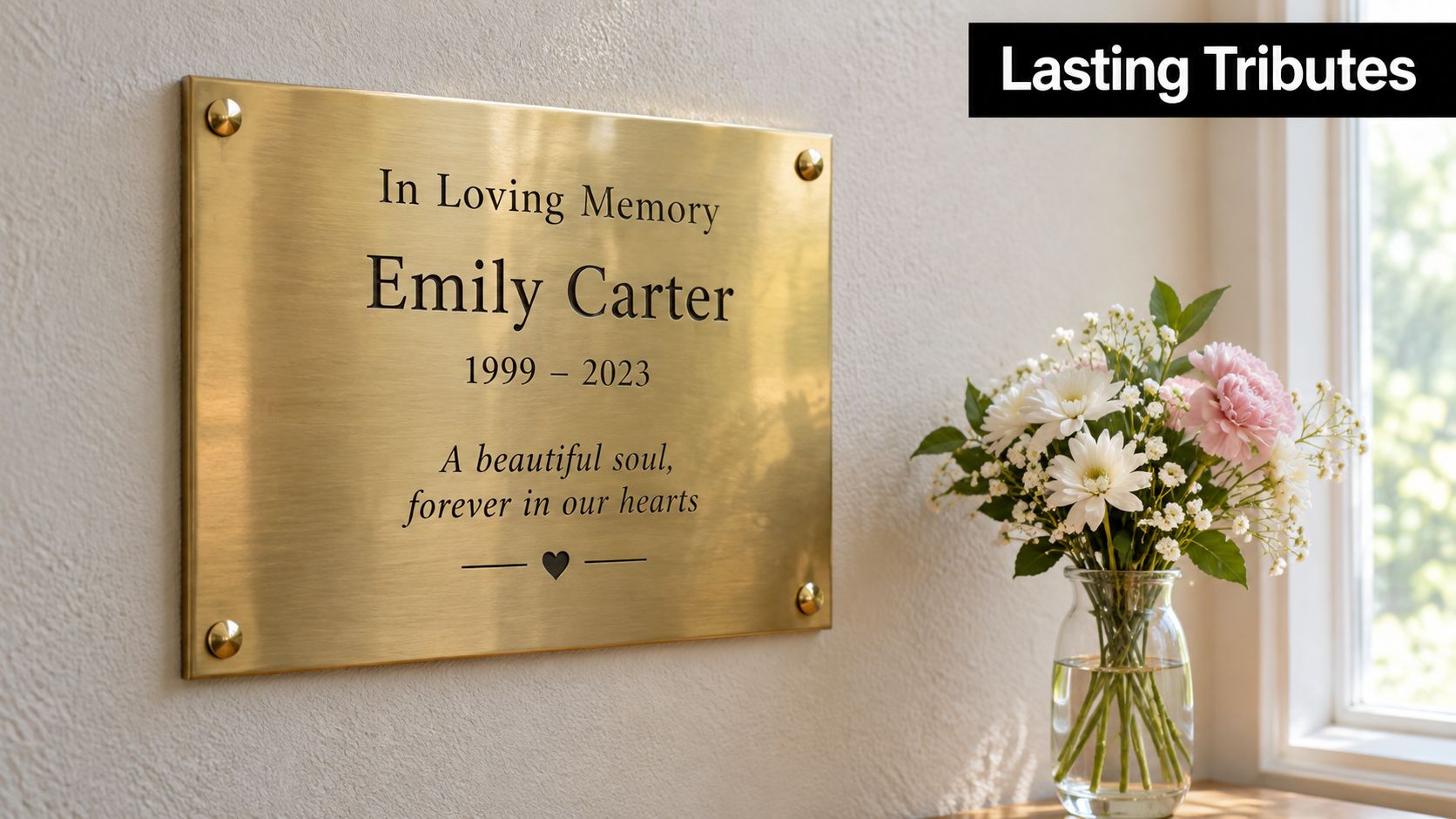
Wall displays ask for a different kind of thinking than a freestanding monument. You're not only deciding what looks respectful. You're also deciding how the plaque meets the surface behind it, how water behaves around it, and whether the text will stay legible from the normal viewing position.
Why wall plaques need more planning
A wall is a bit like a host. Some hosts are strong and dry, such as sound brick or concrete. Others are less forgiving, like painted masonry with moisture movement, old rendered surfaces, or lightweight interior linings. The plaque has to suit the host.
That's why a practical shortlist helps:
- Location first: Indoor and outdoor walls don't ask the same thing from metal, finish, or fixings.
- Wall type next: Brick, concrete, timber, stone cladding, and plasterboard all need different mounting methods.
- Approval before ordering: In managed memorial sites, dimensions and materials may already be set.
- Legibility over decoration: A handsome plaque that's hard to read won't do its job well.
Practical rule: If a plaque is meant to stay in place for years, choose the wall and mounting method before you finalise the artwork.
What people often miss
Many buyers focus on the inscription and border style first. That's natural. The words matter. But most later problems don't come from the wording. They come from avoidable mismatches between plaque, wall, and setting.
A heavy plaque on a weak surface can loosen. A reflective finish in full sun can become hard to read. A plaque made before checking a cemetery specification may need to be remade. Those are workshop problems, not sentimental ones, and they're much easier to solve early.
If you're comparing options, keep one steady idea in mind. The best memorial plaques for wall use aren't attractive objects. They're durable, readable, securely fixed memorials that belong to a real place.
What Wall Mounted Memorial Plaques Are and Why They Last
A family approves the wording, chooses a metal, and expects the plaque to stay readable on that wall for decades. In Australia, that expectation is reasonable, but only if the plaque is treated as a long-life installed asset, not a simple decorative sign.
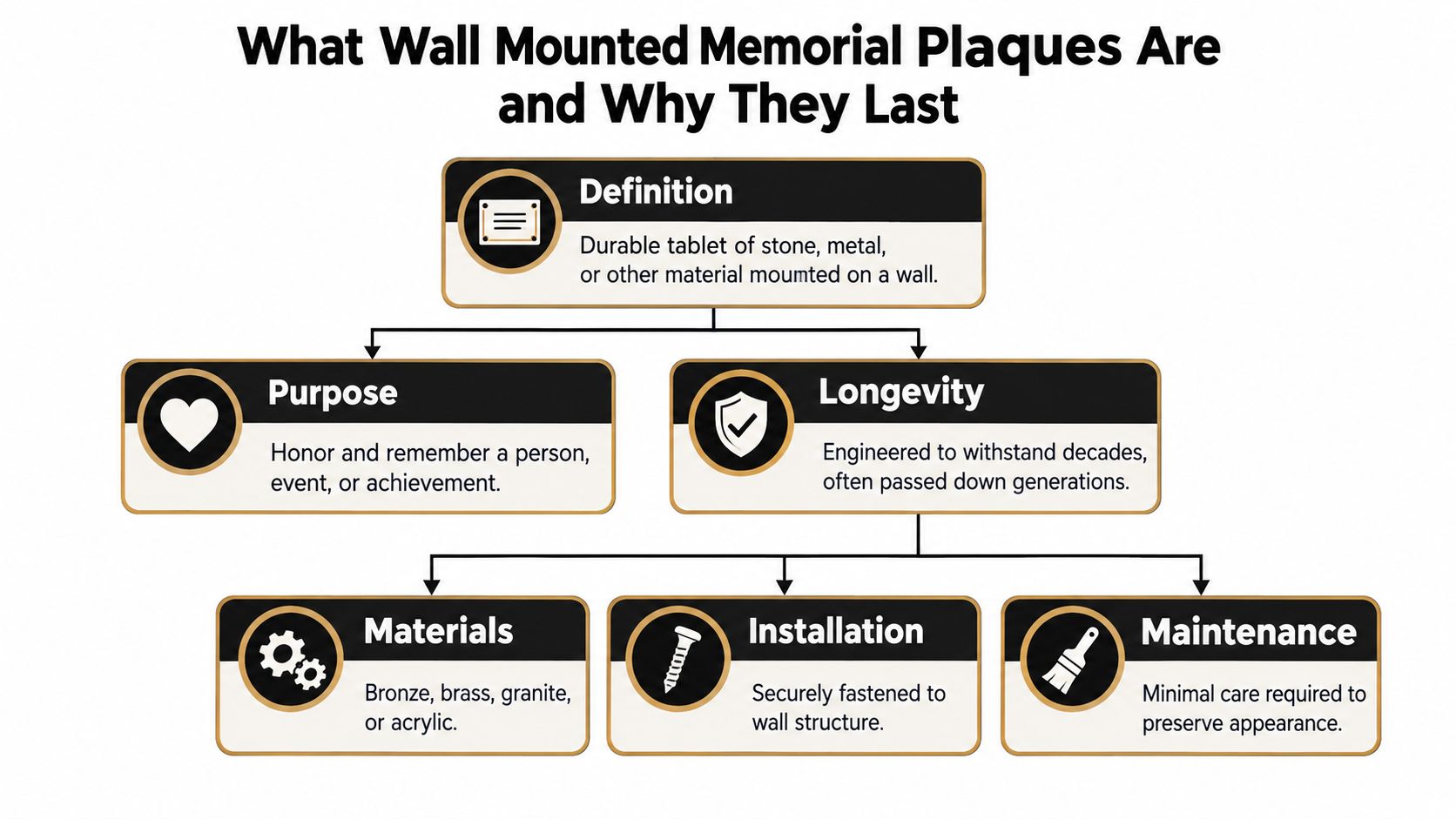
A wall-mounted memorial plaque is a commemorative tablet fixed to a vertical surface for lasting public or private remembrance. The City of Perth defines a plaque as a memorial tablet of stone, metal, or other material inscribed with text and or images to commemorate a person, community, place, or event of public significance. Its policy also calls for durable materials that reduce ongoing maintenance in the City of Perth commemorative works policy.
That definition matters. It places the plaque in the same practical category as other fixed site elements that need approval, exact dimensions, safe mounting, and a service life that suits the setting.
A tradition built for permanence
Australia has been treating memorial plaques as formal remembrance objects for more than a century. In early 1920, next-of-kin of Australian servicemen and women whose deaths were attributable to the war were promised a memorial plaque and scroll, the first plaques were distributed in Australia in 1922, and approximately 60,000 plaques were issued nationwide through the First World War memorial plaque program, as recorded by the Australian War Memorial plaque history.
That history helps explain why plaques are still specified with such care. They are expected to outlast short-term design trends and keep their meaning even after decades of weather, cleaning, and public contact.
Public memorial walls show how far that system can scale. The National Australia Remembers Freedom Wall in Brisbane carries 16,000 plaques, according to Monument Australia's Freedom Wall record. At that scale, consistency is not only aesthetic. It affects approval, spacing, installation method, replacement planning, and long-term maintenance.
Why they last
Long service life usually comes from three plain factors working together. The plaque needs a stable material, a readable surface, and a fixing method that suits the wall and the plaque's weight.
A workshop comparison helps here. A memorial plaque works much like a machine nameplate in a harsh factory. If the metal corrodes, the information fades with it. If the finish throws glare or wears unevenly, the text is still present but harder to read. If the fasteners are wrong, the plaque can loosen even while the face itself remains in good condition.
| Element | What it must do | What failure looks like |
|---|---|---|
| Material | Resist weather, corrosion, and wear | Staining, pitting, surface loss |
| Finish | Keep contrast so the inscription stays readable | Fading, glare, patchy wear |
| Mounting | Hold the plaque securely for the long term | Loosening, tilt, cracked substrate, water traps |
This is why regulated sites often care about more than wording and appearance. They may set plaque sizes, metal types, thicknesses, edge details, and approved fixing methods so every new plaque fits the wall system already in place.
The Australian approval angle people often miss
In a home setting, the owner may have broad freedom. In cemeteries, council memorial walls, RSL sites, schools, hospitals, and civic buildings, the plaque often has to fit an existing framework. That can include approval before manufacture, exact sizing so one plaque aligns with others, and enough weight detail for the installer to choose safe anchors.
Those rules are practical, not fussy. A memorial wall works like a set of matching bookshelves. If one plaque is oversized, too thick, too heavy, or fixed in a different way, it can interrupt the layout, stress the wall surface, or create maintenance problems later.
When a QR layer makes sense
A wall plaque still needs to work on its own, with clear text that can be read without a phone. But a QR layer can add useful depth in the right setting.
It suits sites where space is tight, the story is longer than the plaque can comfortably hold, or future family history may be added over time. A QR code can point to a biography, photo archive, service record, audio tribute, or cemetery record without forcing too much text onto a small face. In public or regulated sites, that hybrid approach is often best treated as an addition to the plaque, not a substitute for legible engraved information on the wall itself.
The practical lesson is simple. A good wall plaque lasts because its material, dimensions, weight, and fixing method were chosen for the wall and the approval conditions, not only for the artwork.
Choosing Materials and Finishes for Indoor and Outdoor Walls
Material choice is where most long-term success is decided. For indoor plaques, appearance often leads. For outdoor plaques, exposure should lead. Rain, sea spray, sprinkler drift, urban pollution, and reflected heat all work on the surface over time.
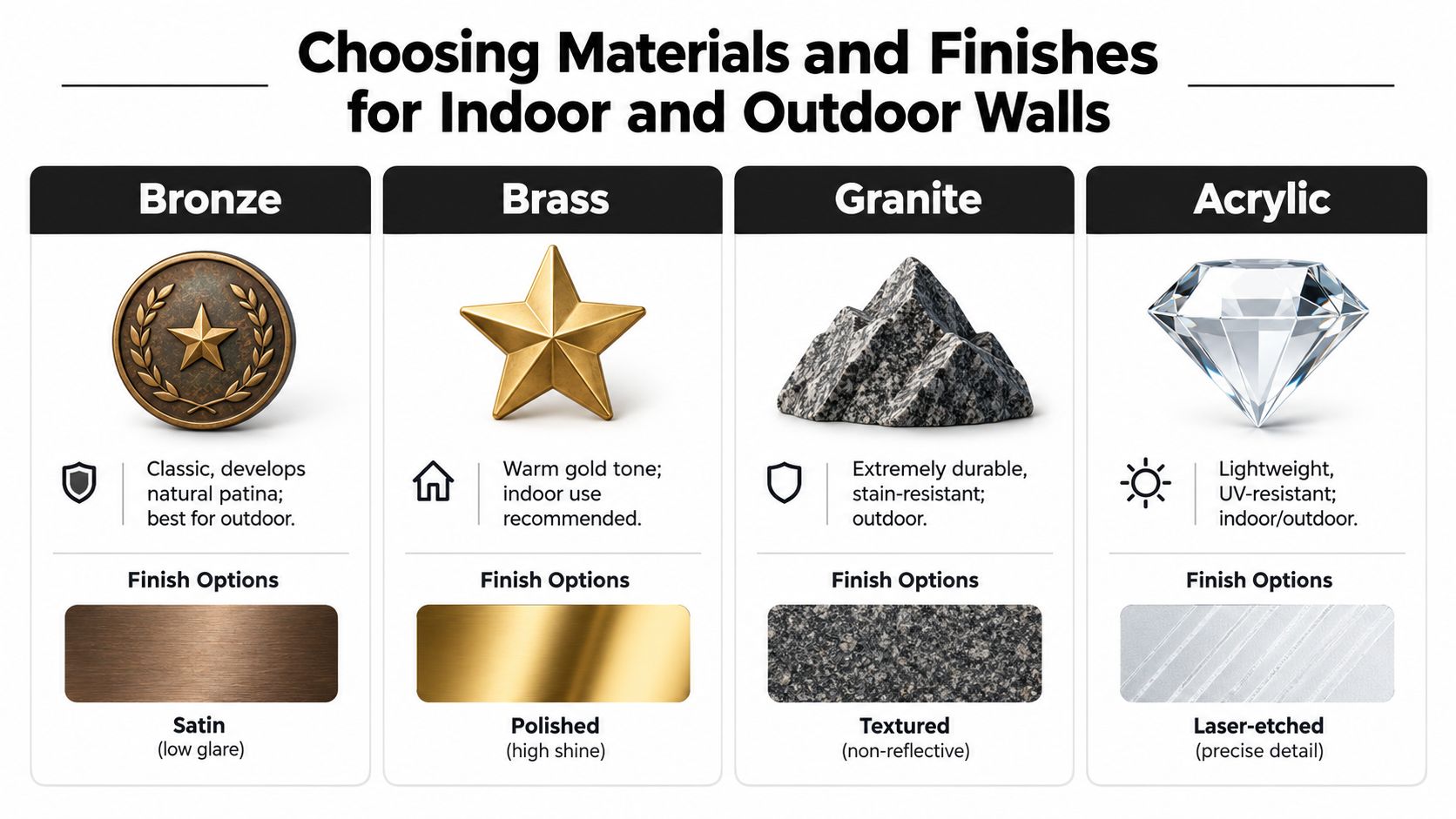
For Australian conditions, stainless steel is often the practical benchmark outdoors. In coastal or high-moisture settings, 316 marine-grade stainless steel is the strongest technical choice because molybdenum improves resistance to pitting from chlorides in sea spray, rain, sprinkler water, and airborne pollution. Unlike coated metals, it doesn't rely on a surface finish that can peel, fade, or wash away, as outlined by Planet Engraving's memorial plaque material guidance.
Reading the environment before choosing the metal
A sheltered foyer wall and an exposed seaside wall may both be vertical surfaces, but they are not the same job. Good plaque selection starts with exposure class.
- Indoor dry walls: Brass, stainless steel, and some stone options can all work well if glare is controlled.
- Outdoor suburban walls: Stainless steel, bronze, and stone are common choices where rain and grime need managing.
- Coastal or high-moisture walls: 316 marine-grade stainless steel is the safest conservative choice when corrosion resistance matters most.
- Heritage or formal civic settings: Cast bronze often suits the visual language and approval expectations.
Finish failure usually comes first
In signage guidance used as a practical cue for plaque selection, solid aluminium 2 mm is commonly associated with about 15+ years of real-world outdoor service, while stainless steel letters are reported at 20+ years, with finish degradation and coastal corrosion spots identified as major failure modes in the Platinum Signs outdoor lifespan guide.
That's a useful lesson. A plaque's life often ends visually before it ends structurally. The metal may still be sound, but if the face loses contrast, stains badly, or becomes difficult to read, the plaque has stopped doing its commemorative job well.
Wall Plaque Material Comparison for Australian Conditions
| Material | Outdoor Lifespan Cue | Finish Behaviour | Best For |
|---|---|---|---|
| 316 marine-grade stainless steel | Strong choice for harsh wet and coastal settings | No coating to peel. Holds legibility well when properly engraved | Coastal walls, public memorials, exposed gardens |
| Aluminium | About 15+ years as an outdoor signage cue | Surface appearance can degrade before structure fails | Lower-weight projects in milder exposure |
| Stainless steel | About 20+ years as an outdoor signage cue | Better long-term surface stability than many lighter alternatives | General outdoor memorial use |
| Bronze | Qualitatively treated as a durable long-life memorial material in Australian policy | Develops a natural aged appearance | Formal memorial walls, civic settings |
| Stone | Qualitatively durable when suited to the wall and mounting system | Less about corrosion, more about staining and fixing compatibility | Feature walls and architectural memorials |
If you're comparing metal options for a fabricated plaque, stainless steel plaques for outdoor memorial use are a practical reference point because they align with the durability logic used in exposed Australian settings.
Sizing Design and Layout Guidance That Keeps Plaques Legible
A plaque can be made from excellent material and still fail if the layout is cramped. Legibility is a design discipline. It depends on size, contrast, spacing, and the actual wall area available, not just the number of words you want to include.
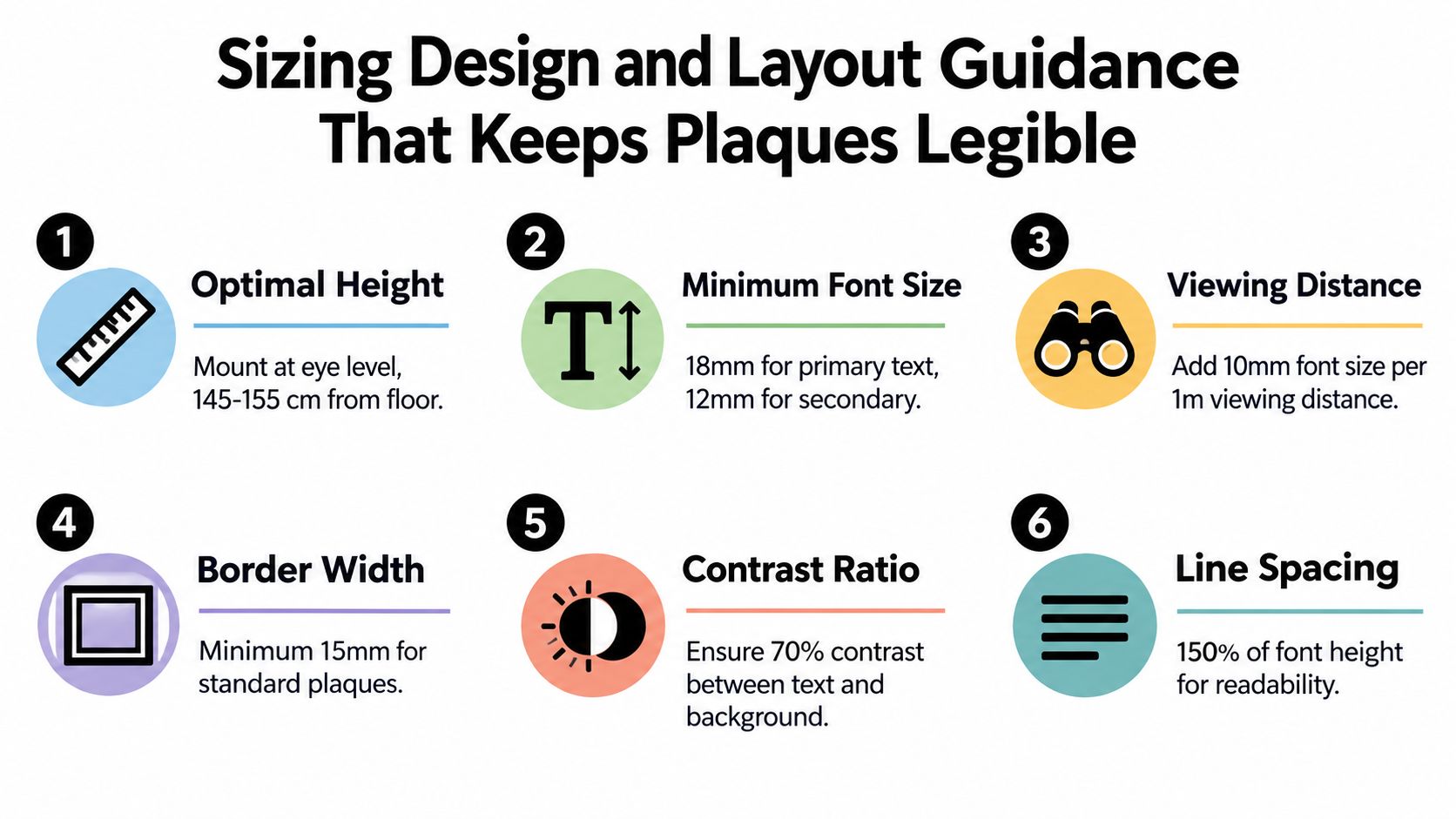
Many families and organisers get caught. They approve the wording before they know the permitted plaque size. Then the engraver has to squeeze too much into too little space. The result may be technically correct but visually tiring.
Approval can set the size before design does
Independent Australian guidance notes that ordering before checking cemetery specification is a common mistake, and that plaque rules can vary by section, including fixed dimensions and material requirements in places such as Perth, as explained in this Australian memorial plaque size guide.
Public place policies can be even tighter. Waverley Council requires approved plaques in public places to be modest in size, nominally A4, made from durable, vandal-resistant materials, and compliant with planning, heritage, environmental, and funding-recognition requirements in the Waverley Council plaque guideline.
Moira Shire Council goes further for park furniture. Its policy specifies stainless steel or bronze plaques with maximum dimensions of 100 mm long by 45 mm wide by 1.5 mm thick and standard laser-cut wording in the Moira Shire memorials and plaques policy.
A simple layout method that works
When space is limited, organise the inscription like a shop sign in three visual layers:
Name or dedication line
This carries the most weight and should get the strongest visual emphasis.Dates or commemorative event
Keep this quieter than the main line so the eye lands correctly.Short tribute
One restrained sentence often reads better than several compressed lines.
Workshop note: If you have to reduce the text so much that people need to lean in and decode it, the plaque is too small for the wording.
Fit the wall, not just the artwork
A plaque mounted inside a recess, on a masonry pier, or between existing architectural features needs margin around it. The wall itself becomes part of the composition. Crowding the edges makes even a well-engraved plaque feel awkward.
Useful checks before final production:
- Measure the actual fixing area: Not the whole wall. Just the clear zone available.
- Allow for edge clearance: Fixings, borders, and wall irregularities all need room.
- Consider viewing position: A plaque seen while standing close can carry more detail than one read from a path.
- Match process to detail: Fine logos, crests, and precise lettering suit custom metal plaque engraving where line control and contrast are important.
A calm, legible plaque nearly always uses fewer words, stronger hierarchy, and better spacing than people first expect.
Weight Fixing Methods and Wall Compatibility Explained
A plaque can look settled and permanent on paper, then become the hardest part of the job once it meets a real wall. The reason is simple. A wall plaque is a long-life asset fixed overhead or at chest height, often outdoors, and in Australia that means the wall type, the fixing load, moisture exposure, and approval conditions all affect the result.
Start with the surface that will carry the plaque. A sound brick pier behaves very differently from plasterboard in a hallway, and a stone-clad wall may have a cavity or brittle face material that should not be treated like solid masonry. The plaque and the wall work as one assembly. If either part is wrong, the installation life shortens.
Start with the wall, then match the fixing
Brick and concrete usually take mechanical fixings well when the base material is solid. Timber is often straightforward if the screw reaches stable structure rather than a thin lining board. Plasterboard needs more care. For anything beyond a light indoor plaque, the safe answer is usually backing support, not wishful thinking.
Use this table like a workshop checklist:
| Wall type | Usually suits | Watch for |
|---|---|---|
| Brick | Masonry anchors, studs, standoff fixings | Soft mortar, uneven face, older repairs |
| Concrete | Anchors, studs, concealed mechanical fixing | Drilling accuracy, water entry points |
| Timber | Screws into stable backing | Seasonal movement, tannin staining, splitting |
| Plasterboard | Backing support, specialised anchors for light plaques only | Pull-out risk, hollow sections, hidden services |
| Stone cladding | Careful fixing choice and substrate check | Cracking, cavity gaps, uncertain backing |
One practical rule helps here. The heavier the plaque, the less you should rely on the face surface alone.
Fixing styles and what each one really does
Face-fixed plaques with visible screws or bolts are simple to inspect and easy to remove later for maintenance. Rear-stud fixing gives a cleaner front and is common where presentation matters, but the drilling and set-out need to be exact. Adhesive systems can work on selected interior walls with controlled surfaces, though they are rarely the first choice for exposed outdoor memorials. Larger plaques sometimes need rails or cleats so the weight is shared more evenly across the wall.
That choice is not only about appearance. It is also about service life, access, and who may need to remove or re-fix the plaque years later.
If the plaque is going onto decorative stone, check whether you are fixing into the cladding itself or into the structure behind it. Those are very different jobs. For background on how exterior stone systems are built and budgeted, this guide to costs of marble wall cladding is useful before you choose drilling points or anchor depth.
Approval, exact sizing, and load all belong in the same conversation
Public and shared sites often regulate more than wording. Councils, schools, clubs, strata properties, hospitals, and heritage locations may set rules for plaque size, thickness, edge detail, fixing method, and where on the wall the plaque can sit. Some approvals also turn on weight. A large bronze plaque may need a different engineer or installer sign-off than a slim stainless plate of the same dimensions.
This catches people by surprise. A plaque that fits visually can still fail the site rules if it projects too far, interferes with access, or overloads a cladding system.
Waverley Council's guideline says plaques must not create trip hazards or obstruction and must comply with planning, heritage, environmental, and government funding recognition requirements, as noted earlier. The lesson applies well beyond one council area. Treat a memorial plaque as a regulated fixture, not just a decorative panel.
Longreach Regional Council's public memorial guidance requires cast bronze with raised, gold-coloured lettering for plaques and says designs should use materials that support a long life cycle of the asset in the Longreach public memorial and monument guidelines. That shows how some Australian sites control fabrication style, not only content.
When a QR layer helps
A QR code belongs in the planning stage, not as an afterthought. It helps when approval limits the plaque size, the wall can only carry a modest plate, or the site wants a restrained inscription with more family history stored online. In that case, the QR layer reduces text crowding while the physical plaque stays readable and compliant.
It does add one more responsibility. The link destination must be maintained for the life of the plaque, and the site owner should confirm that digital additions are allowed.
For projects that need fabricated outdoor plaques with drilled holes, rear studs, or adhesive-ready formats, custom outdoor memorial plaques are one practical route. Where laser-etched detail matters, many makers use Trotec Laser equipment because precise engraving helps keep lettering crisp and hole placement consistent.
Real World Examples From Homes to Large Memorial Walls
A home tribute and a major public memorial wall may feel worlds apart, but they solve the same basic puzzle. They need a suitable material, a readable layout, a fixing method that matches the surface, and a level of permanence that suits the place.
A small plaque on a sheltered home wall
A family might choose a modest metal plaque for a courtyard wall near a favourite seat or plant. In that setting, the emotional goal is closeness. The practical goal is restraint. The plaque shouldn't overwhelm the space, and the finish should stay readable in changing light.
This is also where a QR layer can make sense. A small stainless steel plaque with a QR code can link to a fuller memorial page when the available wall space is tight, a direction increasingly discussed by Australian memorial providers in current QR memorial guidance. The trade-off is simple. A QR code reduces text clutter, but it adds questions about long-term link upkeep, privacy, and whether the site permits non-traditional additions.
A tightly controlled community installation
Council-managed memorials often leave little room for improvisation. A plaque on park furniture, for example, may be limited in size, thickness, material, and even wording style. That means design skill lies in editing, not embellishing.
In jobs like that, laser production becomes useful because it handles compact lettering cleanly. Evright Industrial, backed by evright.com, produces engraved plaques and asset-style identification work with the same precision mindset. In practical terms, that means artwork is translated into exact engraved output, and the process from proof to production can be reviewed through Evright's parent company website, which shows how the engraving workflow supports custom plaque fabrication.
A large memorial wall built for consistency
At the opposite end sits the National Australia Remembers Freedom Wall in Brisbane, with its thousands of plaques as noted earlier. What stands out in large installations isn't only scale. It's consistency. Plaques need alignment, repeatable sizing, durable materials, and a maintenance approach that keeps the whole wall coherent over time.
That same lesson applies on a smaller project. Once a wall carries more than one plaque, consistency becomes part of dignity. Matching margins, common fixings, similar finish levels, and controlled engraving depth all help the memorial read as a unified place rather than a collection of unrelated plates.
The QR question also changes at scale. On a home plaque, a digital layer may add welcome depth. On a public wall, it can complicate governance, visual consistency, and long-term responsibility for online content. That's why hybrid memorials work best when one person or organisation clearly owns the ongoing digital side.
Caring for Your Plaque and Planning Your Next Steps
A wall plaque doesn't need constant attention, but it does need occasional care. Dust, salt, sprinkler residue, and airborne grime build up slowly. Most of the time, the danger isn't dramatic damage. It's the gradual loss of contrast and clarity.
For routine care, keep it simple:
- Use gentle cleaning: Soft cloths and mild methods help preserve the engraved surface and surrounding wall.
- Inspect fixings: Check for movement, staining around holes, or gaps that may let water sit behind the plaque.
- Watch the environment: Irrigation overspray, coastal exposure, and pollution often affect appearance more than people expect.
- Review readability: If glare or darkening is making the plaque harder to read, address it early.
A good final checklist before ordering looks like this.
| Final check | Why it matters |
|---|---|
| Site approval confirmed | Avoids remakes and installation delays |
| Wall measured properly | Prevents fit and edge-clearance problems |
| Material matched to exposure | Protects legibility and appearance |
| Mounting method selected | Reduces safety and maintenance issues |
| Wording proofed carefully | Keeps the tribute accurate and calm |
| QR decision made deliberately | Avoids adding digital complexity by default |
The best results usually come from slowing down at the start. A thoughtful wall plaque isn't only about sentiment. It's about choosing a form that the place can carry well for years.
If you're ready to commission a plaque, Evright Industrial can produce custom engraved memorial plaques for wall applications, including durable metal options and mounting-ready formats suited to Australian conditions. To review materials, fabrication options, and project support, visit Evright Industrial.
Recent Comments