

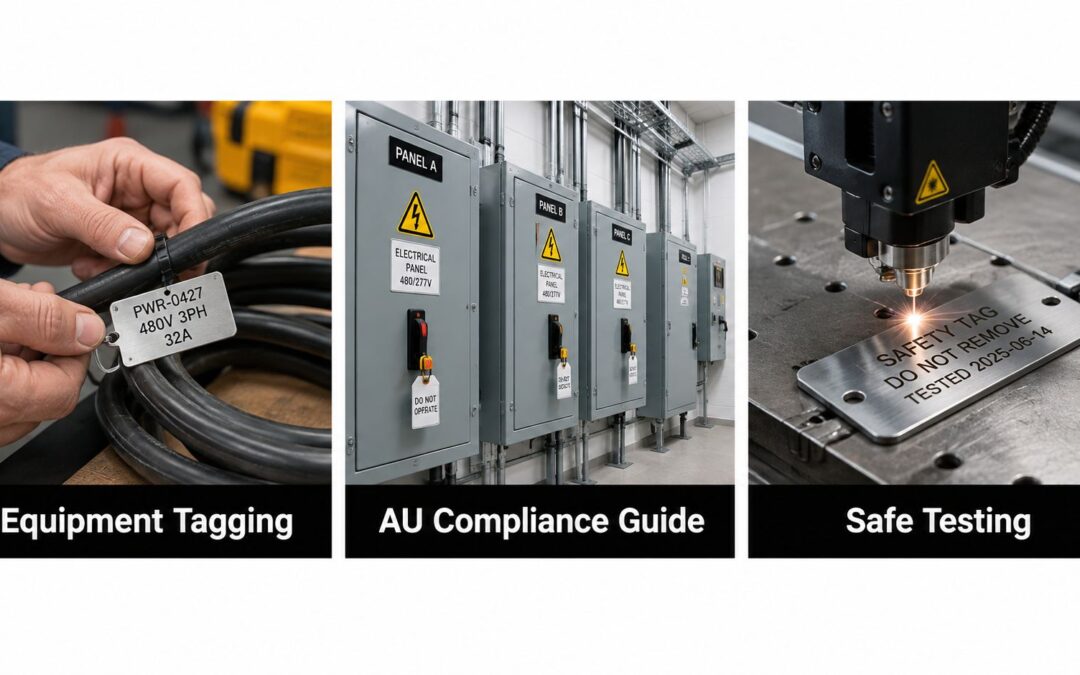
Most advice on tagging electrical equipment starts in the wrong place. A calendar cycle looks tidy on paper, but on an Australian worksite it can become a blunt habit that misses the core question, which is whether the item's condition, use, and environment still justify its current test status.
Australian compliance is risk-based, not built around a universal six-month or twelve-month routine. Safe Work Australia says higher-risk workplaces usually need testing at least every 12 months, while lower-risk workplaces may not need routine testing and still need inspection when necessary to keep equipment safe, and Queensland's guidance shows how sharply intervals can change by activity and equipment class. A practical guide like the electronic asset tagging guide is useful when you're trying to connect labels, registers, and asset history into one workable system.
Rethinking the Universal Tagging Cycle
The most common compliance mistake is treating a tag like a finish line. A pass tag is evidence that someone completed inspection and testing at a point in time, not a promise that the equipment stays safe until the same month next year. Once a cable gets dragged through grit, a plug takes a knock, or a portable appliance changes work area, the old assumption starts to weaken.
Risk comes before the calendar
Safe Work Australia's position is clear. Higher-risk workplaces usually require testing at least every 12 months, while lower-risk workplaces may not need routine testing and still need inspection when needed to confirm safety. Queensland's guidance goes further, because the interval can shift by environment and equipment type, from construction settings through to office equipment with much longer intervals where the risk is lower.
Practical rule: If the tag date is the only thing your team checks, your process is already too shallow.
That is why a generic annual replacement mindset fails on busy sites. Equipment in construction, manufacturing, service work, offices, and hire fleets does not age at the same rate, and it certainly doesn't face the same damage exposure. The better question is not “When was it tagged last?” but “What happened to this asset since the last verified test?”
For teams that want a broader view of asset control, the compliance insights with ELECTE are worth a look because they frame compliance as traceability, not decoration.
Navigating AS/NZS 3760 – 2022 Testing Intervals
AS/NZS 3760:2022 sets the reference point for in-service safety inspection and testing of electrical equipment and residual-current devices. Standards Australia records it as a complete revision published on 24 June 2022, replacing the 2010 edition and its 2011 and 2012 amendments. That matters because the tag is only one part of the control system. The key issue is whether the record behind it matches the condition of the asset in service.
Risk-Based Testing Intervals by Industry
| Work Environment | Equipment Type | Maximum Testing Interval |
|---|---|---|
| Construction work | Equipment not tied to transportable structures, fixed or transportable equipment, or construction wiring | 3 months |
| Construction work | Equipment in the latter categories | 6 months |
| Manufacturing workplaces | Equipment that is not double-insulated | 6 months |
| Manufacturing workplaces | Double-insulated equipment | 12 months |
| Office environments | Equipment without a safety switch | 5 years |
| Service work | Equipment without a safety switch | 12 months |
Those intervals show why a single replacement cycle falls apart on mixed sites. A construction tool, a factory appliance, and a desktop device do not face the same wear, handling, cleaning, transport, moisture, or abrasion. If your tagging process ignores that, the tag becomes a calendar marker rather than a traceable safety control.
Use the electrical safety standards Australia page to align local practice with standard terminology without flattening the differences between industries. For a systems view that keeps records and labels aligned, the compliance insights with ELECTE are also useful.
Operational takeaway: A longer interval reflects lower exposure and lower risk, not lighter discipline. On a busy site, that only works when the equipment history, test result, and tag all point to the same asset.
Executing the Five-Stage Verification Workflow
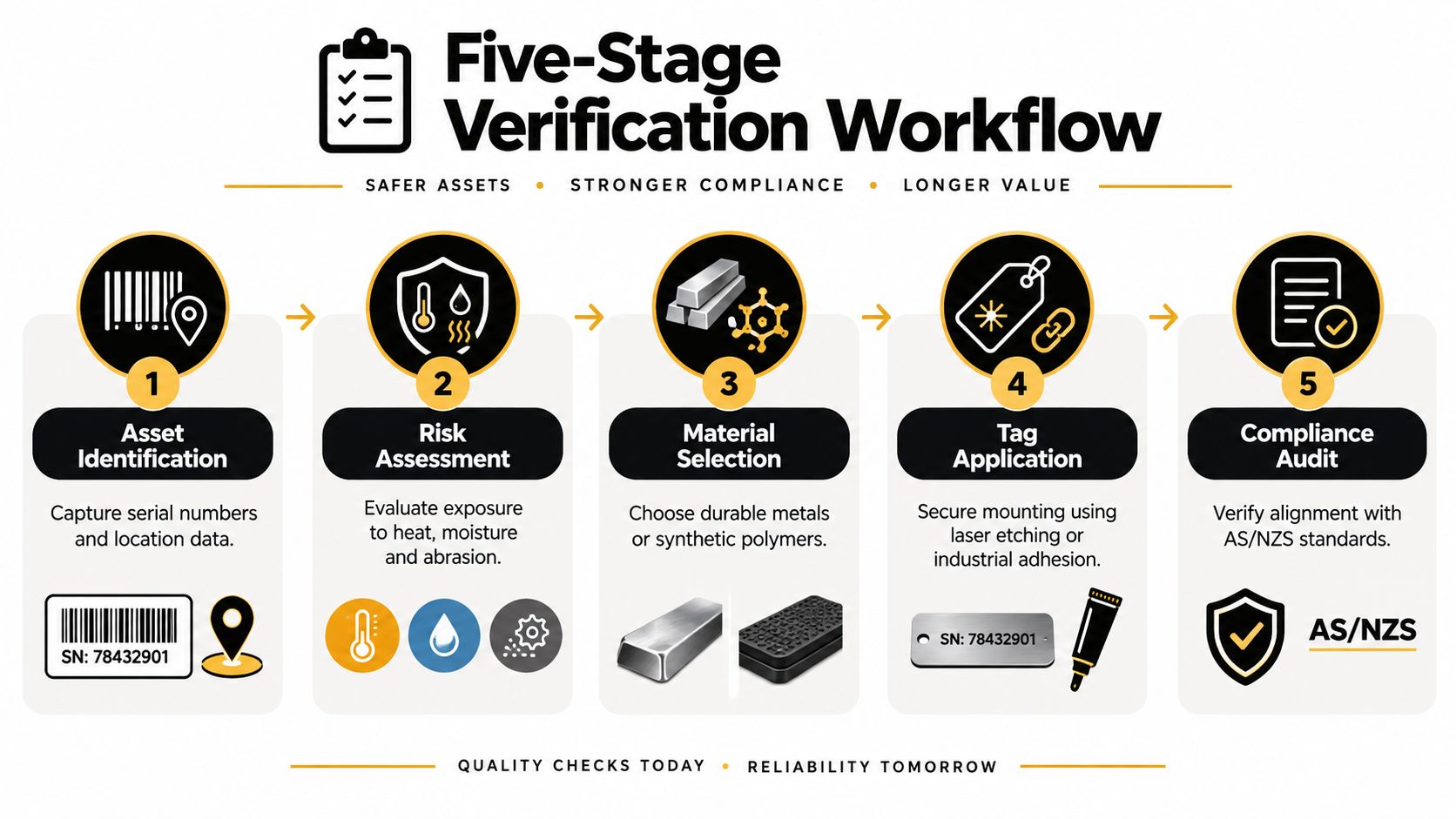
A tag only means something when the item behind it has been properly identified, inspected, and tested. In higher-risk Australian workplaces, the workflow starts with the asset itself and ends with a durable tag that can be matched back to the record without guesswork.
Start with identity, not ink
The first stage is a unique equipment or asset identifier, with location, owner, class, and circuit or isolation point recorded against it. That traceability is the control that stops a tag from floating free of the item it was supposed to protect. If your register can't tell you which asset was tested, the test has limited value during an audit.
The next stages are physical and technical. Inspect the enclosure, plug, flexible cord, and accessories. Then test protective-earth continuity for Class I equipment, power boards, and cord sets, followed by insulation resistance or leakage current, and polarity checks for rewireable plugs and cord-extension sockets.
Apply the tag only after the result is known
The most serious failure is not a missing tag, it's a tag that can't be tied back to a tested asset.
The final step is the tag itself, and it should show the tester, test date, next due date, and outcome. In practice, asset-to-record traceability is the control that matters, because a durable label without a matching record still leaves a gap. On a live site, that gap is where overdue gear stays in service longer than anyone intended.
Selecting Durable Materials and Laser Engraving
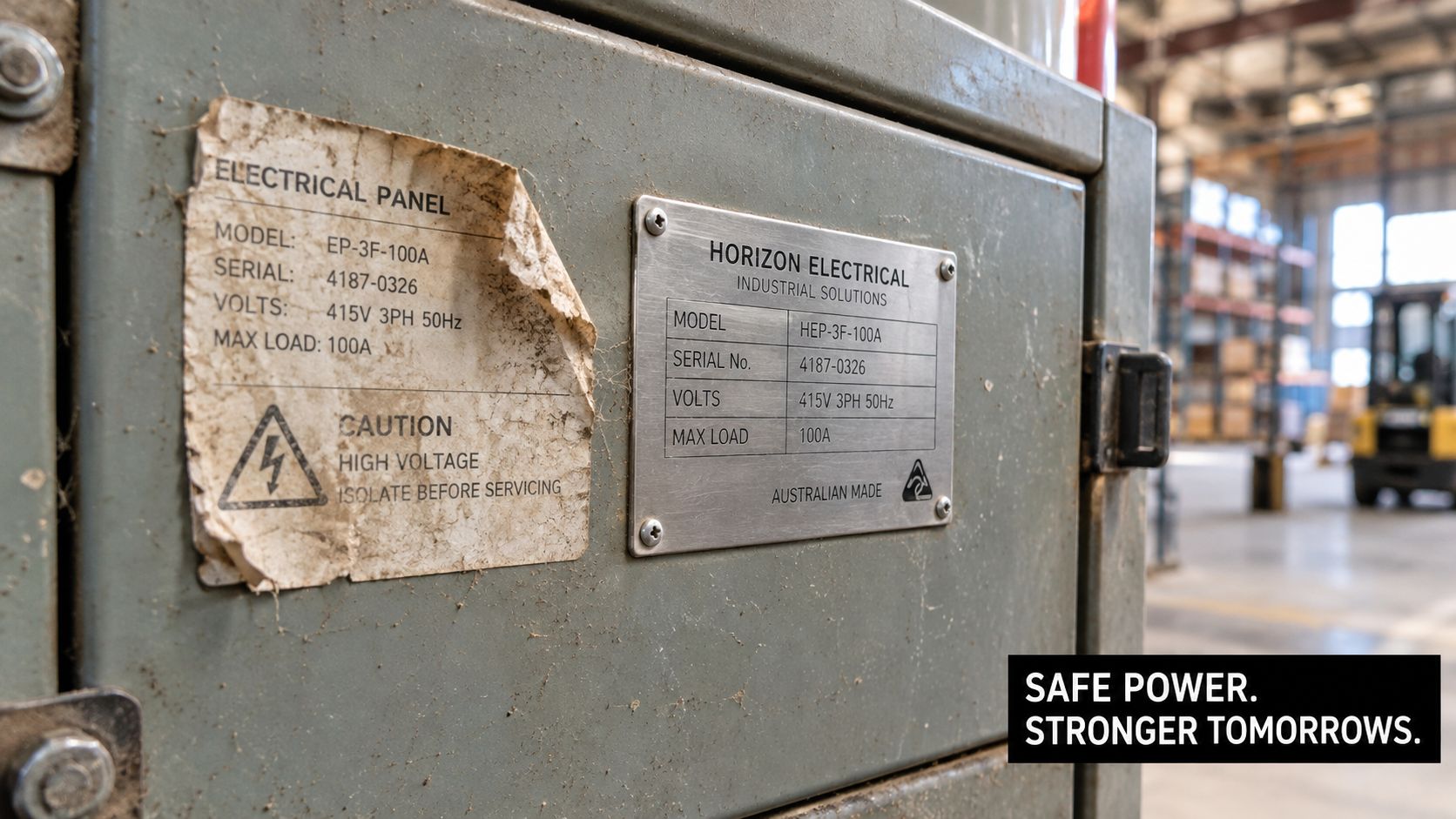
Printed paper labels fail quickly in heat, dust, moisture, and chemical cleaning. Cheap plastic tags can peel, fade, or curl, and once the text degrades the tag stops doing the one job it has, which is to stay legible long enough for a busy person to trust it at a glance.
What lasts in harsh Australian conditions
A compliant tag needs to be bright, distinctive, water-resistant, securely fixed, legible, non-metallic, and incapable of being reused. That combination is not cosmetic, it's a control against misidentification and accidental reuse. The tag also needs enough contrast that a supervisor can read it without lifting leads, opening covers, or second-guessing the asset register.
Precision laser engraving solves a lot of the failure modes that printed labels create. With a Trotec Laser, the marking is permanent and high-contrast, which is exactly what you want when tags sit near abrasion, cleaning chemicals, and constant handling. Evright Industrial uses that approach for custom electrical labels, and their laser marking materials page shows the kind of substrate selection that matters when the tag has to survive the site rather than the office.
What actually works on the floor
You want a tag that stays readable after the shift, after the washdown, and after the next person handles the equipment. That is where precision laser engraving outperforms ink-based printing, because the mark is built into the material rather than sitting on top of it.
Evright Industrial, through Evright Industrial, works with precision laser engraving to produce intricate, consistent asset labels and safety markings for demanding environments. The practical value is simple, the identification stays clear, and the asset can still be matched to its record when the equipment has been in service for months or years.
Implementing Isolation and Danger Tag Protocols
Routine test tags and isolation tags solve different problems, and confusing them is where serious mistakes start. A pass or fail test label tells you the equipment's inspection status. A danger or out-of-service tag tells workers not to use the item, not to energise it, or not to remove isolation without authority.
Separate the controls
NSW guidance treats a compliant tag as a control against misidentification and unauthorised reuse, not just a date label. The tag should be bright, water-resistant, securely fixed, legible, non-metallic, and non-reusable, and it should show the tester's identifier, test date, next scheduled date, and pass or fail outcome. For isolation work, a separate danger or out-of-service tag belongs at every isolation point.
That distinction matters because one label cannot do every job safely. If you tag only the appliance and ignore the isolation point, someone can still energise the supply. If you leave an out-of-service item looking available, a shift change can turn a controlled defect into an operational mistake.
Keep the test tag on compliance, and the danger tag on control. Mixing the two creates confusion when the site is busiest.
Victoria's guidance also draws a useful procedural line, because danger tags should be removed at shift completion or when the work ends, while out-of-service tags remain until repair and verification are complete. That discipline keeps live, isolated, and defective equipment visually distinct for the people who are moving fast between tasks.
Building an Auditable Asset Traceability Register
The physical label is only half the system. The register is what makes the tag auditable, because it holds the asset identifier, location, test result, and the responsible competent person. Without that link, a tag becomes a loose visual cue instead of a control you can defend in a review.
Record the trigger events, not just the routine dates
Safe Work Australia says inspection and testing also need to happen after repair or servicing that could affect electrical safety, before first use when equipment is bought second-hand, and when no previous testing record exists. That means your register has to track more than calendar dates, it has to capture events that change the equipment's risk profile.
The asset tagging and tracking system from Evright Industrial is relevant here because it ties physical identification to a record structure that can follow the item through use, service, and reissue. That's the core value of tagging electrical equipment properly, the tag becomes the fast visual check, and the register becomes the evidence behind it.
Keep the chain unbroken
If the tag and the record can't be matched, the audit treats them as two separate problems.
That's why overdue tools, second-hand gear, and repaired equipment need immediate attention before they drift back into use. A strong register does not just store data, it keeps the asset history visible enough that a supervisor can act before a defect turns into a compliance failure.
Evright Industrial supplies precision laser-engraved electrical labels, asset tags, and compliant identification solutions that suit harsh Australian worksites. If you need durable tagging electrical equipment support that links cleanly to your register and stands up to daily handling, visit Evright Industrial and review what they can produce for your site.
Recent Comments