
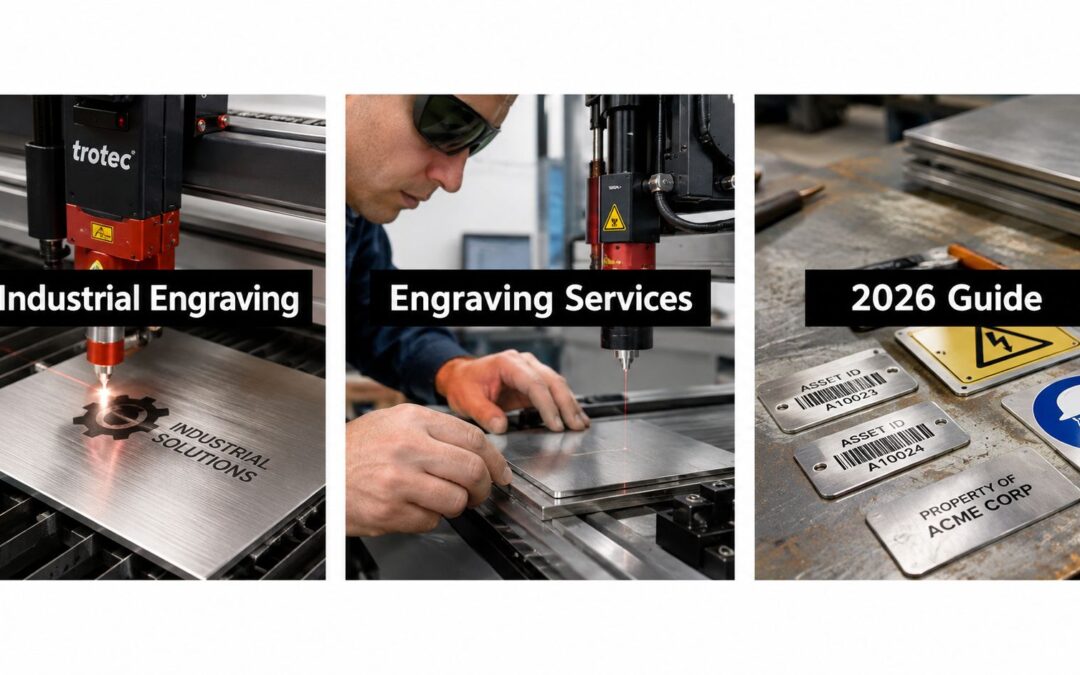
A fitter wipes oil from a pump housing and tries to read a fading serial number. An electrician opens a switchboard looking for the correct isolation point. Nearby, a maintenance supervisor checks a permit while a contractor searches for the equipment record that should match the plate in front of them. These are ordinary moments on Australian worksites, and they show why industrial engraving services are about far more than finish and appearance.
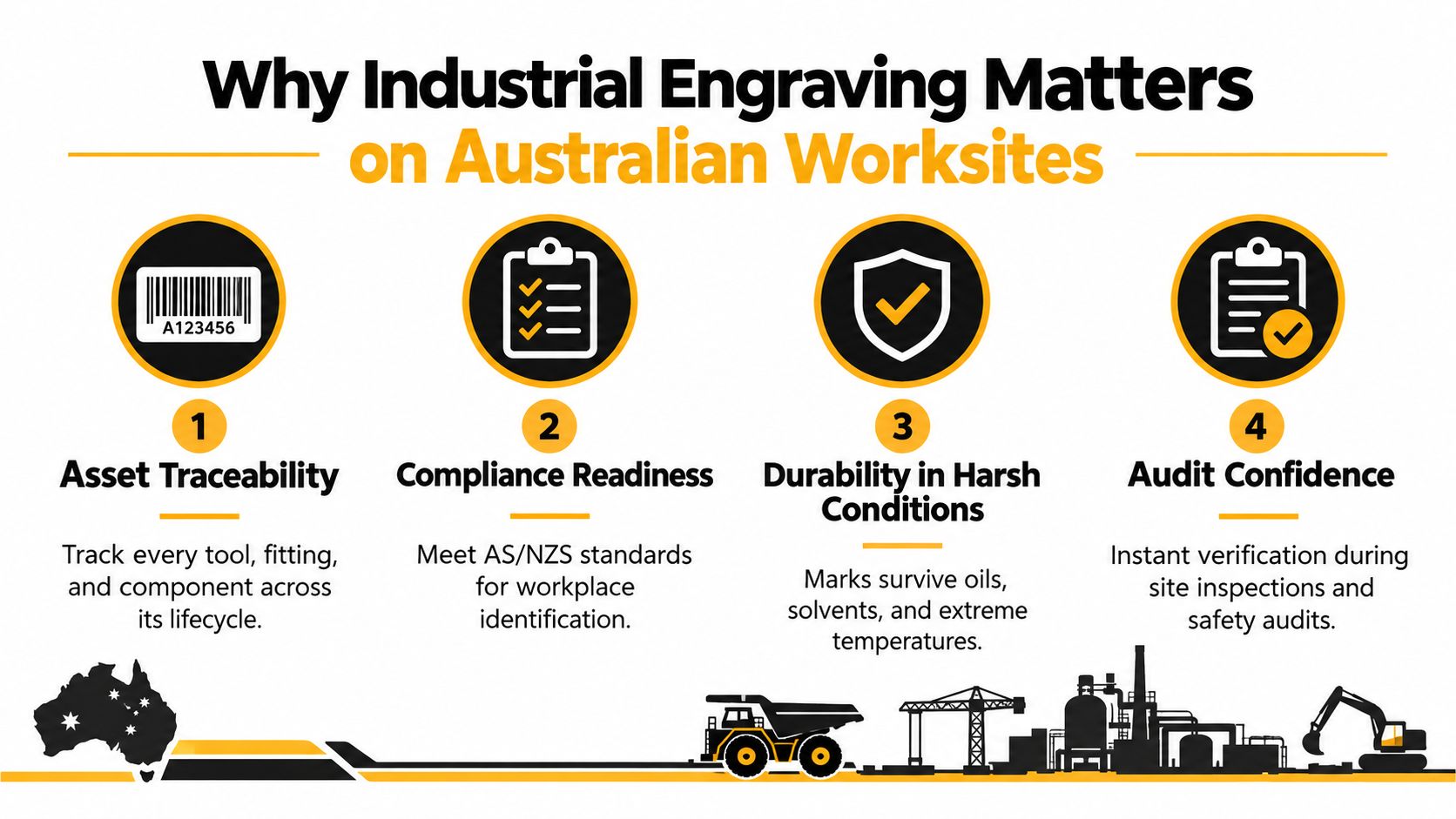
A durable mark has to remain legible, match the asset register, support safe work, and suit the environment where it will be installed. The Australian Bureau of Statistics recorded 50,679 manufacturing businesses, 47,072 manufacturing locations, and 39,139 employing businesses in the 2023–24 financial year, indicating a broad operating base for industrial identification requirements (Australian Bureau of Statistics manufacturing data). Across those sites, labels identify machinery, electrical assets, tools, production equipment, safety-critical components, and replacement parts.
Why Industrial Engraving Matters on Australian Worksites
The risk context makes weak identification a poor economy. Safe Work Australia recorded 200 worker deaths from traumatic injuries sustained while working in 2023, including 84 deaths from vehicle incidents and 24 deaths from workers being hit by moving objects. Machinery operators and drivers recorded 73 fatalities, with a fatality rate of 8.3 deaths per 100,000 workers, almost six times the overall national rate (Safe Work Australia's key work health and safety statistics).
These figures don't prove that engraving prevents incidents. They do show why operators need clear equipment numbers, warning plates, isolation markings, directional signs, and emergency information in environments involving vehicles, machinery, moving parts, and multiple work crews.
Treat the mark as operating infrastructure
A paper label may work in a clean office. On a factory floor, abrasion, oil, solvents, cleaning agents, heat, moisture, ultraviolet exposure, and repeated handling can make temporary identification unreliable. An engraved plate or directly marked component gives maintenance teams a stable reference point, provided the material, contrast, location, and message have been selected properly.
The practical sequence is straightforward:
- Define the operational purpose. Decide whether the mark identifies an asset, warns about a hazard, shows an isolation point, records certification, or supports stock and maintenance traceability.
- Choose information that will remain useful. An asset number, hazard wording, owner, inspection status, or isolation reference may belong on the human-readable face. More changeable information can sit in a controlled digital register.
- Match the substrate to exposure. A plate for an indoor control cabinet doesn't face the same conditions as a marking on outdoor infrastructure or process equipment exposed to chemicals.
- Verify the finished item. Check spelling, serial sequence, symbol, contrast, dimensions, location, and correspondence with the asset documentation before installation.
That approach matters across Australia's manufacturing base because identification isn't confined to major factories. Workshops, warehouses, processing plants, utilities, transport facilities, and infrastructure sites all need marks that remain useful during maintenance and inspection.
The rest of the decision comes down to laser production, substrate performance, safety-sign obligations, hazardous-area traceability, sector-specific use, procurement controls, and supplier capability. Evright Industrial's workflow is one Australian example of how approved artwork and material specifications become a finished engraved product using a Trotec Laser machine.
How Laser Engraving Works and Why It Fits Industry
Industrial laser engraving is a non-contact, subtractive process. A focused beam directs concentrated energy onto the workpiece, vaporising or altering a precisely targeted area instead of depositing ink or pressing a cutting tool against the surface. That distinction matters when the component has fine detail, small text, a delicate finish, or a geometry that would be difficult to hold against a mechanical cutter.
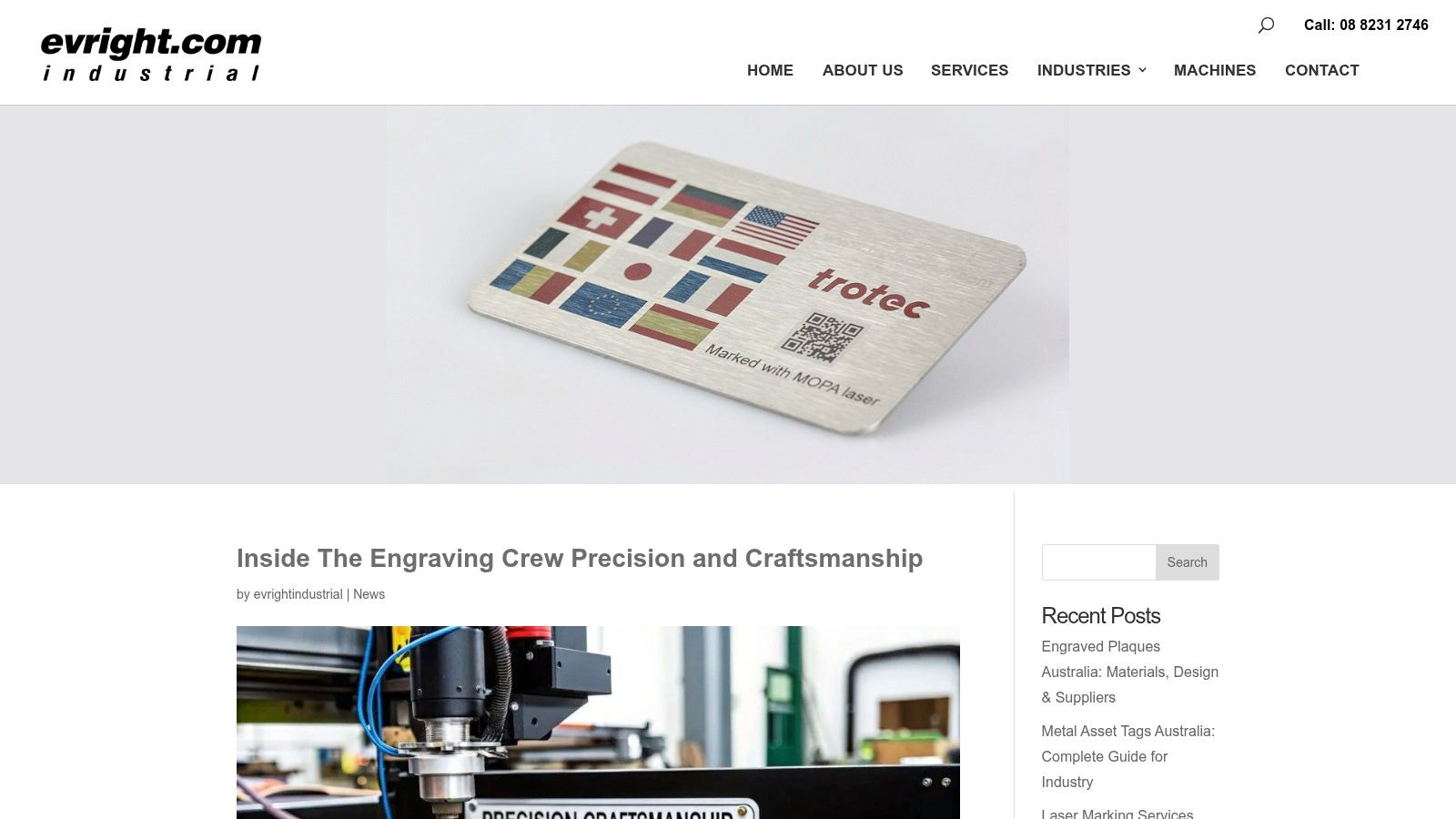
At Evright Industrial, the production sequence starts with approved digital artwork and material requirements. The artwork is loaded into specialised software, machine power and speed are calibrated for the selected substrate, and the Trotec Laser head traces the design to create a clean, permanent mark. The same controlled file can support serial numbers, part codes, logos, and data-matrix-style identifiers across a batch, which helps reduce variation between individual components.
Why the digital workflow matters
Mechanical engraving can produce a strong recessed mark, but it requires physical tool contact, suitable fixturing, and careful management of cutter wear. Dot-peen marking uses a stylus to create a series of indents, which can suit some metal parts but may not provide the visual finish or fine graphic detail required for every sign and label. Chemical etching can create useful results on selected materials, although chemical handling and process control become part of the production equation.
Laser marking is particularly useful when a project needs repeatability, fine graphics, compact identification, or a consistent sequence of variable data. It also avoids physical tool pressure on the labelled component. That doesn't mean every job should automatically use a laser. The supplier still needs to test the substrate, confirm the required contrast, assess the environment, and check whether the proposed mark will remain readable after cleaning and service exposure.
For a practical overview of how different approaches suit different parts, surfaces, and production requirements, review Evright Industrial's laser engraving techniques. The correct choice depends on the component and the job the mark must perform, not on the technology label alone.
Trotec Laser imagery is the appropriate production reference for this work because industrial users need to understand the actual marking system, guarding, setup, and material response. A generic mechanical engraving photograph or unrelated video can make a project look simple while hiding the decisions that determine whether the finished mark scans, survives, and matches the approved record.
Materials That Hold Up in Real Industrial Environments
A plate that looks fine on the bench can fail fast once it goes onto a washdown machine, an outdoor cabinet, or a switchboard that gets opened and cleaned for years. Material choice decides whether the mark stays readable, stays attached, and still suits the job after service exposure. For industrial engraving, that decision starts with exposure, viewing distance, cleaning regime, mounting method, contrast, and whether the item is a safety sign or an asset label.
Anodised aluminium is a practical option for lightweight plates, equipment identification, control panels, and general asset marking. In a Trotec Laser workflow it usually gives clean, consistent contrast and is easy to fixture for repeat production runs. The catch is surface performance. Different anodised finishes do not respond the same way, and a plate that suits a sheltered panel may be the wrong pick where abrasion, frequent wipe-downs, or aggressive chemicals affect the face around the engraved area. For a broader substrate comparison, see Evright Industrial's laser marking materials guide.
Stainless steel earns its place where the tag or plate has to handle rough treatment, moisture, cleaning, or harsher industrial conditions. It suits plant identification, equipment plates, and jobs where substrate strength matters more than keeping weight down. On the factory floor, the trade-off is straightforward. Stainless costs more, can be harder to mount, and its reflectivity can affect readability if the artwork, finish, and installation angle are not resolved early.
Traffolyte and other industrial laminates still make sense for switch plates, control labels, panel identification, and many indoor signs because the layered construction gives clear visual contrast. They are often the sensible choice where operators need quick recognition rather than a heavy-duty metal plate. Grade selection matters. A laminate chosen for an internal electrical panel should not be assumed suitable for outdoor exposure, solvent contact, or higher-heat locations.
UV-stable polymers and coated metals cover another useful group of applications. They can suit jobs where weight, colour coding, electrical insulation, or a specific fixing method drives the specification. Coated metals can also produce a sharp mark when the laser removes or changes the top layer. That only works well when the full service environment is considered first, including coating adhesion, sunlight, solvents, abrasion, and any repainting or refurbishment later in the asset life.
Check geometry before artwork approval
Material is only part of the decision. Geometry can rule a job in or out before production starts.
Evright's published machine-engraving guidance sets limits for non-cylindrical curved surfaces where height variation across the marking area exceeds 25 mm or the surface angle is greater than 30 degrees (Evright's machine engraving guidance). Those limits matter during quoting and file approval, not after the plate or part is already in production.
For pipes, housings, plant components, and irregular surfaces, send the supplier the actual part dimensions, curvature, substrate, proposed marking location, and artwork size first. That allows the production team to assess fixturing, focus, access, and repeatability before the job is released. In practice, that is where many avoidable reworks are prevented.
| Substrate | Best Environment | Watch Out For |
|---|---|---|
| Anodised aluminium | Lightweight equipment plates, panels, indoor and general industrial identification | Abrasion, aggressive chemicals, and finish variation |
| Stainless steel | Plant, equipment, outdoor or heavily handled identification | Reflectivity, weight, contrast, and mounting requirements |
| Traffolyte and industrial laminates | Switch plates, control panels, internal equipment labels | Outdoor exposure, heat, solvents, and incorrect grade selection |
| UV-stable polymers | Lightweight labels, colour-coded identification, selected outdoor uses | Heat, chemical compatibility, surface distortion, and UV performance |
| Coated metals | High-contrast labels and panels where the coating can be selectively removed | Coating adhesion, repainting, abrasion, and chemical attack |
Good material selection describes actual service conditions, not just the finish someone prefers at approval stage. A plate can look premium and still be the wrong choice if the mark loses contrast, wears on the exposed face, or cannot be read from the actual approach path.
Compliance, Durability and the Standards That Govern the Mark
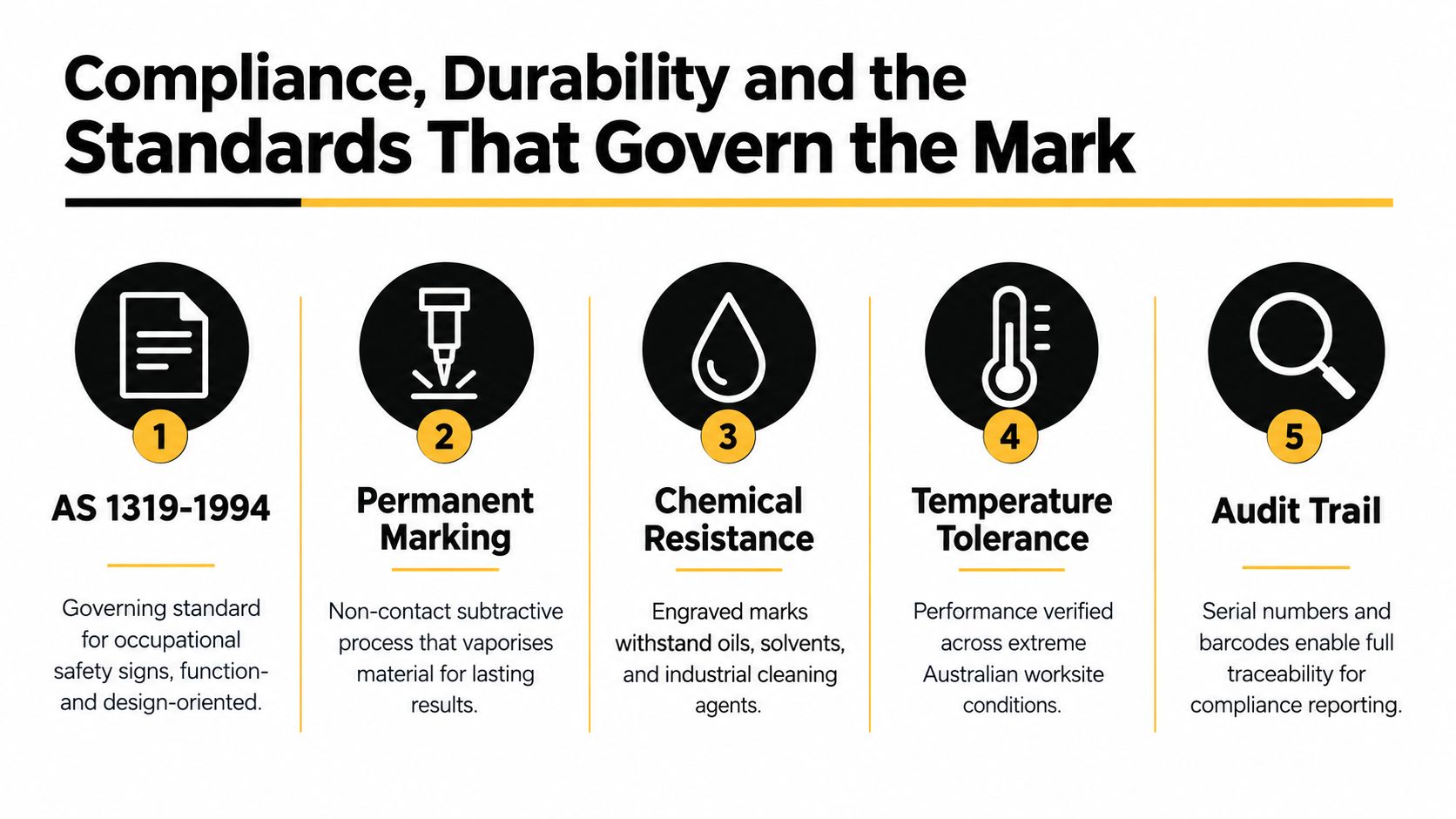
A plate can stay bolted to a machine for years and still fail the job if the wrong message is on it, the sign format is wrong, or nobody can read it from the approach path. On Australian worksites, AS 1319-1994 sets the frame for safety signs used in occupational environments to warn, direct behaviour, and identify emergency or fire-protection information (AS 1319-1994 through Standards Australia).
That distinction matters in production. An engraved label may be durable, chemical resistant, and neatly finished, but durability alone does not make it a compliant safety sign. WorkSafe ACT makes the practical point clearly. Sign material and size need to suit the application (WorkSafe ACT signage guidance). In other words, start with the duty of the mark, then choose the substrate, fixing method, contrast, and layout to suit UV, abrasion, heat, moisture, chemicals, and viewing distance.
Separate the sign duty from the asset label
On a real project, the mark usually falls into one of a few different jobs, and each one needs its own specification:
- Asset identifiers support inspection, maintenance history, ownership, and register control.
- Danger, warning, mandatory, prohibition, emergency, and fire signs carry a safety message and need the correct visual convention.
- Isolation and switchboard labels help workers identify the right equipment and control point before they act.
- Confined-space and chemical-storage signs can carry specific wording and placement requirements.
The legal duty does not stop at making a plate that lasts. The NSW Work Health and Safety Regulation 2025 requires certain signs to identify hazards, stay clearly visible, and be placed next to the hazard. Confined-space signs also need to warn that entry requires a permit. If the message, symbol, placement, or visibility is wrong, a permanent plate is still the wrong control.
For broader electrical coordination, teams dealing with emergency lighting, plant identification, and compliance records may also find this resource on AS/NZS 2293 compliance Brisbane useful.
Hazardous-area equipment needs traceability
Hazardous-area work changes the brief again. AS/NZS 3800:2020 deals with the repair, overhaul, reclamation, and modification of equipment designed for explosive atmospheres. Under the ANZEx scheme rules referenced with the standard, repaired or overhauled equipment and its documentation need identifying marks that show the basis of the overhaul, including the applicable certification documents or relevant protection-technique standard (AS/NZS 3800:2020 through Standards Australia).
In practice, the engraved mark has to match the paperwork exactly. That means the approved wording, character size, location, contrast, substrate compatibility, and legibility after service all need to be settled before production starts. I would also treat any direct marking or attached plate on Ex equipment as an engineering question first, because material removal, local heating, coatings, flamepaths, ingress protection, and certification assumptions can all be affected by how the mark is applied.
On the production side, enclosed laser workflows are part of good shop control. Trotec's SpeedMarker material describes protective housings, safety interlocks, and optional fume extraction, with fully enclosed Class 2 operation depending on configuration (Trotec Laser SpeedMarker brochure). Guarding and ventilation belong in the production environment, while the mark itself still has to satisfy the site's compliance and lifecycle requirements.
Industry Use Cases Where Engraved Marks Earn Their Keep
A maintenance technician doesn't value a plate because it looks polished. They value it because it answers a question quickly, remains readable after service, and matches the documentation used by the site.
Manufacturing asset identification
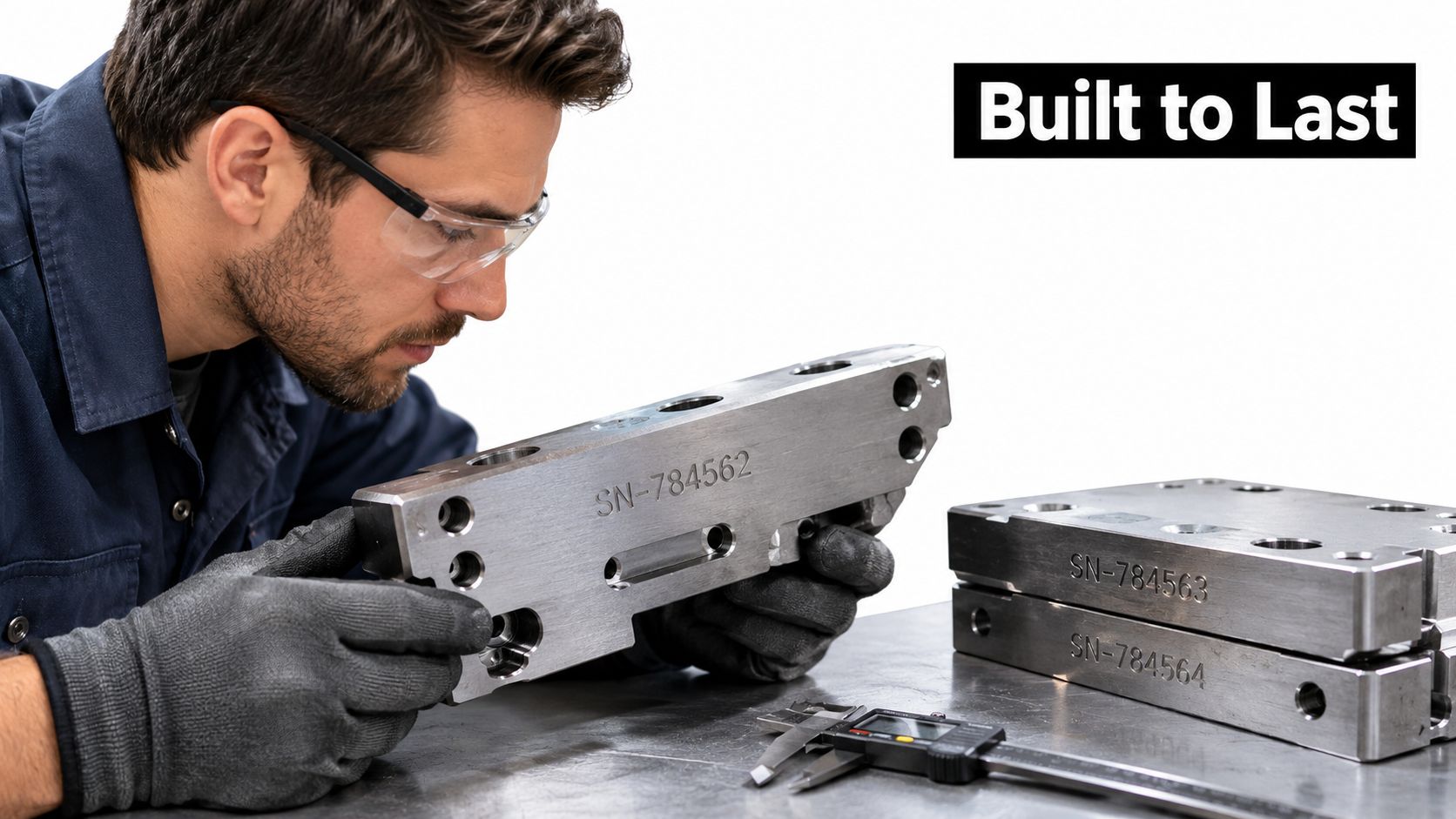
On a production floor, an engraved serial number or component ID can link a motor, fixture, tool, pump, or replacement part to its maintenance history. Oils, solvents, abrasion, and repeated handling make paper labels a poor choice for many assets. A laser-marked plate or directly marked surface gives the fitter a stable reference while the asset register carries the broader service record.
The useful result isn't the mark alone. It is the reduction in uncertainty during inspection, handover, repair, and replacement.
Electrical and essential services
Switchboards, isolation points, plant rooms, control cabinets, and essential-services equipment need identification that an electrician can locate and interpret under working conditions. The label should distinguish equipment, show the relevant hazard or control information, and sit where the worker can see it before interacting with the hazard.
Poor placement defeats a good substrate. A durable plate hidden behind a conduit or mounted away from the approach path doesn't provide the same operational value as a clearly visible, correctly worded sign.
Healthcare and medical equipment
Healthcare facilities subject equipment to repeated cleaning and handling. Bedside equipment, service panels, storage systems, and technical assets need marks that remain readable without becoming another loose label that can peel, tear, or disappear during cleaning.
The design also needs restraint. Human-readable identification should be clear, while a barcode or QR code can connect the item to a controlled register when the surface has enough space and the scanning process has been tested.
Memorial and commemorative work
Funeral homes, memorial planners, councils, and infrastructure clients commission plaques for a different reason. The mark must remain legible and respectful over time, with typography, contrast, mounting, and environmental exposure considered together. Here, the operational outcome is continuity of identity and information, not maintenance isolation.
For teams comparing physical wayfinding, facility identification, and industrial signage and branding, the same principle applies. Branding can't replace a required safety message, and a compliance sign shouldn't be weakened by decorative treatment that reduces visibility.
The following Trotec Laser production reference shows the type of controlled marking process industrial buyers should expect to discuss with a supplier:
Government and infrastructure
Infrastructure sites often need long-lasting security, equipment, access, and safety signage across locations that are difficult to revisit. A good specification considers vandalism, weather, cleaning, viewing distance, replacement procedures, and how the label will remain aligned with the asset register after relocation or modification.
These use cases share one test: can a worker, contractor, auditor, or member of the public understand and trust the mark when it matters?
Procurement and Quality Controls That Prevent Costly Reworks
A rework job usually starts with a small omission. A purchaser sends a photo, a quantity, and a deadline. Production then has to guess the substrate, the fixing method, the exact wording, or which register entry the plate must match. On an Australian worksite, that is how a simple label order turns into scrap, delay, and a compliance problem.
The way to prevent that is to treat engraving as a controlled identification task, not a decorative purchase. If the mark supports isolation, maintenance, hazardous-area traceability, or safety signage duties under AS 1319-1994 and AS/NZS 3800:2020, the order has to lock down what the item says, where it sits, and how it will be verified before it leaves the factory.
The buyer's control list
Artwork approval comes first. Use one controlled file. Confirm every line of text, every symbol, and every variable field before production starts. Serial ranges, asset numbers, and certification references should be checked against the live register while the job is still on screen, not after plates are packed.
Define the marking method. State whether the job needs a surface mark, deeper material removal, a laminate construction, or another specified process. The right choice depends on service conditions, legibility, substrate behaviour, and how long the information must remain readable in service.
Set the physical limits. Record substrate, thickness, overall size, corner detail, hole positions, adhesive specification, text height, barcode or QR code placement, and intended viewing direction. Include curved-surface information early and apply the geometry limits discussed in the materials section before approving artwork.
Require verification. A production check should compare the finished item with the approved order and the reference documents. For higher-consequence equipment, ask for photographs or an independent inspection. The checker should confirm spelling, sequence, contrast, dimensions, placement, and document references.
Plan the lifecycle. Keep information that must survive a software change or database migration in plain human-readable form. Asset number, hazard, isolation point, equipment name, or owner should not disappear because a QR destination changed or a cloud record was retired.
Buyer discipline matters, but supplier discipline matters just as much. As covered earlier in the standards section, controlled laser production still requires material assessment, fume management, ventilation checks, and confirmation that the marking process will not harm the component.
In practice, a Trotec-based workflow is only reliable when approved artwork, selected material, variable-data control, and final inspection stay tied to the same job record. That is the useful part for procurement teams. The machine is only one control point in a longer chain.
Evright Industrial follows that pattern by starting with approved artwork and material requirements, then checking the finished engraved item against the order before dispatch. Buyers building out their own purchasing process can also review Procright tips to cut procurement errors for broader guidance on approval paths, specification control, and supplier communication.
A sound purchase order should state the identifier, reference documents, mark method, substrate, dimensions, minimum character size, placement, verification method, packaging, and replacement procedure. It should also state what happens if the equipment is relocated, modified, decommissioned, or issued with a new register number.
Working with Evright Industrial as Your Engraving Partner
Evright Industrial is the specialised industrial division of evright.com, with close to six decades of laser marking and engraving experience. Its work covers equipment identification, safety signage, asset labels, electrical items, panels, plaques, and permanent part marking for manufacturing, essential services, healthcare, memorial, government, and infrastructure applications.
The production approach uses Trotec Laser machinery, approved artwork, selected materials, and quality checks before dispatch. That fits projects where the supplier needs to handle serial numbers, component IDs, traceability marks, safety wording, and custom layouts rather than merely reproduce a decorative plate.
Sustainability also belongs in the procurement conversation. Responsible material sourcing, energy-efficient processes, and waste reduction can support organisations that need to document broader supply-chain and environmental decisions alongside the technical specification.
For the complete industrial service, review Evright Industrial's Australian engraving capability. The broader evright.com workflow converts approved artwork and material specifications into a finished engraved product, with a Trotec Laser machine selectively removing or altering the surface to create the permanent mark. Visit evright.com as well when you need awards and recognition engraving rather than plant identification.
Evright Industrial produces durable asset labels, safety signage, equipment plates, plaques, and permanent markings using Trotec Laser workflows and carefully specified materials. Visit Evright Industrial with your artwork, substrate, exposure conditions, and compliance requirements so the team can help define a mark that remains useful throughout the asset lifecycle.
Recent Comments