
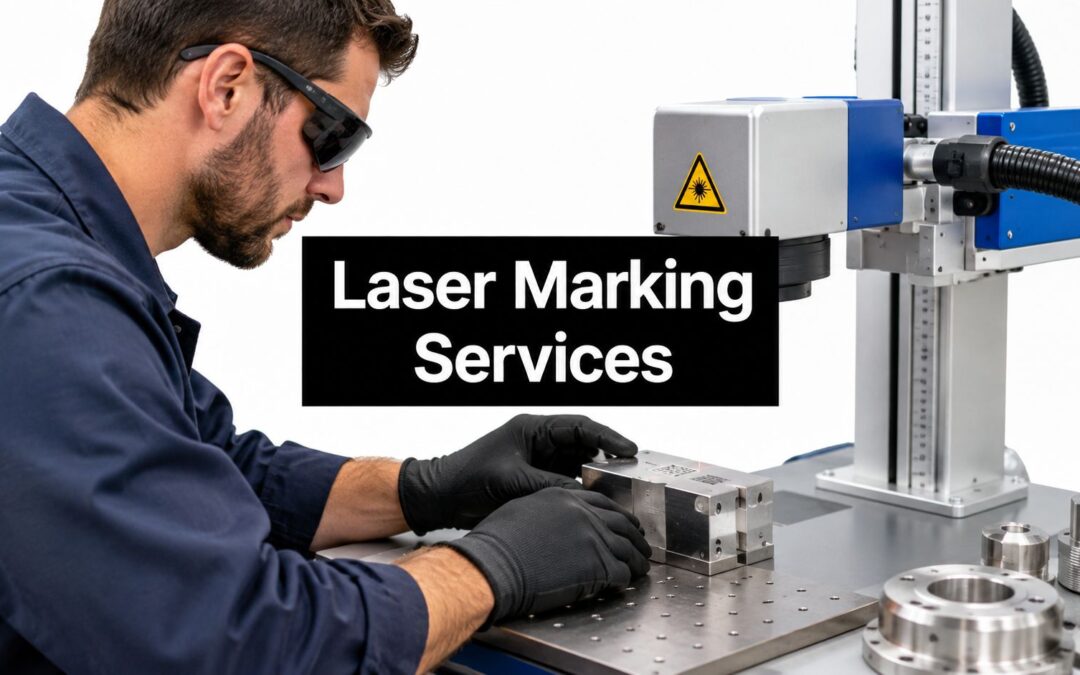
A facility manager discovers the problem during a maintenance shutdown. The stainless-steel asset tags are still attached, but solvent, weather and repeated handling have softened the contrast. An electrician can no longer read several identifiers from the access floor, and a replacement label must match the site register before the equipment returns to service. Searching for laser marking services near me often starts with distance and price, but industrial identification is really a question of durability, legibility, safety and controlled documentation.
Australia has a broad customer base for this work. The Australian Bureau of Statistics business counts recorded 2,662,998 actively trading businesses at 30 June 2024, including 999,161 employing businesses. During 2023–24, the total business population increased by 2.8%, or 73,125 businesses, while manufacturing grew by 0.6% and electricity, gas, water and waste services grew by 2.5%. Those figures point to demand across manufacturing, utilities, construction, infrastructure and other asset-intensive operations, not just a small engraving niche.
Why Local Precision Matters for Industrial Identification
The closest engraving shop isn't automatically the right industrial supplier. A local provider needs to understand how equipment is installed, inspected, modified and retired, because a mark that looks excellent on delivery can fail once it faces cleaning chemicals, outdoor exposure, abrasion or a repainting programme.
A facility manager usually needs more than a plate with a serial number. The job may include an asset register, barcode or QR code, isolation information, equipment location, warning text and a mounting method that keeps the identifier visible without creating a snag or access problem. A contractor may need a small production run quickly, while a manufacturing team may require consistent marks across prototypes, replacement components and repeat orders.
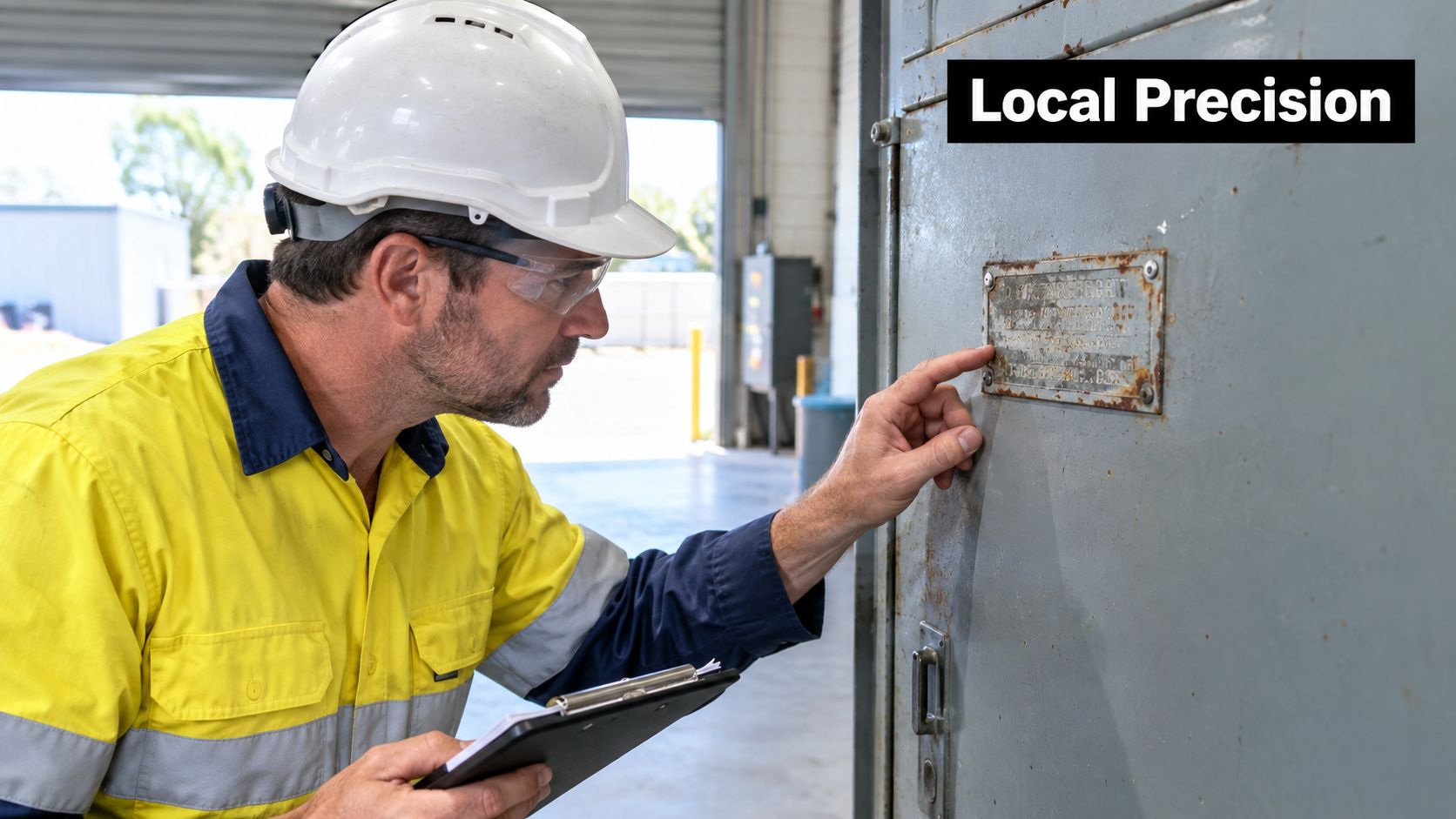
Local support affects the whole asset lifecycle
A nearby industrial partner can review the actual part, confirm the available marking area and test the proposed contrast before production. That matters when a label must fit around bolts, curves, cable entries or an existing control panel. It also reduces the risk of discovering after installation that the viewing angle, character size or mounting location makes the information difficult to use.
Evright Industrial operates as a specialised division of evright.com, with nearly six decades of local manufacturing experience behind its engraving and asset-labelling work. Its service scope includes equipment identification, safety signage, electrical items, switchboards, panels, medical and orthopaedic equipment, industrial parts and custom plaques. The practical value is a process that treats the mark as part of maintenance and compliance, rather than as decoration.
Practical rule: Specify what the identifier must still communicate after installation, cleaning, handling and inspection. Choose the process and material around that requirement.
A useful local supplier should ask for the operating environment, the required data, the viewing distance, the mounting method and the verification standard. If the first question is only “What size plate do you want?”, the supplier may be treating an operational control as a promotional product.
How Advanced Laser Machinery Creates Permanent Marks
Laser marking is a controlled, non-contact process. The beam changes the surface or removes a selected layer to create characters, symbols, barcodes, QR codes and patterns without the distortion associated with mechanical stamping. Trotec Laser systems are designed for precise, repeatable work across metals, plastics, coated surfaces and other industrial materials, but the correct result still depends on the substrate and the intended service conditions.
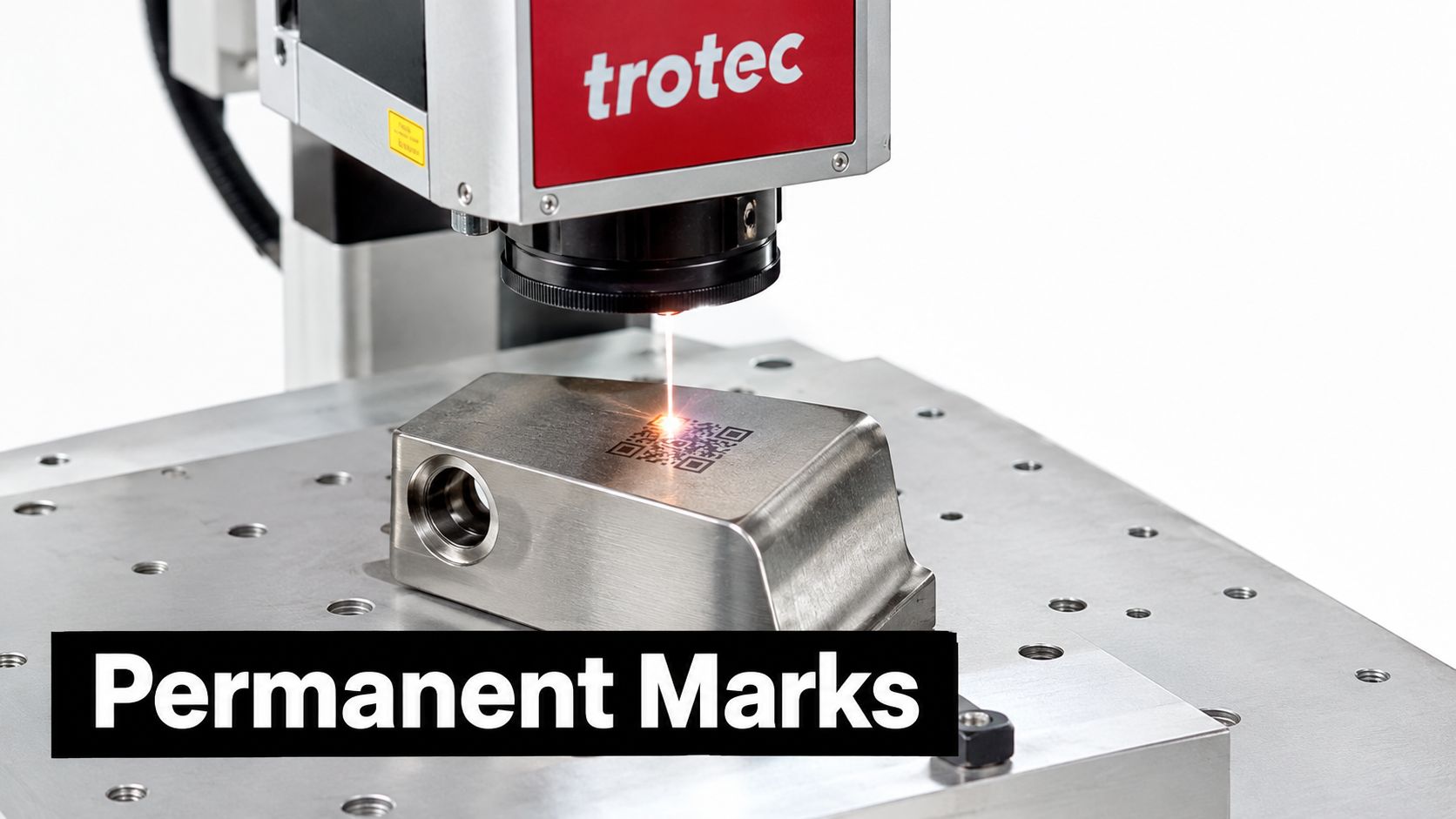
Select the surface reaction before selecting the artwork
A good specification distinguishes between three useful outcomes.
- Annealing changes the surface without cutting into it. On suitable metals, controlled heat can create a contrasting oxide layer. This is useful where dimensional accuracy and a smooth surface matter.
- Ablation removes a coating or anodised layer. The laser exposes the contrasting material beneath, which can produce clean graphics and identification on coated aluminium or painted components.
- Deep engraving removes material. Multiple controlled passes form a physical recess. This is appropriate where abrasion, solvents or outdoor exposure could wear away a shallow visual contrast.
Plastics require a different approach. Depending on the formulation, the beam can create a colour change, carbonisation or foaming effect. A plastic that marks cleanly in a sample may react poorly after a formulation change, so production material should be tested rather than assumed to be interchangeable.
What Trotec machinery changes in practice
Premium Trotec laser machines give technicians fine control over focus, speed, power and repetition. That control helps produce consistent serialisation on batches, sharp machine-readable codes and detailed marks on components with limited space. It doesn't remove the need for process development. Reflective metals, heat-sensitive plastics, coated parts and uneven geometries each require a controlled setup.
Australian manufacturing also operates in technically demanding supply chains. The ABS 2023–24 Research and Experimental Development survey recorded approximately $5.047 billion in manufacturing R&D expenditure, highlighting the need for repeatable product identification and serialisation. A mark that links a component to a drawing, batch, inspection record or replacement schedule supports that discipline.
For a fuller explanation of process choices, review Evright Industrial's guide to laser engraving techniques. The useful question isn't whether a provider owns a laser. Ask which surface reaction they recommend, how they validate contrast, and whether the finished identifier remains readable after the conditions you've described.
The following video provides useful visual context for laser marking machinery and workflows.
A production brief should include the exact data, artwork version, code type, minimum character height, mark location and inspection method. If a QR code matters, verify that it scans on the finished part, not only in the design file.
Treating Material Selection as Corrosion Engineering
A stainless plate, anodised aluminium tag and coated steel panel don't offer the same service life in every location. Material selection should start with the exposure zone, then move to the marking method, contrast and mounting detail. Colour and finish matter, but they come after the question of what the identifier must withstand.
Standards Australia describes AS/NZS 2312 as covering protection of structural steel across interior, exterior, atmospheric and non-atmospheric corrosive environments, supporting a practical specification process for defining exposure zones before selecting asset-label substrates.
Start with the contaminants
Indoor plant-room equipment may face condensation, cleaning products and occasional impact. Coastal infrastructure adds salt and humidity. Chemical-processing sites introduce specific contaminants that can attack a coating, the substrate or the mounting hardware. Outdoor electrical assets also face ultraviolet exposure, temperature changes, rain and accumulated dirt.
A service brief should state:
- Exposure zone: Indoor, outdoor, coastal, chemical, washdown or mixed.
- Substrate requirement: Relevant aluminium, stainless steel, coated metal or approved plastic grade.
- Marking depth and contrast: Whether the identifier needs a surface contrast, coating removal or a tactile recess.
- Cleaning conditions: Solvents, detergents, pressure cleaning or sterilisation where applicable.
- Mounting method: Adhesive, rivets, screws, weld studs or direct marking on the part.
- Verification: Visual inspection, barcode or QR-code scanning, dimensional checks and sample approval.
Coating and marking must work together
A mark can remain physically present while becoming difficult to read. Low contrast is especially vulnerable when grime, oxidation, paint overspray or surface wear changes the background. Conversely, an unnecessarily deep mark can interfere with a protective coating, create a contamination trap or compromise a thin component.
The technician should therefore test the complete system, not only a blank sheet of the selected metal. Test the actual finish, the intended cleaning process and the proposed location. If the asset will later be painted, powder coated or anodised, decide whether the mark is made before or after that operation. The answer changes the contrast, depth and inspection method.
Evright Industrial's information on laser engraving materials is a useful starting point for comparing substrates. The final decision should still be based on the equipment's environment and lifecycle, with a sample approved by the person responsible for maintenance or compliance.
The cheapest plate is rarely the cheapest identification system if technicians must replace it repeatedly or stop work to interpret an unreadable mark.
Navigating Safety Signage and Compliance Standards
Permanent doesn't mean compliant. A highly engraved warning can still fail if the text is too small, the sign sits outside the observer's line of sight, the colour contrast is poor or the message doesn't match the hazard being controlled.
Australian workplace safety signage is governed by AS 1319-1994. The ACT Government signage guidance recommends minimum dimensions of 15 mm for symbols and 5 mm for uppercase text for every metre of viewing distance in good lighting conditions. Those dimensions should increase by at least 50% in poor lighting or difficult viewing conditions.
Size the sign for the observer
A small equipment ID plate and a safety sign serve different functions. An asset ID may be read by a technician standing close to the machine. A hazard warning may need to be recognised by someone approaching an area, wearing protective equipment or working in uneven light.
| Viewing Distance | Min Symbol Size | Min Text Size | Lighting Condition |
|---|---|---|---|
| Each metre of viewing distance | 15 mm | 5 mm uppercase text | Good lighting |
| Each metre of viewing distance | Increase dimensions by at least 50% | Increase dimensions by at least 50% | Poor lighting or difficult viewing |
The sign should sit near the observer's vertical line of sight, against a contrasting background, without obstruction. It must remain clean, illuminated where necessary and in good condition. A laser process can provide durable contrast, but it can't correct a poor layout or a location hidden behind pipework.
Separate identification from hazard control
A label identifying a pump, switchboard or valve isn't automatically a hazard sign. Conversely, a warning label shouldn't be expected to replace isolation procedures, guarding, engineering controls or emergency arrangements. An ACT Health work-health-and-safety guideline explains that signs, administrative controls and personal protective equipment are supplementary controls, used where higher-level controls aren't practical, as interim measures or as backup.
The distinction matters on construction and infrastructure projects. ACT City Services' MITS 00A General Requirements identifies regulatory, hazard, emergency-information and fire signs that must comply with AS 1319, and requires safety and project signs to be submitted for approval before manufacture or purchase.
Western Australia's non-potable water signage guidance shows how precise the message and presentation can be. The required wording is “Non-potable Water – Do not Drink / Avoid Contact”, with a white background, black word legend and a red prohibition overlay on the drinking-water symbol. The signs must remain visible, legible, clean and in good condition, with replacement when environmental deterioration affects them.
Meeting Healthcare UDI and Traceability Mandates
Medical-device marking now has to connect physical identification with regulatory records. A human-readable serial number may help a technician, but a healthcare manufacturer may also need a machine-readable UDI carrier, packaging data and a controlled relationship to the device's ARTG information.
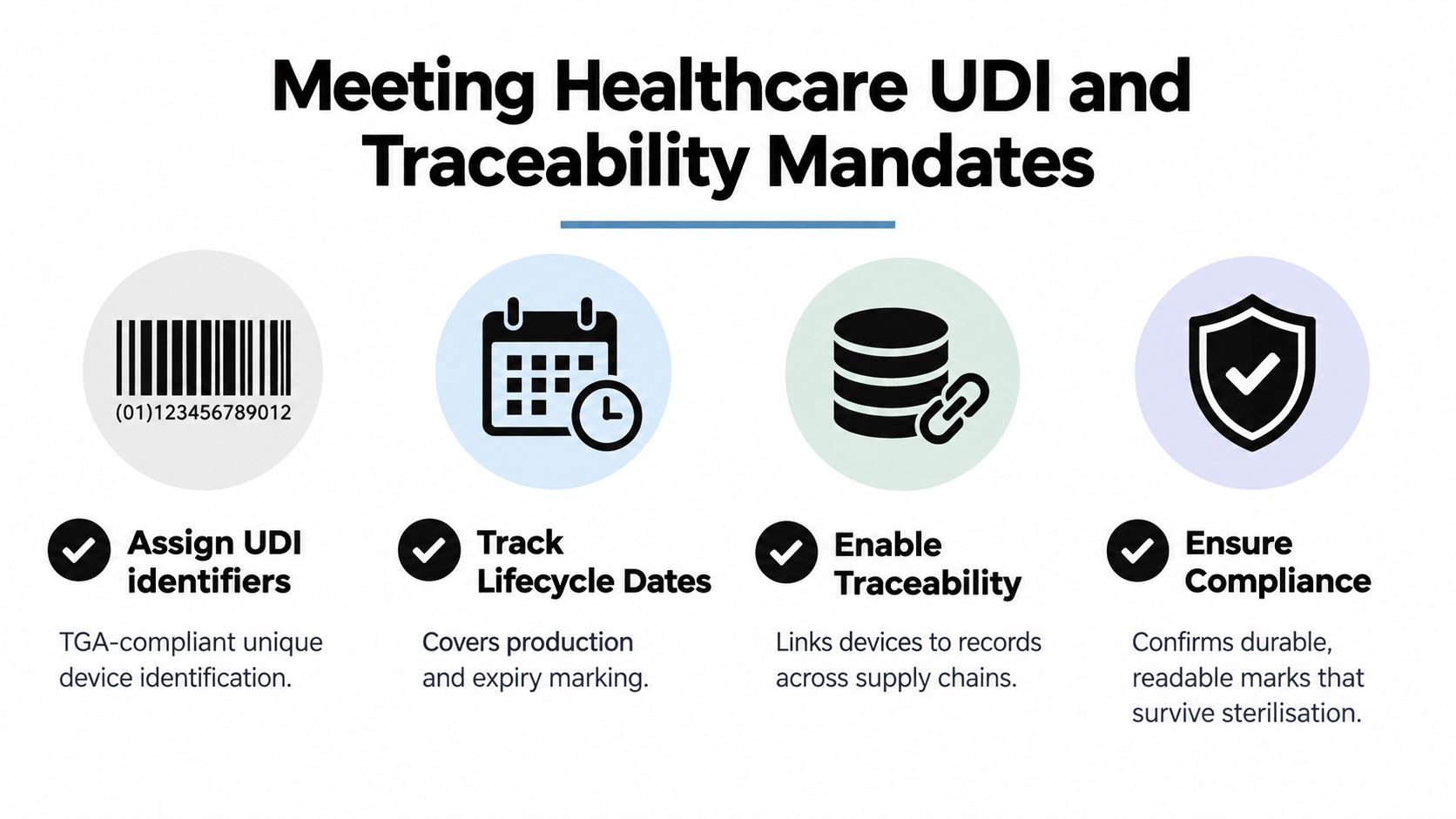
Australia introduced UDI regulations on 24 March 2025, with mandatory labelling for most medical devices beginning 1 July 2026, requiring a UDI carrier on the device label and submission of data to the Australian UDI Database, as set out in the TGA overview of UDI for medical devices.
Build the marking workflow around the record
The practical workflow starts before artwork reaches the laser.
- Confirm the device, packaging and reusable-device requirements.
- Establish the human-readable and machine-readable data.
- Check the identifier against the relevant ARTG and database information.
- Test the proposed mark on the actual device material and finish.
- Verify readability after the relevant cleaning or sterilisation process.
- Retain the approved artwork, sample result and production record.
The TGA framework includes fields such as manufacturer, brand, model or version, handling requirements, warnings and operating instructions. That means a supplier should be able to receive controlled data, identify ambiguities and document which approved version was marked. A visually attractive code that doesn't scan or connect to the correct record is an expensive failure.
Direct marking needs a lifecycle decision
Some devices can carry identification on a label or packaging. Others may need direct marking on the device because labels can separate during use, cleaning or reprocessing. Reusable instruments introduce a further concern, because the selected mark must remain readable through the device's actual cleaning and sterilisation regime without damaging the surface.
Evright Industrial's information on medical device labelling requirements can help structure the initial conversation. The service brief should include device material, available marking area, code format, human-readable text, packaging levels, inspection method and the person authorised to approve samples.
A permanent mark is only useful when the identifier, the device and the controlled record remain connected throughout the product lifecycle.
Evaluating Local Providers for Industrial Capability
A local provider can be close, responsive and still unsuitable for industrial work. Compare suppliers on process control and safety evidence, not only on a short quote or attractive sample plate.
Australian guidance requires laser equipment to comply with AS/NZS 2211. The Western Australian laser safety guidance states that Class 3B and Class 4 systems, generally systems exceeding 5 mW output, must be registered at their place of use, with a suitably qualified Laser Safety Officer overseeing operation.
Ask for evidence, not reassurance
A serious industrial provider should be able to discuss:
- Laser classification: The class of the equipment used for the job and the applicable registration obligations.
- Engineered guarding: Enclosures, interlocked access and controlled entry that prevent exposure during operation.
- Operator competency: Who is authorised to run the equipment, prepare files and release production.
- Process validation: How the provider tests material response, contrast, depth and code readability.
- Change control: How revised drawings, serial ranges and replacement orders are tracked.
- Sample approval: Whether the customer can inspect an approved first article before the production run.
- Documentation: What records accompany the completed work and how repeat orders are matched.
A general promotional engraver may handle logos and gifts competently but lack the fixtures, data controls or safety documentation needed for asset identification. An industrial supplier should also be comfortable discussing awkward geometries, limited access, direct marking, plates, switchboards and batch consistency.
Use location tools, then qualify the shortlist
Directories can help identify nearby machine shops, but they don't replace technical screening. The Uptool resource for shop searches is useful for building a local shortlist before you ask each supplier about materials, equipment, lead times and quality controls.
Sustainability deserves practical scrutiny as well. Ask whether the process avoids unnecessary consumables, how offcuts are managed and whether responsible materials are available. Those choices matter, but they should support the engineering specification rather than override corrosion resistance, legibility or regulatory requirements.
Partnering with Evright Industrial for Your Next Project
The right marking project starts with a risk-based brief. Define the asset, the exposure, the required information, the viewing distance and the approval process before discussing finishes. That approach prevents a common mistake, selecting a visually appealing plate before anyone confirms whether it will survive the site.
Evright Industrial brings nearly six decades of Australian manufacturing experience to equipment identification, safety signage, medical and orthopaedic marking, electrical items, panels, industrial components and custom memorial plaques. Its Trotec Laser machinery supports detailed, repeatable work across materials including stainless steel, heavy metal alloys, titanium, plastics, brass, glass and other alloys. The team also describes energy-efficient processing, responsible material sourcing and waste reduction as part of its operating approach.
A workable project intake
Provide the supplier with:
- The asset or component drawing and revision.
- The exact text, serial range, barcode or QR-code data.
- The substrate, coating and expected environment.
- Cleaning, temperature, chemical and abrasion conditions.
- Mounting details and required viewing distance.
- Sample approval and verification requirements.
- Delivery locations, packaging needs and repeat-order expectations.
The supplier can then recommend annealing, coating ablation, surface marking or deeper engraving, produce a sample and confirm whether the finished result meets the operational purpose. That collaborative step is more reliable than ordering “permanent engraving” without defining what permanent means at the installation site.
For a manufacturing floor, essential-services network or healthcare facility, the mark should support maintenance, traceability and safe work practices long after the initial purchase order closes.
Evright Industrial provides Trotec Laser marking and engraving for durable asset identification, safety signage, medical equipment, electrical panels and industrial components, with material selection and sample verification matched to the operating environment. Visit Evright Industrial to discuss your asset register, compliance signage or direct-marking project with a local Australian team.
Recent Comments