

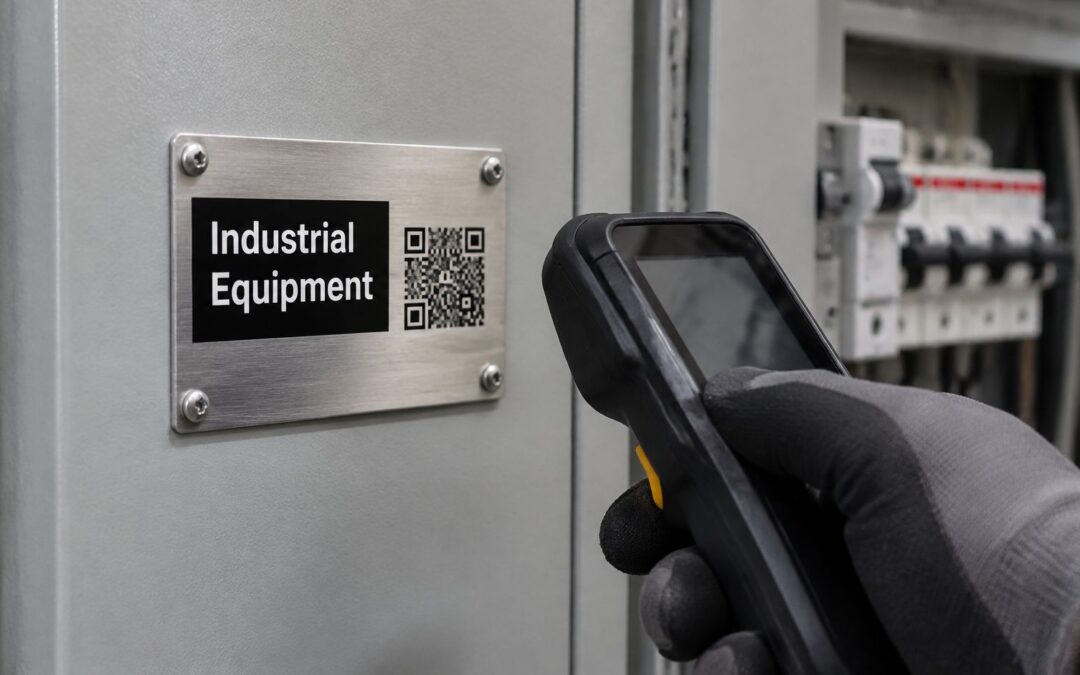
Walk onto any plant floor older than about fifteen years and you'll find the same thing. Some machines wear three different labels, some wear none, and the number everyone quotes in the maintenance meeting doesn't match anything printed on the equipment itself. The register says PUMP-07. The pump says nothing at all.
That gap is where most asset identification work begins, and it's why this guide treats the label as a working control rather than a sticker. What follows is the explanation you'd give a new technician on their first walkaround: what counts as industrial equipment, what has to go on the label, where it goes, and how it keeps people safe when the pressure is on.
What Industrial Equipment Covers and Why Identity Must Outlast Ownership
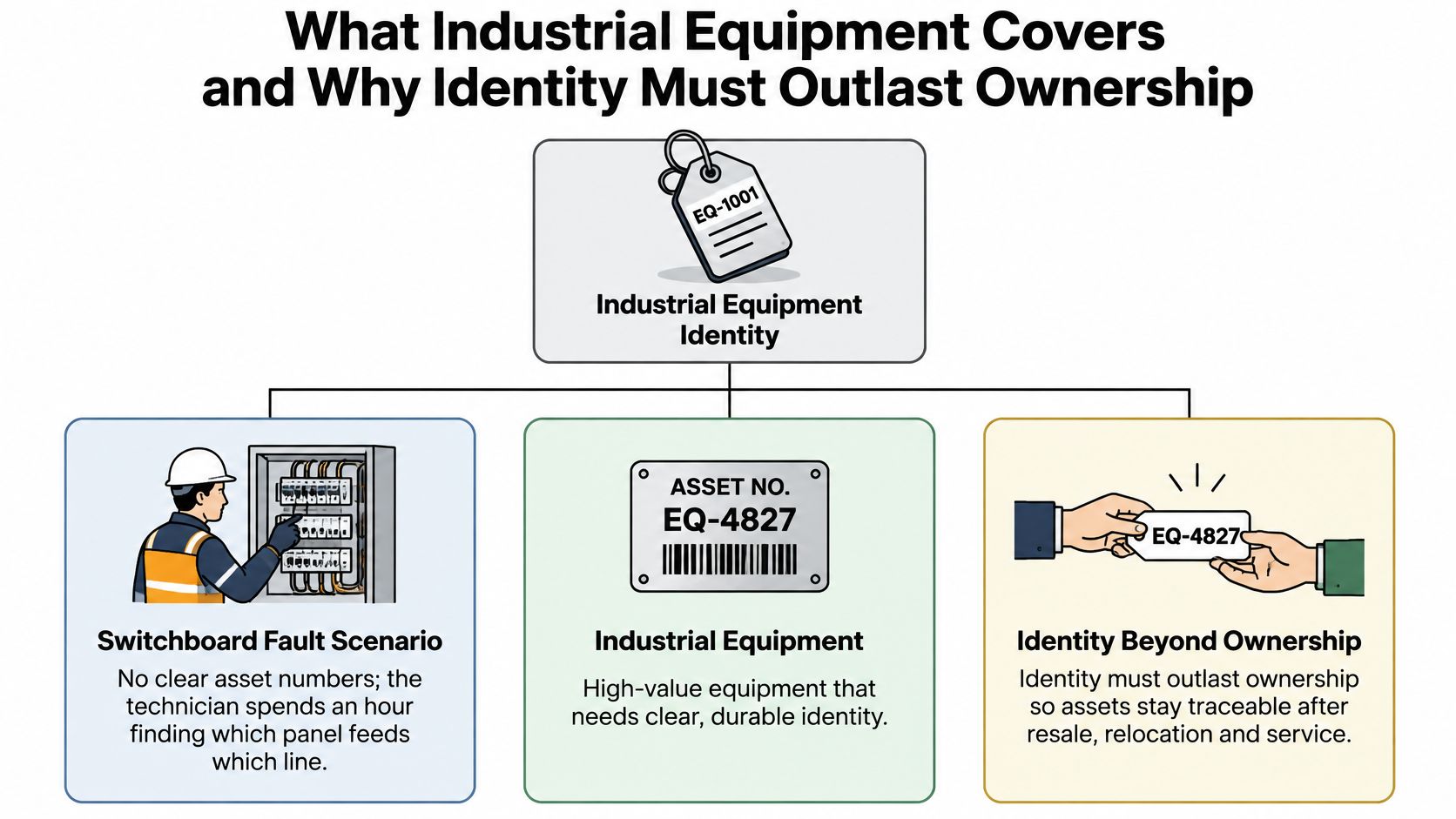
A packing line trips at two in the morning and the electrician arrives at a switchroom of forty panels with no asset numbers on any of them. She needs to know which panel feeds that line, what else the panel supplies, and whether anything downstream is still live. Working it out takes an hour of tracing conduit and chasing decade-old drawings, and the line stands still for all of it.
Industrial equipment is the category of high-value, long-life assets a site runs under load. It covers the machinery that makes product, the electrical gear that feeds it, the mobile plant that moves material around, and the tools and lifting gear that keep the whole thing serviced. What separates these assets from consumables is time. A press, a switchboard or a forklift stays in service for years, and it usually passes through several owners, sites and maintenance teams before it is retired. The label is the part of that record a person can read at the panel when the register is not open.
The categories matter because each one puts different information in front of the person standing at the machine, and each one wears labels down in its own way.
| Equipment category | Typical examples | Label must show | Main exposure |
|---|---|---|---|
| Fixed plant and machinery | Presses, conveyors, CNC machines | Asset number, isolation point, service date | Vibration, oil, heat |
| Electrical equipment | Switchboards, control panels, isolators | Circuit ID, voltage, isolation reference | Dust, moisture, arc heat |
| Mobile equipment | Forklifts, loaders, elevating work platforms | Fleet number, inspection status, owner | Abrasion, weather, impact |
| Process and utility assets | Pumps, compressors, tanks, boilers | Tag number, pressure rating, service history | Chemicals, temperature |
| Medical and laboratory equipment | Surgical instruments, glassware, analysers | Unique device identifier, traceability code | Autoclaving, cleaning agents |
| Tools and lifting gear | Hoists, slings, portable power tools | Serial number, proof-test date, safe working load | Wear, cleaning, rough handling |
The installed base these labels sit on is enormous and still growing. The Australian Bureau of Statistics reported in its September 2025 release that private businesses expected to spend $83.3 billion on equipment, plant and machinery in 2025-26 (ABS private new capital expenditure). Every one of those purchases becomes an asset that someone has to identify, inspect, service and eventually retire.
That long life is measurable. The ABS maintains national machinery and equipment capital-stock series reaching back to 1960, identifying electrical and electronic equipment, industrial machinery and equipment, and motor vehicles separately through to 2024-25, alongside gross fixed capital formation by industry (ABS machinery and equipment series). Equipment is capital that gets measured across successive investment cycles, which is why its identity has to survive longer than any one owner.
Why identity has to outlive the owner
A vehicle's registration changes. The plates change, the owner changes, sometimes the state changes. The vehicle identification number does not. It is stamped into metal, it follows the asset through every sale and every repair, and it is the reason a service history means anything at all.
Industrial equipment needs the same treatment, and many sites do not give it. Three break points account for most traceability failures at industrial sites:
- A sold asset keeps its old internal number. The machine moves to a new site and gets entered into the new register under the old tag, so two sites now claim the same ID and neither history is trustworthy.
- A replacement part arrives with no link to its parent machine. A motor or gearbox is swapped out and recorded as a new asset, and the vibration history stays with the machine while the component records fragment.
- A relocated unit is still listed in the old location's register. Technicians then search a bay that has not held that pump for two years.
The fix is a mark that lives on the metal itself, produced by a machine like the Trotec Laser systems used in Evright Industrial's production, which concentrate laser energy onto a surface to create a controlled, permanent engraving rather than a printed layer that can lift. A Trotec Laser machine marks the plate, the plate stays on the machine, and the register follows the plate.
The question worth asking about every asset on your site is simple. How many owners, sites and maintenance teams will it pass through before it is retired, and will your label still be doing its job at the end of that journey?
Encoding Asset Data in Labels, Barcodes and QR Codes
Three formats can carry identity on an equipment label, and each has a job. The engraved, human-readable asset number is the primary mark, because it stays legible when the power is out, the scanner is flat, or the phone has no signal in a plant room. A barcode earns its place where speed matters and the reader is fixed, such as a stores counter or parts crib where dozens of items are booked out in a shift. A QR code is best when the label has to point somewhere, opening the isolation procedure, the last test date or the service history on a controlled record.
One rule makes the whole system hold together. The code carries the identifier only; the register holds the data. If the code itself stores the location, the owner or the service date, it's wrong the moment any of those change, and someone has to reprint every label in the building.
A code should be a door, not a filing cabinet. It tells you which asset you're looking at, and the register tells you everything else.
Say a switchboard carries the asset number EB-04-P2. The plate shows that number in engraved characters, a QR code that opens the isolation procedure and the last test date, and the engraved legend "Isolate before work". Anyone standing at the panel can identify it without a device, and anyone with a device can reach the controlled record in seconds.
Behind that, the register holds a consistent set of fields for every ID: asset number, equipment class, location code, isolation reference, service status and criticality rating. Keep the field names identical across every site, or reporting collapses when someone tries to pull a fleet view.
Two failures are worth guarding against. A code that resolves to a deleted or outdated record gives the technician nothing, and it teaches people to stop trusting labels altogether. A code that embeds a location or owner breaks the first time the asset moves, which is the one thing you can guarantee it will do. If you're deciding between symbol types, this comparison of Data Matrix code vs QR code covers density, durability and scan conditions.
Ask yourself which of your labels can still be read when the record is down. If the answer is none, the mark isn't doing the job.
How Labels Keep Workers Safe at Isolation Points
Picture the failure that ends in an incident report. A technician isolates the wrong pump, walks away satisfied, and the intended pump starts because a second energy source feeding the same machine was never listed. Australian machine-safety guidance is built around that exact risk: documented energy isolation is required before maintenance personnel enter a machine danger zone, and each worker must lock out or tag out the equipment, including electrical, hydraulic and pneumatic sources, to prevent unintended start-up (Guide to machine safety, SafeWork NSW).
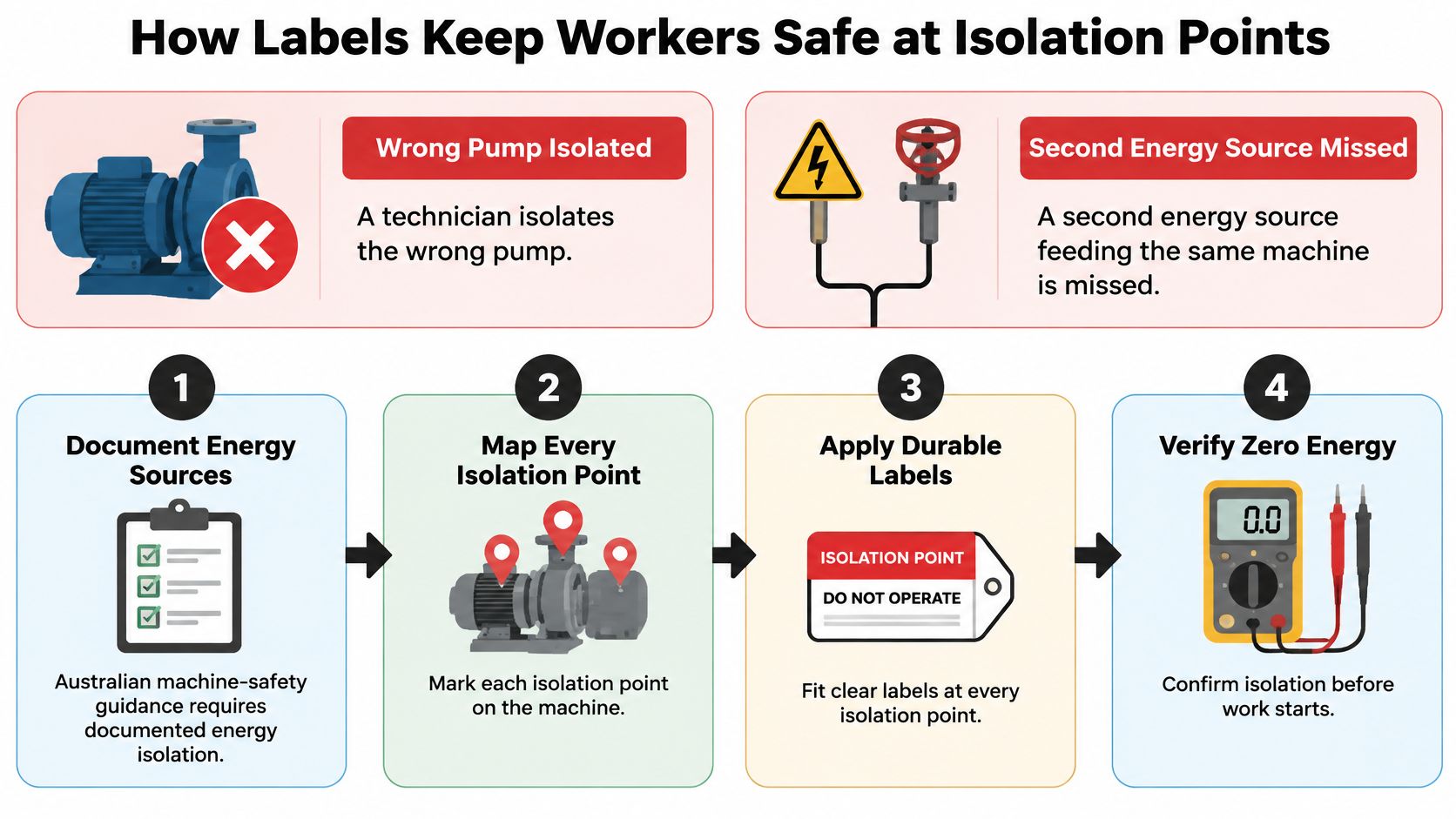
The label's job at that point is a sequence, not a decoration.
- Read the asset number at the point of access. The label is the only thing tying the machine in front of you to the paperwork behind it. The common slip is a plate painted over during a repaint or shifted to a different panel during a refit, so it now describes the wrong equipment.
- Match that number to the isolation procedure. Procedures drift out of date when a machine is modified. If the number on the plate doesn't appear in the procedure, that's a stop signal, not a licence to improvise.
- Locate every isolator listed for that asset. Walk the list physically rather than trusting memory, because isolators get added, moved and removed across a plant's life.
- Lock and tag each source. Every energy source gets its own lock and tag, and the tag carries the name of the person who applied it. Where several crews work the same plant, the isolation record usually lives inside a permit to work system rather than a maintenance spreadsheet, which is what stops one team energising while another is inside the guard. Getting the tag detail right matters more than people expect, and these lockout tagout tag requirements set out what a tag has to carry to be useful.
- Verify zero energy by testing the start control. Nothing confirms isolation except a test at the control, after the lock is on. A label that says the machine is isolated proves nothing on its own.
- Reverse the sequence on recommissioning, with the same label confirming the correct machine. The record and the physical asset get checked against each other one more time, which is where mismatched labels are usually caught before they cause an incident.
The field check: walk your site with a torch and confirm every isolation point, disconnect and service hatch carries a legible label showing the same asset ID as the procedure.
Take a conveyor with a main isolator, a pneumatic bleed valve and a control-panel disconnect. All three need the same asset ID, and all three need to be traceable back to one procedure. If a technician can find two of them and not the third, the label system has already failed.
Choosing Label Materials for Harsh Environments
A label never fails on the bench. It fails in service, and it fails for a reason you could have predicted from the environment it sits in: oils and solvents softening an adhesive, sustained heat cooking a print, UV and rain bleaching a face, abrasion from daily cleaning wiping a number off, or a sterilisation cycle lifting a printed layer off a surgical instrument.
Laser marking behaves differently because it changes the surface rather than sitting on top of it. The Trotec Laser machines in Evright Industrial's production concentrate laser energy onto a chosen surface to create a controlled, durable contrast or engraving, so there's no printed layer to peel. We can mark on almost any material, and the materials we work with include stainless steel, heavy metal alloy, titanium, brass, plastics, alloys and glass.
| Environment | Main exposure | Suitable marking | Check before fitting |
|---|---|---|---|
| Indoor office or clean assembly | Light handling, routine cleaning | Laser-engraved anodised aluminium | Adhesion on painted surfaces |
| Factory floor with oil and solvents | Oils, solvents, abrasion | Laser-engraved stainless steel | Legibility after cleaning cycles |
| Outdoor plant and mining sites | UV, rain, dust, impact | Engraved stainless steel panel | Fixings and corrosion resistance |
| Heat-exposed machinery | Sustained high temperature | Engraved metal or ceramic | Mark stability at rated temperature |
| Medical and sterilised equipment | Autoclaving, cleaning chemicals | Laser-marked titanium or surgical-grade steel | Traceability code remains readable |
| Electrical switchboards | Dust, moisture, arc-hazard warnings | Engraved panel with contrast fill | Wording matches the installed safety requirement |
The test that settles the argument
Two checks decide whether a material is right, and both are cheap. The first is a legibility check after the first real cleaning cycle, not a wipe with a cloth on the bench but the actual method the site uses, whether that's a pressure washer, a solvent wipe or an autoclave load. The second is a sample run before you commit to a full order, so you're judging a marked piece in your own hands rather than a catalogue photo.
Confirm every material and marking finish against that sample before ordering, because performance varies with substrate and finish. A 2 mm stainless plate and a 0.5 mm painted panel behave nothing alike under the same laser settings, and a finish that's perfect on brass may be unreadable on anodised aluminium.
The rule that saves reprints: a label has to stay readable through the entire inspection interval, not just at installation. If your maintenance cycle is twelve months, design for twelve months of grime, not day one.
Consider how a marking choice interacts with the rest of the maintenance system. A fork on a mine site might sit outdoors for years, so fixings and corrosion resistance matter as much as the mark itself. A surgical instrument might be autoclaved hundreds of times, so the traceability code has to survive repeated chemical exposure, not merely exist. For asset labels across plant and machinery, the practical options are set out in this guide to asset tracking labels.
A label that reads fine on the day it's fitted but fails by the second quarter hasn't been specified. It's been guessed.
How Asset IDs Support Maintenance and Condition Monitoring
Predictive maintenance usually gets told as a technology story, all sensors and dashboards, with the identification question left out. The result is a gap that bites during rollout, because sensor data is only useful when it attaches to the correct machine and to that machine's history.
The upside is real when the foundation is sound. BlueScope reportedly avoided more than 1,200 hours of unplanned downtime across Australian facilities over three years after deploying predictive-maintenance technology, alongside 53 prevented process interruptions (Siemens on BlueScope). What made that possible wasn't the analytics alone. It was the ability to know, with confidence, which asset each reading came from.
What has to be standardised before sensors help
Inconsistent names, missing serial numbers, duplicate records and unreadable tags all disconnect a reading from the machine it belongs to. Before a plant scales condition monitoring, each asset needs a small set of facts settled and physically marked:
- A unique asset ID that never gets reused, even after retirement.
- Parent-child links so a motor, gearbox or bearing is traceable to the machine it drives.
- A location code that's maintained when equipment moves, not just at commissioning.
- A criticality rating so attention goes to the assets whose failure stops production.
- A named maintenance owner rather than a shared inbox.
- A controlled process for replacements and relocations, including who updates the register and when.
- Material selection matched to the environment, so the mark survives long enough to be useful.
The brownfield case is where this shows up most clearly. Say a plant replaces a drive motor and the new unit carries the old motor's asset number because that's how the work order was written. Vibration readings from the new motor now attach to the old unit's history, and for two years the reliability team is comparing a healthy machine against a failure trend that never happened. Nobody notices until a bearing fails early and the data says the opposite of the truth.
The honest test: could your asset register tell a technician which motor a sensor is reading from, using only the label on the machine and no database access?
Low-tech improvements often deliver reliability value faster than another analytics platform, because the register has to be right before the data can be.
Common Misconceptions About Equipment Labels
Four assumptions cause most of the trouble, and each one has a correction you can act on this week.
- "A label is a safety control." It isn't. Safe Work Australia recorded 222 traumatic workplace fatalities in 2025, with machinery operators and drivers accounting for 35% of deaths and a fatality rate of 8.7 per 100,000 workers, almost six times the national rate of 1.5 (Safe Work Australia key WHS statistics). The risk sits in how work is done. A label only helps if a worker can read it and act on it under pressure, so test yours with someone who's never seen the plant.
- "Durable means legible." A mark can survive a decade of cleaning and still be unreadable under three years of grime. Add a legibility check to your inspection routine rather than assuming permanence equals clarity.
- "A QR code is enough on its own." A code that opens a missing, moved or outdated record gives the technician nothing, and worse, it erodes trust in every other label on site. Keep the human-readable number primary and the code as the doorway.
- "One label, installed once, is finished." Relocations, replacements and changed configurations all invalidate the old mark and the register behind it. Build the update into the work order that triggers the change, or it won't happen.
The label isn't the control. The control is a worker who can identify the asset, find the right procedure and verify the state of the machine, and the label is what makes that possible.
Run the first check this week: pick five assets, hand the label information to someone unfamiliar with the area, and see whether they can tell you what the asset is, what it feeds and where to isolate it. The result will tell you more than any audit spreadsheet.
Confirm Your Labelling Plan With a Sample Run
Specification arguments get settled fastest with a physical sample in hand. Four steps will get you there without ordering a production run you regret.
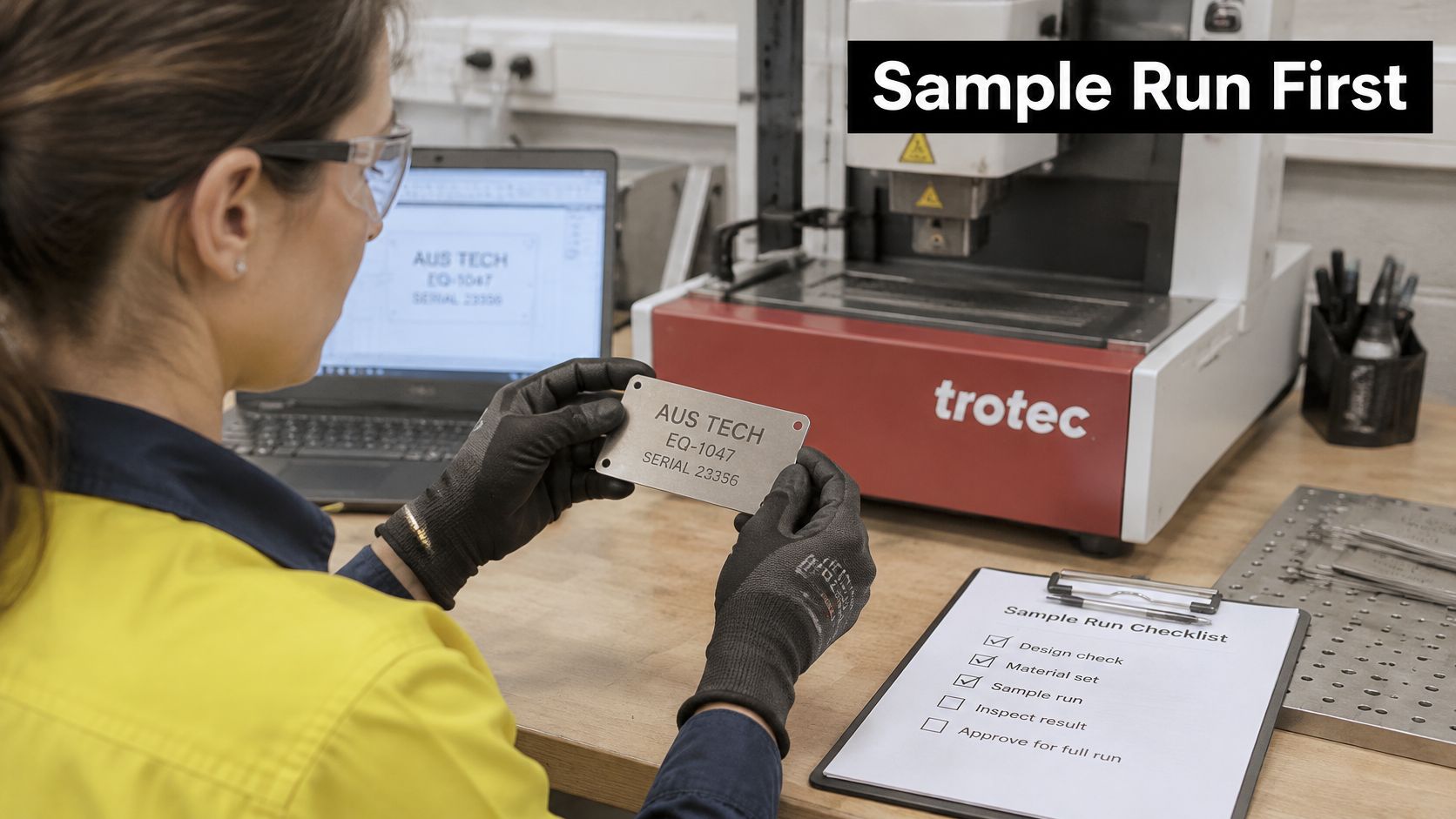
- Pick one item from each equipment category in the first table and write down its operating environment: oils, heat, weather, cleaning method, chemicals.
- Mark every isolation point on that item and confirm the asset number on the label matches the isolation procedure exactly. Mismatches surface at that check, before they're multiplied across a fleet.
- Choose a material and marking finish for that environment, then order a sample rather than a batch.
- Check legibility after the first cleaning cycle and again at the first inspection interval, using the actual cleaning method rather than a gentle wipe.
Sampling is the part worth slowing down for. Evright Industrial offers a sampling service where customers test different materials and marking finishes, and customers can be invited onsite to see the production facility. A full sampling and testing program is carried out before full production of customer-supplied items, so the finish you approve is the finish you receive.
The clip below is worth watching before you choose a finish.
The marking itself is straightforward once the material is right. Production uses laser machines from Trotec Laser, which concentrate laser energy on the chosen surface to create a controlled, durable mark rather than a printed layer that can lift. That's the difference between a label that survives a washdown and one that ends up on the floor of the wash bay. You can review the laser marking process and marking options at evright.com before you request a sample, and compare finishes against the environment you're working in.
Then it comes down to one decision. Which sample will you test first, and which environment will it be exposed to?
Evright Industrial marks asset labels, switchboard panels, safety signage and equipment plates on Trotec Laser machines at its facilities in Adelaide and South East Queensland, and it runs a sample in your chosen material and finish before production starts. If you're rebuilding an asset register or replacing labels that keep peeling off switchboards and plant, send through the equipment list and the environments involved. Visit Evright Industrial to start the conversation.
Recent Comments