
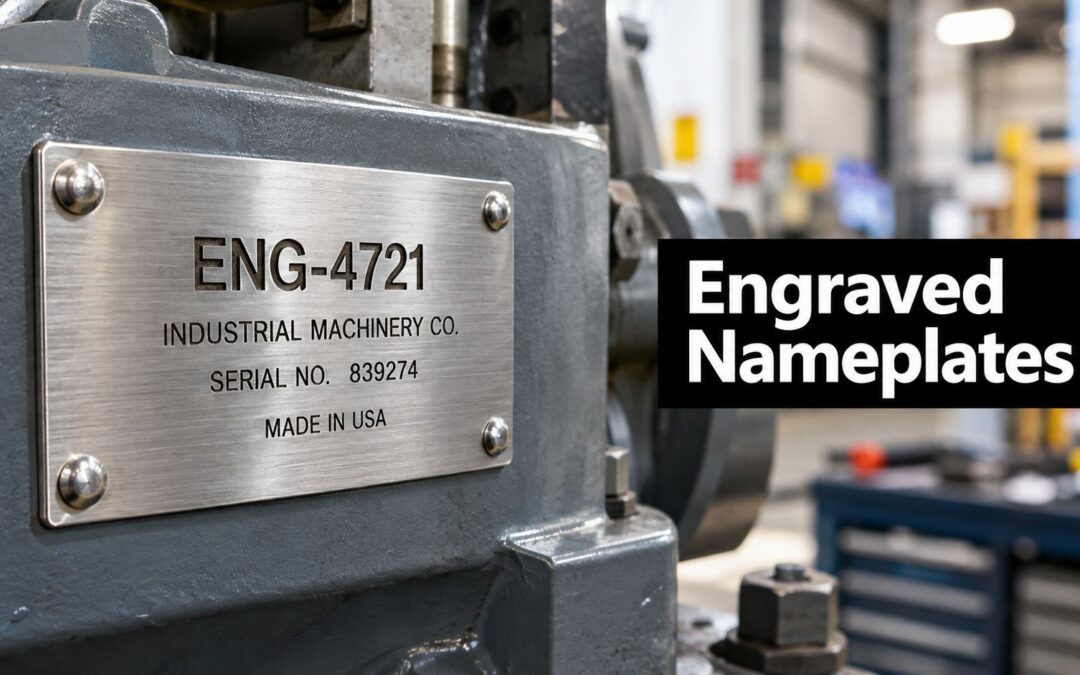
You're in the maintenance bay before sunrise, trying to confirm a component's identity before the next inspection, and the label has disappeared under grease, solvent and abrasion. The equipment is still there, but the information needed to service it is not. That's when an engraved name plate stops looking like a small purchasing detail and starts looking like part of the asset itself.
Industrial identification has to survive the way equipment is used. Hydraulic cylinders, switchboards, valves, access panels and plant assets face vibration, washdown, chemicals, UV exposure, salt and repeated handling. A plate that looks clear on installation day but fails during maintenance creates avoidable confusion, lost records and inspection risk.
This guide treats engraved name plates as a workflow and compliance decision, not a choice between metals. The right solution may be a permanent laser-marked plate, a scan-enabled label connected to an asset register, or a carefully designed combination of both.
The Moment a Wrong Plate Becomes Expensive
At 2 a.m., a mechanic sits beside a hydraulic cylinder in a maintenance bay. The printed adhesive label has rubbed away, the serial number is no longer readable, and the parts manual search returns several similar components. An inspector is due at 7 a.m., so the team now has to identify the cylinder through drawings, purchase records and physical comparison rather than one reliable identifier.
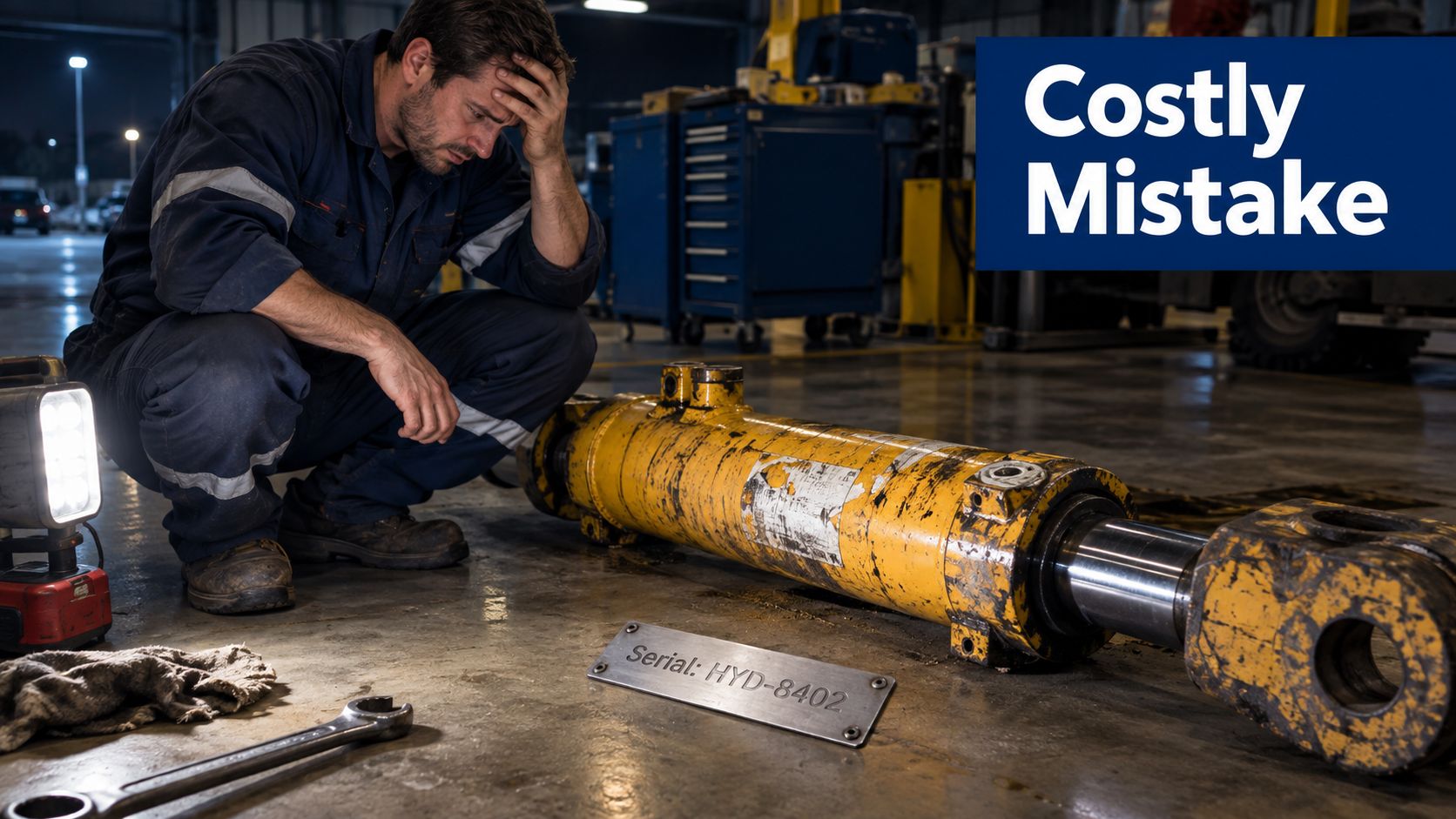
The cost rarely appears on the original purchase order. It appears later as a delayed repair, an uncertain warranty claim, a failed inspection record or a CMMS entry linked to the wrong asset. A technician may fit the wrong part, an electrician may isolate the wrong enclosure, or an auditor may find that the identifier in the register can't be verified on the equipment.
Practical rule: If a number matters after the label has been exposed to the site environment, treat that number as an engineering requirement, not artwork.
A properly specified plate gives the asset one stable identity. The text remains physically associated with the substrate, rather than relying on an ink layer or adhesive bond that can be wiped, peeled or dissolved. That doesn't make every engraved plate suitable for every site. Material grade, thickness, marking method, fixing and placement still determine whether the result works.
Australian industrial buyers also need to think beyond general durability. Asset guidance recommends that identifiers are unique, entered in the correct asset register, visible and scannable, and positioned so they remain readable after guards, covers and panels are installed. The same guidance warns against locations exposed to abrasion, standing water and routine chemical contact, as outlined in this Australian equipment labelling guide.
The reliable outcome comes from matching the plate to the task before production starts. That means defining what must be read by a person, what must be scanned by a system, how the plate will be fixed and which failure mode is most likely to occur.
What Engraved Name Plates Actually Are
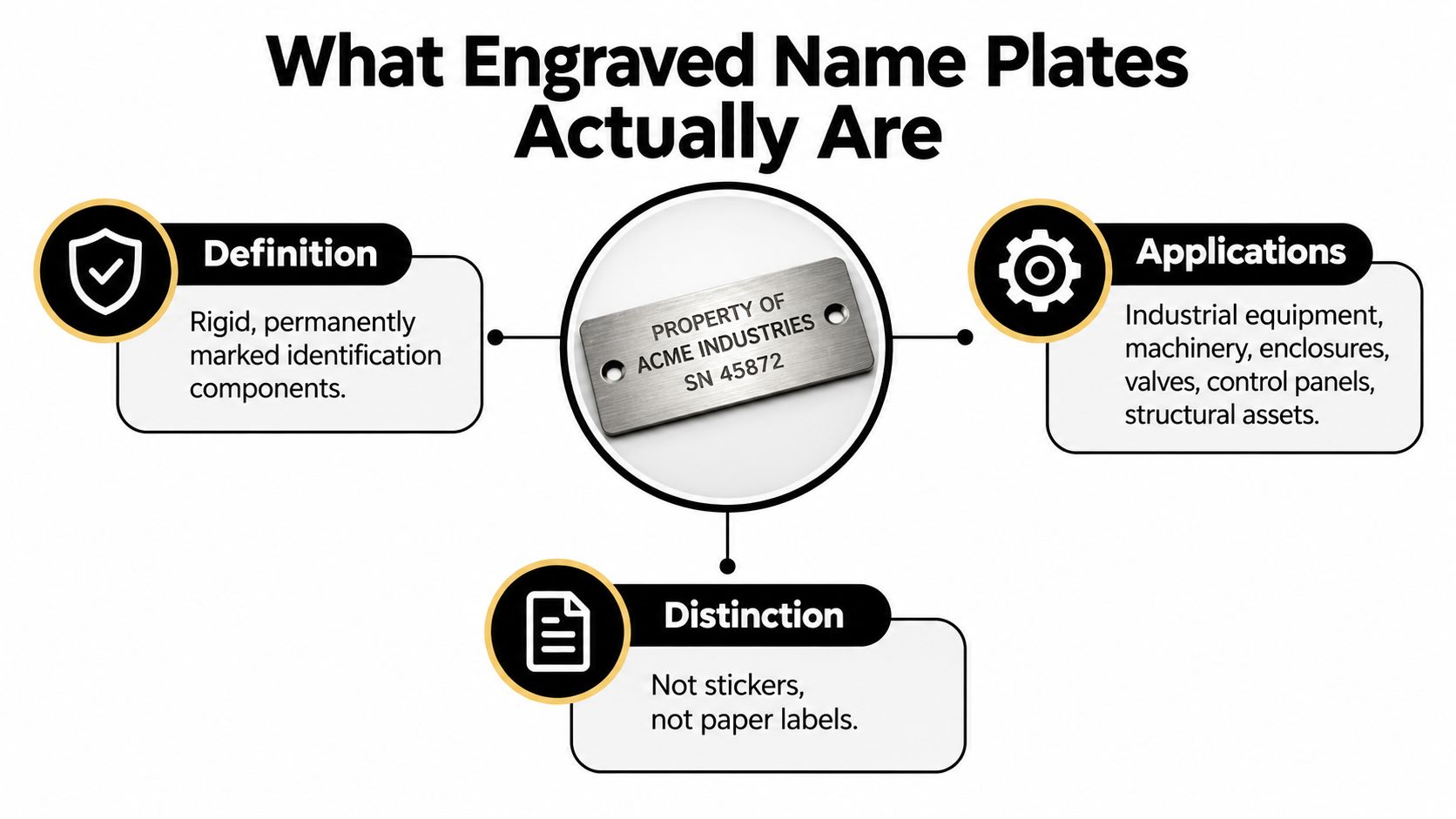
Engraved name plates are rigid identification components that are permanently marked and fixed to equipment or structures. Common applications include machinery, control panels, switchboards, valves, instruments, enclosures, access panels and structural assets. Unlike a replaceable sticker, the plate is designed to remain with the asset through inspection, cleaning, repair and ownership changes.
In traditional rotary engraving, a cutter removes material to create controlled grooves. Modern industrial production also uses laser systems to change or remove a surface layer with tightly controlled energy. On stainless steel, a fibre or YAG laser can create a contrasting mark through oxidation or surface interaction. On anodised aluminium, the laser can remove the coloured anodised layer and reveal the lighter substrate beneath.
The plate is part of the asset
That distinction matters because surface-applied text and physically marked text fail differently. Ink can fade, solvents can attack it, and adhesive-backed labels can lift at edges. A laser mark doesn't create a separate printed film that can be peeled away. Its performance still depends on the substrate, the mark type and the environment, but the identification is integrated into the material rather than merely placed on top of it.
Chemical etching uses an acid or chemical process to remove selected areas, while screen printing applies ink through a stencil. Both can produce clear industrial graphics when specified correctly, yet they require closer attention to coatings, curing, chemical resistance and abrasion. Mechanical engraving offers genuine depth, but tool wear, burrs and access to curved or recessed surfaces can affect consistency.
Why modern laser production is useful
Laser equipment allows repeatable layouts, fine text, serialisation, logos, barcodes and QR codes within one controlled file. A Trotec Laser machine is suited to this kind of production because the operator can control artwork, positioning and marking parameters without treating every plate as a separate manual setup.
The practical question isn't whether laser marking sounds modern. It's whether the selected substrate and mark will remain readable under the equipment's actual service conditions.
Choosing the Right Base Material
The substrate determines more than appearance. It affects corrosion resistance, weight, fixing, contrast, heat tolerance and the marking process itself. Start with the environment, then choose the plate finish and attachment method.
| Material | Best Environment | Durability Notes | Typical Uses |
|---|---|---|---|
| 316 stainless steel | Marine-adjacent, coastal, washdown and corrosive areas | Strong corrosion resistance and suitable for demanding service | Outdoor plant, utilities, food and chemical areas |
| 304 stainless steel | General factory floors and plant rooms | Durable for ordinary industrial exposure, with less resistance than 316 in harsher conditions | Machinery, enclosures and indoor plant |
| Anodised aluminium | Indoor or sheltered locations | Light and visually clear, but aggressive abrasion and alkaline cleaners can damage the marked surface | Control panels, instruments and sheltered machinery |
| Brass or bronze | Heritage, architectural and decorative applications | Attractive and functional where exposure is moderate, but surface appearance changes with the environment | Architectural switchboards, heritage equipment and commemorative plates |
Stainless steel for difficult service
316 stainless steel is the safer starting point for marine-adjacent sites, coastal Queensland, washdown areas and corrosive settings. An Australian industrial engraving guide positions 316 for those conditions because it offers very high durability, while 304 is directed towards general factory floors and plant rooms. The grade won't compensate for poor placement or weak fixing, but it gives the marking a more suitable base.
A useful local benchmark is South Australia Water's TS0133 asset-labelling requirement, which specifies 1.2 mm 316 stainless steel, rounded corners, bevelled edges and a surface compatible with fibre or YAG laser marking. The requirement illustrates a broader principle. Geometry and base metal work together, so the mark shouldn't be specified in isolation. See the practical options for engraving stainless steel plates when the site involves corrosion, cleaning or outdoor exposure.
Aluminium, brass and bronze
Anodised aluminium is often the sensible choice where weight matters and the plate is protected from heavy contact. Laser removal of the anodised layer creates a clean contrast, but the exposed marking can suffer if the face is repeatedly scraped or cleaned with aggressive alkaline products.
Brass and bronze suit situations where finish and character matter alongside identification. Bronze is also widely used for Australian memorial plaques, where it is described as lasting 100 years plus with no maintenance, while granite is stated to last at least 100 years. Brass can tarnish relatively quickly, often within about 2 years depending on environmental harshness, so it needs a deliberate finish decision rather than an assumption that decorative metal is maintenance-free. These material-life details are documented in this Australian memorial plaque material guide.
Engraving Methods and Why Laser Leads
Industrial marking methods solve different problems. Mechanical engraving creates physical depth and can produce a strong tactile mark, but cutter access, tool wear, burrs and complex shapes require careful control. Chemical etching can produce fine detail across a surface, yet chemical processing and subsequent finishing add process considerations. Screen printing is efficient for colour graphics and large visual layouts, but the ink remains a surface layer.
Laser marking has become a common benchmark for permanent industrial identification because it can combine repeatability, fine detail and low consumable use. Fibre systems are particularly suited to metals such as stainless steel, while YAG systems are also used where the required interaction with the substrate calls for that source. Trotec Laser equipment is useful in this context because production teams can move from approved vector artwork to consistent serial numbers, symbols and machine-readable codes within one controlled workflow.
| Method | Mark Depth | Durability | Best Use |
|---|---|---|---|
| Mechanical engraving | Physical grooves with controllable depth | Strong where depth and fixing are suitable | Tactile text, traditional plates and selected metals |
| Chemical etching | Removed or altered surface area | Depends on depth, finish and exposure | Fine detail and specialist metal marking |
| Screen printing | Surface-applied ink | Vulnerable to abrasion, solvents and UV depending on system | Colour graphics, indoor signs and visual instructions |
| Laser marking | Surface alteration, coating removal or oxide mark | Strong when substrate and settings match service conditions | Serial numbers, equipment IDs, compliance plates and codes |
Match the method to the failure mode
A buyer shouldn't choose a laser because it sounds permanent. Ask whether the site will attack the substrate through chemicals, abrasion, heat, UV or salt. AS/NZS 61439 requires manufacturer marking on switchboards and similar equipment to remain durable, visible and legible after installation. Engraved anodised aluminium, stainless steel or engraved laminate can therefore be more appropriate than printed labels where routine wipe-downs, solvents or outdoor exposure are expected, provided the selected material suits the hazard.
Laser marking also brings a capital and production trade-off. It uses very few consumables during marking, but the equipment and programming capability carry a higher entry cost than a simple rotary setup. Large repeat runs, variable serialisation and long service life can justify that investment. Short, decorative or low-exposure work may favour another process.
For buyers comparing equipment economics across applications, compare medical laser costs provides useful context on how laser systems can vary by capability and intended use. The comparison isn't a direct industrial name-plate quotation, but it helps explain why machine class and process requirements affect production pricing.
Designing and Specifying for Real Environments
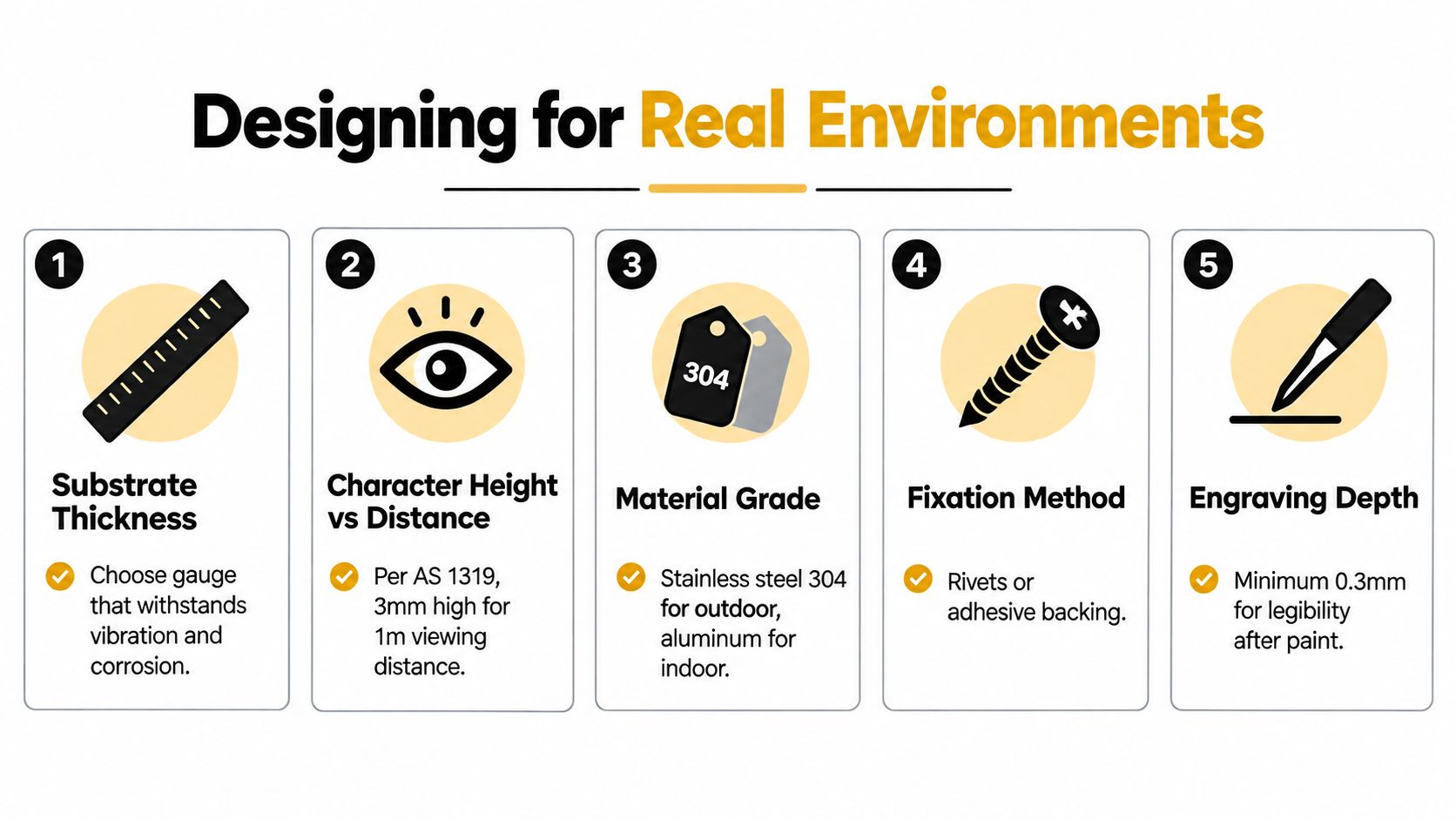
A plate can use the right alloy and still fail inspection if the characters are too small, the corners catch on gloves or the fixing loosens under vibration. The design must describe how the plate will be read, installed and maintained, not just what it should look like in a drawing.
Start with the viewing task
Character height should relate to the distance and lighting under which a technician or inspector will read the plate. AS 1319 provides a readability framework, and the supplied design reference illustrates 3 mm high characters for a 1 m viewing distance. Treat that as a design reference, not a universal answer. A plate inside a dark enclosure, behind a guard or viewed from a vehicle needs different consideration from a clean indoor panel.
Use a short specification checklist:
- Substrate thickness: Select a gauge that resists bending, vibration and corrosion at the mounting location.
- Corner geometry: Rounded corners and bevelled edges reduce snagging and make handling safer.
- Fixing method: Choose screws, rivets, adhesive or another system according to substrate, access and movement.
- Information hierarchy: Separate the asset ID, serial number, hazard information and scan code so a person can find the critical item quickly.
- Artwork handover: Supply vector artwork, exact text, revision status, hole positions and a datasheet showing the intended installation face.
The common mistake: Buyers often upgrade from 304 to 316 when the real failure is a poorly selected adhesive, an undersized rivet or a plate installed where water collects.
Fixing deserves the same attention as marking
Adhesive backing can suit clean, flat anodised aluminium panels, especially where drilling is undesirable. Mechanical fasteners and rivets provide stronger physical retention for stainless plates exposed to vibration or handling, but the holes need correct spacing and access. Thermal cycling can stress both adhesive and fasteners, so the fixing should be tested against the equipment's movement and cleaning routine.
For corrosive or chemical-heavy areas, specify the plate and attachment as one system. A chemical-resistant label option may be more appropriate than a generic plate if the identifier must coexist with aggressive cleaning agents or process chemicals. The applicable AS/NZS marking requirements still focus on the result after installation, so a clean proof isn't enough. The finished plate must remain visible and legible where the operator will encounter it.
Permanent Plates Versus Scan-Enabled Asset Labels
The choice between a permanent plate and a scan-enabled label is really a choice between stable physical identity and connected operational information. A laser-marked plate gives a technician an immediate human-readable identifier. A QR code, Data Matrix code or barcode can connect the physical asset to a CMMS, inspection history, parts list or asset register.
Neither option should automatically replace the other.
| Criterion | Permanent Engraved Plate | Scan-Enabled Label |
|---|---|---|
| Human readability | Immediate, without a device | Usually needs a readable code or supporting text |
| Data changes | The plate may need replacement or an added plate | The linked record can be updated in software |
| Environmental exposure | Metal options can suit harsh service | Material and adhesive must match the site |
| Maintenance workflow | Strong for quick identification and compliance marking | Strong for inspections, records and work orders |
| Failure dependency | Depends on plate visibility and fixing | Depends on scan quality, device access and system availability |
| Best role | Asset identity, serials, warnings and fixed information | Dynamic records, traceability and inspection workflows |
Decide by asset class
Human-readable engraved information remains important for regulatory nameplates, safety instructions, valve tags, instrument IDs and equipment where a technician must identify the item without opening an application. It also provides a fallback when a phone, scanner, network connection or CMMS account isn't available.
Scan-enabled labels are more useful when the identifier needs to open changing information. Inspection status, maintenance history, certificates and work instructions can live in the software rather than being crowded onto the plate. An Australian supplier market overview shows that QR and barcode formats are being combined with metal and polyester options, with listed online pricing ranging from $1.50 to $6.50 per label and one supplier advertising 10 business days for standard production and a 3-business-day urgent option. Those details appear in this Australian asset label comparison, and they also show why buyers need to compare the entire workflow, not just the face material.
A hybrid approach often makes sense. Put the permanent asset ID and essential safety information on the engraved plate, then add a scan code linked to the live record. For projects evaluating that connection, RFID asset tracking is one relevant pathway, although the technology should be selected according to the site's scanning and data requirements.
Ordering, Lead Times and Production Quality
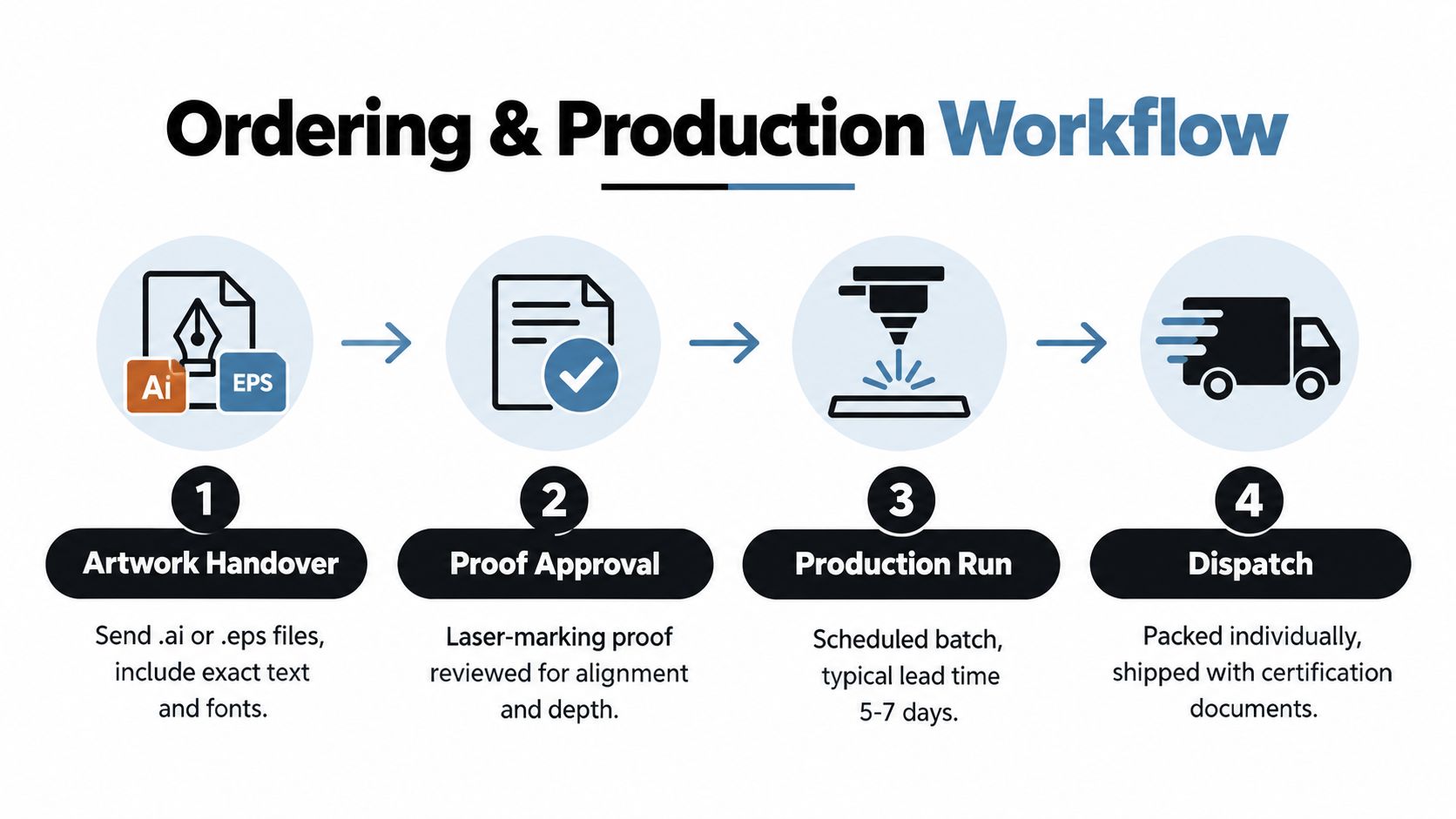
Once the specification is settled, the order should move through a controlled handover rather than a chain of informal emails. The supplier needs the exact data, the correct revision and a clear understanding of which information is fixed and which information varies by asset.
Give production usable information
Supply vector artwork where possible, together with the final text file or asset schedule. Include hole positions, plate dimensions, material grade, finish, character layout, barcode or QR data, fixing requirements and revision status. A logo file alone isn't enough if the supplier still has to interpret serial numbers, line breaks or installation orientation.
The proofing stage should confirm more than spelling. Check the mark's location, alignment, code readability, border clearances and whether the text is legible under the expected site lighting. If the plates carry variable data, approve a representative sample that includes the longest identifier and any unusual characters.
Plan production around the actual order
Stock material and standard hole patterns usually move more than custom-cut specials. Non-standard fixing patterns, unusual thicknesses, multiple finishes and mixed data sets can add coordination time even when the marking itself is straightforward. Australian supplier lead times vary, so ask for a written production commitment rather than assuming that a standard item and a custom batch will follow the same schedule.
The supplied workflow reference describes a typical production lead time of 5 to 7 days for its illustrated batch process. That timeframe must be treated as supplier-specific, not a universal industrial promise. Urgent work can also depend on material availability, artwork readiness and whether the order can join an existing Trotec Laser production run.
Before dispatch, request checks that reflect the risk:
- Text and code verification: Confirm every identifier against the approved schedule.
- Mark consistency: Inspect contrast, depth or coating removal across the batch.
- Physical inspection: Check edges, holes, burrs, finish and plate flatness.
- Documentation: Retain material certificates or traceability records where the project requires them.
- Packing control: Separate variable-data plates so the installation team can't confuse similar assets.
Most rework begins before the laser is switched on. Incorrect fonts, missing revision numbers, unclear hole locations and inconsistent source data create avoidable delays.
Installation, Inspection and Long-Term Maintenance
Installation determines whether the plate remains useful. A durable mark placed behind a removed guard, under a new coating or beside a point of abrasion is still a poor identification system. Position the plate where the operator can see it during normal inspection, while keeping it away from direct impact, standing water and routine chemical contact where practical.
Use the fixing method selected during design. Mechanical fixings generally suit stainless plates on equipment subject to vibration or handling. Adhesive systems can work well for clean, flat anodised aluminium panels when the surface is prepared properly and the service conditions support the adhesive. Weld studs or other heavy-duty attachments may be appropriate for large industrial assets, but they require coordination with the equipment owner and fabricator.
Inspection should be simple enough to become part of normal maintenance:
- Visibility: Confirm guards, covers, paint and insulation haven't obscured the identifier.
- Legibility: Check that grease, residue or abrasion hasn't hidden critical text.
- Retention: Look for loose rivets, damaged screws, lifted edges or failed adhesive.
- Register accuracy: Verify the physical identifier against the asset register and inspection record.
- Environment: Note new chemical exposure, heat, washdown practice or corrosion that may change the original risk.
The advantage of a permanent laser-marked plate is reduced dependence on replacing faded printed labels. It doesn't remove every maintenance task, because the plate can still be obscured, bent or wrongly installed. It does give the site a more stable information carrier when the substrate, mark and fixing have been selected together.
Evright Industrial offers laser-engraved aluminium and stainless-steel plates for equipment identification, including serial numbers, company names, barcodes and QR codes, with production supported by Trotec Laser machinery. Review your asset classes, environmental risks and CMMS requirements, then visit Evright Industrial to discuss a plate or scan-enabled labelling specification suited to the way your site operates.
Recent Comments