
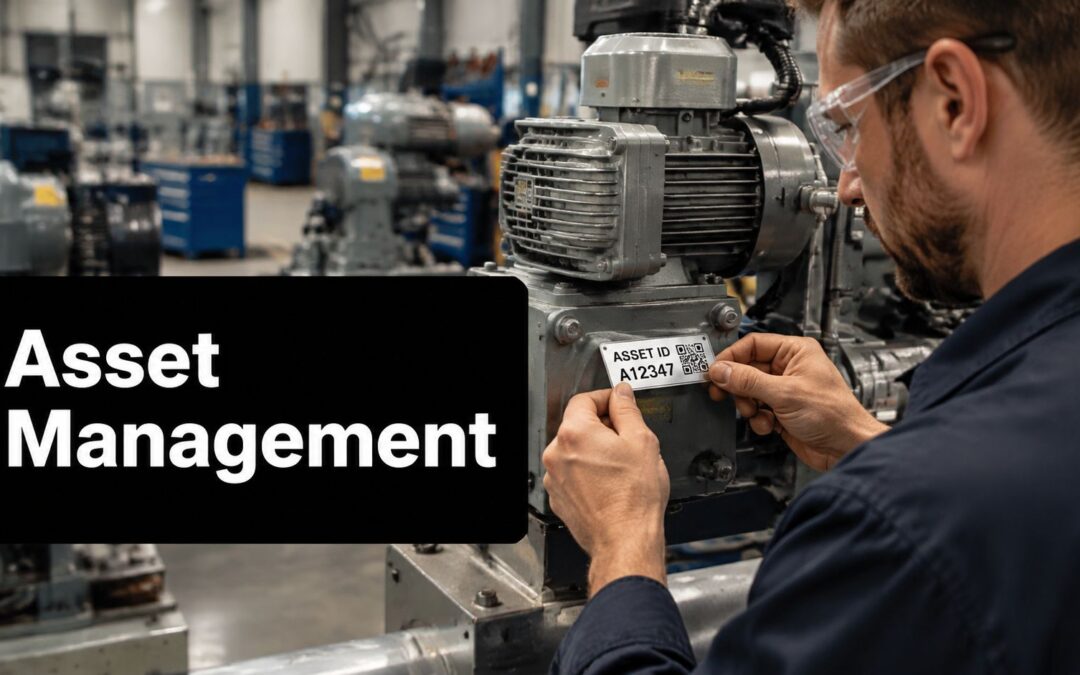
Asset management is the coordinated set of processes an organisation uses to realise value from its assets across their entire lifecycle, from planning and acquisition through to operation and disposal. In Australia, that discipline is formalised through AS ISO 55000, adopted nationally in 2014.
A faded equipment label rarely looks like a major operational problem until someone needs the correct pump during an outage, a technician records maintenance against the wrong machine, or an auditor asks for evidence that a controlled item was inspected. On a hospital ward, an untraceable device can delay service and create uncertainty about its history. On a manufacturing floor, an unreadable tag can disconnect a physical asset from its maintenance record. At a remote utility site, inconsistent identification can turn a routine inspection into a costly search.
That's what asset management looks like in practice. It isn't just an inventory list, and it isn't only maintenance. It's the organised control of assets, information, risks, costs, performance and responsibilities over the asset's useful life. Durable identification is the physical link that makes the system work.
Understanding What Asset Management Really Means
A facility manager starts the morning with three competing problems. A contractor cannot locate the asset scheduled for inspection, technicians have found two machines with nearly identical descriptions, and finance is questioning whether several registered items still exist. The organisation may have software, spreadsheets and work orders, but those records only support decisions when staff can connect each digital record to the correct physical asset.
Asset management is the coordinated activity of an organisation to realise value from assets. It applies across asset classes and organisation sizes, covering the decisions, information, responsibilities and controls that shape how assets support the organisation. The discipline therefore reaches beyond filing records. It requires a consistent basis for decisions about physical and non-physical assets, supported by guidance from Standards Australia.
Value depends on control
Value does not mean revenue alone. An asset may support safe patient care, maintain a public service, meet a compliance obligation, protect workers or prevent an unplanned shutdown. To manage those outcomes, the organisation needs reliable information about the asset's identity, location, condition, criticality, ownership and lifecycle status.
The practical distinction between asset management and record keeping matters:
- An inventory says what exists. Asset management connects each item to responsibility, risk, performance and lifecycle decisions.
- A maintenance schedule says what work is due. Asset management helps determine whether maintenance, replacement or retirement will deliver value.
- A label shows identity. A durable, readable label preserves that identity through handovers, servicing, audits and changes in personnel.
Identification is the physical control that links the register to the equipment on the floor, in a ward or at a remote site. Label material, marking method and placement must suit the asset's environment. A laser-marked identifier may be appropriate where cleaning, abrasion or exposure would make an ordinary label unreliable. The right choice depends on the surface, operating conditions and information the organisation must retain.
For a facilities perspective, the Facility Management Insights asset guide provides further context on the management discipline. Evright's fixed asset management guide focuses on the practical control of fixed assets.
Practical rule: If a technician, contractor or auditor cannot identify the same asset you mean, the register is not under operational control.
The Asset Lifecycle From Planning to Disposal
Australian asset management guidance treats the lifecycle as a connected decision system. NSW Fire and Rescue describes a lifecycle that includes needs assessment, planning, acquisition, delivery, operations and maintenance, and disposal. Each stage influences the next, so a cheap or poorly specified decision at acquisition can create identification, maintenance and end-of-life problems later.

Make each phase operational
Needs assessment establishes the service requirement. A hospital might need equipment that can be cleaned repeatedly, while a water operator may need infrastructure that can be identified at an isolated site.
Planning defines the specification, funding, risk controls and information requirements. Teams should decide what identifier the asset will carry, what data it must contain and how that data will enter the register.
Acquisition is more than purchasing the physical item. Procurement should capture manufacturer details, warranty information, supplier records, compliance documents and the organisation's own asset identifier.
Delivery is the handover point. The asset should arrive with its identity confirmed, its location recorded and its documentation connected to the correct record. If contractors apply inconsistent labels during installation, the owner inherits avoidable data problems.
Operations and maintenance depend on people finding the right asset and recording work against it. A durable tag supports inspections, stocktakes, service calls and changes in responsibility.
Disposal closes the lifecycle. The organisation needs to confirm that the item has been removed, transferred, decommissioned or replaced, while retaining the history required for governance and compliance.
| Lifecycle Phase | Key Decisions | Operational Outcome |
|---|---|---|
| Needs assessment | What service is required, and what risks matter? | A defined asset requirement |
| Planning | What specification, identifier and data structure are needed? | A controlled acquisition plan |
| Acquisition | What information and evidence must suppliers provide? | A complete asset record |
| Delivery | Has the asset been correctly identified and handed over? | A reliable starting point |
| Operations and maintenance | How will work, condition and location be recorded? | Better control during service |
| Disposal | How will the asset be retired, transferred or replaced? | A closed lifecycle record |
A lifecycle approach also exposes trade-offs. Selecting the lowest-cost label at purchase may appear sensible, but replacement labelling, lost records and repeated verification can cost more in operational effort. The better decision considers the environment, expected service life, cleaning regime, heat, chemicals, abrasion and the importance of preserving identity.
The supporting video offers a visual introduction to the lifecycle process. Watch it after reviewing the decisions above, so the stages remain connected to real operational work.
Why Durable Asset Identification Is the Operational Linchpin
An asset register becomes useful when staff can match its records to physical items without guesswork. NSW health guidance requires asset labels and tags to align with AFM Online and recognises that an organisation's asset label may differ from a manufacturer's label. Queensland health guidance requires SAID barcode labels on financial assets and maintainable items for tracking and reporting. Those requirements show why identification is part of asset management itself, not a cosmetic addition.
Design the identity before choosing the label
Start with the data structure. Decide whether the identifier will be numeric, alphanumeric, barcode-based, RFID-enabled or a combination. Define the naming convention, location fields, asset class, criticality and ownership rules before production begins. A label can't repair a confused register.
Temporary stickers and printed paper labels often fail in industrial settings because moisture, cleaning chemicals, abrasion, heat and sunlight attack the adhesive or surface. A manufacturer's serial number may also be unsuitable as the organisation's primary identifier, particularly when equipment is moved, replaced or grouped into a larger system.
Laser marking offers a different approach. A laser removes or changes the surface of a selected material with controlled precision, producing text, symbols, barcodes or serialised information without relying on ink that can rub away. The correct result still depends on the substrate, marking depth or contrast, label design and environment. Laser marking isn't automatically suitable for every material, but it gives teams a durable option when traceability must survive ordinary operational wear.

Match technology to the operating environment
Trotec Laser machines are relevant where organisations need precise, repeatable marking across asset tags, data plates, signage and equipment components. The practical benefit isn't the machine name alone. It's the ability to produce consistent identifiers that remain legible and fit the required data format.
Before approving a production run, test the proposed material and mark under real conditions:
- Check exposure: Include cleaning agents, outdoor weather, vibration, heat and abrasion.
- Check readability: Scan barcodes at the distance and angle technicians will use.
- Check placement: Keep the identifier visible without placing it where it interferes with operation or safety controls.
- Check handover: Confirm that contractors, owners and maintenance teams use the same identifier and nomenclature.
For practical information about the marking process, Evright Industrial's engraved metal labels explain how a durable physical identifier can support asset records. Evright Industrial is one production option for organisations requiring industrial asset labelling, while Trotec Laser technology provides the equipment platform used for precision laser marking applications.
A durable label won't create good asset data, but poor labelling will undermine good asset data.
Real-World Asset Management Across Australian Industries
The same principle appears in very different workplaces. A factory, hospital, water authority and funeral home won't use identical registers or materials, but each needs a dependable connection between an item and its record.

Manufacturing
A production plant has machinery distributed across work cells, stores and maintenance areas. The operations team assigns each machine a unique identifier, places a laser-engraved tag where technicians can read it safely, and links that identifier to preventive maintenance instructions, service history and spare-parts information. When a contractor arrives, the physical tag removes ambiguity from the work order.
The trade-off is between putting the label in the most visible location and protecting it from impact, heat or contamination. The right position supports both scanning and survival.
Healthcare
A hospital asset team needs to distinguish equipment that looks similar but has different service requirements, locations or ownership records. A barcode-based register, aligned with Queensland Health's SAID approach for financial assets and maintainable items, gives staff a consistent way to connect equipment with tracking and reporting processes.
The label must remain legible through cleaning and movement. A decorative or short-lived label may be cheaper initially, but it creates friction whenever staff need to identify equipment quickly.
Utilities
A regional water authority may manage pumps, control cabinets, valves and other infrastructure across dispersed locations. Permanent identifiers reduce dependence on memory and local knowledge, particularly when contractors service sites they don't routinely visit. The mark can connect the physical item to inspection records, isolation procedures and replacement planning.
Asset management also extends to metered services and facilities. Teams responsible for property operations may find a submetering guide for Queensland landlords useful when they're connecting service measurement with broader building information.
Memorial applications
A funeral home commissioning a custom laser-engraved plaque is managing a different kind of asset requirement. Longevity, legibility, material suitability and accurate approval records matter more than barcode scanning, but the control principle remains familiar. The organisation must preserve the correct identity and specification through design, production, approval and installation.
These examples show that asset management isn't defined by one software package or one label style. It's defined by the quality of decisions and the reliability of the information trail.
Compliance Requirements and Regulatory Frameworks
Compliance affects asset management at two levels. Management-system frameworks shape terminology, decision-making and lifecycle governance. Other rules specify how particular assets must be identified, labelled, stored or reported. Operations teams need to convert those requirements into practical controls, including register fields, approval steps, label materials, placement rules and retained evidence.
Australia adopted ISO 55000 as AS ISO 55000 in 2014. Standards Australia approved it on 20 October 2014 and published it on 11 November 2014, following the international launch of the ISO 55000 suite in February 2014. The framework provides consistent terminology, principles, intended outcomes and lifecycle decision guidance for different organisations and asset classes. Standards Australia's published standard remains the formal reference for teams establishing an asset management system.
For financial-sector participants, the Corporations Act 2001 provides the corporate-law context, while ASIC administers the AFSL regime. AFSL responsibilities may cover investment management advice, custodial and depository services, brokerage, market-making, underwriting and managed investment funds. ASIC's RG 133 was reissued in December 2024 and sets minimum standards for AFS licensees that hold assets, including requirements concerning how those assets are held. In practice, custody records, controls and supporting evidence must align with the organisation's regulated activities.
Labelling can carry a safety obligation
A label can be part of the safety control, not merely an inventory aid. Queensland Health requires laser equipment labels to follow AS/NZS IEC 60825.1:2014. Each laser requires three radiation hazard labels: a warning label, an explanatory label and an aperture label. They must be yellow with black text, durable, permanently fixed, legible during operation and visible without exposing a person to radiation. Review the Queensland Health laser labelling requirements before specifying the marking process.
| Framework | Applies To | Key Requirement |
|---|---|---|
| AS ISO 55000:2024 | Asset-owning organisations of all types and sizes | Defines terms and establishes principles and outcomes for asset management |
| Corporations Act 2001 and AFSL regime | Financial-sector asset management participants | Establishes the corporate and licensing context for regulated activities |
| ASIC RG 133 | AFS licensees that hold assets | Sets minimum standards for funds management and custodial services |
| AS/NZS IEC 60825.1:2014 | Laser equipment in the Queensland Health context | Specifies required hazard labels and their durability, visibility and format |
Standards define the boundary. The organisation still has to choose a marking method, material and data process that suits the asset's environment, cleaning routine, access conditions and service life. A compliant register is of limited value if the identifier on the equipment cannot be read or matched to the record.
Implementing Asset Management in Your Organisation
A workable implementation starts with scope, not software. Define the assets, services, locations and obligations that matter most, then build an identification system people can use during ordinary work. Australian public-sector frameworks, including WA's Strategic Asset Management Framework and Austroads' ISO 55000-based guide, reinforce the value of governed decision processes and evidence-based prioritisation.

Start with an honest baseline
Assess the current register. Compare records with what staff can physically locate. Identify duplicates, missing items, unclear ownership, outdated locations and assets that lack a usable identifier.
Define scope and priority. Don't attempt to label everything with the same level of detail on the first pass. Prioritise assets with high service importance, safety exposure, regulatory obligations, expensive downtime or difficult access.
Design the identifier. Set naming rules, numbering logic, barcode or RFID requirements, label dimensions and placement standards. Include the fields technicians need, not every possible field someone might want later.
Test the material. Use samples in the actual environment. Check cleaning, weather, chemicals, abrasion, heat and scanning. Trotec Laser equipment can support precise and repeatable production, but the substrate and application still determine the final result.
Connect the physical and digital processes
Once identifiers are approved, make them part of work orders, procurement, commissioning, inspection, stocktake and disposal. A new asset shouldn't enter service without a verified record, an assigned owner and an identifier that staff can locate. A retired asset shouldn't remain active because nobody updated the system.
The ITAM best practices for 2026 resource from myhalo offers useful broader context for managing technology assets and data processes. The same operational discipline applies beyond IT, although industrial teams must account for harsher environments and different compliance requirements.
For organisations that need a system to connect records with physical equipment, industrial asset management software can provide a structured operating layer for identification, maintenance and lifecycle information.
Improve through controlled feedback
Review failures rather than merely replacing damaged labels. If technicians can't scan a tag, ask whether the problem is placement, contrast, surface contamination, device compatibility or the data structure itself. If contractors create duplicate records, clarify the handover process and ownership of the identifier.
Asset management becomes durable when the organisation treats it as a managed operating practice. Start with a controlled asset group, measure the quality of the records qualitatively, correct the process and expand when the workflow works in real conditions.
Frequently Asked Questions
Is asset management the same as maintenance?
No. Maintenance is one activity within asset management. Maintenance keeps an asset operating or restores it after failure. Asset management also covers needs assessment, planning, procurement, commissioning, risk, performance, information quality, renewal and disposal. A maintenance team may report that a pump is serviceable, while asset management asks whether the pump still delivers the required service, carries the right risk profile and remains the best whole-of-life decision.
Is laser engraving suitable for every asset?
No marking method suits every substrate or environment. Laser marking is often appropriate for metal tags, data plates and selected equipment surfaces, but the team should test the material before production. Consider cleaning agents, heat, sunlight, vibration, abrasion, corrosion, scan distance and whether the mark must remain visible during operation. For safety-critical equipment, confirm the applicable standard and label placement requirements before selecting the design.
How can a small Australian business begin without a major project?
Start with a defined asset group, such as production machinery, electrical equipment or high-value tools. Create a simple register with a unique identifier, description, location, responsible person, condition and next required action. Label the selected assets consistently, verify every record on site, then connect the identifiers to purchase records, service documents and disposal decisions. Expanding a tested process is safer than buying complex software before the organisation knows what information staff can maintain accurately.
Evright Industrial can help Australian organisations turn asset registers into physical identification systems through durable industrial labels, data plates, equipment marking and custom laser engraving produced with Trotec Laser technology. Visit Evright Industrial to discuss your asset environment, labelling requirements and the materials suited to your operational and compliance needs.
Recent Comments