
Most carbon footprint reduction advice starts in the wrong place. It tells industrial operators to choose lighter materials, buy recycled packaging, or purchase offsets, while overlooking the emissions created when a safety sign fades, an asset label fails, and a replacement has to be manufactured, shipped, installed, and eventually discarded.
On a factory floor, mine site, healthcare facility, or infrastructure project, the lowest-carbon purchase isn't always the lightest or cheapest one. A durable label produced with precise, energy-efficient equipment can prevent repeated procurement and rework across its service life. That changes the practical question from “What has the smallest footprint today?” to “What will create the fewest emissions before this item is finally retired?”
Why Carbon Footprint Reduction Means More Than Switching Materials
Household electricity often dominates public discussion about carbon footprint reduction. Industrial buyers face a different calculation. Their decisions affect production energy, material waste, transport, installation, maintenance, and replacement cycles, all within environments that can expose products to sunlight, abrasion, chemicals, moisture, heat, and vibration.
A low-cost label that lasts only until the next maintenance cycle may appear efficient on a purchase order. It isn't efficient if it needs regular replacement. Every repeat order can involve fresh material, machine time, packaging, freight, staff time, removal of the failed item, and disposal. Those impacts are easy to miss because procurement systems usually record unit price, not total lifecycle emissions.
The cheap boots test
A mine-site worker doesn't choose boots solely because they cost less on day one. If an inexpensive pair fails quickly, the replacement cycle becomes part of the overall cost. A tougher pair may require a higher initial outlay, yet fewer replacements can mean less manufacturing, fewer deliveries, and less waste over the working life of the product.
Industrial identification works the same way. A laser-engraved asset label or compliance marking that remains legible in harsh Australian conditions can avoid the recurring emissions associated with disposable alternatives. The exact outcome depends on the substrate, fixing method, exposure, cleaning regime, and application, so durability needs to be specified for the site rather than assumed from a material name alone.
This doesn't mean every premium material is automatically sustainable. A durable product that is over-specified, difficult to recycle, or frequently replaced for design reasons can still perform poorly across its lifecycle. Responsible sourcing, repairability, material recovery, and a clear end-of-life plan belong in the same decision.
For broader context on how material choices can influence packaging outcomes, MSP Packaging's sustainable packaging guide is a useful reference. Industrial teams should apply that same discipline to labels, plaques, signs, tags, and identification components.

Before changing specifications, document the conditions that cause failure. A practical sustainable material sourcing approach should consider service life, chemical resistance, legibility, fixing reliability, waste generated during production, and the likelihood of repeat orders.
Practical rule: Specify the product that avoids the most replacements, not simply the product with the smallest material footprint on the day it is purchased.
Where Australian Industrial Emissions Actually Stand
Australia has made measurable progress, but the remaining work is becoming harder. The Australian Bureau of Statistics emissions reduction data records annual net greenhouse gas emissions of 446.4 million tonnes of carbon dioxide equivalent in the year to December 2024. That result was 27% below the June 2005 baseline used for Australia's 2030 Paris target, yet emissions were almost flat year on year, rising only 0.05% from 2023.
The Climate Change Authority states that emissions are currently 28% below the 2005 level and need to fall by an average of 15 Mt CO2-e per year to reach the 2030 target of 43% below 2005 levels. For an operations manager, the message is straightforward. National decarbonisation is real, but progress can't rely on the easiest early gains continuing indefinitely.
Manufacturing sits inside that challenge. Australia's industrial and resources sectors emitted 185 Mt CO2-e in the year to June 2023, with manufacturing contributing 32 Mt CO2-e, according to the Climate Change Authority's industry analysis. Those figures point managers towards stationary energy, process heat, fuel switching, and electrification, rather than treating offsets as a substitute for operational changes.

Regulation makes the direction clear
The Safeguard Mechanism applies to facilities emitting more than 100,000 tonnes of carbon dioxide equivalent per year, with baselines generally declining by 4.9% annually through 2030, as explained by the Department of Climate Change, Energy, the Environment and Water. Government materials state that the mechanism covers approximately 56% of industrial-sector scope 1 emissions, making it a significant lever for manufacturing and other energy-intensive operations, as outlined in the industry sector plan.
Smaller operators may not fall directly within the threshold, but they still supply, service, or transport goods for organisations that do. Their customers increasingly need credible emissions information, reliable asset identification, and evidence that operational improvements are more than a marketing claim.
Four Practical Levers for Reducing Industrial Carbon Footprint
Carbon footprint reduction works best when managers attack the sources they can control rather than collecting disconnected green initiatives. Four levers are especially relevant to engraving, asset labelling, safety signage, and equipment identification.
1. Reduce energy used by production equipment
Start with the machinery that performs the work. Replace inefficient legacy processes where a modern system can deliver the required result with less energy, fewer passes, and less rework. Trotec laser machines support precise cutting and engraving, which can help operators avoid the repeated setup, tooling, and correction associated with less controlled methods.
Don't assume that replacing one machine solves the problem. Record operating patterns, idle time, extraction requirements, maintenance needs, and the energy used across the complete production process. A machine that is efficient while cutting but routinely runs empty or requires frequent failed batches still needs better scheduling and process control.
2. Specify materials for the real environment
Choose materials based on exposure and service requirements. For an outdoor electrical installation, a label may need resistance to ultraviolet exposure, moisture, cleaning chemicals, abrasion, and temperature changes. For a healthcare setting, the cleaning regime and legibility requirements may matter more than weight.
A responsible sourcing review should ask where material comes from, how much offcut it creates, whether the product can be separated or recovered at end of life, and whether a tougher specification will prevent repeat orders. The right choice isn't automatically the thickest or most expensive option. It is the option that meets the operating need without predictable early failure.
3. Use precision to reduce waste
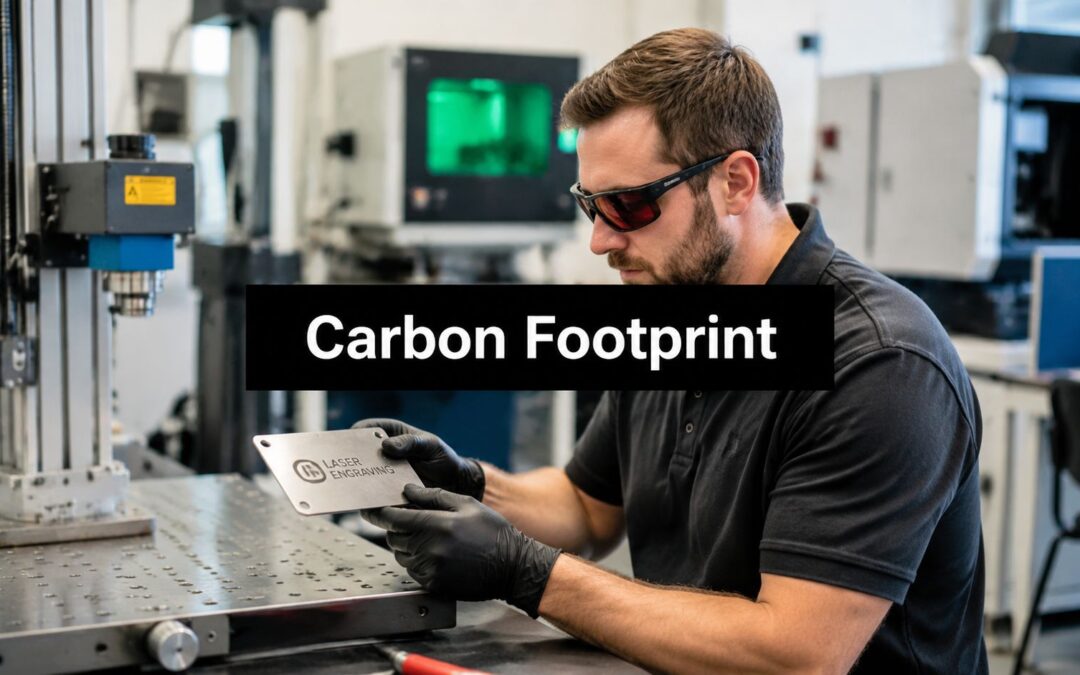
Laser engraving can place marks accurately and repeatably, reducing errors that send finished parts into the waste stream. Digital artwork and controlled settings also make it easier to reproduce a sign or label without rebuilding the process from scratch.
Waste is often a process-control problem before it's a material problem.
Review nesting, sheet utilisation, proofing, rejected pieces, and offcuts. A good operator checks a small sample before committing a full run, confirms text and identification codes, and keeps approved artwork available for future additions. That approach protects both material and production time.
4. Consolidate supply and logistics
Transport is frequently hidden inside the replacement cycle. Small, urgent orders can mean separate packaging, separate freight, and separate receiving activity. Designing a durable standard for common asset classes can allow planned production and consolidated delivery.
For a broader operational review, the guidance on improving operational efficiency is relevant because energy, waste, scheduling, and procurement decisions interact. A reduction in repeat orders can be as valuable operationally as a change in material.
The Durability Versus Disposability Trade-Off
Procurement teams often compare products using the figures easiest to obtain, usually unit price, weight, and apparent material footprint. That method misses the operational burden created by failure. A standard label may degrade within a year in harsh conditions, while a durable laser-engraved label may remain serviceable for a decade or more when correctly specified and installed. Those service-life descriptions are practical scenarios, not universal guarantees, because actual performance depends on substrate, exposure, fixing, handling, and maintenance.
The comparison below shows what needs to be considered before approving a supposedly greener substitute.
| Emissions Factor | Standard Label, Replaced Annually | Durable Laser-Engraved Label |
|---|---|---|
| Initial material | May use less material per unit | May require a more robust substrate |
| Production | Repeated production runs | Fewer planned production runs |
| Rework | Greater exposure to incorrect or faded identification | Lower risk when the marking remains legible |
| Freight | Replacement shipments recur | Deliveries can be consolidated around planned projects |
| Installation | Staff revisit the asset to remove and fit replacements | Installation is less frequently repeated |
| Disposal | Failed labels enter the waste stream more often | End-of-life event occurs less frequently |
| Record keeping | Asset records may need repeated updates | Stable identification supports consistent records |
What the table changes
The durable option doesn't win because “premium” automatically means sustainable. It wins when its service life is materially longer and the site doesn't need to replace it for avoidable reasons. Procurement should ask for evidence of suitability, define the environmental conditions, and confirm that the marking meets the required visibility and compliance standard.
The same logic applies to asset governance. Reliable identification supports fixed asset management practices, including consistent records, maintenance decisions, and equipment tracking. If a label fails, the organisation may lose more than a piece of plastic or metal. It may lose confidence in the identity and status of the asset.
A cheaper product can still be the right choice in a protected indoor application with low exposure and easy access. A heavier or more durable product can be wasteful where the sign is temporary. The decision should follow the duty of the item, not a blanket preference for either disposability or premium materials.
How Evright Industrial and Trotec Laser Technology Deliver Sustainable Results
Sustainable production begins with disciplined decisions before a machine starts. The operator needs the correct artwork, material, dimensions, fixing method, quantity, and environmental requirements. That preparation reduces avoidable proofing errors and helps the production team make full use of each sheet or blank.
Evright Industrial operates as a specialised industrial division of evright.com, an Australian laser engraving and awards company with nearly six decades of expertise. The industrial work extends that capability into equipment identification, safety signage, asset labelling, and custom memorial plaques, serving applications across manufacturing, healthcare, essential services, and government.

Precision supports longer service life
Trotec laser machines allow technicians to produce intricate designs and consistent marks across repeat jobs. That consistency matters in industrial settings because a failed batch can consume material twice, delay installation, and trigger another freight movement. Precision doesn't remove every source of waste, but it gives the operator better control over the work.
Material selection remains central. A technician needs to match the substrate to the environment rather than treating laser capability as a reason to use one material for everything. Responsible sourcing, appropriate thickness, reliable fixing, and durable marking work together to reduce the likelihood of premature replacement.
A short visual demonstration can help teams understand how controlled laser processing fits into a production workflow.
Evright Industrial uses this precision-driven approach for asset tracking on manufacturing floors, safety and security signage, essential-services equipment, healthcare identification, and commemorative plaques. The relevant sustainability outcome is practical rather than theatrical: fewer rejected pieces, less avoidable offcut, better repeatability, and products designed to stay useful in demanding conditions.
That doesn't make laser engraving a universal answer. Large-scale process heat, fleet fuel, electricity procurement, and site design can outweigh a labelling decision. Industrial engraving is one controllable part of a broader carbon footprint reduction programme, and its value increases when operators measure replacement frequency and waste rather than relying on assumptions.
Your Carbon Footprint Reduction Action Checklist
Use this checklist during a production review, procurement meeting, or site walk-through. Start with the items that affect repeated work and high-use equipment.
- Audit production equipment: Identify older engraving, cutting, printing, extraction, lighting, and finishing equipment that consumes energy while idle or requires repeated passes. Record operating patterns before choosing a replacement.
- Map failure points: Collect examples of faded signs, detached labels, damaged plaques, and unreadable equipment markings. Note the location, exposure, cause of failure, and time required to replace each item.
- Review material specifications: Ask whether each product is designed for its actual environment. Check ultraviolet exposure, moisture, chemicals, abrasion, temperature, cleaning, and fixing requirements.
- Compare lifecycle requirements: Put the initial purchase beside expected replacement, freight, installation, disposal, and administration activities. A low unit price shouldn't end the discussion.
- Check supplier processes: Ask suppliers how they control artwork, proofs, production quality, offcuts, rejected pieces, and material sourcing. Responsible practice should be specific enough to verify.
- Analyse waste streams: Separate clean offcuts, rejected parts, packaging, damaged labels, and end-of-life products. Look for the process step creating each stream, then test whether better nesting, proofing, or sizing can prevent it.
- Consolidate repeat orders: Standardise common dimensions and identification formats where operationally appropriate. Planned batches can reduce urgent reordering and fragmented deliveries.
- Include transport in the review: Examine fleet movements, contractor travel, freight frequency, and domestic aviation where relevant. Electricity improvements won't address fuel-related emissions on their own.
- Set approval criteria: Give procurement teams a written hierarchy: safety and compliance first, suitability second, service life third, and price within the approved performance requirement.
- Measure the result: Track replacement frequency, rejected units, material use, urgent freight, and downtime. These operational indicators show whether a carbon footprint reduction measure is working.
Don't try to complete every action at once. A focused pilot on one asset class can reveal whether a durable specification reduces repeat work before the organisation changes every label or sign.
Building a Sustainable Future for Australian Industry
Industrial sustainability is strongest when it joins several ordinary decisions. Durable labels reduce replacement pressure. Precise production controls waste. Efficient equipment reduces energy used during manufacturing. Responsible sourcing improves the quality of the procurement decision, while better scheduling can reduce repeat freight and urgent work.
Australia's electricity transition has already delivered significant emissions reductions through renewable-energy deployment and market mechanisms. The Clean Energy Regulator reports that administered schemes reduced emissions by 65.5 million tonnes of CO2-e in 2023, up from 62.1 million tonnes in 2022, with an estimate of 70.8 million tonnes in 2024 in its reporting. The Clean Energy Regulator's emissions reduction report records the Renewable Energy Target contribution at 48.3 million tonnes in 2023, including 29.3 million tonnes from the Large-scale Renewable Energy Target and 19.0 million tonnes from the Small-scale Renewable Energy Scheme.
The Clean Energy Council also reports that renewable energy growth since 2015 has avoided over 200 million tonnes of CO2 emissions and that, by the end of 2025, it would deliver about 40% lower electricity emissions than a 2015 baseline, equivalent to roughly 340 million tonnes saved over the decade, as stated in its sector reporting. Those results show why electricity matters, but they don't remove the need to address transport, fuel, process heat, materials, and replacement cycles.
A pathway study for Australian industry found that coordinated action could reduce industry emissions by up to 92% by 2050 from 2020 levels, with about two-thirds of required investment directed to the energy system and one-third to industrial technologies, electrification, and energy efficiency, according to Pathways to Industrial Decarbonisation. The implication is practical. Operators need to allocate capital to infrastructure and equipment, not rely mainly on end-of-pipe measures.
Waste prevention belongs in that strategy. Teams reviewing asset labels and equipment markings may also find myhalo's guide to zero e-waste useful for thinking about longer product life, repair, reuse, and responsible end-of-life decisions.
The Safeguard Mechanism's declining baselines reinforce the direction of travel. Industrial businesses that improve energy use, material life, production control, and asset management now will have more options than businesses forced to react after a failure, customer requirement, or regulatory pressure.
Evright Industrial provides precision laser engraving, durable asset labelling, equipment identification, safety signage, and custom plaques for demanding Australian environments. Visit Evright Industrial to discuss a material, marking method, and production approach that can reduce repeat replacements and support your carbon footprint reduction goals.
Recent Comments