

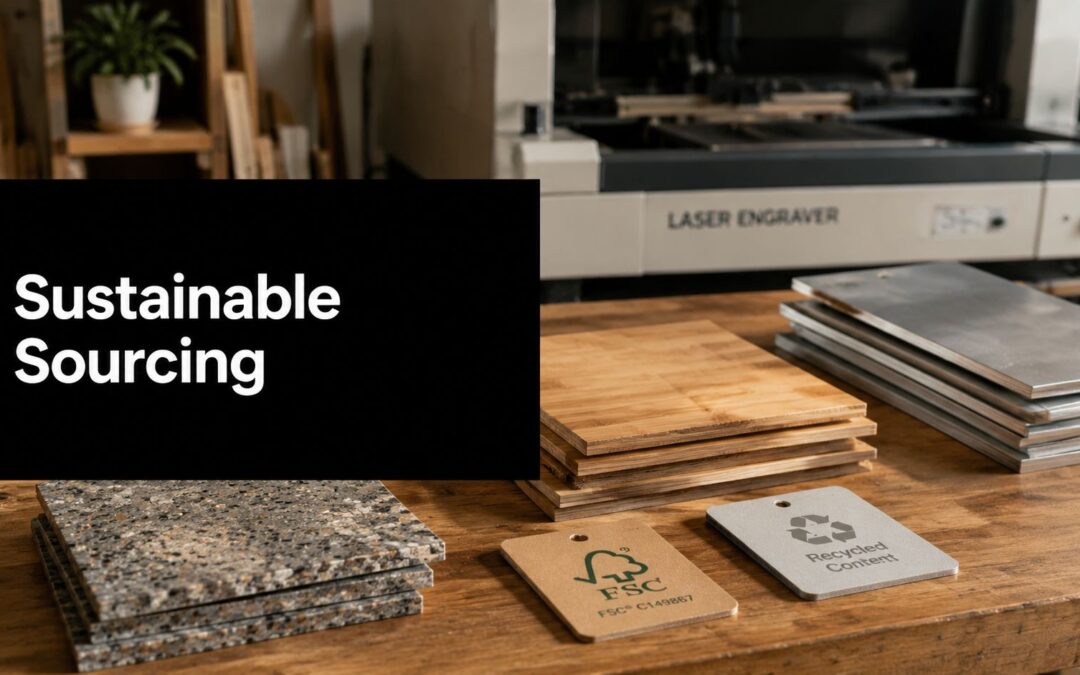
You've used the same substrate for years. It passes dimensional checks, produces a clean mark and survives the customer's normal inspection. Then a tender asks for verified recycled content, an auditor requests chain-of-custody records, or your internal ESG gate rejects the supplier because the material's end-of-life route isn't documented. The substrate hasn't suddenly become unusable. The specification has become incomplete.
Sustainable material sourcing for industrial engraving isn't a matter of choosing the highest recycled-content figure on a brochure. The material must also hold its mark, tolerate the operating environment, work predictably on a Trotec Laser machine and come with evidence a procurement team can defend. This article applies that practical test to Australian policy, supplier documentation and laser-engraved asset labels.
The Moment Your Standard Substrate Spec Stops Passing
A familiar aluminium, phenolic or plastic sheet can still meet its old quality specification while failing a new procurement review. The tender may ask where the resin originated, whether recycled content is independently verified, whether bonded layers can be separated, and what happens to the plate or tag at end of service. Production has not necessarily changed. The evidence required to approve the material has.
That shift reflects Australia's resource position. In 2019, Australia extracted 2,587 million tonnes of materials, used 1,287 million tonnes domestically and exported more than half of all extracted material. The same economy-wide analysis estimated an end-of-life recycling rate of 51.1%, but an overall circularity rate of only 5.1%. Recycling activity exists, yet material value can still leave the domestic system or be lost from it. The Australian material-flow benchmark provides procurement teams with a defensible baseline for assessing dependence on virgin inputs and overseas processing.

Find the gaps before the tender does
Separate evidence of performance from a description of the product. A conventional QA file may record thickness, colour, hardness and marking requirements. A circular-procurement file must also address origin, composition, restricted substances, processing and recovery, while confirming that the substrate will run predictably on the intended Trotec Laser process.
Check for these warning signs:
- Missing EPD: The supplier describes environmental benefits but cannot provide a verified Environmental Product Declaration or equivalent impact record.
- Unverifiable resin origin: The document uses “recycled” or “eco-friendly” language without identifying pre-consumer or post-consumer inputs, mass balance and batch traceability.
- Restricted substances: Plasticisers, pigments, coatings or adhesives are not mapped against the restricted-substance list relevant to the contract.
- Unrecoverable laminate: Multiple layers perform well in service but cannot be separated, identified or accepted by an available recovery system.
- Unproven laser behaviour: The material meets a general product standard but has not been tested for edge char, fumes, contrast or adhesive failure under the intended engraving process.
A substrate decision is also an assembly decision. Cladding, surface preparation, adhesive choice and the marking layer can determine whether a durable material remains recoverable. The Quickfit Container Accessories cladding guide offers a useful reference for considering how layers interact rather than treating the sheet as an isolated purchase. Before trialling a new grade, document cleaning, abrasion and preparation steps with the relevant industrial surface preparation methods. Record the laser settings, mark contrast, edge condition, fumes, adhesive response and any damage after environmental testing.
Score your position on the circularity spectrum
Use four stages to identify how each substrate input is sourced and recovered:
- Take, make and dispose: You buy virgin material, use it once and have no documented recovery route.
- Recycled-content inclusion: The product contains recycled input, but recovery, take-back or future feedstock is not connected to the purchase.
- Closed-loop recovery: The supplier identifies how material is collected, processed and returned to a comparable application.
- Regenerative sourcing: The procurement model supports resource renewal, responsible production and improvement beyond simple material substitution.
This is a working diagnostic, not a certification ladder. Weigh current substrate purchasing by category, trace the origin documents for each input and score every material against the four stages. Record what can be proved. A high recycled-content figure does not compensate for premature failure, unreadable identification or an end-of-life route that exists only on paper.
Packaging shows that recycled sourcing has entered mainstream Australian procurement. In 2022–23, post-consumer recycled content across packaging excluding wood reached 2.82 million tonnes, or 44% of packaging put on market, while pre-consumer content added 10% and virgin feedstock supplied 46%, according to APCO's packaging consumption and recovery data. The 2025 National Packaging Targets aim for an average 50% recycled content across packaging, and APCO guidance reports aggregate recycled content across all material types at 40% in 2024. These figures do not select an engraving substrate for you. They do show why tenders increasingly ask for documented recycled inputs and recovery arrangements.
Practical rule: Treat every unsupported sustainability claim as unscored until the supplier provides evidence.
Finish the baseline with three outputs: a mass-based view of current purchasing, a document register showing what is and is not verifiable, and a risk score covering durability, laser compatibility and end-of-life recovery. That record gives procurement a defensible tender position without sacrificing the substrate performance the production floor still requires.
Substrate Families Worth Putting Through a Trotec Laser
The right substrate depends on the asset's environment. A high recycled-content plate that fades, delaminates or produces an unreadable barcode is not a sustainable result if it has to be replaced early.
On a Trotec Laser system, the machine type, lens, power, speed, frequency and air-assist settings all affect the result. CO2 lasers generally suit coated, organic and many plastic substrates, while fibre lasers are used for direct marking and annealing on suitable metals. Always test the exact grade, coating and adhesive rather than relying on the family name.
| Substrate Family | Typical Recycled Content | Durability Profile | Trotec Laser Compatibility | Best-Fit Application |
|---|---|---|---|---|
| Anodised aluminium | Supplier-specific, must be verified | Strong outdoor and chemical performance when the anodising quality is consistent | CO2 laser can remove the anodised layer for contrast; fibre laser can mark suitable metal surfaces | Asset tags, equipment plates and outdoor identification |
| Recycled acrylic | Supplier-specific, with recycled input requiring evidence | Good visual finish, but some grades can be more vulnerable to UV, impact or chemical exposure | CO2 laser can produce clean cutting and engraving; edge finish and fumes vary by formulation | Indoor signage, displays and lower-abrasion labels |
| FSC-certified wood and bamboo | Recycled content isn't the primary metric | Performance depends on species, moisture, coating and exposure; untreated surfaces weather quickly | CO2 laser is generally suitable, with possible edge darkening or char | Interior signs, presentation products and controlled environments |
| Stainless steel | Recycled input varies by mill and grade | High resistance to corrosion, abrasion and many industrial chemicals | Fibre laser is appropriate for direct marking or annealing; CO2 requires a suitable marking medium | Durable plant identification and safety signage |
| Recycled-content engineering plastics | Supplier-specific | Strong grades can perform well, but recycled content may affect colour consistency, UV stability and batch behaviour | CO2 or fibre compatibility depends on polymer, additives and surface treatment | Electrical identification, machine panels and controlled industrial areas |
| Bio-based composites | Supplier-specific | Can offer useful surface performance, but binders and moisture response require validation | CO2 response depends on the matrix; char, odour and edge quality need testing | Interior or lightly exposed labels where the formulation is documented |
Reclaimed aluminium can vary in anodising quality, so ask for coating details and run samples from production-intended batches. High recycled plastic content can also affect UV resistance and colour uniformity. Those aren't arguments against recycled inputs. They're reasons to specify the performance boundary instead of selecting on recycled content alone.
For metal identification work, compare the substrate decision with the practical requirements described in laser engraving on metal. The procurement file should state the asset environment, expected abrasion, chemical exposure, sunlight, cleaning method, adhesive requirement and readability period before a supplier offers a grade.
Evaluating Suppliers on Evidence Not Brochures
A supplier scorecard should make unsupported claims commercially useless. Start with four evidence pillars, then require the evidence before discussing price or a preferred-supplier agreement.
| Evidence Pillar | Weight (%) | What Counts as Proof | Pass Threshold |
|---|---|---|---|
| Chain-of-custody documentation | 25 | Batch records, mill certificates and traceable origin documents | Complete records for the proposed production grade |
| Third-party recycled-content verification | 25 | Accredited verification identifying input type and mass basis | Claim matches the tender definition and supplied batch |
| Trotec Laser test sample | 30 | Test on the exact grade, including marking, cutting, fumes and adhesive behaviour | Readable mark and acceptable production result |
| Disclosed Scope 1-3 emissions | 20 | Defined boundary, methodology and supplier data or verified declaration | Boundary and data limitations clearly stated |
These weights are a practical starting point, not a universal rule. For an indoor sign, laser behaviour might carry less risk than it does for a barcode plate on a treatment plant. The important control is that claims without paperwork score zero, rather than receiving partial credit because the brochure sounds polished.
Build the shortlist around a production sample
Request the exact grade intended for production, not a visually similar substitute. A 50 mm × 50 mm sample is sufficient for an initial workflow check, provided the sample includes the proposed coating, face film, adhesive and backing.
Run the sample through the intended Trotec workflow and record:
- Mark quality: Contrast, minimum readable character size and barcode performance.
- Edge response: Char, melt, burrs, delamination and dimensional change.
- Process safety: Fume profile, odour, extraction requirements and safety-data-sheet warnings.
- Batch control: Lot number, certificate match and variation between samples.
- Service behaviour: Resistance to abrasion, cleaning chemicals, sunlight or other defined exposure.
Red flags include vague “eco-friendly” wording, post-consumer claims with no mass basis and a missing safety data sheet. A supplier that can't disclose the material composition should not be allowed to define the test criteria.
For operations that need stronger visibility across supplier records and documentation, supply chain visibility solutions can complement the manual approval process. The system matters less than the discipline. Store the evidence against the actual grade and lot, not against a broad supplier name.
Turning Australian Procurement Rules into Tender Clauses
A substrate tender can satisfy circular-procurement policy and still fail in production if the material burns poorly, delaminates or wears out before the label's service life. Write the tender so environmental evidence, durability and Trotec laser compatibility are assessed together.
Australian guidance supports a practical sequence: confirm the purchase is needed, reduce demand without reducing performance, test alternatives and circular options, then place measurable sustainability requirements in the tender and contract. The Commonwealth sustainable procurement guidance identifies energy, greenhouse-gas emissions, waste, recycled products, hazardous substances, packaging and end-of-life recycling as relevant considerations.
Write those considerations as obligations, not aspirations.
| Policy or Standard | Source | Tender Clause Wording | Mandatory vs Preferred |
|---|---|---|---|
| Commonwealth sustainable procurement guidance | Department of Finance guidance | “The respondent must disclose material composition, recycled content, relevant environmental impacts, hazardous substances, packaging and end-of-life arrangements for each proposed substrate.” | Mandatory |
| ESP Policy | Australian Government ESP Policy | “The respondent must provide the environmental information and reporting required for procurements within an applicable ESP Policy category and threshold.” | Mandatory where applicable |
| NSW recycled-content rule | NSW recycled-content reporting guide | “The respondent must state recycled content by mass using the applicable definition and provide records suitable for annual agency reporting.” | Mandatory for applicable NSW tenders |
| Circular procurement principles | Recycled-material procurement guidance | “The respondent should prioritise recyclable, durable, mono-material or take-back-supported options, subject to fitness for purpose.” | Preferred unless specified |
| ISO 20400 or GECA evidence | Applicable standard or certification scheme | “The respondent may provide current third-party certification or equivalent independent evidence. Certification does not replace disclosure of grade-specific performance.” | Preferred, or mandatory if named |
The ESP Policy covers construction services, furniture, fittings and equipment, ICT goods and textiles. Its staged requirements begin on 1 July 2024 for construction-services procurements at or above $7.5 million, and on 1 July 2025 for the other categories at or above $1 million, as set out in the policy details. NSW's rule applies to eligible tenders released on or after 1 July 2026 with an estimated total contract value of $1 million or more ex GST. Agencies must report annually, with a compliance statement due by 31 October.
Keep the clauses that make claims auditable during negotiation. Recycled-content disclosure, record retention, audit rights, safety information and take-back commitments should remain fixed requirements. Allow commercial flexibility on colour, delivery sequence or an equivalent recycled or virgin option only where the specification permits it.
A worked tender schedule can assign sustainability a weighting of at least 20 per cent. Score verified content, documented end-of-life recovery, durability evidence, emissions information and reporting quality, while setting a minimum pass mark for each critical attribute. A lower-priced substrate should not compensate for poor durability, incompatible laser processing or missing evidence.
Reading an EPD or Recycled-Content Statement Like an Auditor
An Environmental Product Declaration isn't a green label. It's a structured environmental statement whose value depends on its declared unit, system boundary, product-category-rule reference and verification.

Read the front page, then test the boundary
Begin with the declared unit. A substrate may be reported by mass, area or another functional basis. You can't compare figures until the units describe a comparable purchase.
Next, check the system boundary. Does it cover raw-material extraction, manufacturing, transport, packaging and end of life? A narrow boundary may be valid for its purpose, but it won't answer a procurement question about the full supply chain.
Then confirm the PCR reference and version. The product-category rules determine which impacts are measured and how results are calculated. Finally, identify the verification body and check whether the declaration applies to the exact product family, thickness, coating and manufacturing site you're buying.
Auditor's eye: A polished environmental story is weaker than a defined unit, transparent boundary and traceable verification record.
Recycled-content statements need the same discipline. Separate pre-consumer material, generated during manufacturing, from post-consumer material recovered after use. The distinction affects how buyers interpret circularity and how agencies report purchased recycled content. Ask for the percentage by mass, calculation method, input definition, verification status and batch connection.
Extract only what the contract needs
For an engraved substrate, capture the carbon-footprint result, acidification potential and stated end-of-life scenarios where the EPD provides them. Then translate the record into procurement KPIs:
- Recycled input by mass: Verified recycled material divided by total substrate mass.
- Scope 3 emissions per square metre: Use the declared unit and convert only when the density and thickness basis are documented.
- Recoverable material at end of life: Record the proportion supported by an actual waste service, processor or supplier take-back route.
Your one-page KPI extract should include product code, supplier, manufacturing site, declared unit, boundary, PCR, verification body, recycled-content split, impact results, recovery pathway, document expiry and batch reference. Keep the full EPD attached. The extract is for decision-making, while the source document preserves the audit trail.
How a Real Asset-Labelling Roll-Out Pulled It Together
A mid-sized water utility needed an asset-labelling programme covering 22,000 anodised aluminium tags and 9,000 phenolic plates for pump stations and treatment skids. The labels had to tolerate UV, hydrocarbons and cleaning-in-place chemicals, while maintaining identification and barcode readability during service.
The procurement lead tested three substrate options on a Trotec Speedy 400. The trial criteria were engraving depth, edge char and 1,000-hour salt-spray resistance, followed by abrasion testing for barcode legibility. Laser marking was selected over mechanical stamping because the team needed a consistent, readable code after abrasion exposure, not only a permanent indentation.
The material decision followed the asset, not the marketing claim
The preferred aluminium supplier carried an EPD and ISO 14001 certification. The phenolic option was specified with FSC-certified paper cores and a verified 32% post-consumer recycled phenolic resin. That combination didn't make every material attribute identical. It gave the buyer a documented basis for selecting each substrate according to the operating environment.
The project team tracked recycled-content mass, defect rate and laser cycle time each quarter against the tender KPIs. That reporting structure exposed the trade-off clearly. A substrate could produce a strong environmental result but still require rejection if the mark was inconsistent, the edge char exceeded the acceptance limit or the face failed chemical testing.
| Substrate | Salt-spray result (1,000 hrs) | Barcode legibility after abrasion | Recycled content (verified) | EPD available |
|---|---|---|---|---|
| Anodised aluminium option | Recorded against trial acceptance criteria | Recorded after abrasion testing | Verified supplier result | Yes for preferred aluminium supplier |
| Phenolic plate option | Recorded against trial acceptance criteria | Recorded after abrasion testing | 32% post-consumer resin | Confirmed during supplier review |
| Alternative substrate one | Recorded against trial acceptance criteria | Recorded after abrasion testing | Required further verification | Required further verification |
This is how sustainable material sourcing works in practice. The buyer doesn't pretend that one substrate suits every asset. They define the exposure, test the exact material on the production machine, preserve the evidence and report the result against measurable contract requirements.
Your 90-Day Sustainable Sourcing Checklist
A 90-day programme works when each week produces an artefact someone else can review. Start with the current buying record, not a new policy document.

Weeks 1 to 4
- Week 1, audit: Map substrate spend by mass, category, supplier and application. Record thickness, coatings, adhesives and current disposal route.
- Week 2, document: Send EPD, recycled-content, safety-data and chain-of-custody requests to your key suppliers. Ask for the exact production grade.
- Week 3, assess: Score each material for durability, laser compatibility, restricted substances and recovery options.
- Week 4, revise: Update the supplier scorecard and draft tender clauses covering disclosure, audit access, take-back and reporting.
Use a supplier conversation to test whether the documentation is operational or merely promotional. For wider procurement planning, the best practices for sourcing in 2026 provide useful context, but your substrate scorecard still needs to reflect the actual laser process and service environment.
Weeks 5 to 8
Pilot one substrate family rather than changing every label at once. Run samples on the intended Trotec Laser machine, then instrument the trial for recycled-content mass, defect rate and laser cycle time. Review the results with production, engineering, sustainability and finance, and use Evright Industrial's technical advisory line to challenge assumptions before you commit to a frame agreement.
Weeks 9 to 12
Lock in the policy update, brief the audit team on EPD interpretation and approve only materials with a complete evidence trail. Report first-quarter savings, emissions information, recycled-content mass and process performance to the procurement committee, so the programme survives the next budget cycle.
The same discipline applies to media as to material. If you use video in internal training or supplier briefings, keep it focused on Trotec Laser machine imagery, not mechanical equipment footage:
For teams that need a practical partner, Evright Industrial can help connect substrate selection, asset labelling and laser-process validation, while Evright.com provides the broader engraving service context and shows how the work fits together from specification through finished mark.
Evright Industrial offers substrate assessment, durable asset labelling and precision laser engraving for industrial, infrastructure, healthcare and essential-service applications. Visit Evright Industrial with your current substrate specification, supplier evidence and asset environment, and ask the team to help turn them into a testable, auditable sourcing plan.
Recent Comments