

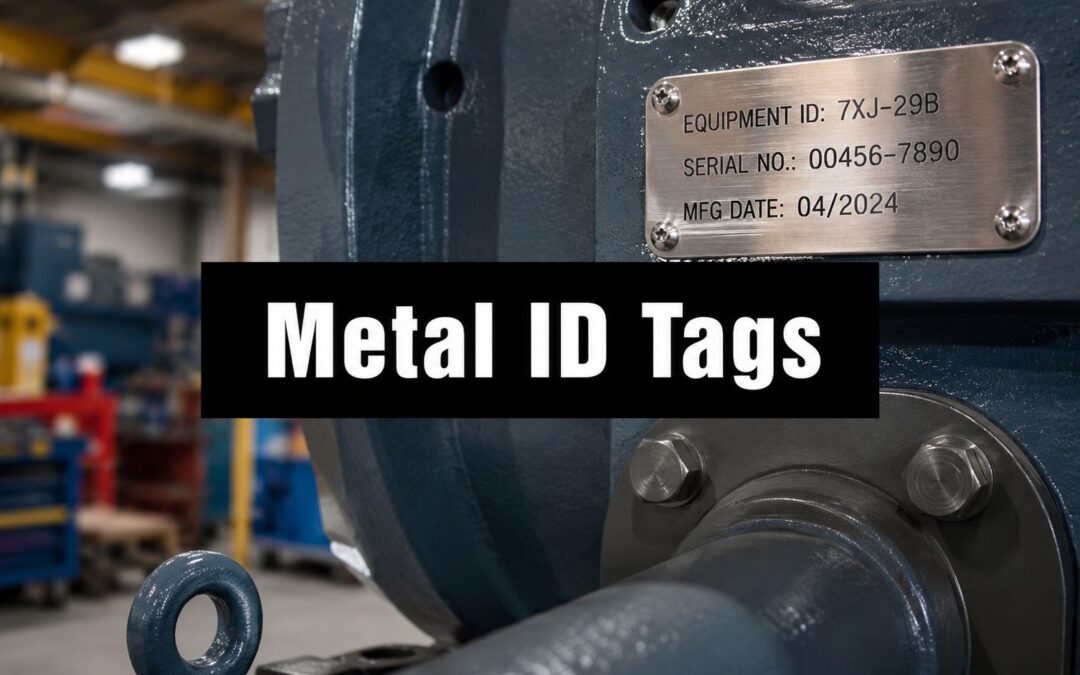
You're on the floor with a tag that's unreadable, a maintenance record that no longer matches the asset, and a supervisor asking why the pump, the panel or the hire unit can't be traced cleanly. That's the job of metal identification tags equipment, they keep the physical asset tied to the inspection, service and compliance trail when stickers, paint marks and handwritten notes have already failed. In Australian conditions, that means choosing a tag that survives the environment first, then the workflow, then the paperwork.
A good tag isn't decoration. It's the persistent identifier that follows the asset through washdown, vibration, outdoor storage, rework and audit checks. If you treat it as a branding exercise, you'll replace it early and pay twice.
Why Metal Identification Tags Matter on Real Equipment
A failed tag usually shows up at the worst moment. A fitter needs the serial on a pump, the label has been scoured off by cleaning, and the only thing left is a faint stain where the plate used to sit. A compliance check then turns into a scavenger hunt because the asset no longer maps cleanly to the register.
That's why metal identification tags equipment are not just labels. They are the stable link between a physical item and the records built around it. WorkSafe Victoria requires plant to be identified by a unique number or code where people could be exposed to risks from the plant, and to use that identifier consistently across inspection and maintenance records, which makes the tag part of the control system, not an accessory. See also what asset tagging means in practice.
What the tag has to do in the field
A tag on a real asset has to survive dirt, oils, cleaning chemicals, ultraviolet exposure and hurried handling. It also has to remain legible from a sensible distance, because if someone has to guess at a serial number, the system has already lost its value.
A tag that looks fine at installation but can't be read six months later is a failed control, not a finished job.
For fleet operators, maintenance teams and hire yards, the useful standard is simple. The tag should stay with the asset, carry the identifier people use, and still be readable after the environment has done its worst. If you're using digital inspection tools, a clean physical identifier becomes even more important, because the record needs a stable bridge from the screen to the machine. A practical example is capture vehicle defects digitally, where the physical identifier has to line up with the report every time.
The old habit of painting numbers on equipment is too fragile for most serious jobs. Metal gives you permanence, and permanence is what inspection systems depend on.
The Three Decisions That Drive Every Tag Specification
Every usable spec comes down to three choices. Pick the substrate, choose the marking method, then decide how the tag will be fixed to the asset. If those three are wrong, the rest of the order won't save you.

Start with the substrate
The metal itself sets the ceiling for durability, appearance and cost. A lightweight indoor asset can be tagged very differently from a coastal pump skid or a medical washer that gets blasted daily. If the substrate can't survive the environment, nothing else matters.
Then choose the mark
The marking method determines readability, detail and permanence. Laser engraving, stamping and etching each leave a different kind of mark, and that changes how the tag behaves under abrasion and cleaning. Fine codes need a process that holds detail, while a simple asset number can tolerate a rougher finish.
Finish with attachment
How the tag is fixed matters as much as what's on it. A perfectly engraved plate that comes loose after a month is useless. Mechanical fasteners, adhesives, cable ties and weld-on studs all solve different problems, and the wrong one usually fails in a very predictable way.
Practical rule: choose the material for the environment, the marking method for the data, and the fixing method for the surface. If one of those three is compromised, stop and redesign the spec.
That's the mental model buyers should use before they ask for quotes. It keeps the conversation grounded in service life, not samples.
Choosing the Right Metal for Australian Conditions
Australian buyers usually end up choosing between three sensible substrates, and each has a clear lane. Anodised aluminium suits lighter indoor labelling. 316 stainless steel suits washdown, outdoor and corrosive service. Coated brass still has a place for legacy assets and decorative work, but it is rarely my first choice for harsh service.

Why coastal exposure changes the answer
Salt air is not a niche issue in Australia. The Australian Bureau of Statistics reported that around 86% of Australians lived in coastal areas in the 2021 Census, which means corrosion risk sits inside normal procurement, not on the fringe. That matters for equipment mounted near ports, treatment plants, warehouses, schools and hospitals, because the surrounding air can be enough to shorten the life of a weak tag.
If a tag sits anywhere near marine air, specify for corrosion first and appearance second. A plate that looks fine in the store room but pits, stains or lifts in service has already failed.
What I would specify by environment
For manufacturing, anodised aluminium works well where the tag is inside, protected and read by people on the floor. It is efficient, light and usually enough for clean internal assets. Keep the finish simple and the layout clear.
For utilities and outdoor infrastructure, I would move to 316 stainless steel without hesitation. That is the substrate I trust when the tag faces washdown, spray, weather and rough handling. If the site is exposed, do not save a small amount on material and pay for replacement later.
For a specification benchmark, the Endress+Hauser data sheet for a durable on-metal tag lists 316L stainless steel, 59 × 30 × 0.8 mm, IP66/68, -55°C to +80°C, salt-spray and seawater resistance verified to 240 h, and UV resistance above 4 gray scale (Endress+Hauser data sheet). That is the sort of baseline buyers should expect when washdown or weather is in play.
For healthcare, stainless is usually the safer call because cleaning regimes punish weak substrates quickly. Coated brass can still work where appearance matters, but I would keep it for lower-stress, lower-exposure applications. Hospital tags fail when the coating lifts or the surface gets attacked by repeated cleaning, so specify the metal for the cleaning method, not for the brochure.
If the application also needs on-metal RFID, use that only where the asset really benefits from scan speed, batch reading or hands-off capture. The HID IronTag specifications show an industrial RFID tag built for harsh service, with up to 4 m read distance on metal, 902–928 MHz operation, -40°C to +85°C service and IP68 protection (HID IronTag specifications). That kind of tag belongs on assets where the read method matters as much as the metal.
For readers who are still comparing substrate options, the quickest way to decide is to separate indoor identification from exposed service. This comparison chart of metal suitability, durability, and maintenance needs in Australian weather conditions makes the trade-offs plain.
Engraving and Marking Methods Compared
The marking method should match the information density and the environment. Don't overcomplicate a simple asset number, but don't under-spec a label that needs machine-readable data and long-term readability.

What each process actually does
Laser engraving removes or alters the surface without contact. That's why I favour it for small serials, variable data and clean high-contrast marks, especially when the substrate needs to stay intact.
Mechanical stamping gives a blunt, durable impression and still has a place on simple plates, but it's less flexible for fine graphics and compact layouts. Chemical etching can produce clear marks, but it introduces another process step and usually isn't my first pick for fast industrial turnaround.
Printed overlays look neat on day one and then struggle in real service. Adhesive systems are vulnerable to heat, solvents, abrasion and cleaning, so I treat them as a short-life option unless the environment is controlled.
Where laser output wins outright
If the tag needs variable data, a tight layout or a small batch turned quickly, laser engraving wins on control and repeatability. It also suits marks that need crisp contrast on a metal surface without stressing the substrate, which is exactly why I'd use a Trotec Laser workflow for industrial tags. In the same vein, laser engraving on metal is the process I'd point a buyer to when they want permanent detail rather than a printed surface that can fail.
| Method | Durability | Design flexibility | Best for |
|---|---|---|---|
| Laser engraving | High | High | Serial numbers, codes, small runs |
| Mechanical stamping | High | Low | Simple IDs, rough handling |
| Chemical etching | Medium to high | Medium | Detailed marks, controlled production |
| Printed overlays | Low to medium | High | Short-life or sheltered uses |
Attachment Options That Survive the Job
A tag is only as good as the way it's fixed. I've seen excellent plates fail because someone chose a fastening method that didn't match vibration, cleaning or surface shape. That's a specification problem, not a manufacturing problem.
Match the fix to the failure mode
Rivets and screws are the safest default for many assets because they give a direct mechanical hold. They can loosen under vibration if the installation is poor, so they need proper hole placement and a sensible substrate.
Structural adhesives suit clean, flat surfaces where drilling isn't allowed, but they dislike repeated washdown and the wrong chemistry. If the asset sees aggressive cleaning, I prefer a mechanical fix.
Cable ties are only worth considering for temporary tags or curved surfaces where the tag may move later. Outdoors, UV exposure can make them brittle over time, so they're not a life-of-asset answer.
Weld-on studs belong on heavy plant where the attachment point can be permanent and the asset justifies that level of commitment. They're strong, but they do demand the right fabrication environment.
If the asset gets hot, wet, scrubbed or vibrated, assume the attachment will be the first point of failure and specify accordingly.
For mixed industrial sites, I'd rather over-spec the fix than deal with a missing tag later. The tag should outlast the install job that put it there.
Custom metal asset tags can be built around the surface you've got, which is what matters when you're tagging curved housings, panels or equipment that can't be altered easily.
Standards and Compliance Your Tag Should Quietly Meet
Compliance should be designed into the tag, not added as a separate paperwork exercise. If the identifier isn't durable, consistent and readable, the register won't stay trustworthy for long.
What the tag has to support
For equipment programs in Australia, the practical requirement is usually straightforward. The asset needs a unique identifier that people can use in inspection and maintenance records, and the tag needs to keep that link intact over time. That's why I think about substrate, marking and attachment as compliance variables, not just manufacturing choices.
The clearest compliance benchmark in the material I reviewed is the DIN SPEC 91406 style stainless tag profile, because it shows how serious specifications describe service conditions rather than relying on vague claims. 316L stainless steel, sealed ingress protection, low and high temperature operation, and resistance to salt and seawater all tell a buyer what the tag can survive before it reaches the plant.
Where buyers usually get caught
The mistake is buying a tag that looks compliant on day one but can't survive the actual environment. A clean number plate that fades, peels or corrodes stops supporting audits, electrical records and healthcare traceability. A tag that can't be cleaned properly can also become a maintenance nuisance in facilities where hygiene matters.
I'd treat the tag as part of the controlled record set. If the identifier changes, disappears or becomes unreadable, the compliance trail weakens even if the machine itself is fine.
Laser-Engraved Plates or On-Metal RFID Tags
A bad spec here causes pain later. A laser-engraved plate is the better fit when crews need a permanent visible identifier and the job still depends on human-readable checks. An on-metal RFID tag earns its place when the site needs faster scanning, tighter inventory movement and scan-based maintenance across a larger asset base.

Choose visible metal when the process is simple
If technicians read the label, write the number down, and move on, a laser-engraved plate is the cleaner option. It is cheaper to specify, easier to inspect, and it does not bring readers, middleware or extra training into the workflow. In many manufacturing yards and utilities, that is still the right call.
It also suits harsh sites where the failure mode is damage to the visible identifier, not a need for digital tracking. Coastal equipment, washdown areas and plant-floor assets still need a mark that stays legible after cleaning, abrasion and handling. If the team only needs a dependable number on the asset, keep the tag simple and make the engraving permanent.
Choose RFID when movement is the problem
If the site is constantly reconciling stock, parts or equipment location, RFID makes more sense. The tag supports faster reads where manual scanning slows the job, and the Australian industrial metal RFID examples show the kind of resilience needed on conductive surfaces, with sealed protection and long-range performance on metal, as noted in the substrate durability discussion above.
The freight and logistics sector's role in Australia's economy is one reason connected tracking keeps gaining ground in infrastructure-heavy operations, because traceability matters when assets keep moving through many hands (Australian freight and logistics strategy). The same logic now shows up in maintenance planning, inventory control and predictive upkeep in car factories, where identification has to support a wider digital workflow.
My blunt recommendation
Use laser-engraved metal when you want certainty, low complexity and long life. Use on-metal RFID when the asset base is large, movement is frequent and the business value comes from scan speed and system visibility, not just a visible number on the plate.
For buyers who still want a vendor-spec anchor, the point is simple. Check the environment first, then decide whether the tag needs to survive as a label or function as a data carrier. That is the fork in the road.
Specification Checklist and How Evright Industrial Delivers
A purchase order should read like a build spec, not a wish list. Start with the substrate, name the marking method, define the attachment, set the data content, and ask for the compliance evidence that matches the environment. Leave out any one of those items and the quote is incomplete.
What to put in the spec
- Substrate: state whether the job calls for anodised aluminium, 316 stainless steel or another metal suited to the site.
- Marking method: require laser engraving, stamping or etching by name, not just “tag”.
- Attachment: specify rivets, adhesive, studs or another fixing method that matches vibration, cleaning and surface shape.
- Data content: include serials, asset numbers, barcodes, QR codes or RFID compatibility if the workflow needs them.
- Compliance evidence: ask for material and environmental suitability, not just a sample photo.
- Service expectation: define the environment the tag must survive, then judge the spec against that.
That checklist is the difference between a tag that looks fine in a proposal and one that keeps working in the field. I'd rather see a narrow, realistic spec that the supplier can execute properly than a broad one that gets diluted at manufacturing time.
Evright Industrial, the industrial division of evright.com, handles metal identification work through laser machinery that produces consistent, high-contrast marks with fast turnaround and energy-efficient production. For buyers who want a practical path from spec to finished tags, that means one shop can take the metal, the marking requirements and the mounting details and turn them into a usable asset label system.
If you need metal identification tags for equipment that will survive Australian conditions, start with the environment and work backwards from the failure you're trying to prevent. Send your specification to Evright Industrial and ask for a tag build that matches the substrate, marking method and attachment your site needs.
Recent Comments