

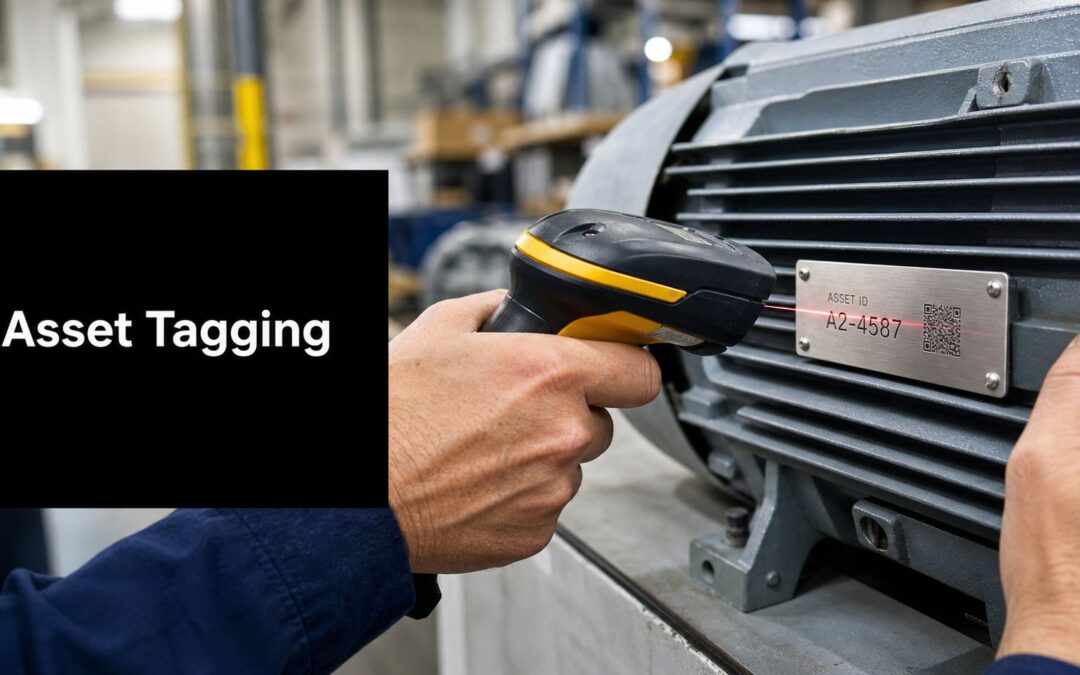
Asset tagging is the practice of attaching a durable, organisation-controlled label to equipment so it can be scanned and tied to a digital record. The manufacturer's serial number is still there, but it usually belongs to the maker, not to your site, your audit trail, or your maintenance system.
You can think of it as creating a second identity for every item you care about, one that your team controls from purchase to disposal. In Australian facilities, that extra identifier is what turns a loose item of gear into an asset you can track, verify, maintain, and account for with confidence.
The Core Idea Behind Asset Tagging
A facility manager usually reaches for asset tagging when the spreadsheet starts drifting away from reality. A pump sits in one bay, a laptop has been reassigned twice, or a steriliser has a serial number but no fast way to match it to the maintenance history. The problem is rarely that the asset has no identity, it's that the identity isn't built for your organisation's workflow.
Manufacturer serial number versus organisation asset tag
The serial number comes from the factory. It identifies the product as built, but it does not automatically support your internal processes, your site codes, or your audit structure. Asset tagging adds a company-controlled label that links the item to a record you can scan, update, and query across sites and teams, which is why it matters in multi-site Australian operations where consistency is everything. For readers who also want the broader maintenance context, fixed asset management guidance shows how tagging sits inside the larger control framework.
The practical difference is simple. If two similar pumps move between depots, contractors, and maintenance bays, the organisation tag keeps each one distinct in your system even when the manufacturer details look identical. That is also why a proper tagging policy matters, because the policy defines how tags are created, applied, maintained, and retired across the whole asset lifecycle, not just at installation time (asset tagging policy guidance).

Practical rule: if your team needs to scan it, audit it, maintain it, or hand it over, it needs an identifier that belongs to your organisation, not just the manufacturer.
A useful reference point is the DPP Grid resources hub, which helps frame how physical items can connect to structured digital records. Asset tagging follows the same logic in a plant, hospital, or depot, one physical label, one record, one source of truth.
How Asset Tagging Works in Practice
Asset tagging becomes useful the moment the label does real work every time someone touches the asset. The process goes beyond sticking on a tag. It is a chain of actions that turns a physical object into a trackable record inside your system.
The four-step workflow
A site first assigns a unique ID in asset tracking software or a CMMS. That ID is then encoded into a physical tag, usually as a barcode, QR code, or RFID element. Staff scan it during check-outs, audits, maintenance, or transfers. Each scan writes a time-stamped event into the asset record, building a history of location, custody, and condition, as described in the asset-tagging workflow from Camcode.
That event trail is the value. A label by itself is just a label, but a scan creates an operational record that the maintenance team, auditor, or supervisor can use later.
A tag only earns its keep when the scan updates the record.
A pump that moves from a manufacturing plant to a contractor's van and then into a maintenance bay shows the idea clearly. The tag lets staff confirm it is the same unit at each handover. If the pump is checked in, repaired, and returned, the system keeps that history without someone retyping serial numbers by hand.

For facilities that want a clearer view of how the scan data connects to location tracking, the Fleetalyse GPS tracking guide 2026 shows the same custody-and-location logic in a fleet setting.
Why the tag has to survive daily use
A scan process fails quickly if the tag cannot be read. Australian industrial sites need labels that stay legible through dust, handling, cleaning, and time, because a failed tag breaks the chain of traceability. That is why the physical design matters as much as the software behind it.
A tag that survives the plant floor keeps the record alive. Metal labels built for harsh environments are often specified for that reason, including custom metal asset tags from Evright Industrial, where the marking has to remain readable after repeated contact, washdowns, and exposure to heat or abrasion.
Once the tag stops holding up, the system loses confidence fast. Staff begin guessing, records drift, and the asset history becomes harder to trust.
Common Tagging Technologies and Materials
A tag only works if it suits the way the asset is used. A laptop in an office, a steriliser in a hospital, and a switchboard on a noisy plant floor all need different levels of durability, readability, and scanning convenience.
Choosing the technology to match the job
Barcodes are the simplest starting point. They are low cost, easy to scan, and a good fit for assets kept indoors and checked one at a time. QR codes carry more machine-readable information, so staff can move from a label to a digital record quickly with a phone or handheld scanner.
RFID works differently. It suits sites where teams want to read many items quickly, sometimes without direct line of sight. That matters in warehouses, depots, and busy industrial areas where an asset may be hard to reach or turned the wrong way. Technical guidance for harsh-environment RFID tags shows why they are selected for demanding sites, with UHF EPC Class 1 Gen 2 operation at 860 to 960 MHz, read range of about 20 ft, or 6.09 m, operating temperatures from -40 to 85°C, storage to 90°C, and Type 4X/IP68 ingress protection, plus 316 stainless-steel mounting hardware and PPS housing. Those features support better read reliability when heat, moisture, and physical wear would put a weaker tag out of service. Similar hardware details are set out in the Emerson technical specification.
Laser-engraved metal labels sit in a different category again. The mark is formed by changing the material itself, rather than printing a layer on top that can peel, fade, or smear. That makes laser engraving a practical choice where abrasion, chemicals, or UV exposure would quickly damage a standard label. For a grounded reference point on durable plates, custom metal asset tags show how metal construction is used for long-life identification in harsh workplaces.
Matching Tag Technology to Environment
| Technology | Best For | Limitations |
|---|---|---|
| Barcode | Office equipment, controlled indoor sites | Needs line of sight and regular handling |
| QR code | Quick access to digital records, mixed-use assets | Still depends on scan visibility |
| RFID | High-volume tracking, industrial sites, faster reads | Higher system complexity and hardware cost |
| Laser-engraved metal | Harsh environments, long-life identification | Less suited to low-cost, disposable items |
The choice also comes down to the life of the tag itself. asset tracking best practices points to the same rule, if the label is meant to stay with a desk item for a short time, a simple printed code may be enough. If the label has to stay readable on a plant floor, the material and marking method need to do more work.
Where Asset Tagging Pays Off Across Australian Industries
Asset tagging shows its value most clearly when the workplace is messy, distributed, or heavily regulated. Australian organisations don't all need the same label, but they do need the same outcome, reliable identification that survives the conditions on site.
Manufacturing, healthcare, and essential services
In manufacturing, tagged equipment helps teams keep plant floors audit-ready and reduce confusion when machines, tools, and spare parts move between lines. A clear label makes cycle counts faster and supports maintenance histories that stay attached to the right asset, even after it has changed bays or shifts.
In healthcare, the benefit is traceability under pressure. Medical equipment has to be identifiable during cleaning, storage, transport, and maintenance, and tag durability matters because sterilisation and chemical exposure can destroy weak labels. In electrical contracting and essential services, tagged switchgear, transformers, and field tools need to survive depot handling and remote site work, where staff may not have the luxury of chasing a missing identifier.
If the label can't survive the site, the record won't survive the audit.
Government, infrastructure, and memorial applications
Government and infrastructure teams often manage assets across multiple facilities, so the core need is consistency. Long-life tags help staff verify ownership, location, and responsibility across dispersed networks, which is valuable when accountability matters as much as identification.
The surprising crossover is memorial work. The same laser engraving process used for industrial asset labels can produce plaques that need lasting legibility and a clean finish. Funeral homes and memorial planners often care less about inventory control and more about permanence, but the material logic is the same, the mark has to endure.
For readers comparing practical uses, the asset tracking overview from InvGate is useful background because it shows how tracking follows assets through their lifecycle, from acquisition to retirement.
Best Practices for Durable, Compliant Tags
A tag only helps operations if it stays readable after real site conditions get to work on it. Once a label fades, lifts, or wears through, the problem stops being cosmetic and starts affecting maintenance, inspections, and audit records.
Start with the material, then match the environment
Choose the label material for the conditions it will face. Lamacoid and anodised aluminium suit many identification jobs, while stainless steel and engineered polymer films are a better fit where chemical exposure, abrasion, heat, or outdoor weather will attack a weaker surface. The ANACONDA field-equipment standard shows how physical design supports day-to-day use, because it calls for a unique Asset Tag ID, a QR code, and a short description on a 1" × 3" tag made from 0.032" anodised aluminium (Metalphoto) or 0.0625" Lamacoid (ANACONDA specification).
That mix is practical. The QR code connects the asset to its digital record, while the human-readable ID and description still make sense during offline inspections, maintenance checks, or handover work when scanners are not the first tool people reach for.
Build in attachment, placement, and scan reliability
Adhesive-backed labels can work well on smooth indoor equipment, but rough, curved, or contaminated surfaces often need mechanical fixing instead. Surface preparation matters just as much, because a label applied to dust, oil, or residue will not stay in place for long. Placement matters too, since labels located in high-wear areas get scraped, cleaned, and knocked more often, which shortens their life and makes scanning harder.
Rule of thumb: if staff have to bend, crouch, or clean around a tag every day, it needs a tougher substrate and a safer location.
Rugged industrial tags are built for that kind of treatment. A useful reference is Avery Dennison's RFID tag overview, which shows how industrial tags are designed around durability, attachment choice, and reliable reading in demanding environments. That is the sort of benchmark worth using when deciding whether a label belongs on a plant asset, a workshop tool, or equipment that moves between sites.

ROI, Compliance, and Risk Reduction
Asset tagging is often approved as a small procurement item, but it behaves like a control system. The return comes from fewer errors, cleaner audits, and less time spent reconciling what's on the floor with what's in the register.
A study cited in industry material reports that asset tagging systems can improve inventory accuracy from an average of 63% to over 95% after implementation (industry article). In practical terms, that means fewer missing items, fewer manual corrections, and less time wasted chasing mismatches across sites or departments. In distributed Australian operations, that kind of uplift matters because a bad count doesn't stay confined to one room, it spreads into maintenance planning and procurement.
The compliance angle is even sharper. Healthcare, utilities, and government teams depend on a clean audit trail, and a failed tag breaks that trail at the physical layer. Once the tag can't be read, the asset record loses credibility, no matter how good the software is.
Bottom line: durable labelling is a risk-control decision, not a cosmetic one.
Good tagging also supports better maintenance histories. When scans create consistent event records, teams can see where an asset has been, who used it, and what condition it was in when it changed hands. That makes the tag itself part of the evidence chain, which is why label durability should sit alongside software and process in the ROI conversation.
Implementing a Tagging Program That Lasts
A tagging program lasts when the policy is written before the labels are ordered. Start by deciding what belongs in the asset register, how IDs are assigned, who applies tags, and what happens when a label is damaged or an asset is retired. That policy should also cover tag format, placement rules, and who approves exceptions.
A sensible rollout starts small. Pick one site or one equipment class, such as pumps, laptops, or switchgear, then test the workflow from ID creation to scan and maintenance update. That pilot shows where the process breaks before you scale it across the broader register.
The choice of tag material belongs in that first pilot as well. A serial number already identifies the item at the manufacturer level, but the asset tag links it to your internal record, so the label has to survive the same environment as the equipment. In Australian plants, depots, and workshops, that usually means heat, washdowns, dust, abrasion, and frequent handling. For teams comparing setup options, the asset tracking best practices guide is a useful reference point.
If your program needs physical labels that can survive those conditions, Evright Industrial produces laser-engraved metal asset labels and related marking work for equipment identification and safety signage. For budgeting and capital planning, the Section 179 lab write-off with Labs USA is a reminder that equipment decisions and identification decisions often sit in the same approval cycle. Laser engraving matters because it keeps the identifier readable after the printed sticker would have worn off, peeled back, or become hard to scan.
A good pilot tells you whether your tags survive the site, not just the design review.
FAQ
Do asset tags replace serial numbers? No, they complement them. The serial number identifies the item from the manufacturer, while the asset tag links it to your internal record and workflow.
Do all tags need to be metal? No. Office equipment can often use simpler barcode or QR labels, but harsh or safety-critical environments usually need more durable materials.
Is scanning enough on its own? Not quite. Scanning works only when the ID, tag, software, and maintenance process are all kept in step.
Recent Comments