

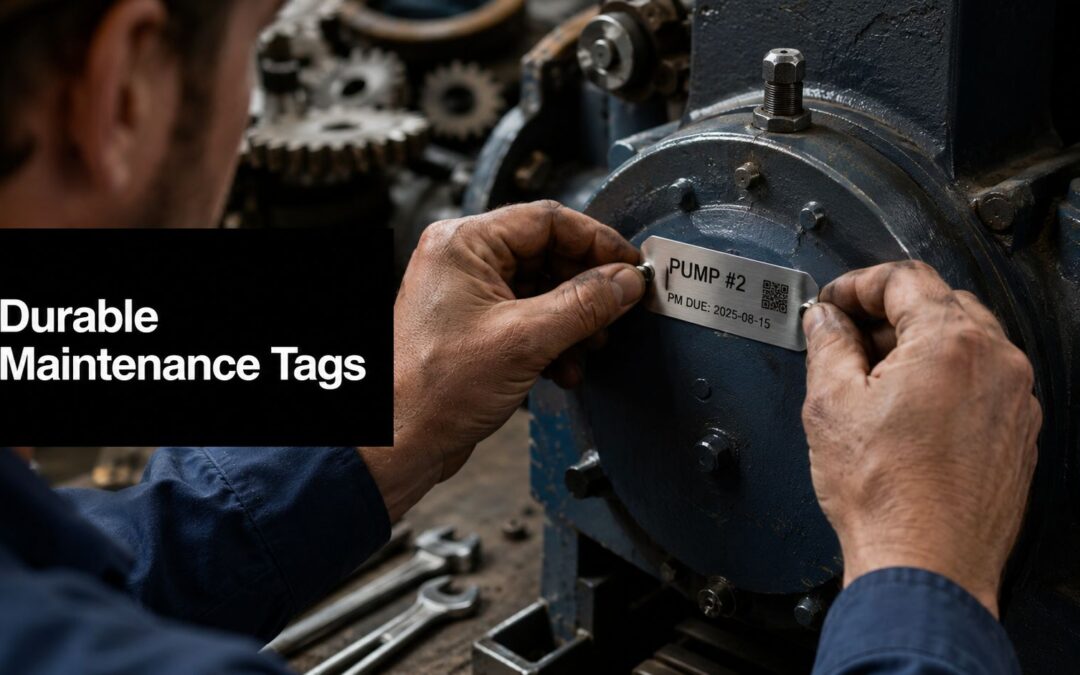
A technician reaches a packaging line during a busy shift and finds a familiar problem. The conveyor's asset plate is still attached, but its maintenance tag has peeled away, faded under washdown, or snapped from its fixing point. When an auditor asks for the last inspection record, production stops while the team searches the CMMS, checks old paperwork, and confirms which department owns the equipment.
The missing tag may have cost very little, but it can create a serious traceability problem. In Australia, equipment maintenance tags are part of a broader control system, linking the physical asset to inspection intervals, service records, isolation procedures, and accountable people. The reliable approach treats every tag as three connected decisions: substrate, marking method, and fixing method.
Why a Missing Maintenance Tag Stops the Line
The line manager remembers that the conveyor was tested recently. The maintenance supervisor is confident the record exists. The technician can probably find it after searching by location, serial number, or asset description. None of that helps much when the auditor needs to verify the equipment at the point of use and the physical evidence is missing.
A durable tag gives the technician an immediate connection between the machine and its record. If that connection fails, the organisation may still have the information in its digital system, but the asset becomes difficult to identify with confidence on the floor. A similar issue appears in routine maintenance work, where practical guidance such as this handy preventative maintenance info helps teams organise servicing before small identification or condition problems become operational disruptions.
The tag is a system, not a sticker
A maintenance tag earns its place through three layers:
- Substrate: The base material must suit heat, ultraviolet exposure, chemicals, vibration, and washdown.
- Marking method: The information must remain readable, whether it's applied by print, engraving, or another process.
- Fixing method: The attachment must hold the tag in its intended position for the equipment's service conditions.
A printed adhesive label may work inside a clean control room. The same label can fail quickly beside an oily motor, a hot conveyor, or a high-pressure washdown zone. A strong metal substrate can also fail if it's attached with an unsuitable adhesive or a fragile tie.
Practical rule: Specify the tag, its marking, and its fixing as one engineered item.
Why field evidence still matters
The CMMS is valuable, but it may be offline, inaccessible from the work area, or difficult to search during an audit. The physical tag acts like a small field record. It tells the person standing beside the asset whether the equipment has been inspected, when the next check is due, and whether the item can remain in service.
That's why a missing tag can stop work even when the maintenance database is accurate. The problem isn't just poor labelling. It's the loss of a visible control that supports safe decisions in real time.
What Equipment Maintenance Tags Are
An equipment maintenance tag is a physical record fixed to a machine, tool, instrument, or other maintainable item. It connects the asset in front of a worker with its inspection, test, calibration, or service history. A dry-cleaning ticket offers a useful comparison. It stays with the garment through the service cycle and shows what happened and when.
The tag supports the maintenance register or CMMS rather than replacing it. Its practical role is to help a technician match the physical asset with the correct digital or paper record, especially when several similar items are nearby.

Three common tag types
Inspection and test tags show that a defined check has been completed. For portable electrical equipment covered by the Australian in-service testing regime, the process includes visual inspection, electrical testing, and a durable compliant tag. The tag can identify the testing organisation or technician, test date, next test date, and unique asset identification number.
In-service and out-of-service tags show the equipment's immediate status. An in-service tag supports continued use after the required check. An out-of-service tag tells workers not to use the item. Failed equipment must be marked “DANGER / OUT OF SERVICE” and removed from service immediately. The Australian test and tag process, including these tag details and status requirements, is explained in Australian test and tag standards explained.
Calibration tags apply to measuring instruments where accuracy affects the work. They identify the instrument and make its calibration status visible, including a due date or reference to the calibration record. A scale, electrical tester, pressure gauge, or medical instrument may therefore need a different layout from a portable power tool.
Asset labels and maintenance tags are different
An asset label mainly identifies ownership, asset number, barcode, or location. A maintenance tag records changing service or compliance evidence that must be updated according to an inspection or calibration schedule.
Sites may also use lock-out tags, inspection-pass tags, warning tags, and isolation notices. The required combination depends on the hazard and work process. A barcode can identify the machine in the asset register, while a separate maintenance tag shows its current inspection status.
The same principle applies across dispersed infrastructure. Teams delivering broadband construction services also need consistent asset identification so field workers can connect physical equipment with reliable records.
Australian Standards That Shape the Tag on the Asset
A maintenance tag is the visible control point between an asset and its compliance record. Under the AS/NZS 3760 regime for in-service electrical safety, portable equipment is visually inspected and electrically tested before a durable tag records the result. The tag normally identifies the technician or testing organisation, test date, next test date, and unique asset identification number. The standard should shape the tag specification, not be treated as an afterthought.
Those fields let a worker assess the equipment at the point of use, even when the full record sits in a remote system. If testing fails, the equipment must carry “DANGER / OUT OF SERVICE” and be removed from service immediately, as noted earlier.
Reading the tag as an auditor would
An auditor or safety officer should be able to answer five questions without searching through paperwork:
- Which asset is this? The unique identification number should match the asset register.
- Who performed or organised the test? The technician or testing organisation provides accountability.
- When was it tested? The test date identifies the latest inspection event.
- When is the next test due? The next-test date supports control of the testing interval.
- What is the current result? The tag or associated status record should distinguish equipment that may remain in service from equipment requiring isolation.
Colour can speed up that first check. Australian workplaces commonly use blue for in-service equipment, red for out-of-service equipment, and yellow for inspection tags. The exact colour convention must be controlled and communicated on each site. Colour supports quick triage, while the written fields provide the evidence.
Required fields and their evidence
| Tag Field | Standard Reference | What It Proves |
|---|---|---|
| Technician or testing organisation | AS/NZS 3760 guidance | Identifies who completed or recorded the test |
| Test date | AS/NZS 3760 guidance | Shows when the latest inspection and test occurred |
| Next test date | AS/NZS 3760 guidance | Shows when the next scheduled check is due |
| Unique asset identification number | AS/NZS 3760 guidance | Connects the physical equipment to its controlled record |
| Failure status, including “DANGER / OUT OF SERVICE” where applicable | AS/NZS 3760 guidance | Communicates that failed equipment must not remain in service |
The WHS Act 2011 also forms part of the operating context. It established a unified safety framework across Australian jurisdictions and introduced significant penalties for failures to manage workplace hazards, including up to $50,000 for an individual PCBU and up to $500,000 for a body corporate under Category 2 offences (Australian safety tag guidance).
That requirement affects the whole tag system. The substrate must remain legible, the marking must resist the service environment, and the fixing method must keep the tag attached until the next review. A faded or detached tag can break the connection between the asset and its controlled record, even when the paperwork remains accurate.
Choosing the Right Tag Material for the Environment
Material selection should begin with the environment, not the catalogue price. A tag used indoors on a clean, low-contact surface may need only a light-duty solution. A tag on a washdown pump, outdoor switchboard, or vibrating motor needs a substrate and fixing method that can tolerate the same conditions as the asset.
Three choices appear frequently in industrial procurement:
- Adhesive plastic laminates: Fast to apply and suitable for cleaner, lower-exposure locations. Their adhesive and printed surface are vulnerable to heat, solvents, abrasion, and edge lifting.
- Anodised aluminium: Lightweight, suitable for outdoor use, and well suited to laser marking. It offers a practical middle ground for equipment exposed to UV and moderate chemical conditions.
- Stainless steel: A strong choice where abrasion, moisture, washdown, and aggressive contaminants create a high risk of tag loss or illegibility. For high-risk assets, engraved metal with permanent fixing is the stronger specification (South Australian Water asset-labelling standard).
Compare the service conditions
| Substrate | Heat resistance | UV/weather | Chemicals | Vibration | Washdown |
|---|---|---|---|---|---|
| Adhesive plastic laminate | Limited by adhesive and face material | Suitable for controlled exposure | Limited against aggressive solvents | Vulnerable to edge lift and peel | Vulnerable where water reaches the adhesive |
| Anodised aluminium | Suitable for many industrial locations | Strong outdoor option | Suitable for moderate exposure | Requires suitable mechanical fixing where movement is present | Suitable when installed away from direct damage |
| Stainless steel | Strong option for demanding service | Strong outdoor performance | Strong choice for harsh exposure | Performs well with rivets, wire, or engineered ties | Well suited to repeated cleaning and washdown |
A dairy clean-in-place area shows why this matters. A printed polyester label can lose its usefulness when heat, detergents, water pressure, and repeated handling attack the print or adhesive. A lasered stainless tag removes the ink layer from the equation, but it still needs an appropriate fixing method and accessible placement.
Procurement test: Ask what will attack the tag first, the marking, the material, the adhesive, or the fixing hole.
For practical asset-label formats and specifications, procurement teams can review Evright's asset tracking labels and compare the required information with the exposure at each asset location. Don't overspecify every item. Use lighter-duty adhesive tags for short-cycle or low-exposure assets, and reserve permanent engraved metal for equipment where traceability must survive the operating environment.
Substrate Marking Method and Fixing as One System
A tag specification often fails because the buyer chooses the material first and treats marking and fixing as installation details. That sequence separates decisions that must work together.
The system has three parts:
- Substrate: The physical base, such as anodised aluminium, engraved plastic, or stainless steel.
- Marking method: The way information is applied, including thermal transfer, screen printing, or laser engraving.
- Fixing method: The attachment, such as adhesive, cable tie, rivet, wire, or chain.
A stainless steel tag with a weak plastic cable tie may still disappear from a vibrating machine. A thin polyester label pop-riveted to a motor may remain attached, but its face material can still smear, fade, or degrade. Matching only one component doesn't create a durable identification system.
Fixing choices must follow the asset
Australian utility specifications treat attachment as part of the engineering requirement. South Australian Water allows labels to be attached with rivets or with wire and connector or cable-tie fixings, while other Australian infrastructure requirements call for labels to be permanently fixed or placed immediately adjacent to the equipment, clearly visible from the normal access position, and mechanically fixed rather than relying on double-sided tape (asset identification requirements).
That produces different sensible combinations:
- A stainless tag on an isolator may use permanent rivets where removal isn't expected.
- An aluminium bar tag on a switchboard may use a stainless cable tie when the tag must remain attached to a cable or accessible harness.
- A small tool tag may use a chain or wire where the asset's shape prevents a flat plate from sitting securely.

Why laser engraving suits permanent tags
Laser engraving is particularly compatible with metal substrates because the marking becomes part of the surface rather than a separate ink layer. The approach is useful for asset IDs, serial numbers, barcodes, QR codes, and dates that must remain readable through routine handling.
The marking still has to meet readability requirements. Australian compliance labelling guidance states that labels must be visible to the unaided eye, with a compliance mark at least 3 mm high and alphanumeric characters at least 1 mm high. It also calls for contrast or raised or engraved marking, plus the brand or trade name, model number, and Regulatory Compliance Mark on a permanent, readily accessible surface (equipment maintenance and service tag guidance).
For a supplier comparison, Evright's laser etching services show how the marking process can be considered alongside the selected substrate and attachment design.
Sector Use Cases from Manufacturing to Healthcare
The same framework produces different tag specifications because each sector exposes equipment to different hazards. A factory motor, a substation asset, a medical instrument, and a food-processing pump may all need traceability, but they don't share the same surface, cleaning routine, or vibration profile.
Four practical applications
Manufacturing: A conveyor motor or packaging-line drive needs a tag that remains readable during vibration, oil exposure, and routine maintenance. Stainless steel or anodised aluminium with laser marking and mechanical fixing gives the technician a stable reference for asset ID and inspection information.
Utilities: Outdoor assets face UV, rain, temperature changes, and difficult access. An engraved anodised aluminium tag can provide a durable identification point, while the fixing method should reflect whether the tag sits on a panel, cable, pole-mounted item, or isolator.
Healthcare: Medical electrical equipment requires careful maintenance and calibration control. Tags must remain legible after repeated cleaning, including wipe-downs with products used in clinical environments. A smooth, permanently marked metal tag or suitable two-ply engraved plastic may be more appropriate than an exposed printed adhesive label.
Essential services: Water treatment and food-processing equipment may encounter moisture, chemicals, abrasion, and regular washdown. These conditions favour stainless steel, particularly where the tag can be secured with rivets, wire, or a chain rather than relying on an adhesive edge.

The same decision logic also applies to mobile plant. A fleet manager reviewing trailer maintenance needs to know not just which trailer is in the yard, but which physical asset corresponds to its service and inspection history. A tag that survives road grime, handling, and outdoor exposure supports that link.
The visual below reinforces the principle: sector requirements change the specification, but the system remains substrate, marking, and fixing.
Trotec Laser is another relevant reference point for procurement teams reviewing laser equipment and marking workflows. Use Trotec Laser machine imagery, rather than mechanical equipment imagery, when illustrating the precision-marking process in educational or product content.
Recommendations for Durable Asset Labelling
A sound procurement decision follows a simple order. Compliance drives the data fields. The environment drives the substrate. The marking and fixing methods complete the system.
For a high-risk electrical asset, the tag may need the unique asset ID, technician or testing organisation, test date, and next-test date required by the applicable AS/NZS 3760 process. A calibration tag may also need the instrument identifier and calibration due date. The exact layout should remain readable from the normal access position and should not obscure manufacturer or regulatory information.
A practical specification
- Use permanent marking: Laser engraving on anodised aluminium or stainless steel removes reliance on surface ink.
- Select the fixing deliberately: Use mechanical fixing where vibration, moisture, or access conditions could defeat adhesive.
- Keep the data controlled: Serialised asset IDs should match the CMMS or asset register exactly.
- Make status obvious: Use the site's controlled colour convention and ensure failed equipment carries the required danger or out-of-service message.
- Inspect the tag itself: Include tag condition in routine maintenance rounds so fading, detachment, and unreadable characters are corrected before the next audit.
Thermal-printed adhesive labels can smear when exposed to hydraulic fluid, while hand-engraved plates can develop weaknesses around poorly formed fixing points. These shortcuts may look acceptable at installation but create avoidable replacement work later.
A Monday morning checklist
- Audit the tags currently installed.
- Record where tags have faded, peeled, cracked, or detached.
- Classify assets by heat, UV, chemical, vibration, and washdown exposure.
- Standardise on one or two suitable substrates instead of allowing uncontrolled variation.
- Confirm the required fields with the safety, maintenance, and asset-management teams.
- Test the fixing method on representative equipment.
- Use a laser-engraving specialist for serialised, traceable production runs.
Evright Industrial can produce laser-engraved asset labels and related equipment identification work, including serialised information suited to maintenance and inspection records. Procurement teams can also use an asset tagging template to organise fields before requesting a production quote.
The practical explanation of how laser engraving supports durable identification is straightforward. A laser machine marks the selected substrate with consistent, repeatable information, while the final tag design still depends on correct material choice, readable fields, and suitable fixing. Trotec Laser machinery is one example of the type of precision equipment used in professional marking workflows.
If your current tags are failing, don't wait for the next audit to expose the gap. Review the asset environment, required compliance fields, and attachment points this week, then ask Evright Industrial to help specify and produce durable laser-engraved equipment maintenance tags. Visit Evright Industrial to discuss asset labels, serialised tags, safety signage, and a marking solution matched to your site conditions.
Recent Comments