

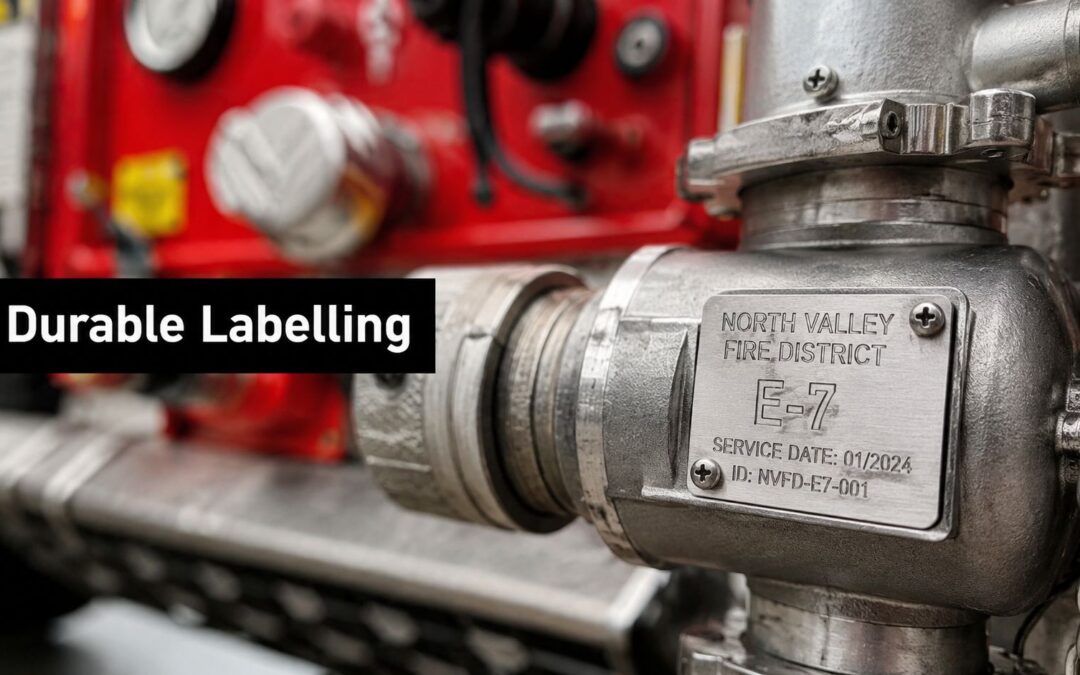
A crew member reaches for a defibrillator during a bushfire response, but the asset tag is faded, the serial reference is difficult to read and the equipment register points to an outdated vehicle location. That failure rarely begins with one dramatic mistake. It starts with a label selected for a clean indoor environment, then exposed to ultraviolet light, heat, solvents, salt, vibration and repeated handling.
Emergency services equipment identification needs to work under pressure, across vehicles, boats, buildings, medical devices and rescue tools. The right approach combines Australian compliance requirements with a marking method chosen for the asset's actual service conditions. A sticker may be adequate for a temporary internal reference. It isn't a sound default for equipment that must remain identifiable through long maintenance cycles or demanding operational use.
Why Scale Changes Everything About Equipment Identification
Western Australia's Department of Fire and Emergency Services reported that its operational fleet comprised over 1,600 vehicles in 2020, including aerial pumpers, urban pumpers, incident control vehicles, rescue utilities, tanker trucks, water carriers, flood rescue boats and marine vessels (WA emergency services vehicle and equipment information). The fleet formed part of a $125 million investment in local emergency services manufacturing, connecting procurement with both response readiness and domestic industrial capacity.
That isn't a uniform fleet. Each vehicle class brings different surfaces, access points, cleaning routines and exposure profiles. A tanker label may face abrasion and mud, while a flood rescue boat encounters water, sunlight and salt. An incident control vehicle may carry communications equipment that needs an accessible, legible compliance mark as well as an internal asset identifier.
A fleet of that size also creates a replacement and maintenance problem. Equipment moves between vehicles, vehicles change roles and components are removed for servicing. Without a consistent identification system, teams end up relying on handwritten notes, local knowledge or labels that only make sense to the person who applied them.
Practical rule: Treat identification as part of the asset system, not as a finishing detail added after procurement.
The same WA programme recorded the distribution of 828 automated external defibrillators, funded by a $1.4 million Emergency Services Levy investment, to bush fire brigades and State Emergency Service units (DFES operational fleet and equipment information). The devices were fitted to fire appliances, SES utility vehicles and flood boats. That deployment shows how medical response equipment now shares operational platforms with pumps, tools, communications units and rescue hardware.
A mixed fleet needs more than a generic asset sticker. It needs durable identifiers, consistent naming, controlled placement and records that connect the physical mark to the responsible service, location and maintenance history. Practical guidance on building that system is available in these asset-tracking best practices.
The shortcut that fails is buying one label type for every asset. Start with the equipment categories, environments and inspection requirements. Then select the substrate, marking method and fixing system.
Navigating Australian Standards for Emergency Equipment Signage
Australian emergency equipment signage falls under different compliance regimes. Start by deciding whether the mark identifies workplace emergency equipment or forms part of a building evacuation system. That choice affects the standard, placement requirements and the permanent marking method you can use.
Use the correct standard as the first filter
For workplace safety signs, WorkSafe ACT identifies AS 1319-1994 as the Australian Standard covering the design and use of safety signs in work environments (WorkSafe ACT signage guidance). It includes emergency information signs that identify or direct people to safety equipment, exits and first aid resources. Teams developing custom safety signs Australia should use this framework before specifying artwork, substrate or fixing details.
Building exit signs and emergency lighting follow a separate path. AS/NZS 2293.1:2018 covers their design, installation and commissioning for buildings, and Standards Australia identifies it as a primary referenced document in NCC 2022 (Standards Australia overview of emergency lighting and exit signs). The National Construction Code requirements for emergency lighting and exit signs require emergency lighting systems to comply with AS/NZS 2293.1. Exit signs must remain clearly visible to people approaching the exit and be installed on, above or adjacent to each required exit.
WorkSafe ACT also notes that AS 1319 excludes internal building exit signs governed by AS 2293.1. An engraved plate identifying a fire extinguisher location cannot substitute for an illuminated exit sign. They may both be called safety signage, but their compliance tests and installation roles differ.
Turn the distinction into a material decision
Apply this decision tree before selecting a marking method:
- Is the item a building exit or part of emergency lighting? Address AS/NZS 2293.1 and NCC requirements first. A suitable-looking plate does not establish compliance, because visibility, installation and system performance also matter.
- Does the sign identify or direct people to workplace emergency equipment? Assess it under the AS 1319 framework, then choose contrast and a surface that stays readable in the actual work environment.
- Is the mark an asset or compliance identifier on equipment? Confirm equipment rules, access needs and maintenance records before specifying a permanent tag.
Keep an equipment identifier separate from an evacuation sign unless the design and installation requirements are deliberately being met as one system. A well-made plate in the wrong position still leaves an operational weakness.
Selecting Materials and Fastening Methods That Survive Real Conditions
Material selection determines whether an identification programme remains useful after years of service. Adhesive labels are quick to apply, but ultraviolet exposure, heat cycling, abrasion and chemical cleaning can attack both the face material and the adhesive bond. They have a place for temporary references or controlled indoor use, but they're a poor default for exposed emergency services equipment.
Anodised aluminium and stainless steel are stronger candidates when the mark must resist solvents, salt spray and repeated contact. Cast aluminium tags can also provide long-lasting service, although installers need to control alignment and fixing carefully. A durable substrate still fails if it's installed where a hose, fitting or protective cover constantly strikes it.
Australian communications compliance guidance provides useful mechanics for permanent equipment marking. It states that compliance labels must be visible to the unaided eye, with the compliance mark at least 3 mm high and alphanumeric characters at least 1 mm high. The label must remain visible through contrast or raised or engraved marking, be a permanent feature on a readily accessible surface, and display the brand or trade name, model number and Regulatory Compliance Mark (Australian compliance labelling guidance).
Those requirements don't automatically make every emergency equipment tag compliant. They do establish a practical baseline for legibility, permanence and access where the rules apply.
| Material | Expected Lifespan | Compliance Risk | Best Use Case |
|---|---|---|---|
| Adhesive polyester or vinyl | Variable, depending on exposure and adhesive | Peeling, fading or loss of information can undermine traceability | Temporary references or protected indoor equipment |
| Cast aluminium | Long service potential with secure fixing | Installation misalignment and surface damage can affect readability | Vehicle and equipment plates requiring a rigid tag |
| Anodised aluminium | Long-lasting engraved contrast when correctly specified | Poor contrast or unsuitable placement can reduce readability | General fleet and industrial asset identification |
| Stainless steel | High resistance to abrasion, solvents and harsh environments | Incorrect fixing or inaccessible placement can defeat the mark | Marine, coastal, exposed and high-contact equipment |
Laser engraving is often a better fit than surface printing because it removes or changes the surface rather than leaving a fragile ink layer. Trotec Laser machines provide the controlled beam, repeatability and detail needed for consistent identification across different tag batches. Evright Industrial uses Trotec laser machinery for precision engraving, with material selection and production controls suited to industrial identification work.
For building-side requirements, electrical contractors should also separate equipment tags from the installation and testing obligations that apply to emergency lighting. DLG Electrical's guidance on emergency lighting installation provides useful context for that distinction. For exposed asset plates, review stainless steel equipment tags before defaulting to an adhesive solution.
Laser Engraving and Marking Best Practices for Durable Identification
Laser engraving isn't automatically durable just because a laser was used. The substrate, settings, mark depth, contrast and final location all determine whether an inspector can read the identifier after the equipment has been cleaned, handled and placed back into service.
Trotec Laser machines are well suited to repeatable emergency services equipment marking because the process can be controlled across production batches. That consistency matters when multiple vehicles or sites need the same character layout, numbering logic and visual hierarchy.

Control the mark before scaling production
Start by testing the intended substrate. On softer metals, excessive depth can remove more material than necessary and produce rough edges. On stainless steel, a balanced setting can preserve surface integrity while keeping characters sharp. Don't approve a sample from a clean bench and assume it represents the installed result.
Use this production sequence:
- Test the material: Mark a sample using the proposed character height, layout and fixing method.
- Apply the cleaning regime: Expose the sample to the detergents, solvents or decontamination process used by the service.
- Inspect under realistic conditions: Check direct light, low light, glare and the viewing angle an inspector will use.
- Lock the settings: Record the approved laser parameters and substrate so replacement tags match the original asset class.
- Verify the record: Match every physical identifier to the asset register before dispatch or installation.
Evright Industrial, a specialised division of evright.com, applies this approach to manufacturing floors, healthcare facilities, essential-service fleets and government infrastructure. Its work includes equipment identification, asset labelling and customised engraved items, supported by Trotec laser machines and material-focused production controls. To understand how the process works, visit evright.com for imagery of laser machines marking materials in practice.
Place the mark where it can do its job
For workplace equipment location marks under AS 1319-1994, prioritise direct recognition and clear direction to the emergency resource. For building exit and emergency-lighting signs under AS/NZS 2293.1, treat visibility to approaching occupants and correct installation on, above or adjacent to the required exit as the governing test.
Don't hide an identifier behind a fitting, under a removable cover or in a shadowed recess. A secondary concealed mark may support service records, but it can't replace the primary identifier that a responder or inspector needs to find quickly.
Placement, Visibility and Maintenance Lifecycle Planning
A permanent mark has no operational value if nobody can see it during an inspection or response. Placement must account for the incident environment, not the conditions in which the tag was designed. Smoke, darkness, glare, protective clothing and hurried movement can all reduce the time available to interpret a label.
For building evacuation systems, the NCC focuses on maintaining a minimum level of visibility along evacuation routes. AS/NZS 2293.1 therefore needs to be considered as a complete emergency lighting and exit signage system, not merely as a requirement to attach a sign near a doorway. For workplace equipment location signage, AS 1319-1994 provides the relevant framework for signs directing people to emergency-related facilities.
Build visibility into the installation plan
Walk the route as an occupant, responder and inspector would. Check whether a hose reel, stored box, open vehicle door or temporary barrier blocks the sign. Confirm that the mark remains accessible after the equipment is mounted and that the contrast works against the actual background surface.
A readable tag in the workshop can become an invisible tag on the vehicle. Approve placement on the installed asset, not on a loose sample.
Maintenance records need the same discipline as the physical mark. NSW Health states that from 13 February 2026, compliance is required for the maintenance, servicing and recording of fire equipment, including additional 2-, 5-, 10-, 25- and 30-year actions for specific assets (NSW Health fire equipment maintenance bulletin). Annual attention alone isn't enough where the applicable requirements include longer-interval actions.
The NSW Rural Fire Service uses a hierarchy-based approach. If an asset has no specific maintenance standard in the corporate asset management system, the manufacturer's recommended maintenance schedule becomes the default, and equipment must remain serviceable (NSW Rural Fire Service equipment maintenance guidance). ACT audit reporting has found equipment generally ready for use, while identifying scope to improve readiness. That makes repeatable records and clear ownership important rather than administrative extras.
Tie the physical mark to a living register
A useful register should connect:
- Asset identity: The unique identifier, equipment type and service location.
- Physical reference: The tag position, plate format and any secondary mark.
- Maintenance responsibility: The assigned officer, contractor or facility team.
- Inspection timing: The applicable interval and next scheduled action.
- Service evidence: Completed checks, defects, repairs and replacement decisions.
For teams reviewing the building component, guidance on annual emergency lighting routines can help frame recurring inspection tasks. The Australian compliance framework remains the controlling reference for the site, but the operational principle is universal. A label, a responsible person and a recorded inspection must remain connected throughout the asset's service life.
Real-World Project Checklist and Next Steps
A rollout is ready when regulation, material, marking method, placement and traceability have been considered together. Start by inventorying every asset that requires identification. Group assets by exposure, such as coastal salt spray, desert heat, indoor climate-controlled areas or high-contact mechanical locations.
Then map each group to the correct requirement. Workplace emergency equipment location signs sit within the AS 1319-1994 framework. Building exit and emergency-lighting signage requires attention to AS/NZS 2293.1:2018 and the NCC. Maintenance records need to reflect the applicable AS 1851 routines and the hierarchy established by the asset management system and manufacturer's instructions.

Check the project before approval
- Regulation review: Confirm whether each mark is a workplace equipment sign, a building evacuation sign, an equipment compliance label or an internal asset identifier.
- Material audit: Match aluminium, anodised aluminium or stainless steel to ultraviolet exposure, chemicals, abrasion, moisture and fixing conditions.
- Method validation: Test laser engraving on representative samples, then inspect character definition after the planned cleaning and service process.
- Placement strategy: Approve the physical location on the installed asset, checking line of sight, accessibility, contrast and interference from fittings.
- Traceability system: Link each unique identifier to the asset register, responsible officer, location and next inspection action.
Procurement resilience also deserves attention in rural and remote operations. Queensland's Rural and Remote Emergency Services Standardisation guidance applies to Level 1 and Level 2 facilities, was approved on 5 February 2025 and has a review due in February 2027 (Queensland Rural and Remote Emergency Services Standardisation guidance). Standardised tags and repeatable specifications can make replacement and stocking decisions more manageable across dispersed sites.
A 2026 Australia market analysis estimates that 70% to 80% of emergency room equipment supply by value is sourced overseas and projects annual market growth of 4% to 6% from 2026 to 2035 (Australia emergency room equipment market analysis). Those figures are projections and estimates, not guarantees, but they reinforce a practical point. A labelling system should support replacement planning, local recordkeeping and consistent identification when equipment models or suppliers change.
Evright Industrial offers laser-engraved equipment identification, asset labelling and safety signage for industrial, healthcare, essential-service and government environments. Its Trotec laser capability supports repeatable marking on suitable metal substrates, while project planning can address material, layout, placement and register requirements together.
Evright Industrial can help you specify durable tags, engraved compliance details and repeatable asset labelling for emergency services equipment across vehicles, facilities and remote sites. Visit Evright Industrial to discuss your asset environment, marking requirements and next production steps.
Recent Comments