

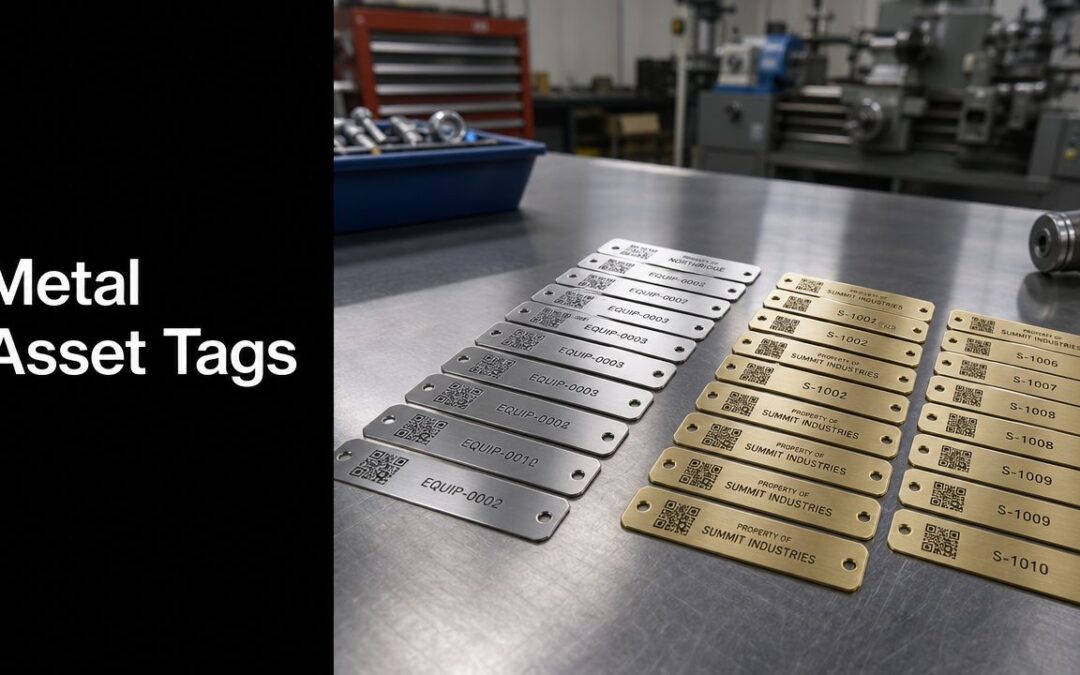
You're usually standing in front of the same problem when these jobs land on your desk. The asset has to stay identifiable after washdowns, sun, vibration, chemicals, and the odd bit of rough handling, yet the label that looked fine on day one has already started lifting, fading, or rubbing back to bare metal. That's where custom metal asset tags earn their keep, because the tag has to survive the site, not the sample sheet.
A good metal tag is not just a nameplate with a logo on it. It's a permanent identification system built around the environment, the data you need to carry, and the way your team reads and scans assets in the field. That's why industrial buyers keep moving away from temporary marks and toward durable, machine-readable tags for long-life registers, maintenance routines, and compliance checks, especially as the broader asset-tags market is projected to reach USD 3.4 billion by 2035 from USD 2.0 billion in 2025 at a 5.6% CAGR (Future Market Insights).
What Custom Metal Asset Tags Actually Are
A maintenance manager usually notices the problem at the worst possible time, after a routine audit or a shutdown when a barcode won't scan and the old vinyl label has turned into a scrap of grey film. The asset itself may still be fine, but the identification has failed, which means someone has to stop, cross-check serials by hand, and rebuild the record from scratch. That's the practical difference between a generic label and custom metal asset tags, one is disposable identification, the other is engineered to stay readable.

Built for a job, not just a look
A custom metal tag is made around a specific equipment set, site condition, and data requirement. It can carry serial numbers, barcodes, QR codes, logos, safety notes, or inspection fields, and the layout is chosen so the asset can be read quickly by people and scanners alike. That's why machine-readable tagging has become central to modern inventory control and security workflows, rather than a decorative extra.
The common mistake is to think all metal tags are the same. They aren't. A tag for a warehouse trolley, a switchboard, a pump skid, or a roadside cabinet may all use metal, but the surface finish, mark depth, fixing method, and data structure should change with the job.
Why metal became the default for long-life registers
Metal is used because it survives the things that destroy paper or vinyl, abrasion, chemicals, heat, and repeated cleaning. Industry guidance also treats tags as more than identifiers, they help streamline inventory management, improve security, prevent theft, and support regulatory compliance, especially when the tag carries machine-readable data for fast scanning and recordkeeping (BannerBuzz metal asset tag guide).
That shift matters in Australian industry because the cost of a failed tag is rarely the tag itself, it's the audit delay, the rework, and the uncertainty over what the asset is. A custom tag is therefore specified for the environment, not pulled from a shelf because it “looks industrial enough.” The reader should treat the tag as part of the asset record, not as an accessory.
Materials and Finishes That Survive the Job
Material choice decides whether a tag still reads cleanly after years of handling, cleaning, and exposure. In Australian industrial settings, anodised aluminium is often the first specification because the anodic layer is integral to the metal, not just a surface coating, which helps protect the mark and preserve barcode or serial legibility under repeated use (National Band metal tags). That matters where staff are reaching past the tag every shift, or where the equipment gets wiped down, sprayed, or lifted into and out of service often.

Choosing the substrate by environment
Start with the exposure, then work backwards.
- Anodised aluminium suits most plant, equipment, and fleet applications because it stays light, is easy to machine or laser mark, and resists everyday handling well.
- Stainless steel makes more sense where chemical exposure, washdown, or coastal conditions are part of the job, especially if the tag must keep its form under harsher treatment.
- Brass is usually chosen where appearance matters more, such as commemorative or decorative plates, rather than hard-use inventory labelling.
For buyers comparing chemical resilience, it's useful to pair metal-selection thinking with general corrosion-prevention guidance such as anti corrosion coating solutions from NSP Coatings, because finish failure often starts long before the whole tag gives up. The substrate is only half the story, though. Thickness, edge treatment, and surface finish all affect whether the mark stays legible after knocks and cleaning.
Finish matters as much as the alloy
A bright surface can look sharp at dispatch and still fail on a site if glare, abrasion, or residue build-up hides the code. A matte or suitably treated finish can make scanning easier, while a protective overlay may help in specific environments where the mark needs an extra layer of defence. That's why the best specs are matched to the exact surface conditions, not to a generic idea of “durability”.
For stainless-heavy applications, a useful reference point is the way stainless steel equipment tags are commonly chosen for harsher duty cycles. The practical lesson is simple, pick the substrate for the abuse it will take, then choose the finish for readability, not just appearance.
Engraving, Etching and Printing Compared
The marking method decides whether the data is still there when the asset comes back for inspection years later. A tag can be made from the right alloy and still fail if the information is only sitting on the surface in a way that wears away. In practice, the question is not which method looks neat at delivery, it's which one still gives a clean scan after site conditions have done their work.
Why laser work usually wins on repeatability
Laser engraving, especially through a Trotec laser workflow, turns a digital file into a consistent mark with strong control over depth, line quality, and sequential numbering. That makes it ideal for barcode and QR production where contrast and repeatability matter. A well-set laser job can produce crisp serials that stay legible because the information is physically formed into the surface rather than sitting on top of it.
Mechanical stamping has its place, but it is less flexible for complex layouts, small codes, and variable data. Chemical etching can also produce durable marks, yet it depends heavily on process control and is generally better suited to certain industrial uses than to high-mix asset-register work. Printed or surface-applied graphics can be acceptable in lower-stress settings, but they're the first to go when abrasion and cleaning become part of the routine.
Practical rule: if the tag has to be scanned in the field, design for contrast first, then depth, then surface finish.
What survives in Australian field conditions
On a mine site, in a plant room, or on roadside infrastructure, the mark has to remain visible after dust, grime, washdowns, and handling. That's where laser marking and engraved data usually outperform printed graphics because the identity is part of the tag, not a layer on it. For businesses that want machine-readable identification tied to digital records, the advantage is not cosmetic, it's operational.
A Trotec laser machine is particularly relevant here because the production file can carry sequential numbering and variable data without changing the physical tooling every time the register changes. That makes it practical for batch work where asset data needs to stay accurate across hundreds of labels.
For a production example, laser engraving metal is the route most teams look at when they need consistent marking on rigid substrates and a readable code that won't disappear in normal service. The useful question is not “Can it be marked?” It's “Will it still scan after the environment has had a say?”
Attachment Methods and Installation Discipline
Most tag failures start at the fixing point, not in the metal. A tag can be beautifully engraved and still come loose because the surface wasn't prepared properly, the adhesive never cured, or the mounting method didn't suit the vibration and heat around it. In the field, that's the difference between a tag that lasts and a tag that gets peeled off, smeared, or shaken loose.

Adhesive mounting needs discipline
Pressure-sensitive metal tags need a clean, dry surface and roughly 48 hours of dwell time to reach full adhesive performance (My Asset Tag video guide). That detail is easy to ignore, then expensive to discover later. If the asset is cleaned too late, loaded too early, or exposed to heat and flexing before the bond has settled, the service life can shorten sharply.
The surfaces that cause grief are usually the ones teams assume are “good enough”, slightly oily powder coat, dusty aluminium, curved plastics, or freshly wiped metal that still carries cleaner residue. The tag may hold for a while, then edge lift starts, dirt gets under the film, and the fixing fails faster than anyone expected.
Mechanical fixings suit harsher duty cycles
Rivets, screws, cable ties, and weld-on studs all have their place. Rivets and screws are useful where vibration, heat, or repeated washdowns make adhesive risky. Cable ties can work on temporary equipment or where a non-permanent mount is needed, while weld-on studs suit some fixed industrial assets where the mounting point can be integrated into the structure.
If the equipment flexes, heats up, or gets cleaned aggressively, choose the fixing method first and the tag second.
The decision comes down to how the asset is used, not how convenient the installation looks during commissioning. Curved surfaces, dirty housings, and moving parts all reduce the margin for error. Installation procedure is not an afterthought, it's part of the tag's design life.
For a practical production context, Evright Industrial can supply metal labels with mounting options suited to the application, including adhesive-backed or pre-drilled formats, depending on what the asset and site conditions demand.
Compliance, Traceability and Inspection Cycles
A durable tag matters because auditors, maintenance teams, and supervisors need to trust what they're reading. In sectors where assets are inspected repeatedly, a tag that survives the intervals between checks supports traceability, replacement planning, incident review, and routine verification. That's especially important in sectors where serious workers' compensation claims remain concentrated, including manufacturing, transport, construction, and health care and social assistance, the very places where equipment identification has to outlast hard use and long audit gaps (Safe Work Australia context referenced in the brief).
Why readable data supports the whole workflow
Machine-readable identification turns a physical object into a record that can be searched, scanned, and reconciled quickly. That's useful for inspection cycles because the same tag can carry a unique serial, a barcode, or a QR code, letting teams move from visual checks to digital records without rewriting labels each time a register changes. It also helps with replacement planning, because the tag remains the stable reference even when the equipment moves between sites or departments.
Tamper evidence matters too. A tag that is difficult to remove cleanly makes unauthorised swapping or casual relabelling more obvious, which is useful in security-minded environments and in public assets that need controlled identification. Sequential numbering also helps because it allows missing items, duplicate records, and asset drift to show up more clearly during an audit.
Audit discipline depends on survivability
The tag doesn't need to be fancy, it needs to still be there when someone turns up with a checklist. That's the compliance test. If the code has rubbed off, the screw has loosened, or the adhesive has let go, the whole workflow slows down and the inspection becomes a manual hunt.
For teams formalising their register and maintenance process, asset tracking best practices is a practical reference point because the tag is only one part of the larger recordkeeping system. Durable identification supports the record, but it doesn't replace the need for disciplined asset control.
Real-World Use Cases Across Australian Industries
The same tag format can solve very different problems depending on where it lands. A manufacturing line, a switchboard room, a hospital, a council depot, and a memorial wall all ask for a different balance of durability, readability, and appearance. The job is to match the construction to the site, not to force one generic specification across every use.
Manufacturing and plant equipment
On a production line, serialised anodised aluminium tags are often used to keep preventive maintenance records tied to the exact machine or sub-assembly. The value is in quick identification when equipment is moved, rebuilt, or serviced. A sharp barcode or QR mark helps technicians get to the right record without relying on memory or handwritten notes.
Electrical and essential services work
Electrical contractors often need tags that stay readable on switchboards, distribution points, and essential-service equipment after installation and inspection. In these settings, the tag has to survive dust, handling, and occasional cleaning while remaining legible for compliance checks. A small, well-placed metal tag does that job better than a temporary sticker that blisters or peels.
Healthcare and infection-control cleaning
Healthcare facilities put tags through repeated cleaning cycles, which is why mark retention matters as much as the substrate. Mobile devices, trolleys, and support equipment need identification that won't blur when wipes, disinfectants, and constant handling become normal. A durable metal plate also helps keep the equipment recognisable when teams swap items across departments.
Government infrastructure and public assets
Roadside cabinets, public infrastructure components, and council-managed assets need identification that can be read after weathering and vandalism risk. The tag has to support long-term maintenance planning without drawing attention to itself. In these cases, the best spec is often the one that stays legible without becoming a visual distraction.
Memorial and commemorative work
Brass or anodised plates can carry names, dates, and inscriptions where permanence and finish matter together. The requirements are different from industrial labelling, but the principle is the same, the inscription has to remain clear for years, not weeks. The production house needs to respect both the material and the message.
Specifying, Ordering and Lead-Time Planning
A clear purchase request saves time, rework, and sample churn. Suppliers need the substrate, thickness, size, finish, marking method, fixing type, quantity, and the data structure before they can quote accurately. If the job includes a logo, barcode, QR code, or sequential numbering range, that information should be supplied up front so the layout can be built once and tested properly.

The information that avoids delays
- Substrate type. State whether the tag should be aluminium, stainless steel, brass, or another approved metal.
- Material thickness. This affects stiffness, mounting, and durability.
- Overall dimensions. A code that fits at 70 mm wide may not fit at 35 mm.
- Surface finish. Matte, brushed, anodised, or protective layers change readability.
- Engraving or printing method. The mark needs to suit the service environment.
- Attachment type. Adhesive, rivets, screws, cable ties, or other fixings.
- Quantity. Batch size affects setup and production planning.
Lead time is usually shaped by artwork approval, sample runs, and batching, not just the actual marking step. Good suppliers ask for vector artwork, logo files, and data sheets because the production stage depends on clean inputs. If you're comparing options, a production partner such as Evright Industrial can work from the site requirements, the asset list, and the preferred fixing style to produce labelled metal hardware that matches the register rather than a generic template.
The fastest quote usually comes from the clearest brief.
Standardising sizes and finishes where you can helps keep procurement simpler and avoids unnecessary variation. Pilot runs are worth it when the environment is harsh or the code is critical, because a sample that scans cleanly in the workshop is still not a substitute for field conditions. A short sample cycle upfront is cheaper than relabelling a whole fleet later.
Lifecycle, Maintenance and Choosing Right the First Time
The cheapest tag is rarely the lowest-cost option once failures, relabelling, and audit errors are counted. A sensible tagging programme starts with service life, then checks the tag at the same rhythm as the asset itself. If the equipment is moved, cleaned hard, or exposed to heat and vibration, the tag spec should reflect that from the start.
Keep the life cycle in view
Inspect tags during routine maintenance, especially where cleaners, dust, chemicals, or handling can wear away the mark or undermine the fixing. Replace tags before they become unreadable, not after the audit fails. If your site is planning relocations, register changes, or system migrations, choose a tag format that can keep working through those changes instead of forcing a full hardware refresh.
The right questions are usually simple. What will the surface see? How often will it be scanned? Does the fixing suit the vibration and heat? Will the code still read after washdown or weather exposure? If those answers are clear, the tag choice usually becomes clear too.
A CTA for Evright Industrial. If you're specifying custom metal asset tags for equipment that has to survive Australian site conditions, send through the substrate, size, fixing method, and data format, and let the production team turn that brief into a readable, durable tag that fits the asset and the way it's used.
Recent Comments