
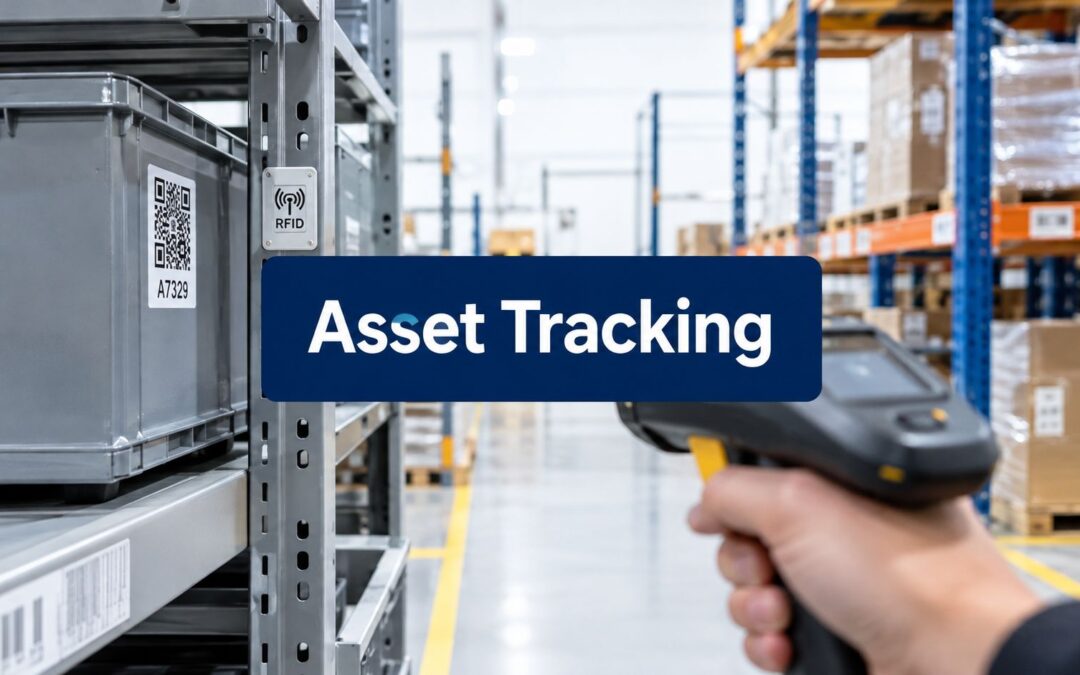
A technician reaches a pump that has stopped working, but the label is unreadable and the register lists three similar units at different sites. Maintenance loses time confirming the model, service history and responsible custodian. If the equipment is safety-critical, that delay can become an operational risk, not just an administrative annoyance.
The most useful asset tracking examples combine four practical elements: a durable physical identifier, a scanning method, a maintained digital record and a workflow that records custody, location, condition and servicing. Barcodes and QR codes work well when people can see and scan the label. RFID helps when teams need to identify multiple items without direct line of sight. Laser-engraved tags and plates suit assets exposed to heat, chemicals, sterilisation, UV, abrasion or outdoor handling.
The eight applications below cover manufacturing, essential services, healthcare, construction, government infrastructure, memorial production, renewable energy and laboratories. Trotec Laser machine imagery belongs in this context as a visual language for precision marking and identification, not mechanical equipment imagery. The practical question in every case is the same: can a worker identify the asset quickly, can the database be trusted, and can the organisation prove that the process delivers operational value?
1. Manufacturing Floor Equipment Tracking and Identification
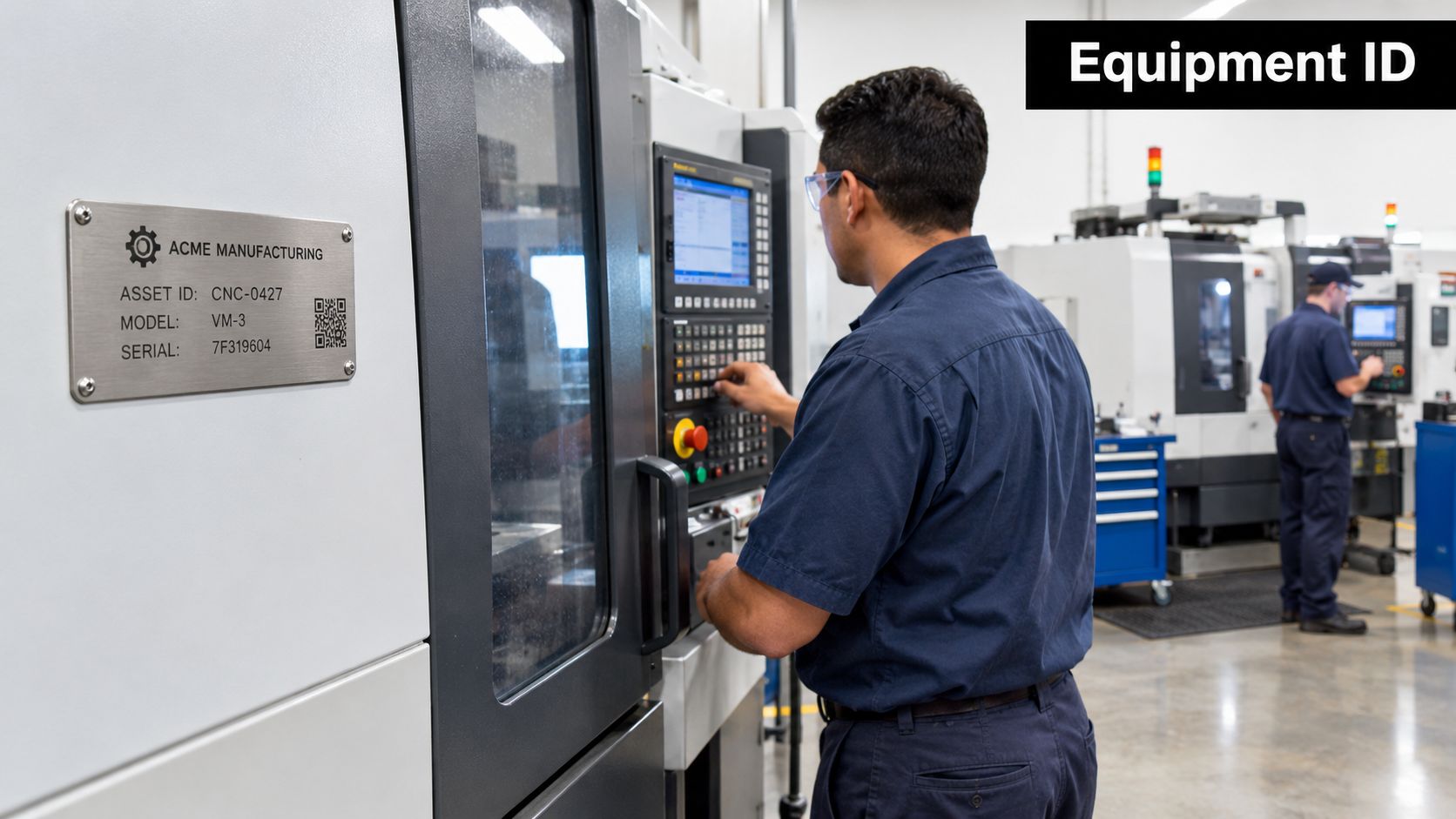
A production floor contains more than fixed machinery. Dies, gauges, fixtures, tooling, mobile test equipment and replacement components move between workstations, stores and maintenance areas. A printed sticker may be adequate for a clean office environment, but it can fail when exposed to coolant, solvents, heat, impact or repeated cleaning.
Laser engraving creates a permanent identifier on a suitable metal, coated plate or engineered substrate. The mark can contain a serial number, human-readable asset code and, where the surface and scanning distance allow it, a QR code. Trotec Laser machines support consistent marking of equipment identifiers and component numbers, while the digital system holds the richer record, including location, custodian, service history, calibration status and disposal information.
Make the handoff visible
Automotive manufacturers can mark engine components and assembly equipment with traceable identifiers. Aerospace suppliers can link permanent serial numbers to inspection and production records. Heavy equipment manufacturers can assign codes that support rental-fleet control and ownership verification.
The workflow matters more than the label alone. Scan the asset when it enters stores, moves to a workstation, goes to maintenance and returns to production. Standardise the placement and format so a technician doesn't need to search around every machine.
Practical rule: A label should identify the asset without replacing the database. Put stable identity on the asset, and keep changing information in the digital record.
A useful starting point is manufacturing asset management software, where identification, scanning and records need to work together. To evaluate ROI, compare missing-asset investigations, maintenance search time, unplanned production interruptions and duplicate purchases before and after implementation. Evright Industrial can discuss precision laser marking, durable labels and integration considerations for manufacturing operations.
2. Electrical and Utility Equipment Identification for Essential Services
Utility equipment rarely sits in a controlled indoor store. Transformers, switchgear, circuit breakers, cabinets, meters and distribution assets face rain, dust, sunlight, temperature changes and field handling. Technicians also need to identify the correct unit quickly during fault response, isolation and planned maintenance.
A weather-resistant engraved plate or directly marked housing can carry the asset code, equipment type, installation details and a scannable identifier. The connected record should show network location, configuration, work history, inspection requirements and the person or team responsible for the next action. A QR code is useful when technicians can reach the label safely with a mobile device. Where access is restricted or multiple items must be read together, a different technology may be more appropriate.
Treat identification as a safety control
State electricity authorities can use consistent equipment tags to support grid management and outage response. Regional utility operators can apply the same schema across poles, transformers and substations, while electrical contractors can record the precise asset involved in a troubleshooting or isolation task.
Markings need strong contrast and sensible placement. Emergency contact information can be valuable, but it shouldn't crowd out the unique identifier or critical equipment information. Installation dates and next-service details belong in the system unless the field environment genuinely requires them on the plate.
- Use durable substrates: Match the plate or marking process to UV, moisture, chemicals and abrasion.
- Set placement rules: Position identifiers where technicians can read them without entering an unsafe area.
- Connect every scan: Record inspections, faults, isolation events and completed work against the same asset record.
For broader infrastructure visibility, advanced metering infrastructure provides useful context around connected utility information. Evright Industrial applies laser-labelling expertise to durable identification for essential services, with project decisions based on material, contrast, placement and the operational record behind the mark. Learn more at Evright Industrial's industrial marking service.
3. Medical Equipment and Healthcare Facility Asset Management
A hospital bed, infusion device, diagnostic instrument or mobility aid can move through wards, treatment rooms, stores and repair areas in a single day. A register that records only purchase details won't tell a biomedical team where the device is now, whether it has been serviced or who last accepted custody.
Healthcare asset tracking needs a clear identity that survives cleaning, disinfection and routine handling. Laser-marked stainless steel or suitable medical-grade labels can provide a durable serial number or code. A barcode or QR code can link the identifier to maintenance records, sterilisation status, location, department and responsible engineering contact. The scan should update the record at defined points, not only during an annual stocktake.
Protect the clinical workflow
Hospitals can apply the approach to beds, monitors, surgical equipment, imaging systems and other mobile devices. Aged care providers can track mobility equipment and monitoring devices across residents, storage areas and maintenance rooms. Diagnostic imaging teams can use the same lifecycle record for major equipment, provided the identifier is placed where it remains visible and doesn't interfere with operation or cleaning.
The Western Australian Auditor General reported in its 2026 audit that four public entities didn't know the location of all their portable assets, and that 34% of 115 sampled portable assets weren't at their recorded locations. The audit also identified the need to track critical items requiring servicing and calibration, including medical and scientific equipment. The audit report.pdf) supports a practical conclusion: location evidence and calibration evidence should sit in the same control framework.
Schedule marking during planned maintenance windows. Use mobile scanning during ward rounds and audits, and measure success through fewer search requests, faster equipment retrieval, fewer overdue services and cleaner compliance records.
Watch the healthcare marking application in practice:
For a focused implementation path, see hospital equipment tracking. Evright Industrial can help healthcare teams assess marking materials, cleaning exposure and label placement before production.
4. Construction and Rental Equipment Fleet Management
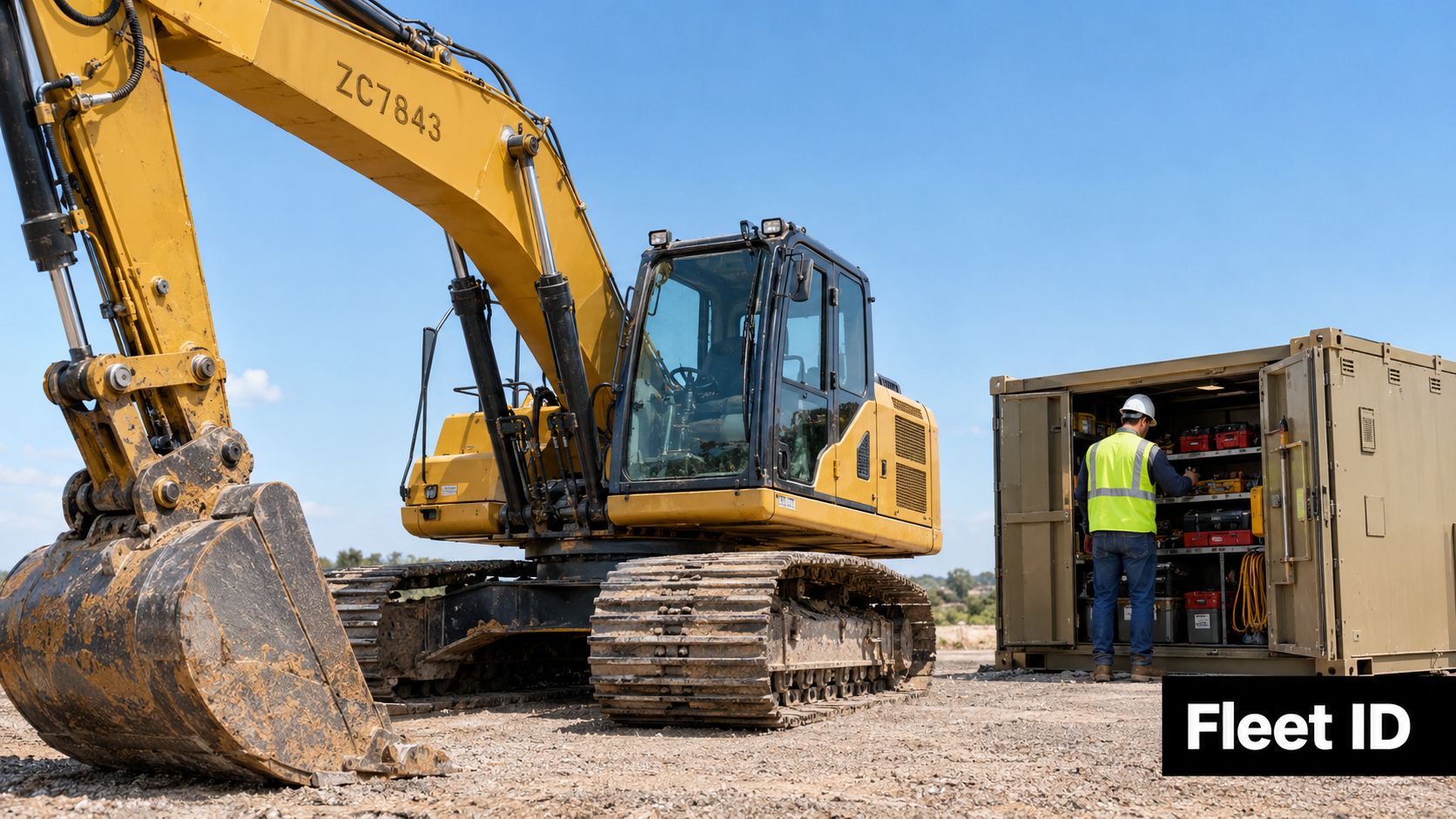
Construction equipment changes hands constantly. An excavator moves between projects, a compressor returns to a depot, and a tool kit may be loaded into a vehicle without a formal handoff. Rental businesses face the added need to prove what was issued, where it went, when it returned and whether damage or missing components occurred during the hire period.
Permanent identification helps establish ownership when paint, stickers or removable labels deteriorate. Mark large equipment in more than one visible location, and use a secondary identifier inside a protected area where practical. The database should connect the asset to a project, site, customer, custodian, condition record, service schedule and billing event.
Capture the transaction, not just the location
Construction contractors can mark tool kits and specialist equipment for site accountability. Civil infrastructure teams can track road-building and trenching equipment across regional projects. Rental operators can use barcode scans at checkout and return to support utilisation, condition reporting and invoice accuracy.
Laser marking on metal, coated surfaces or appropriate composites must be selected for the asset's exposure. A high-contrast code may be readable from a distance, but a mobile scan still requires a suitable angle and clean enough surface. GPS or telematics may help with mobile machinery, while a physical mark remains essential when the asset is offline, parked or separated from its vehicle.
“If the handoff isn't recorded, the location record is only an assumption.”
Evaluate the system through missing-tool incidents, time spent locating equipment, idle fleet capacity, maintenance delays, theft investigations and rental billing disputes. An open integration can connect fleet records to other systems, including an open API for smart fleet integration. Evright Industrial provides industrial laser marking options for durable fleet identification, with material and placement selected for job-site conditions.
5. Government and Infrastructure Security Asset Marking and Signage
Government facilities need identification that remains legible, consistent and difficult to alter. Water infrastructure, transport sites, power facilities, depots and public buildings may use equipment plates, warning signs, access markers and location identifiers across many properties. A locally improvised label style makes inspections slower and can weaken confidence in the register.
Laser-engraved aluminium, stainless steel and suitable composite materials can support standardised plates and signage. A unique serial number or QR code can connect each physical marker to a facilities database, work order, inspection record or security verification process. The mark itself doesn't create security. It gives staff a stable reference for checking whether the physical asset matches the authorised record.
Build a repeatable sign system
State departments can use approved templates across water, power and transport locations. Defence contractors may require controlled identifiers for equipment and facilities. Local councils can standardise safety signage across depots, parks, treatment sites and public buildings, while keeping site-specific instructions in the relevant record.
Design decisions should account for viewing distance, lighting, vandalism and the need for replacement control. WorkSafe ACT guidance identifies AS1319-1994 as the governing standard for safety signs in Australian workplaces. It recommends symbol sizing of at least 15 mm per metre of viewing distance and uppercase text of at least 5 mm per metre in good lighting, with both increasing by at least 50% in poor lighting or viewing conditions. These figures are set out in WorkSafe ACT's signage guidance.
Use controlled templates, approved materials and an audit process that checks legibility, location and tampering. Evright Industrial can produce precision-marked identification and signage for infrastructure projects, with Trotec Laser machinery supporting repeatable output. Visit Evright Industrial for project information when you need to align the physical marking system with facility records and compliance requirements.
6. Funeral Services and Memorial Plaque Production
Not every laser-marking application is about moving equipment through a warehouse. Funeral homes, cemetery operators and memorial providers need a permanent link between a person, a tribute and a specific location. The identifier may be a name, date, image, family message or site reference rather than an inventory code, but accuracy and durability remain critical.
Trotec Laser machines can support detailed engraving on granite, marble, wood, acrylic and stainless steel, subject to material suitability and the required finish. A memorial plaque or urn should be treated as a controlled production record. The provider needs the approved wording, artwork, material choice, dimensions, proof history and final sign-off associated with the job.
Respect the approval workflow
Australian funeral homes may commission granite plaques and urns with custom inscriptions. Cemetery operators need consistent memorial identification for burial sites, while funeral service chains often balance approved design templates with personalised requests.
A reliable process includes a written proof, family approval and a final verification before engraving. High-resolution photo engraving can create a meaningful likeness, but the source image, contrast and material must be assessed before production. Outdoor exposure, cleaning practices and installation conditions should guide material selection.
- Confirm every character: Names, dates and family wording need independent review before production.
- Match material to place: Consider weather, moisture, cleaning and the visual expectations of the cemetery or memorial setting.
- Preserve the job record: Keep the approved artwork and production details linked to the completed tribute.
See memorial plaque wording examples for practical direction on preparing a tribute. Evright Industrial combines precision engraving with controlled artwork and proofing processes, helping families and providers turn approved memorial designs into durable finished pieces.
7. Renewable Energy and Solar Installation Equipment Tracking
Distributed energy assets create a record-keeping challenge. Panels, inverters, isolators, mounting systems and related electrical components may be installed across homes, commercial buildings and remote sites. The service team often arrives years after installation, with a warranty question or performance issue and incomplete paperwork.
A durable identifier placed before installation can link the physical equipment to system specifications, installation date, warranty information, installer details and maintenance history. QR codes are useful when a technician can scan safely from a mobile device. A human-readable serial number remains important when the code is dirty, damaged or inaccessible.

Mark before the roof visit
Solar installers can mark equipment before mounting, reducing the risk of awkward access or damage during installation. Renewable energy operators can maintain a single record for assets distributed across many buildings. Solar farm teams can connect inverter and mounting equipment to inspection routes, fault records and replacement planning.
The marking method must suit UV, moisture, heat and abrasion. Aluminium, glass and stainless steel each require a considered process, and a label placed on a hot or exposed surface may need a different substrate from one installed inside a protected enclosure.
A practical scanning workflow records commissioning, handover, service visits and warranty work. Evaluate ROI by tracking the time spent confirming system identity, warranty claim preparation, repeat visits caused by missing information, service completion and fault-history accuracy. Evright Industrial uses Trotec Laser machinery and industrial marking expertise to support durable solar and renewable-energy identification. Visit Evright Industrial's renewable asset labelling team to discuss materials, codes and installation workflows.
8. Laboratory and Research Equipment Asset Management Systems
Laboratories depend on equipment that has a specific location, owner, condition and calibration requirement. A benchtop instrument may be shared by several teams, moved for an experiment or removed from service while waiting for repair. If its identifier is missing, researchers can lose confidence in the result and managers can struggle to prove that required controls were followed.
Laser-engraved tags and direct markings can withstand chemical exposure, cleaning and sterilisation when the material and process are selected correctly. The physical code should connect to the laboratory information system or asset database, where users can access calibration certificates, service records, operating instructions, responsible staff and status.
Link the instrument to evidence
University laboratories can track shared instruments across departments. Pharmaceutical facilities can connect analytical equipment to GMP documentation. Medical research institutions can maintain records for specialist diagnostic and research equipment, including service history and calibration evidence.
The Australian National Archives recommends 17 metadata properties for an efficient information asset register, including a unique identifier, name, description, keyword, location, format, status, creation date, update frequency, owner, custodian, rights type, security classification, personal information and risk. The complete framework appears in the National Archives guidance on information asset registers. For laboratory teams, the principle is straightforward: an identifier without ownership, location and risk information is not a complete control.
Use a marking protocol that matches the LIMS or asset database fields. Add a QR code only where it remains readable after cleaning and doesn't compromise the equipment. Measure value through fewer overdue calibrations, faster audit responses, fewer duplicate purchases and less time spent finding shared instruments. Evright Industrial can develop precision laser marking for laboratory environments, with the final approach based on substrate, chemical exposure and record structure.
Comparison of 8 Asset Tracking Examples
| Application | Implementation complexity 🔄 | Resource requirements ⚡ | Expected outcomes ⭐📊 | Ideal use cases | Key advantages & tips 💡 |
|---|---|---|---|---|---|
| Manufacturing Floor Equipment Tracking and Identification | Moderate, laser markers + MES/ERP integration; operator training required | Medium–High, industrial lasers, integration, asset tags, training | High, permanent IDs, reduced loss/downtime, improved maintenance scheduling | Automotive, aerospace, heavy equipment manufacturing | Tamper-resistant permanent marks; standardize placement; use QR codes and regular audits |
| Electrical and Utility Equipment Identification for Essential Services | High, large-scale retrofit, compliance-driven label design | High, deep engraving on metals, GIS integration, coordinated rollouts | High, rapid identification in emergencies, weather-resistant IDs, faster fault response | Power utilities, substations, pole/transformer networks | Deep engraving for outdoor durability; include voltage/emergency contacts; design to standards |
| Medical Equipment and Healthcare Facility Asset Management | High, validation, biocompatibility testing, regulatory documentation | High, cleanroom-compatible processes, UDI/LIMS integration, testing | High, equipment accountability, regulatory compliance, reduced billing/errors | Hospitals, diagnostic centers, aged care facilities | Sterilization-resistant marking; schedule during maintenance windows; include biomedical contact info |
| Construction and Rental Equipment Fleet Management | Moderate, fleet-wide marking and system integration across sites | Medium, large-format lasers, GPS/mobile asset apps, multi-surface marking | High, reduced theft, accurate billing, optimized utilization | Equipment rental firms, construction contractors, civil infrastructure projects | Mark multiple visible surfaces; add contact info for returns; use barcode scanning at checkout |
| Government and Infrastructure Security Asset Marking and Signage | High, security clearances, validated designs, restricted personalization | Medium–High, secure production, standardized templates, authorization controls | High, tamper-evident IDs, consistent signage, audit-ready documentation | Defence, critical infrastructure, public facility networks | Tamper-evident serials and authentication; develop standard templates; perform regular audits |
| Funeral Services and Memorial Plaque Production | Low–Moderate, design consultation and material-specific setup | Low–Medium, stone/wood/acrylic materials, high-resolution engraving tools | High, durable, personalized memorials; timely delivery | Funeral homes, cemeteries, memorial service providers | High-resolution photo engraving; offer template portfolios and proofing for families |
| Renewable Energy and Solar Installation Equipment Tracking | Moderate, UV-resistant marking settings and monitoring integration | Medium, specialized materials/settings, QR/RFID integration, scheduling for retrofits | High, faster maintenance, warranty tracking, better performance records | Solar installers, solar farms, distributed renewable portfolios | Mark before installation; include QR links to docs; color-code for voltage/safety |
| Laboratory and Research Equipment Asset Management Systems | High, LIMS calibration integration and strict protocol alignment | High, chemical/sterilization-resistant materials, database integration, validation | High, calibration traceability, research reproducibility, reduced equipment loss | Universities, research institutes, pharmaceutical labs | Include calibration dates and QR links to records; align marking protocols with LIMS |
Turn Tracking Examples Into a Practical Rollout
The right asset tracking method starts with the operating environment, not the technology catalogue. Choose a barcode or QR code when a worker can reach and see the identifier and the linked record contains the information that changes over time. Choose RFID when teams need to read multiple assets or items that aren't convenient to scan individually. Consider GPS or connected telemetry for mobile assets whose location changes outside controlled sites. Use a laser-engraved tag or plate when durability, legibility and long-term identity matter more than the lowest initial label cost.
The marking material must match exposure. Heat, chemicals, sterilisation, UV, moisture, impact and abrasion can each change the specification. A label that works on an indoor cabinet may fail on a substation, a hospital trolley or construction equipment. The substrate, contrast, mounting method and placement should be tested against the actual cleaning, handling and environmental conditions.
Use a controlled implementation sequence
Start with the register. Define the fields required for each asset class, including unique identifier, name, description, location, status, owner, custodian, risk, maintenance and calibration information. The National State of the Assets programme, led by ALGA and supported by IPWEA, has operated since 2012 and provides evidence-based reporting on Australian local government infrastructure assets. Participation is free for every Australian local government, and reports inform funding decisions and long-term planning through IPWEA's National State of the Assets programme. That governance mindset applies beyond councils. A trustworthy physical identifier is useful only when the organisation maintains the record behind it.
Next, standardise the label schema. Decide which assets need a serial number, which need a barcode or QR code, and which justify RFID or connected location data. Establish placement rules, naming conventions, ownership fields and disposal procedures before the first production batch. Record scans at receiving, installation, checkout, transfer, maintenance, return and disposal checkpoints.
Audit the physical population against the register on a defined cadence. Australian businesses lose an estimated A$4.3 billion in physical assets each year, according to Telsyte research cited by Telstra. The same Telstra asset-tracking report estimates annual losses of nearly A$1 billion in shipping equipment or mobile storage, more than A$800 million in IT equipment and more than A$700 million in vehicles. These figures provide context for the control problem, but your ROI case should use your own baseline.
Track practical outcomes:
- Missing assets: Count unresolved items and replacement purchases before and after rollout.
- Maintenance response: Measure the time needed to identify equipment, location and service history.
- Operational continuity: Record downtime linked to unavailable, misidentified or overdue-maintenance assets.
- Billing accuracy: Compare checkout, return and usage records with rental or project invoices.
- Compliance evidence: Test how quickly the team can produce location, custody, calibration, inspection and disposal records.
Evright Industrial applies precision laser engraving and asset-labelling expertise with Trotec Laser machines. Its team can help select durable substrates, define identification content and produce consistent labels, plates, signage and memorial work for Australian operating environments. For teams building a broader digital command centre for buildings, the physical identifier can provide the reliable reference point that connects field assets to the wider facilities record.
The best rollout is usually controlled rather than dramatic. Start with one asset class or site, prove that workers scan at the intended checkpoints, correct duplicate or incomplete records, then expand using the same schema and placement rules. Discuss the environment, materials and evidence requirements with Evright Industrial before committing to a production run.
Evright Industrial provides precision laser engraving and durable asset labelling for equipment identification, QR codes, serial numbers, safety signage and memorial plaques. Visit Evright Industrial to discuss a custom marking system that connects physical identifiers with dependable tracking records across your Australian operation.
Recent Comments