

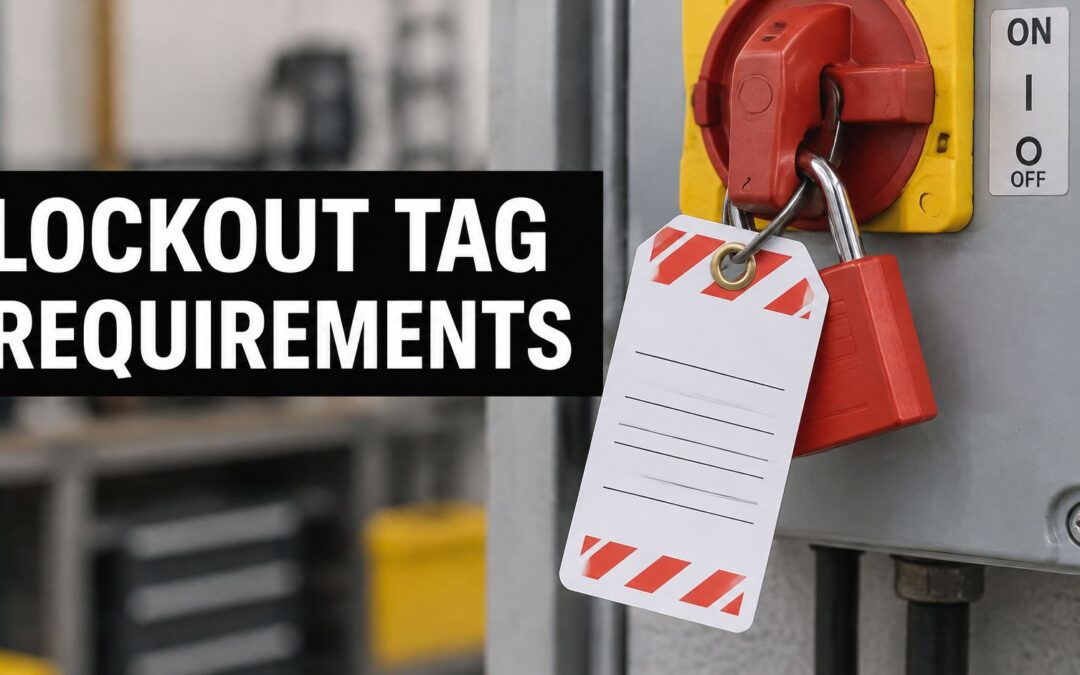
Most advice on lockout tagout tag requirements starts with colour, material and what to print. That's backwards. A tag won't stop a switch, valve or start button being used, no matter how bright it is. It records who isolated the plant, what they isolated and why nobody else should touch it. The lock does the physical work.
I would start every audit with one question. Could someone restart this equipment while your tag is hanging there? If the answer is yes, your problem isn't tag design. It's an unsecured isolation. Fix the lock, the sequence and the verification first, then make the tag clear enough that a stranger understands it without asking around.
Required Information on Every Lockout Tag
Put seven fields on every tag, in the same order every time. Consistent placement helps crews read it quickly and spot a missing entry before work starts.
| Field | What to record | Example |
|---|---|---|
| Equipment or isolation point | Asset ID and location of the isolation device | Pump P-204, Breaker 12, MCC Room 2 |
| Energy or hazard type | Each source the tag covers | Electrical, hydraulic pressure, stored energy |
| Applied by | Full name and signature of the worker | J. Nguyen, signed |
| Date and time applied | Start of the isolation | 14 May, 06:30 |
| Warning statement | Plain prohibition on operation or reconnection | Do not operate or reconnect. Lock applied by owner. |
| Work reference | Work order or permit number | WO 48217 / Permit E-119 |
| Removal authority | Who may remove the tag | Signatory only, after verification |
Why Each Field Earns Its Space
The asset ID plus location ties the tag to one isolation point, not just a machine area. "Pump isolated" is weak when there are three pumps. "P-204, Breaker 12" tells the next person exactly what's controlled and lets them cross-check the register.
The energy or hazard type prevents a common false assumption, that switching off power made the job safe. A press might be electrically isolated but still hold hydraulic pressure or a raised load. Listing each source forces the person applying the tag to account for it.
Name, signature, date and time create ownership. At handover, the incoming crew knows who to contact and whether the isolation belongs to the current job. Without a time, a tag left from yesterday looks the same as one protecting someone now.
The 2 AM Test
A stranger reading the tag at 2 am should know what's isolated, who to call and whether it's safe to touch. The work order or permit reference connects the tag to the documented job, while the warning states the required action in plain words. Removal authority closes the loop by naming who can end the isolation.
Cover the name with your thumb. If the remaining text doesn't clearly say what must not happen, rewrite the tag before it's used.
Don't leave blank fields and fix them later. An incomplete tag is unfinished isolation paperwork, and crews can't rely on guesswork when deciding whether plant is safe.
Why a Tag Never Works Alone
Think of the lock as the door and the tag as the sign on the door. The lock stops someone turning the handle. The sign explains why the door is locked, who locked it and who to ask before it's opened. Hanging the sign without locking the door doesn't restrain anything.
That's the central point behind the Australian approach. Lockout is the physical control. Tagging supports it with information. A tag can be overlooked, misunderstood, detached or deliberately bypassed. It can't resist a hand closing a switch or vibration affecting an unsecured device.
| Control | Physically stops operation | What it communicates | Typical use |
|---|---|---|---|
| Personal lock and danger tag | Yes, with the worker's own key | Worker name, date, time and plant | Maintenance and repair on energised or stored-energy plant |
| Group lock with shared tag | Yes, each worker adds a lock | Every worker on the job | Multi-crew shutdowns and contractor work |
| Out-of-service tag alone | No | Equipment is faulty or awaiting repair | Warning only, never a substitute for isolation |
| Informational asset label | No | Equipment identity and isolation point location | Permanent marking of isolation points |
Where Teams Confuse the Controls
An out-of-service tag says equipment is faulty or awaiting repair. It does not authorise hands inside guarded areas, electrical work or removal of components. Treat it as a status notice, then apply the full isolation process before work begins.
An asset label has a different job again. It identifies equipment and helps workers find the right breaker, valve or isolator. Useful, yes. Protective on its own, no.
Decision rule: If someone could restart the plant by pressing a button or closing a switch, a physical lock goes on the isolation point before any tag is hung.
For group work, each exposed worker adds a personal lock to a shared hasp. The tag then identifies the job while every lock has to be removed by its owner before restoration can occur. That's how the protection stays personal, even when several crews share one isolation point.
How to Apply Lockout Tags in Eight Steps
Hang the lock before you hang the tag. A tag is the written record and the warning at the control. The lock is what keeps the next person from restoring energy. Get that order wrong and the paperwork can look finished while the plant can still move.
Each step closes a different failure path. The Safe Work Australia Managing the Risks of Plant in the Workplace Code of Practice identifies lockout as the most effective isolation procedure and sets out eight core actions, from shutdown through to testing by attempting reactivation without exposing anyone to risk.
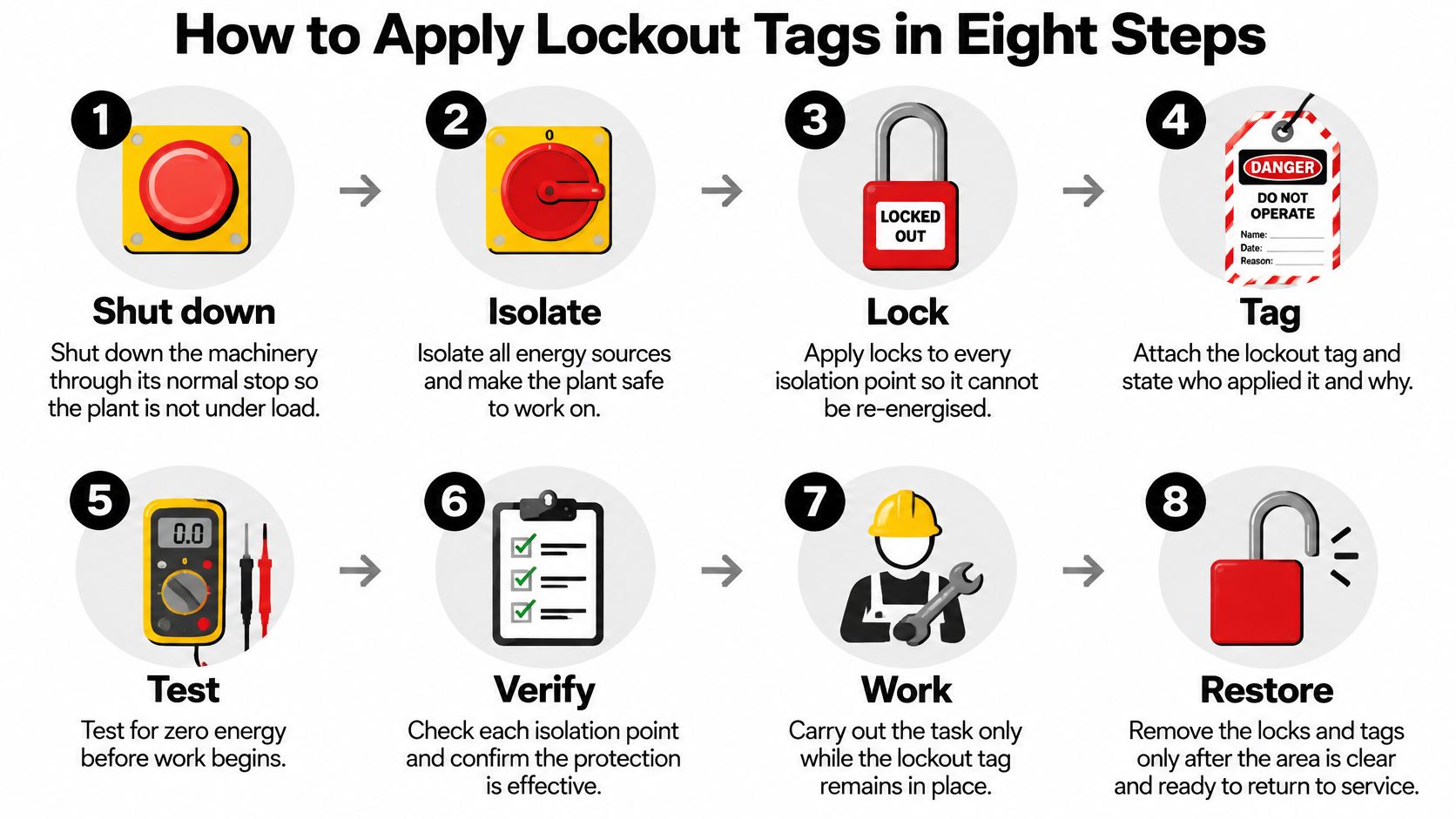
- Shut down machinery. Use the normal stop so the plant isn't under load. An emergency stop is not an isolation device, so a red button is not the end of the job.
- Identify every energy source and hazard. Include electrical, pneumatic, hydraulic, thermal, mechanical and stored energy. Springs, raised loads, pressure accumulators and capacitors can stay dangerous after the motor has stopped.
- Identify isolation points. Match one point to each source using drawings, labels and a physical check on site. Where pipework or cabling has changed, memory is a poor substitute for that check.
- Isolate all energy sources. Operate each switch, valve or disconnect to its safe position. One source left live leaves the isolation incomplete.
- Control or de-energise stored energy. Bleed pressure, discharge capacitors, lower or block gravity loads and allow hot surfaces to cool where the job requires it. Read the result on the gauge, indicator or the component itself.
- Lock out isolation points. Fit a personal lock, hasp, circuit-breaker lockout, valve lockout or equivalent device at every point. Removal should take a deliberate action, not a casual tug.
- Tag controls, energy sources and hazards. Fill in every field, fix the tag where it can be seen at that point, and record the isolation on the register or permit. A tag tucked behind pipework warns nobody. The tag documents the lock. It does not replace it.
- Test by attempting to reactivate. With nobody in the line of fire, try the normal start control, then return controls to off or neutral. For electrical work, use the test method the job requires rather than trusting a start attempt alone.
Don't Skip the Test
Step 8 is the one crews drop once the tag looks filled in. I would not treat the job as ready at that point. A completed tag with no test means the isolation is unverified. You have evidence that someone filled in a tag, not evidence that the plant cannot move or become energised.
Choosing Tag Material, Size and Colour
Colour and laminate grade draw most of the debate. They do not isolate anything. A tag records who isolated the plant and warns the next person who walks up. The lock, hasp or breaker device is what stops a restart. Choose a material for the worst conditions on the job, not the conditions in the store, then still fit a physical lock at every point.
Under Safe Work Australia's Managing Electrical Risks in the Workplace Code of Practice, a danger tag should be durable, securely fixed, dated and signed, identify hazards such as multiple supplies, sit prominently at every isolation point and be removable only by its signatories.
| Environment | Recommended material | Minimum size | Attachment |
|---|---|---|---|
| Indoor dry workshop | Laminated card or polyester | 100 x 50 mm | Reinforced eyelet with stainless tie |
| Outdoor or UV exposure | UV-stabilised polyester or engraved aluminium | 100 x 50 mm | Stainless steel tie or ring |
| Wet, washdown or chemical | Polyethylene or engraved stainless steel | 100 x 50 mm | Stainless steel tie |
| Hot surfaces or furnaces | Engraved stainless steel plate | 100 x 50 mm | Stainless steel ring or chain |
| Switchboard or panel | Engraved polyester or stainless plate | 100 x 50 mm | Cable tie through eyelet, removable only by signatory |
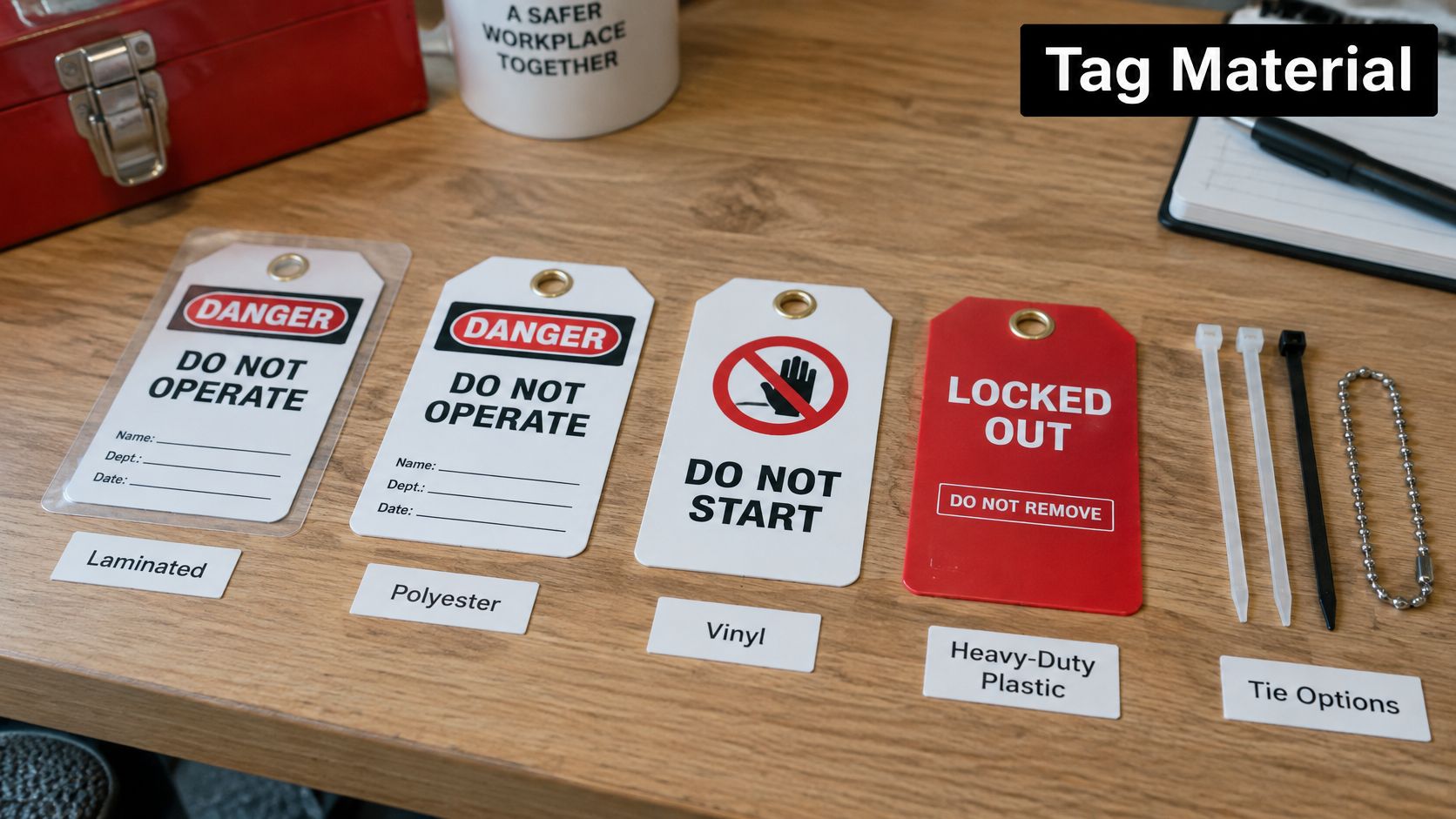
Use red for danger or prohibition and yellow for caution, following AS 1319 safety sign conventions. Keep those colours distinct from permanent asset labels so a danger tag does not blend into normal equipment marking. Text should be readable at arm's length. The writable area has to fit the full name, date, time, hazard and work reference without cramped handwriting. A tidy colour that hides the name fails the next person who needs the warning.
Engraved Versus Printed Templates
A permanent engraved plate works well where the asset ID, hazard lines and field prompts never change. Laser engraving puts that layout permanently into metal or polymer. A laminated card suits short jobs where workers handwrite the date, signature and time in a writable box, provided the marker and surface hold up outdoors or during washdown.
The trade-off is practical. An engraved plate stays readable beside a furnace or on a washdown line, yet someone still has to complete the date, name and hazard or the plate is only a blank warning. A card is faster to fill and easier to remove when the job ends. It fails if rain or solvent takes the writing with it. Either way, the tag documents the isolation. It does not hold the energy off.
If you're comparing print options, suppliers where you can order printed swing tags show how much writable space and eyelet strength vary between products. For fixed industrial layouts, compare that against custom safety tags matched to the environment and isolation point.
Before fitting, check that the material suits the environment, the writable area fits every field and the attachment can't slip off. I would reject thin plastic ties on outdoor or vibrating plant. Use a stainless tie, ring or chain where heat, movement or chemicals can damage weaker fixings. A strong fixing keeps the warning where people can see it. It is still not a lock.
Personal, Group and Out-of-Service Tags
Say three crews need the same press during one shutdown. Mechanical fitters are inside the guarding, electricians are at the drive and cleaners are working around the feed area. One tag with one supervisor's name doesn't protect all three groups if that supervisor leaves or finishes early.
A personal danger tag identifies the worker who applied it, the date and time and the plant isolated. WorkSafe Victoria's isolation guidance states that a tag is only an information device and cannot physically prevent operation, and that a lock should be used where practicable.
Shared Work and Shift Handover
- Group lockout: Each worker places a personal lock on a shared hasp. One shared tag can list the job and crew, but the isolation holds until the last personal lock is removed.
- Shift handover: The incoming crew checks the tag, register and isolation points, then adds its locks before the outgoing crew removes theirs. There's never an unprotected gap.
- Contractors: Contractors use their own locks and sign the site register. The site controller keeps that register current so nobody restores plant while an external crew is still exposed.
- Maintenance status: Use equipment maintenance tags to show repair status, but don't mistake that status for personal protection.
An out-of-service tag flags faulty equipment that hasn't been isolated for work. It warns operators not to use the plant, but it never authorises maintenance to start. Mixing these tags with personal danger tags creates dangerous ambiguity, so keep the wording, purpose and storage locations separate.
Controlled Removal
Only the tag's signatory removes it, after confirming the work is complete, tools and people are clear, guards are restored and the area is ready for re-energisation. Record the removal against the work reference. If a signatory is unavailable, use your documented exceptional removal process rather than letting another worker cut the lock on judgement alone.
On every job, ask one plain question. Who holds each key? If nobody can answer for every lock, stop and reconcile the hasp, tags and register.
Special Cases for Electrical, Confined Space and Stored Energy
A tag on a switchboard records who isolated what. It does not prove the conductors are dead. Backfeed and standby supplies are the usual miss: the main isolator is locked, then a generator or photovoltaic system still feeds the board.
Safe Work Australia's Managing Electrical Risks in the Workplace Code of Practice requires businesses to identify relevant circuits, disconnect active conductors from every applicable supply and consider standby systems such as generators and photovoltaic systems, lock isolating switches where practicable and apply danger tags at switching points.
| Case | Extra requirement | Verification before work |
|---|---|---|
| Electrical switchboard | Lock isolating switch, danger tag at switching point, remove or rack out breakers where practicable | Test for dead or equivalent check |
| Confined space entry | Tag states a person is inside and isolation stays until all have left | Check each isolation point is secured |
| Pneumatic or hydraulic system | Bleed or dissipate stored pressure, block and lock valves | Gauge reads zero |
| Gravity or spring energy | Block or lower loads, chock or pin moving parts | Attempt start from normal control after isolation |
| Multiple isolation points | Tag and lock every point, list each on a register | Register reconciled against plant before work |
| Lockout impracticable | Documented risk assessment with alternative controls | Supervisor sign-off recorded |
For removable or rack-out breakers and combined fuse-switch units, remove or rack them out where reasonably practicable, lock them open and danger tag them. Then complete a test for dead or equivalent check before anyone touches a conductor. Sequence matters. Isolate, lock, tag, then test. A paper record of that sequence still leaves the circuit live if the lock never went on.
Confined Spaces and Stored Energy
Confined-space tags carry a second message the ordinary danger tag does not. The tag must state that a person is inside and that isolation stays until everyone has left. Agitators, conveyors, valves and services often sit outside the space, so each of those points needs its own lock. Removing one because the internal job looks finished exposes whoever is still inside.
Stored energy needs a reading or a physical block, not a tag that says "bled." A hydraulic gauge at zero, a load lowered onto blocks, or a moving part pinned gives the crew something they can check. Springs and gravity do not care that the valve handle is tagged. If the pin is missing, the energy is still there.
Facilities reviewing material flow around shutdown areas sometimes assess adjacent access changes such as moving company mezzanine storage solutions, but no layout change reduces the need to prove zero energy at the plant.
The more energy sources a plant has, the more isolation points and tags it needs, and each point needs its own register line.
Where a lock will not fit, do not drop to a tag and start the job. Write the risk assessment, name the alternative controls and get supervisor sign-off before work starts. That paperwork explains the gap. It does not close it.
Confirm Your Tag Program Before the Next Shutdown
A full drawer of tags does not make a shutdown safe. The tag records the job and warns the next person. Only a lock holds the isolator, and only one lock per exposed worker closes the gap most colour charts never mention.
Run this check while you can still replace stock and correct the register.
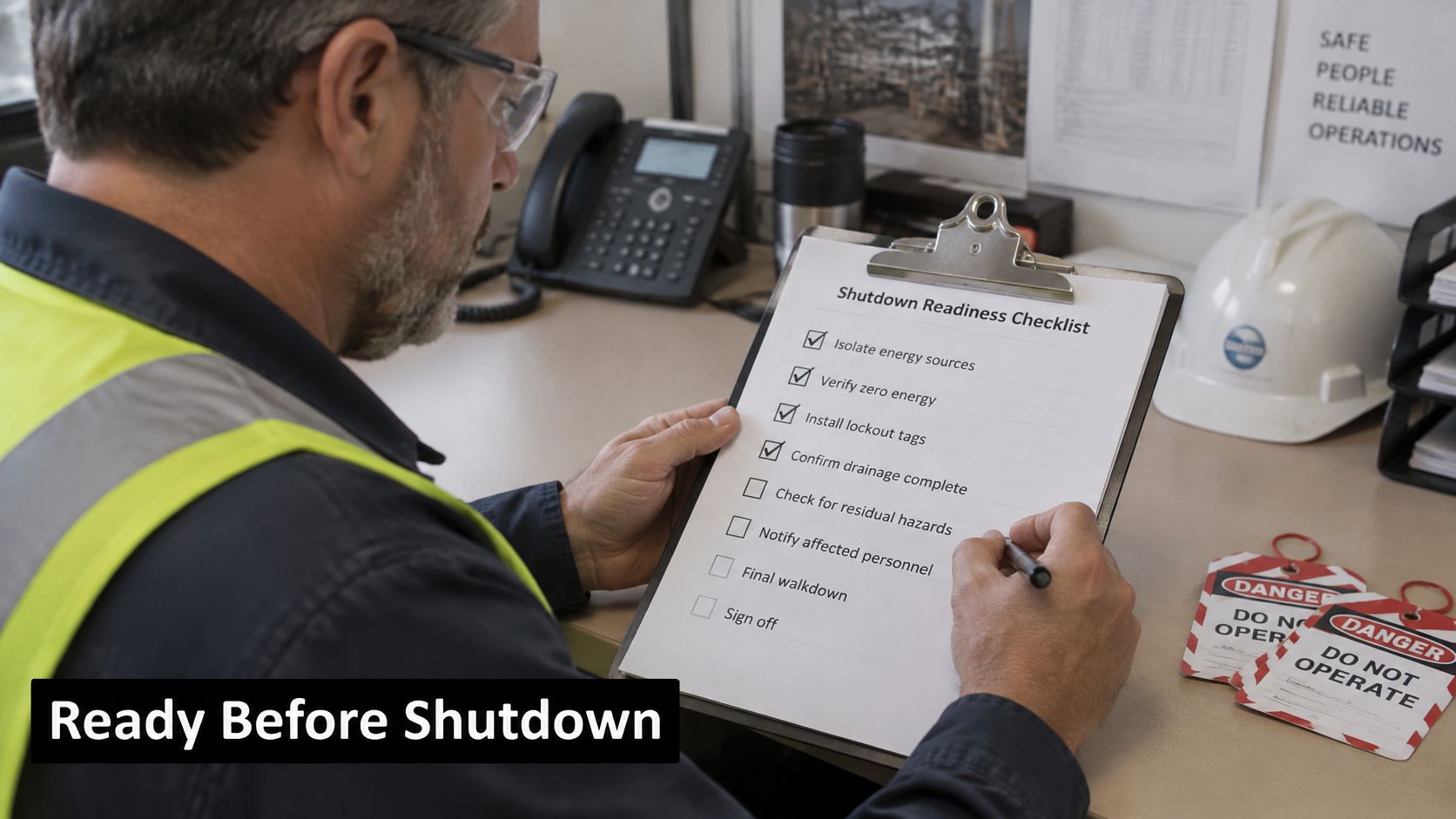
- Audit every tag against the seven required fields and flag missing names, dates, times or hazards.
- Replace faded tags with durable engraved or laminated versions matched to UV, washdown, chemicals or heat.
- Check every isolation point has a personal lock and tag, with group locks fitted to shared hasps.
- Engrave asset IDs at isolation points so the tag, permanent label and register all match.
- Train crews on the lock, tag and test sequence, including the attempted restart and electrical testing.
- Set a register review date and record who signed off.
I would not clear a shutdown pack on paperwork alone. Walk the points. If a hasp has a tag and no personal lock, the isolation is incomplete.
Use a safety compliance checklist so each area audits the same fields, the same lock-and-tag pairing, and the same sign-off line.
Evright Industrial is the industrial division of evright.com. You set the tag field layout once. We engrave it permanently onto the chosen material using laser technology, and the finished tag is ready to fit at each isolation point. Our range includes asset labels, safety signage, steel plaques, panels, switch plates, electrical switchboards, stencils, branding and laser cut architectural designs, and we can mark on almost any material.
Standardise that layout before the next shutdown, then match material and size to the environment at the isolator. Evright Industrial produces durable laser-engraved tags, asset labels and safety signage for demanding industrial environments, so names, hazards and asset IDs stay legible. Visit Evright Industrial to discuss the right material, size and field layout for your site.
Recent Comments