
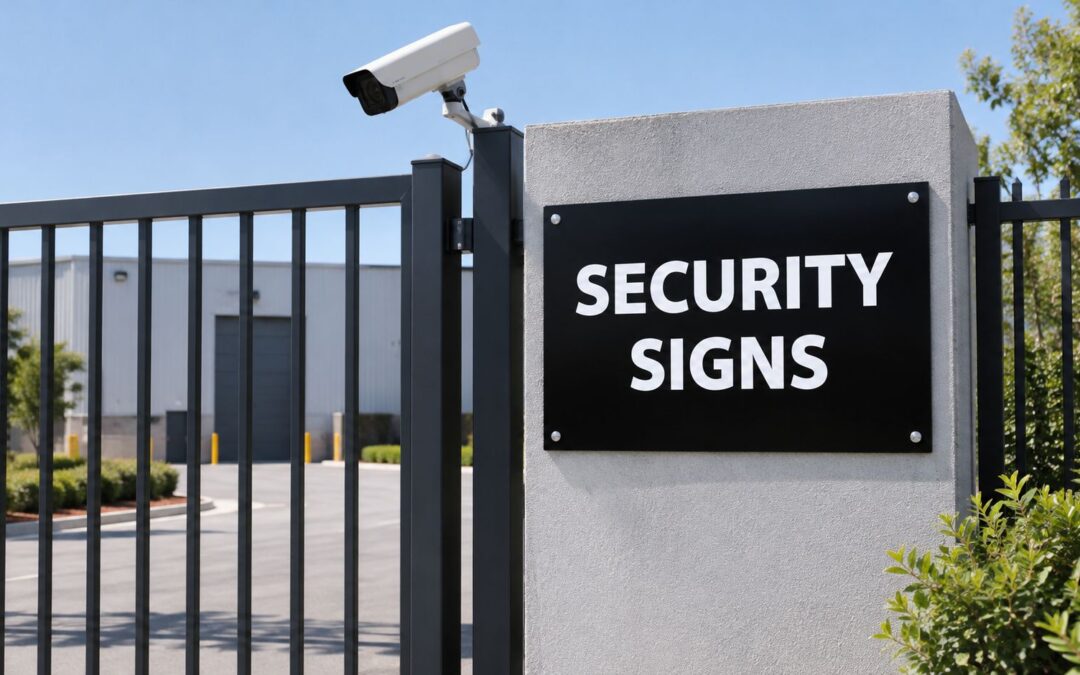
A contractor arrives at your depot before reception opens. The vehicle gate is open, the loading bay looks like an entrance, and the only warning is a faded sticker behind a parked forklift. If you're reviewing security signs for business, this is the problem to solve: people need to know where to go, what requires permission and where they must stop, before they cross the boundary.
Why Security Signs Matter on an Industrial Site
Follow that contractor through a better-organised site. A gate sign directs deliveries to the receiving area. A pedestrian entrance identifies the visitor reporting point. At the equipment compound, an authorised-access notice makes the boundary clear without requiring someone to shout across the yard.
Those signs have different jobs. They guide legitimate visitors, communicate access conditions and distinguish public routes from controlled or hazardous areas. For manufacturing plants, healthcare facilities, essential services depots and government sites, that operational clarity matters just as much as an anti-theft message.
Put the risk in perspective
Australia recorded 595,660 victims of theft excluding motor-vehicle theft in 2024, the highest level since 2003 and a 6% increase on 2023, with retail locations accounting for 45% of recorded thefts, according to the Australian Bureau of Statistics theft release. Those figures establish commercial exposure; they don't measure whether signs prevent theft.
Practical rule: A sign should explain a control that exists, not stand in for a control you haven't installed.
A restricted-access plate belongs with a controlled gate or door. An equipment identification plate should connect to the asset register. A visitor notice needs a reporting process that someone manages.
- Physical boundaries: Use gates, fencing and locks to establish where access changes.
- Operational controls: Give staff a clear process for visitors, contractors and deliveries.
- Supporting visibility: Keep entrances lit and sightlines open so people can see both the boundary and its instructions.
For perimeter planning, FenceScape's discussion of by-law compliant perimeter fencing offers a useful companion resource, although Australian projects need their own local approval checks rather than imported compliance assumptions.
The broader relationship between identification, instructions and daily operations is explored in signage as a critical part of commerce and life. The purchasing decision should start with the behaviour required at each boundary, not a catalogue of threatening slogans.
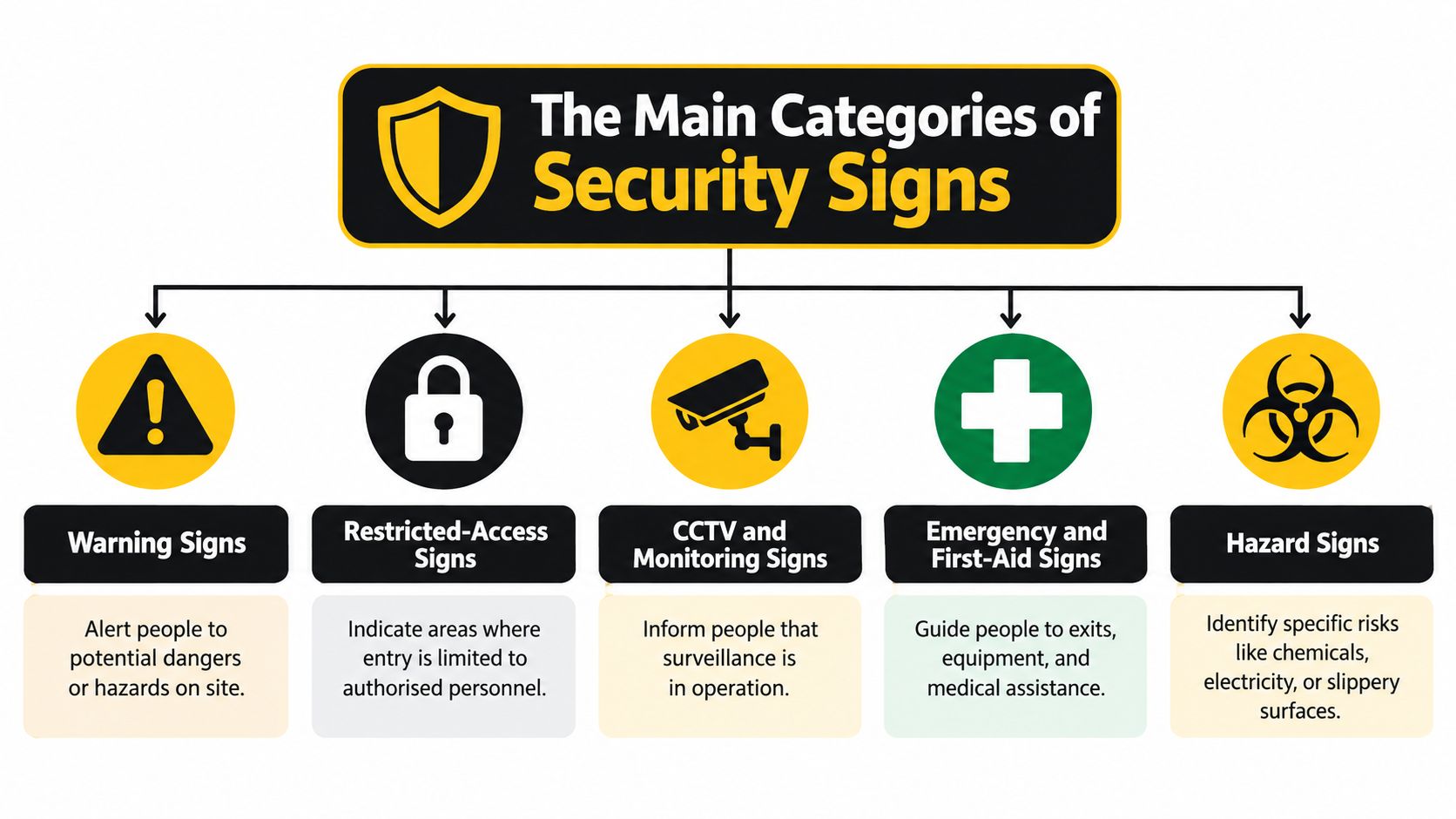
The Main Categories of Security Signs
Start an audit by sorting signs according to what people must understand or do. A surveillance notice isn't a hazard warning, and a hazard warning doesn't tell a delivery driver where to report. Combining unrelated instructions into a crowded panel makes the important message harder to find.
AS 1319-1994 specifies occupational safety-sign requirements for controlling safety-related behaviour, warning of hazards and providing emergency information, including fire-protection information, as described by Standards Australia. That framework provides a useful foundation, but it doesn't make every commercial security notice an occupational safety sign.
Use the categories below to separate messages before deciding on individual panels.
Match the message to its purpose
- Warning signs: Identify a danger before someone encounters it. Choose wording that describes the actual risk rather than a vague instruction to be careful.
- Restricted-access signs: Establish who may enter. Staff Only, Authorised Personnel Only and No Admittance Without Permit communicate different access conditions, so choose deliberately.
- CCTV and monitoring signs: Explain that monitoring occurs. Monitored Area needs to correspond with the actual system and its operating arrangements.
- Emergency and first-aid signs: Help people find assistance, exits and emergency equipment. Don't bury these directions among access restrictions or corporate branding.
- Hazard and chemical placards: Identify specific risks and, where applicable, communicate prescribed hazardous-chemical information. A generic security notice is no substitute for the required placard.
A chemical-store entrance illustrates the distinction. It may need an access restriction, hazard identification and mandatory PPE instructions. Those messages can coexist, but each should retain its recognisable purpose rather than becoming a paragraph of mixed instructions.
For an initial audit, record each sign's category, intended reader and required response. If nobody can explain what action a panel supports, question whether it belongs there.
Also check the words against site procedures. Staff Only is unsuitable if inducted contractors routinely enter without staff supervision. Restricted Access is incomplete operationally if visitors have no way to request permission. Choose language the business can apply consistently.
Choosing Materials That Survive Australian Industrial Use
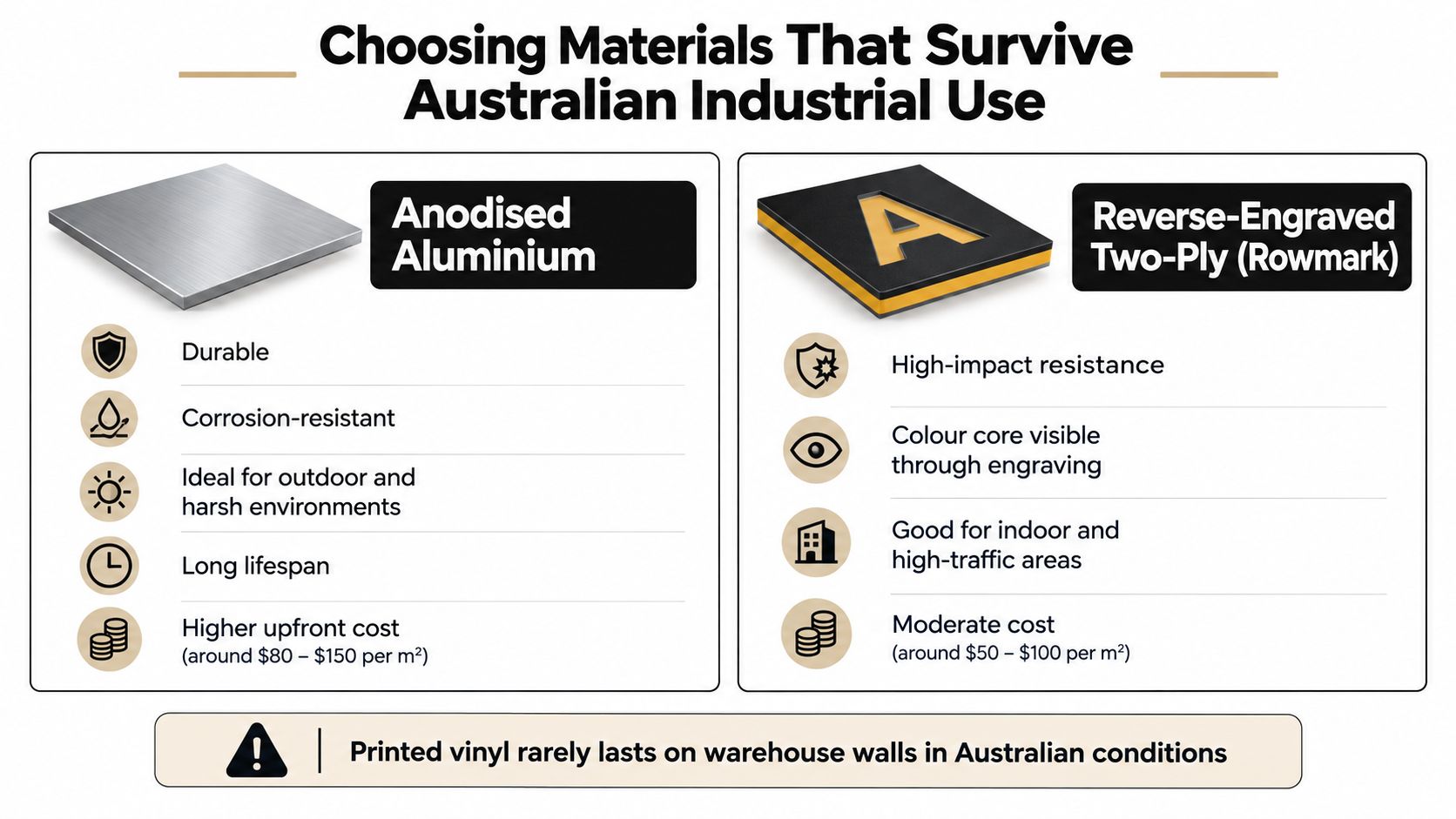
A gate sign I fitted at a Brisbane freight depot tells the story better than any spec sheet. Eighteen months on, the printed vinyl panel beside it had faded to a pale ghost of the original, while the engraved plate still read cleanly from the cab of a moving truck.
Specify the exposure before the substrate. An internal corridor, a washdown bay and an external equipment compound shouldn't automatically receive the same construction. Ask what will touch the face: sunlight, cleaning chemicals, oils, tools, hands or moving equipment.
For hazardous chemicals, durability isn't merely a purchasing preference. Queensland WorkSafe's guidance for pool-chemical retailers calls for durable, weather-resistant placards that remain legible from normal approaches, with HAZCHEM lettering at least 100 mm high.
The comparison below is a starting point, not a substitute for checking a particular product's exposure rating.
| Material | Suited to | Check before committing |
|---|---|---|
| Anodised aluminium | Fixed external identification and gate signage | The marking method and finish, because the substrate alone doesn't establish how the legend will perform |
| Laser-marked stainless steel | Handled equipment plates, plant identification, demanding locations | Cleaning agents, the marking process and the contrast the finished mark delivers |
| Engraving laminates | Interior panels and moderate-duty locations | The actual Rowmark or traffolyte product and its suitability; front engraving through a cap layer and reverse engraving through a clear face are different constructions |
| Polycarbonate and rigid PVC | Larger panels | Whether the specified grade, finish and mounting arrangement suit the exposure |
| Self-adhesive vinyl | Temporary information, protected areas, planned replacement cycles | Whether the adhesive tolerates an oily, dusty or repeatedly washed surface |
For stainless work, the available stainless-steel sign options give a practical starting point for that conversation.
Permanent marking can outperform surface printing, but no marking method makes a plate immune to damage.
Reverse engraving protects the legend behind a face layer. Laser marking avoids reliance on an applied printed label, depending on the material and process. Neither construction survives deep abrasion, aggressive chemical attack or an unsuitable cleaning regime by default.
Trotec Laser machinery belongs in the production discussion because material and marking method must be specified together. Request a sample made using the proposed process, then assess contrast, cleaning compatibility and fixing details before committing to a run. A durable plate with an unsuitable adhesive is still a poor specification.
Designing Signs That Meet Australian Standards
I've watched a depot sign-off stall over a plate that looked completely professional. Correct colours, crisp logo, tidy branded border. The plate failed at the one thing that mattered: telling the approaching forklift driver what to do, at a size he could read from the seat.
That gap is where compliance lives. Safe Work Australia's asbestos guidance calls for clear, visible identification of asbestos-containing areas, plant, equipment and components, with warning signs conforming to AS 1319-1994 where direct labelling isn't possible. Visibility and continued maintenance sit inside the control itself, a long way from finishing touches.
Design starts at the decision point. Size lettering and symbols for the position where the reader must act: the driver at the gate, the pedestrian at the door. I measure letter height from the spot where someone has to commit to an action, never from wherever the installer happened to stand with the ladder. Then check contrast under the site's real lighting, because a combination that reads cleanly on an artwork proof can wash out under floodlights or full afternoon sun. Mounting height follows the same logic, and a truck dock will rarely want the same answer as a staff corridor.
Symbols carry weight where the hazard or the required action is unfamiliar, and plain wording such as Authorised Personnel Only Beyond This Point names both the condition and the boundary. Where parts of the workforce read other languages first, adding those languages beats shrinking the English text. A minimal text plate can still identify a room, provided it leaves the instruction inside a safety message intact.
The Queensland guidance noted earlier describes safety signs visible from up to 20 metres in all directions of approach. Treat that as a context-specific check, scaled down for a plant room door or an equipment plate.
Match the construction to the spot it occupies. An external gate wants a weather-rated rigid panel on secure fixings. A plant room suits engraved laminate or marked metal selected for the exposure, while a washdown area needs plate, adhesive and mounting assessed as a single assembly. Protected corridors rarely justify heavy construction, and a switchboard benefits from legible engraved identification kept consistent across the installation.
Brand elements belong in the border. Once a safety instruction gets forced into decorative typography or low-contrast corporate colours, the sign stops doing its job. Use workplace safety signage guidance to shape the specification you take to a supplier, then have the responsible site adviser confirm the applicable requirements. A sign maker's artwork approval doesn't certify the whole workplace for audit.
CCTV and Monitoring Signs Without the Privacy Mistakes
At a western Sydney depot I once found a gate sign warning that the premises were under 24 hour monitored surveillance. The recorder had been dead for months, and nobody could say where the footage had been going before that. The sign was still doing its deterrence job. It was also making a claim the business could not support.
A CCTV sign carries two functions, deterrence and notification, and a short warning slogan covers only the first.
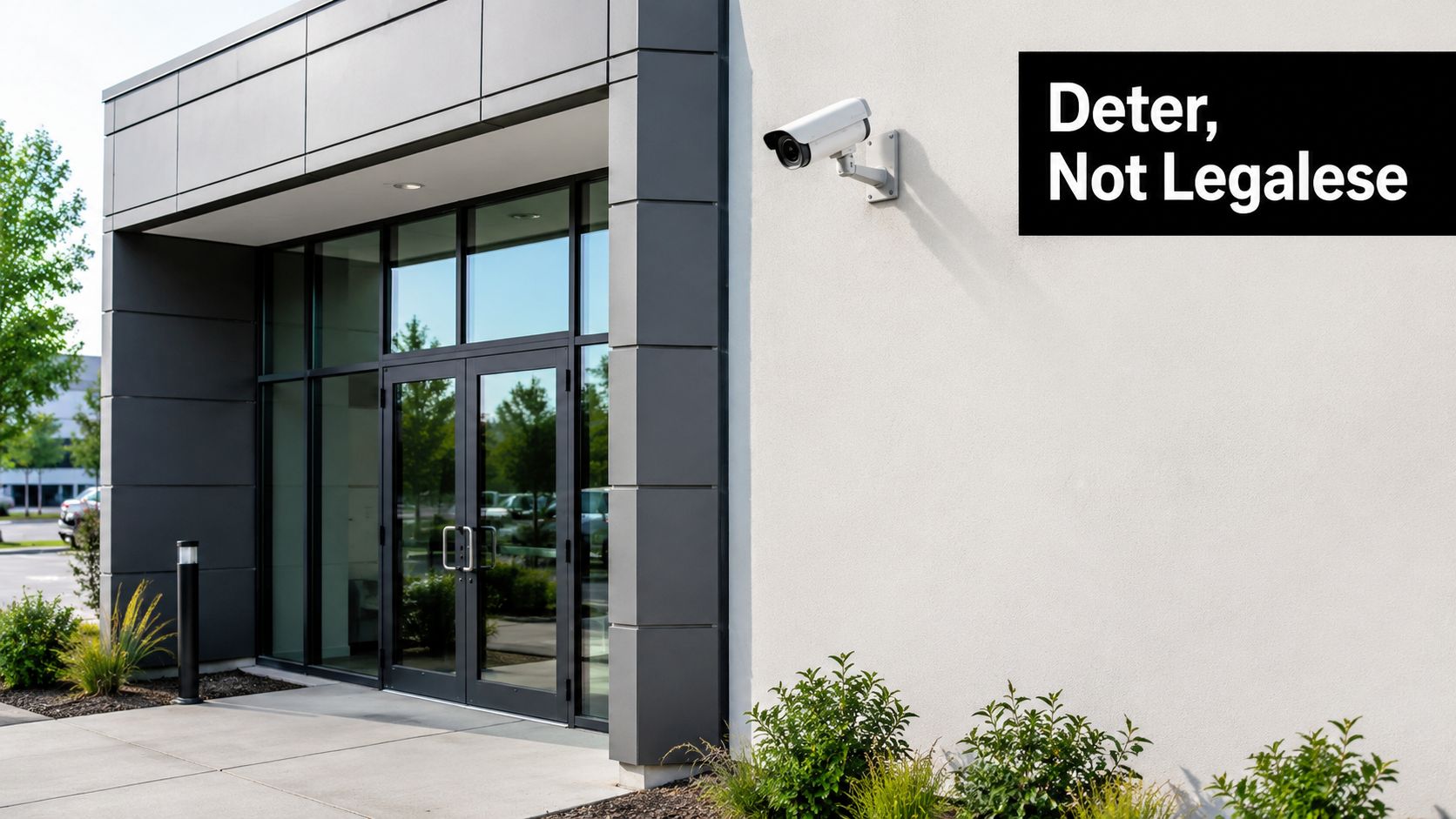
The Office of the Australian Information Commissioner's security-camera guidance says organisations covered by the Privacy Act generally must notify people before surveillance captures their image, secure the resulting personal information, and destroy or de-identify it when it's no longer needed. State and territory surveillance laws can also apply, so a camera icon and a slogan rarely close out the obligation.
A workable notice names the operator, describes the monitored area, and gives a contact point along with access to fuller privacy information. It also stays honest about the system's operating state. Recording and live monitoring are different things, and a sign should not imply someone is watching continuously unless that is true. Coverage matters as much as wording: compare the sign's position with the camera's field of view so notification happens before capture where that is required. If equipment has been removed or a service discontinued, the claim on the plate comes down with it, because Victoria Police's armed-robbery prevention guidance recommends signs or stickers clearly showing when protective equipment, including CCTV and monitored alarms, is in use. A truthful description beats an impressive but unsupported claim.
For the physical coverage side, Networking2000's guide to camera placement for businesses works as a supplementary planning resource alongside Australian privacy advice. The video below can also help frame a discussion with the installer.
A surveillance notice should describe what the business does with cameras and information, not what it hopes the reader will assume.
Before approving artwork, have the system operator and the person responsible for privacy review it together. That prevents the sign supplier from being asked to resolve policy questions through typography.
Placement and Visibility Best Practices
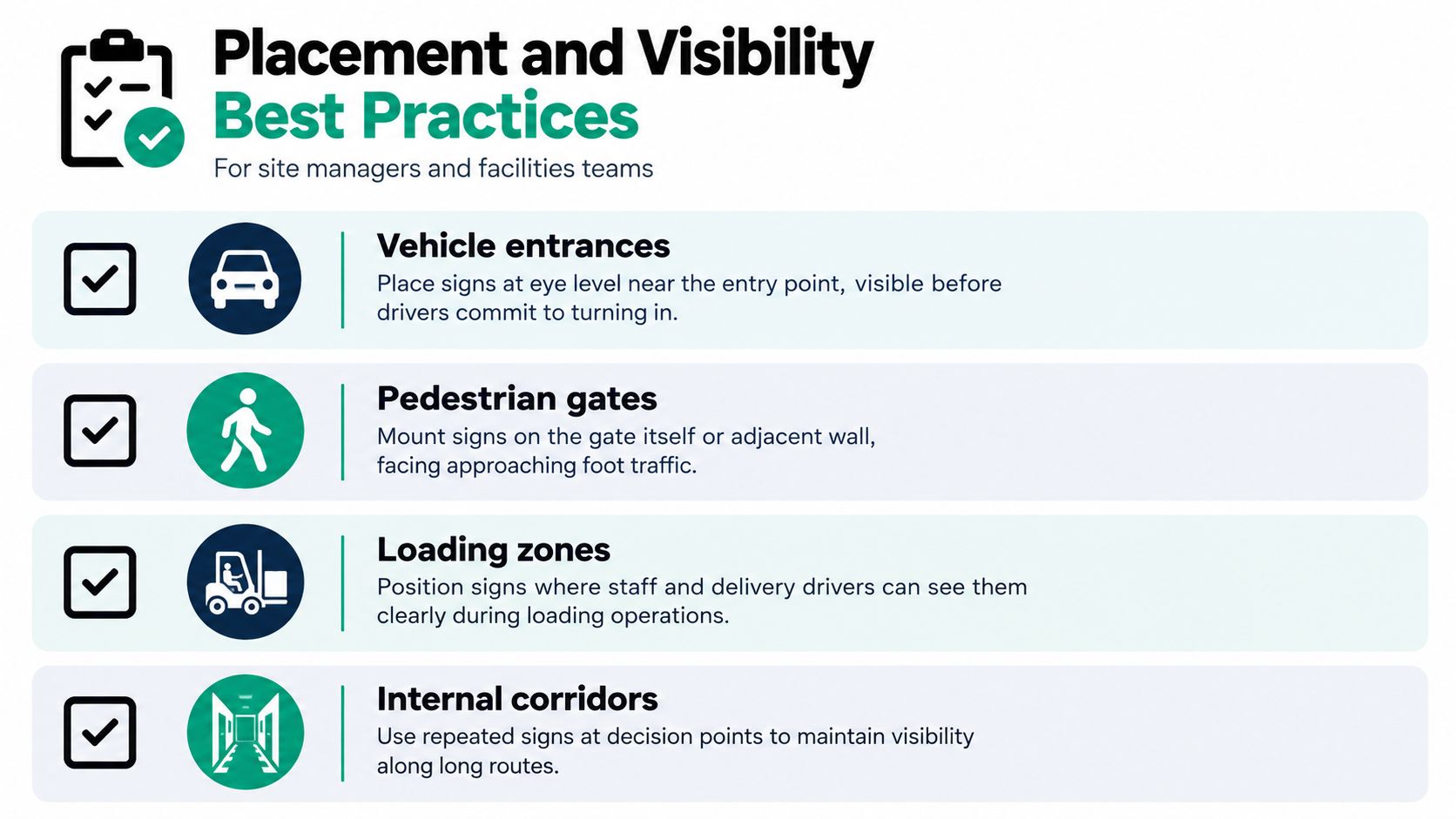
Walk the site as someone who has never visited it. Start outside the boundary, follow the delivery route and return through the pedestrian entrance. A sign that's obvious to an employee may be invisible to a driver concentrating on turning clearance.
Use the placement checklist as a route map, then test each location against real obstructions.
Check decisions before destinations
- Vehicle entrances: Put instructions where drivers can read them before committing to a turn or crossing the access boundary.
- Pedestrian gates: Face notices towards approaching foot traffic. Check visibility with the gate both open and closed.
- Loading zones: Account for parked trailers, stacked goods and forklift movements. Don't place the only instruction behind the activity it governs.
- Internal routes: Repeat essential directions at genuine decision points, not on every available wall.
- Controlled rooms and compounds: Check plant rooms, switchboards, chemical stores, server rooms and valuable equipment enclosures individually. Match the notice to the door or boundary it controls.
When reviewing camera sightlines, even a residential resource such as DLG Electrical's guide to choose and place home cameras can prompt useful questions about obstructions. Industrial coverage still needs its own assessment of traffic, equipment and operating conditions.
Prioritise immediate danger, access prohibition, mandatory PPE, emergency information and surveillance notice according to the decision at that location. Avoid assembling a wall of equal-sized panels where the reader has to search for the urgent instruction.
Keep the installation current
Assign an owner to the sign register and include condition checks in the site's inspection routine. Record the location, wording, construction and replacement requirement so maintenance staff aren't guessing what the damaged panel originally said.
Victoria Police's business arson-prevention guidance recommends removing graffiti within 24 to 48 hours to discourage repeat vandalism. That's a graffiti-response recommendation, not a statutory signage inspection interval.
For signs, set inspection timing according to exposure and consequence. Add checks after washdowns, maintenance, storm damage and layout changes. Replace or reposition a panel when it becomes faded, obscured, damaged or attached to equipment that has moved.
Customisation, Engraving and Working With Evright Industrial
A useful production brief connects the sign's message to its operating conditions. Sending a spreadsheet of wording without locations, exposure details or mounting requirements leaves the supplier to guess about decisions the site manager should make.
Custom laser engraving is one option alongside standard safety panels, replaceable labels and larger printed approach signs. Use each where it fits. Small permanent plates suit equipment identification; they aren't substitutes for entrance notices that must be read from an approaching vehicle.
Give the workshop a complete specification
Evright Industrial, the specialised industrial division of evright.com, provides engraving and asset-labelling solutions for applications including equipment identification, safety signage and custom commemorative plaques. For security projects, the useful connection is between a readable access notice and the fixed identification that helps staff manage the equipment or area behind it.
- Application: Identify whether the item is a restricted-access panel, fixed-asset label, switchboard ID or isolation-point plate.
- Site conditions: Supply photographs, cleaning products, exposure details and the proposed mounting surface.
- Artwork: Provide approved wording, symbols, asset references and any location-specific identification.
- Acceptance: Agree on material, finish, dimensions, fixing arrangement and the proof-approval process.
Trotec Laser machinery supports intricate marking and repeatable artwork, but the machine name alone isn't the specification. The production team still needs to match the substrate and marking process to the service conditions. Request a representative sample where appearance, cleaning or abrasion is a concern.
Workshop check: Approve the information first, the artwork second and the production sample where the application warrants it.
Move from approved proof to installation
Start a project discussion through evright.com, the parent engraving and awards business. A practical workflow runs from consultation and design through material selection, production, quality checking and dispatch; confirm those stages and approval responsibilities when placing the order.
For repeat batches, keep an approved artwork master and a controlled list of asset or location changes. Check spelling, identifiers, symbol selection and fixing positions before production rather than relying on installers to catch errors.
The strongest security-sign specification isn't necessarily the heaviest metal or the most elaborate engraving. It's the construction that preserves the right message, in the right place, for the people who need to act on it.
Evright Industrial offers custom engraved identification plates, asset labels and safety signage for business access-control and equipment requirements. Visit Evright Industrial with your site photographs, approved wording and exposure details to discuss materials, marking methods and mounting options for your project.
Recent Comments