

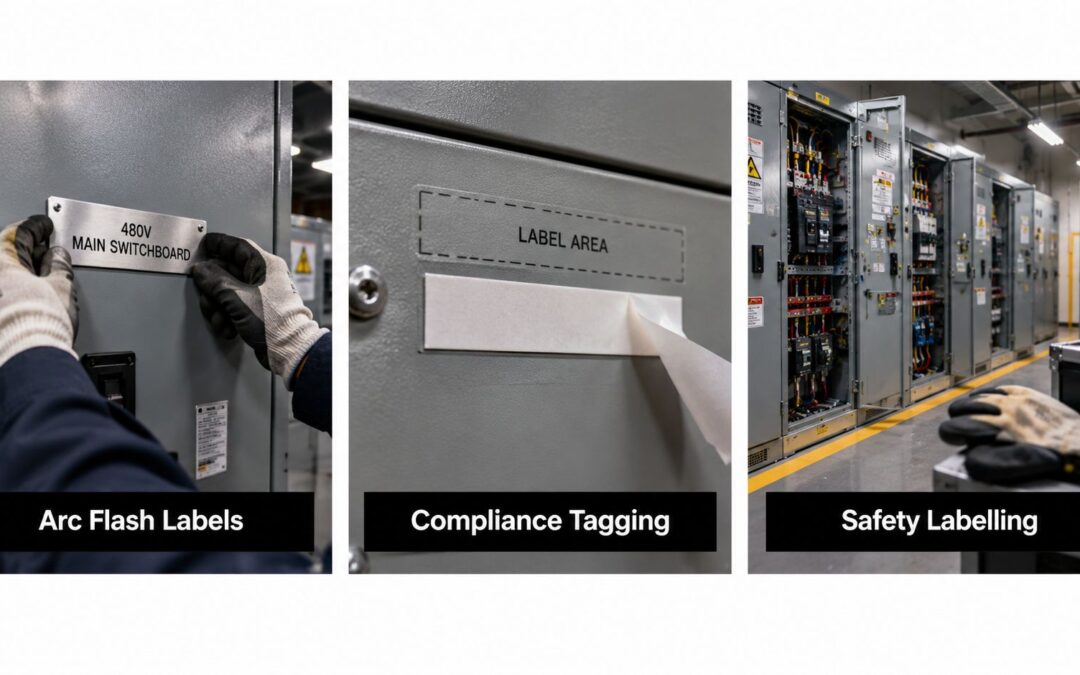
You're standing in front of a switchboard with a maintenance job waiting, production asking when the line will restart, and a warning sticker that's peeling at the corners. The voltage is readable, but the assessment date isn't. Before anyone opens the enclosure, you need to know whether that label describes the equipment as it stands today.
That's the practical challenge with arc flash labels. The engineering assessment has to be right, the information has to make sense to an electrician, and the physical marking has to survive the environment. An immaculate report in the office won't help much if the warning on the factory floor is unreadable.
Why Arc Flash Labels Matter on Australian Industrial Sites
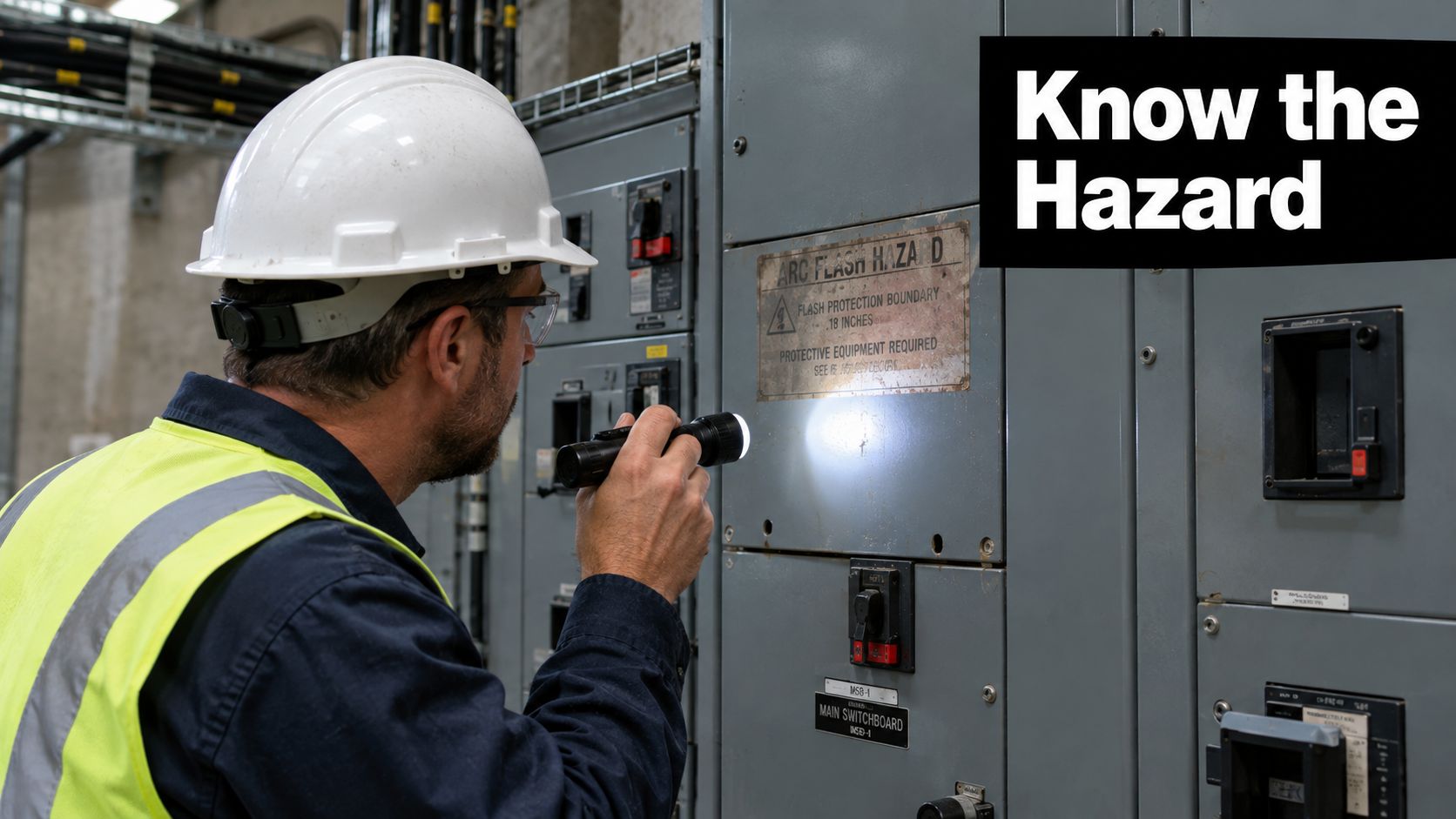
An arc-flash warning belongs where a worker can see it before accessing the hazard, not somewhere inside the compartment they've already opened. Its purpose is to identify the equipment, flag the exposure and communicate the assessed precautions at the point of work.
The consequences aren't theoretical. A WorkSafe Queensland incident alert reported 32 switchboard arc-flash incidents since 2013, including 20 involving injuries requiring hospitalisation, and seven associated enforcement notices during the reported period. Those figures document harm, not proof that labels alone prevent it.
The warning needs to be visible during the worker's initial approach.
Understand the Australian framework
Australian requirements sit within national standards, jurisdictional safety obligations and equipment-owner specifications. AS/NZS 3000:2018, the Wiring Rules, provides the broader installation framework, while AS/NZS 4836:2023 addresses safe work on or near low-voltage installations, including arc flash, arc blast, electric shock and electrocution.
An equipment-owner specification can add detailed requirements for enclosure warnings, label fields and work activities. Don't treat one organisation's colour scheme or template as a universal Australian format.
The practical sequence is straightforward:
- Identify the exposure. Have a competent assessor establish where an arc-flash hazard may exist.
- Apply higher-order controls. Consider de-energisation and engineering measures before relying on administrative warnings and PPE.
- Communicate the residual risk. Translate the accepted assessment into equipment-specific information that workers can read.
Practical rule: A generic electrical danger sticker identifies a hazard. An assessed arc-flash label communicates what that hazard means at that equipment.
Treat the label as a controlled record
The label is the final visible communication step, not the assessment itself. Its equipment identifier, voltage and protective requirements must match the accepted engineering documentation.
That changes the purchasing decision. You're not ordering coloured stickers. You're commissioning equipment-specific safety records, with technical accuracy, legibility and physical durability all part of the job.
What Goes on an Arc Flash Label in Australia
Start with the calculation, not the artwork. A label supplier shouldn't infer incident energy from the switchboard's appearance, nominal voltage or an old PPE category.
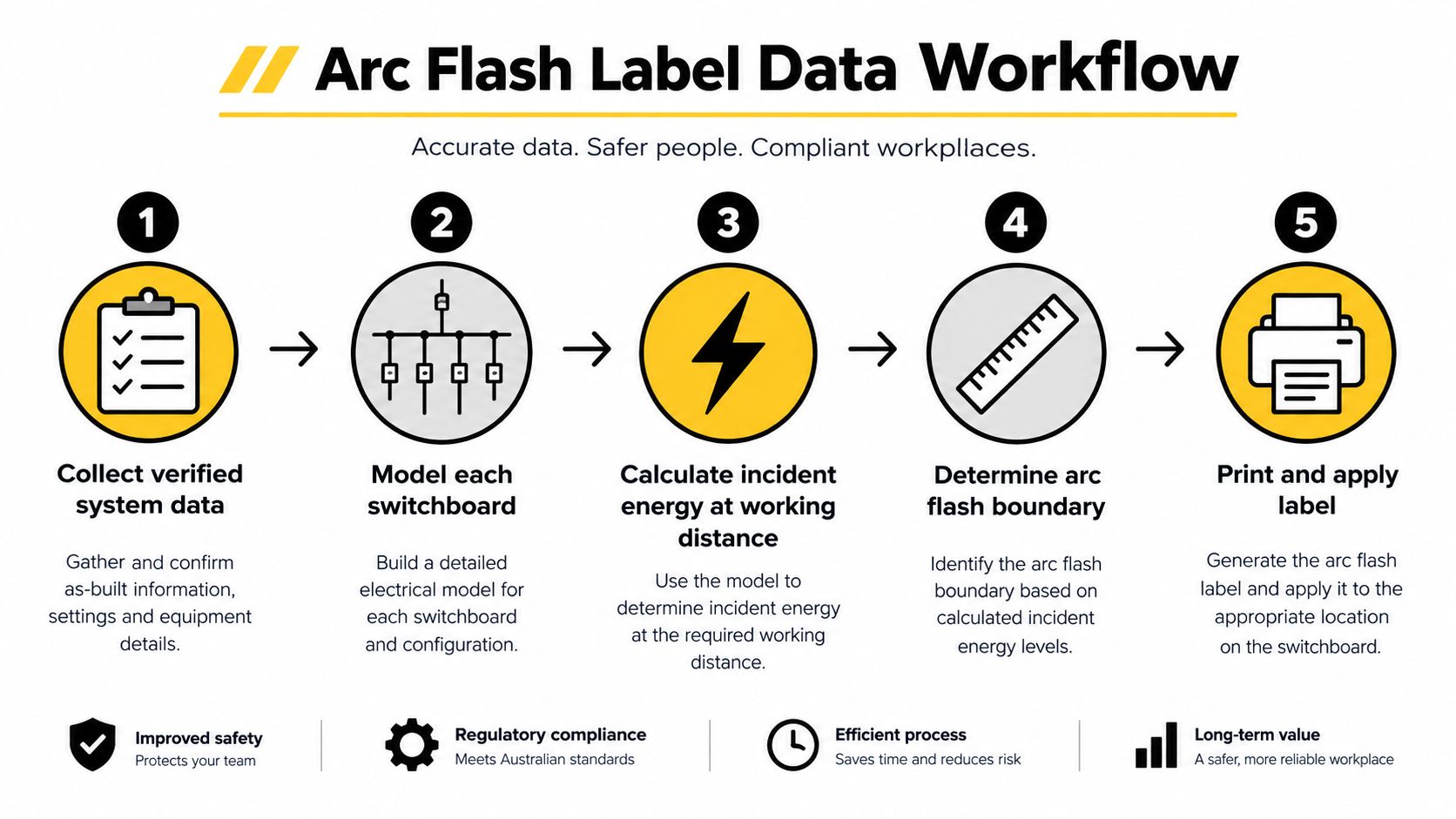
The Australian arc-flash hazard management guidance describes a workflow that connects verified system information to calculated exposure and the eventual equipment label.
Build the data before building the label
- Collect verified system data, including voltage, prospective fault level, protective-device characteristics, conductors and enclosure details.
- Model the relevant equipment, rather than assuming every section of a switchboard has the same exposure.
- Calculate incident energy at a stated working distance.
- Determine the arc-flash boundary and task-appropriate PPE.
- Independently review assumptions, particularly protection-clearing times and operating conditions.
- Release the approved label for installation, preferably near the incomer, with a process for subsequent updates.
The visual workflow summarises production, but independent review must remain an explicit approval gate.
Give the electrician usable information
Sydney Water's technical specification for arc flash requires assessed switchboard labels to carry nominal voltage, assessment date, asset or protection-device identifier, incident energy in cal/cm² at the stated working distance, arc-flash boundary in millimetres, minimum safe working distance and PPE category for each work activity. It also requires installation after acceptance of the final assessment.
Use that as a detailed benchmark, alongside the applicable site specification. Include the equipment or bus identifier, site and location information where required, and distinguish door-open and door-closed conditions when the assessment does.
The common production mistakes are avoidable:
- Missing working distance. The energy value can't be interpreted properly without its calculation distance.
- Category without context. A generic PPE category doesn't replace calculated energy or activity-specific requirements.
- Crowded artwork. Tiny fields and compressed abbreviations make technically correct information difficult to use.
Keep the label aligned with the wider switchboard labelling requirements, including equipment identification. A hurried worker with gloves and a torch needs a clear hierarchy of information, not a miniature copy of the engineering report.
Reading the Incident Energy Bands and Colours
Incident energy is the calculated thermal exposure at the working distance printed on the label. Read those values together before interpreting a category or choosing PPE.
Sydney Water provides a useful Australian operational example, but its categories and colours belong to its procedure. They shouldn't be copied onto another site's labels without acceptance by that site's electrical-safety authority.
Australian Arc-Flash Incident Energy Bands and Colour Coding
The following bands and associated hazard colours come from Sydney Water's arc-flash operational procedure.
| Category | Incident Energy (cal/cm²) | Label Colour |
|---|---|---|
| Category 0 | 0 | No hazard-band colour specified here |
| Category 1 | Up to 4 | Blue |
| Category 2 | 4–8 | Yellow |
| Category 3 | 8–25 | Orange |
| Category 4 | 25–40 | Red |
| Dangerous or above Category 4 | Above 40 | Purple |
The table is a screening reference, not a calculation method. At a shared band endpoint, use the classification assigned in the accepted assessment rather than independently rounding or reclassifying the value.
Read the number before the colour
Energy Safe Victoria's Arc Flash Hazard Management Guideline identifies incident energy above 1.2 cal/cm² as requiring appropriate PPE and explains that exposure at or above that level can cause severe burn injury. Its hierarchy also treats PPE as the least effective control, selected for residual risk after higher-order measures.
Colour helps workers recognise a category quickly, but it must remain a secondary cue. Dirt, poor lighting and surface deterioration can make colours difficult to distinguish, so retain readable category text and numeric values.
A coloured background can attract attention. It can't explain the working distance, operating condition or task restrictions.
Sydney Water's procedure also prohibits ordinary cotton and synthetic clothing in the specified exposure circumstances. Synthetic fibres can melt onto skin, while clothing can ignite during an event.
Use the approved PPE schedule for the actual task. Don't assume ordinary workwear is suitable because a label looks less severe than the one on the neighbouring board.
Choosing Materials and Production Methods That Last
The cheapest label is rarely the cheapest installed solution if a maintenance crew has to remove it, clean the enclosure and fit a replacement. Compare the complete construction, including substrate, marking, protective layers and attachment, rather than buying on material name alone.
A paper sticker that becomes unreadable after cleaning hasn't performed its safety function. However, no responsible supplier should promise that a particular sticker fails on a fixed timetable, or that an engraved label is indestructible.
Match the construction to the exposure
| Construction | Practical selection consideration |
|---|---|
| Screen-printed polyester | Request evidence for the complete ink, film and adhesive system under the site's cleaning conditions. |
| Vinyl stickers | Check suitability for heat, sunlight, oils and edge lifting rather than assuming all vinyl grades behave alike. |
| Printed labels with overlaminates | Useful protection depends on laminate compatibility, sealed edges and the underlying adhesive. |
| Etched stainless steel | Consider contrast, reflections, fastening and how any colour-filled areas will withstand cleaning. |
| Anodised aluminium | Confirm the marking process, anodised finish and chemical compatibility. |
| Engraving laminate or Traffolyte-type sheet | Specify the actual composition. Phenolic and acrylic products aren't interchangeable. |
For printed-film options, compare the construction as well as the substrate.
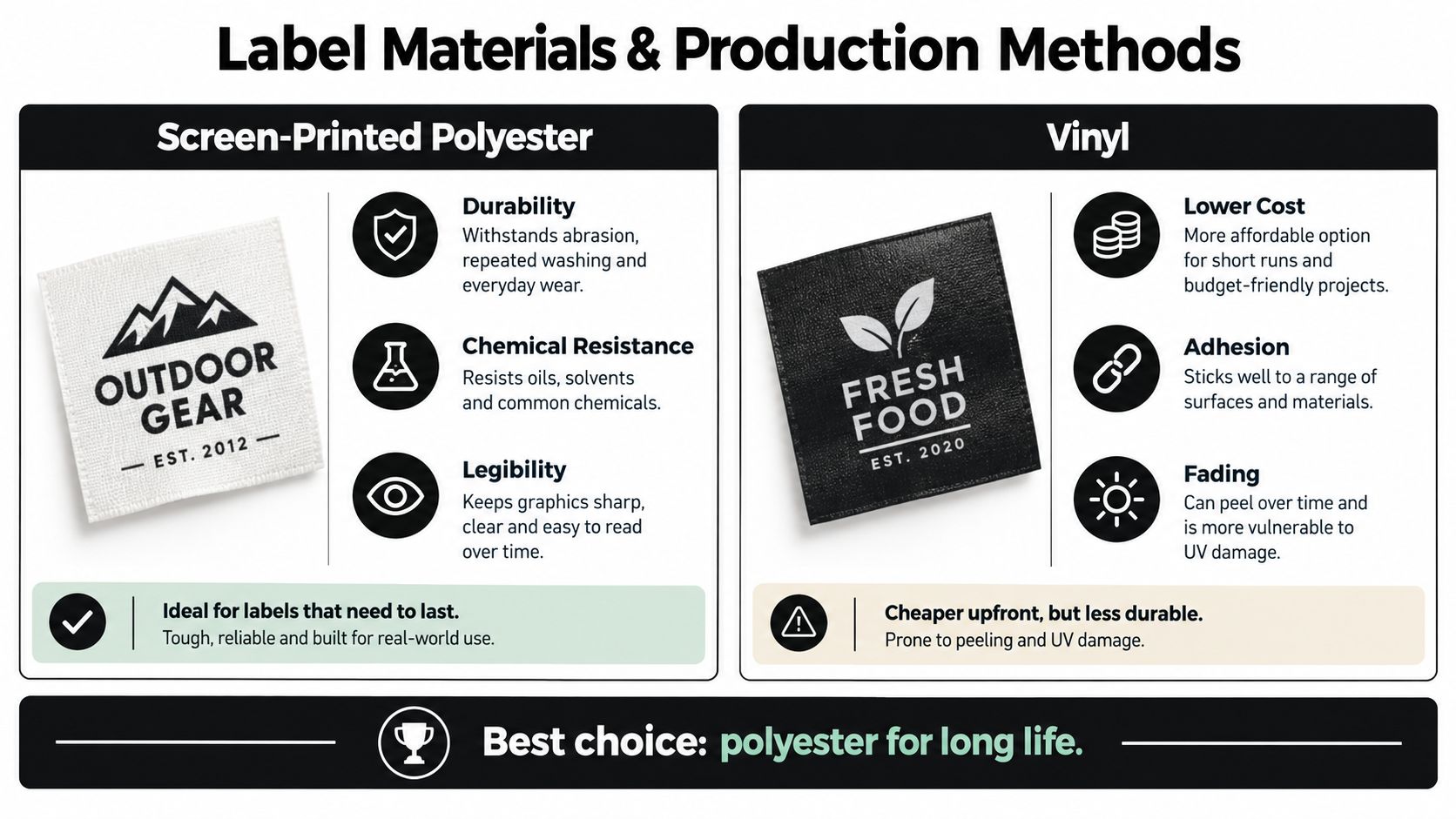
The chart is a starting point, not a substitute for product-specific testing. Review high-temperature label materials when panel heat is a concern, and separately check chemical wipe-downs, UV exposure and mechanical knocks.
Specify laser engraving without overpromising
Trotec Laser equipment uses a non-contact beam to mark or remove material at the surface. With a suitable laser-compatible engraving laminate or anodised aluminium, that can avoid relying solely on surface-printed text.
Laser engraving is a strong production choice for durable identification, but the substrate still matters. Colour layers, coatings and adhesives can deteriorate even when engraved characters remain readable.
The laser-engraving and awards specialist evright.com provides a practical route from approved artwork to engraved signage: select the substrate, confirm the layout and produce the marking using a workflow also suited to memorials and corporate signage.
Packaging has different priorities. Power Print's resource on labelled water bottles for events offers a useful contrast: event labels and switchboard warnings serve different purposes, so packaging decisions shouldn't become an industrial material specification.
Sizing, Placement and How to Fasten the Label
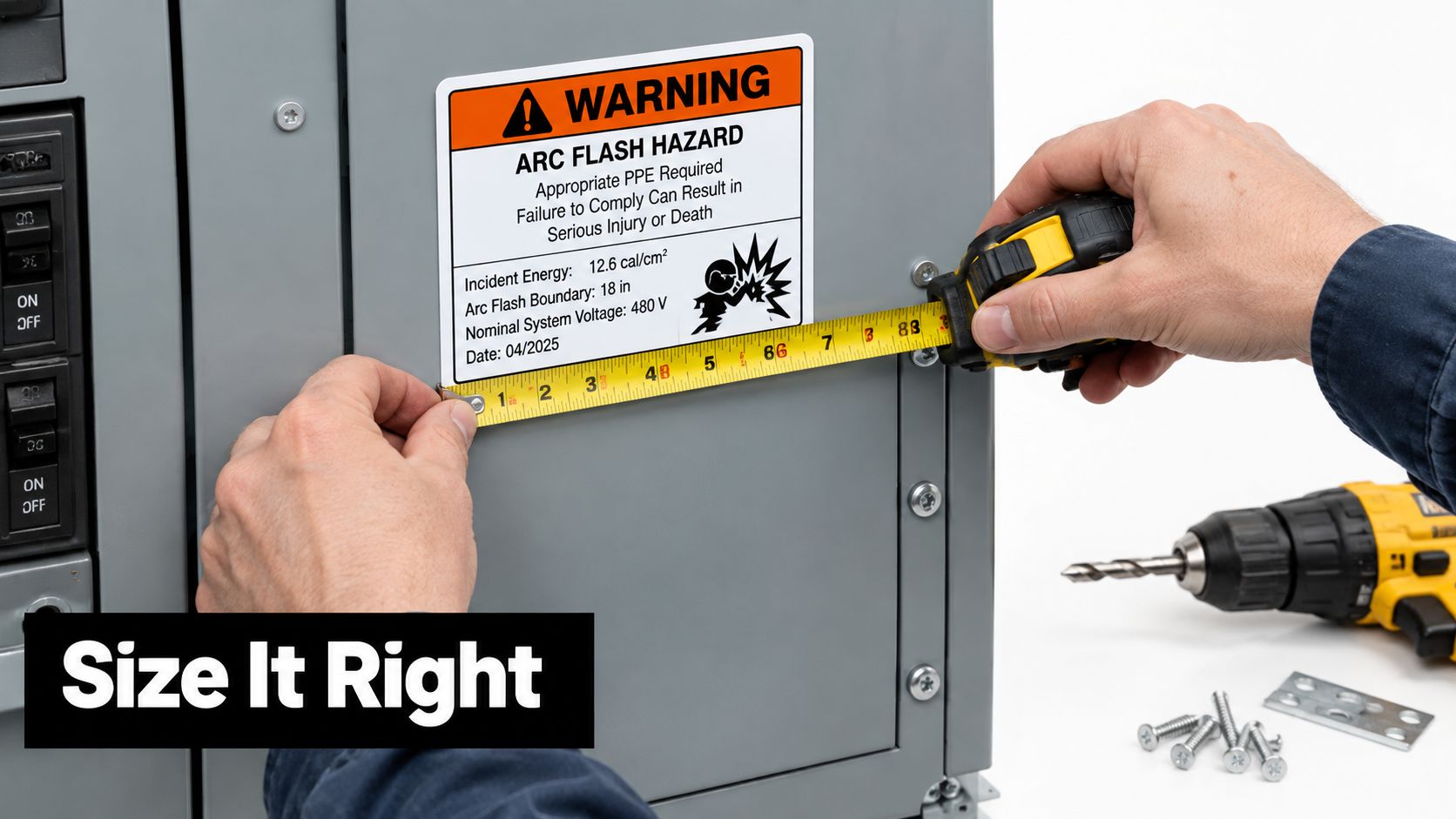
Size the label around readability, not the spare corner on the enclosure. There's no defensible universal text height or label area to prescribe without checking the applicable specification, viewing conditions and information load.
Measure the available surface before finalising artwork.
Position the warning before the access point
Recommend a conspicuous front position near the incomer, around eye level where practical. Check that handles, open doors, temporary notices and adjacent equipment won't obscure it.
If different compartments or operating states have different assessed exposures, identify those sections clearly. Any supplementary internal label should add information, not replace the warning needed before opening.
The Energy Queensland technical standard requires warning labels on relevant electrical enclosures where workers may access internal compartments or remove covers and an arc-flash hazard may be present. Its front-mounted switchboard labels communicate potential incident energy and required PPE for different sections.
Choose an attachment system deliberately
Pressure-sensitive acrylic products such as 3M VHB can be candidates for suitable smooth surfaces, but specify the grade against the actual coating, temperature and cleaning exposure. Screws, rivets or stand-offs may suit other applications, provided the enclosure manufacturer and responsible electrical person approve the fixing method.
Don't drill an energised enclosure or compromise its sealing and clearances to mount a warning.
Before handover, check:
- Surface preparation. Remove contamination and use the adhesive manufacturer's approved cleaner. Confirm whether an isopropyl alcohol wipe is compatible.
- Bond development. Follow application pressure, temperature and dwell instructions before loading or cleaning.
- Field readability. Check contrast, energy values and PPE information under realistic lighting.
- Installation evidence. Record the asset identifier and photograph the completed label.
For broader decisions about sight lines and competing notices, consider practical signage advice from Safety Space.
Use the video as a supplementary visual reference, not an installation specification.
What the Label Does Not Replace on Site
A prominent warning is not permission to work live. It communicates assessed equipment conditions; it doesn't authorise the worker's chosen method.
The distinction matters because an equipment label and a task assessment answer different questions. The label records calculated exposure and protective requirements, while the task assessment considers what the worker is about to do and what could initiate an event.
Check the task, not just the category
Switching method, door position, racking, test instruments, tools and isolation status can change the exposure circumstances. A worker shouldn't assume that a label prepared for one activity applies unchanged to every intervention.
Melbourne Water's risk-based approach illustrates the distinction: workers start with the default PPE shown on the label, assess the task and potential initiators, and reduce PPE only where a written task risk assessment justifies it. That's an organisation-specific procedure, not a general licence to downgrade protection.
The Energy Queensland document cited earlier also records 13 Western Australian mining workers injured during 2011–2015, requiring medical attention or restricted duties. Those incidents reinforce the need for labels to support de-energisation and other higher-order controls, rather than substitute for them.
Stop-work test: If the equipment configuration no longer matches the assessment, don't improvise a new PPE category from the old label.
Escalate uncertainty before work starts
Suppose a label displays Category 4, but maintenance has changed the protection settings since the assessment. That doesn't automatically prove the printed energy is wrong, but it makes the label unverified until a competent assessor checks the change.
Stop, establish the applicable safe-work process and escalate. Where work can be de-energised, isolation and verification of de-energisation must follow the site's competent electrical procedures.
A wider workplace safety signage system should make responsibilities and access restrictions clear. Even excellent signage can't compensate for an unsafe work method, unsupported assumptions or a worker proceeding beyond their competence.
Reviewing, Replacing and Documenting Each Label
A label can remain perfectly legible while becoming technically obsolete. Maintenance managers therefore need separate checks for physical condition and engineering validity.
SafeWork NSW's electrical-work guidance reports more than 1,000 electrical incidents and nearly 600 injuries since 2020. Those figures concern electrical incidents broadly, but they underline why hazard information needs active management rather than a fit-and-forget approach.
Set an approved review schedule
Have the responsible electrical engineer or asset owner define the periodic review interval and record the next due date. Don't adopt an unsupported universal replacement cycle, and don't wait for that date when the electrical system changes.
Reassessment triggers should include:
- Protection changes, including settings, devices and clearing characteristics.
- Supply changes, such as transformer replacement or revised network fault levels.
- Equipment modifications, including switchboard alterations, motor-drive upgrades, solar generation and battery connections.
- Work-method changes, including revised working distances or operating procedures.
Not every change necessarily alters the calculated energy. The competent assessor determines that, and records the decision.
Link the physical label to controlled documents
Maintain an arc-flash register that connects each label identifier to its asset, accepted study, source calculation, responsible engineer and review date. Keep superseded artwork out of the production folder so an old label can't be reordered accidentally.
AGL's approach of using a numeric register reference is a useful governance model. For teams organising supporting records, VideoLearningAI's overview of types of compliance documents can help distinguish registers, procedures, approvals and inspection evidence.
Field inspections should check legibility, contrast, colour, adhesive edges and fastener integrity. Then compare the label's assessment reference with the current register and approved configuration, not merely the calendar.
Keep the installed label, its artwork file and its engineering source under the same change-control process.
Missing or obscured labels can undermine an otherwise complete assessment. NOPSEMA enforcement material and WorkSafe WA audit guidance recognise displayed labelling as part of implementation, so retain evidence of installation and subsequent inspection.
Replacement should close a documented change, not conceal uncertainty. Ask the engraving team to preserve consistent asset references and artwork fields across sites, while the engineer retains responsibility for the technical values.
Evright Industrial offers precision laser engraving and durable asset labelling for switchboards and other industrial equipment. Bring your approved arc-flash assessment, equipment register and site exposure requirements to Evright Industrial to discuss suitable substrates, readable artwork and a consistent label production process.
Recent Comments