
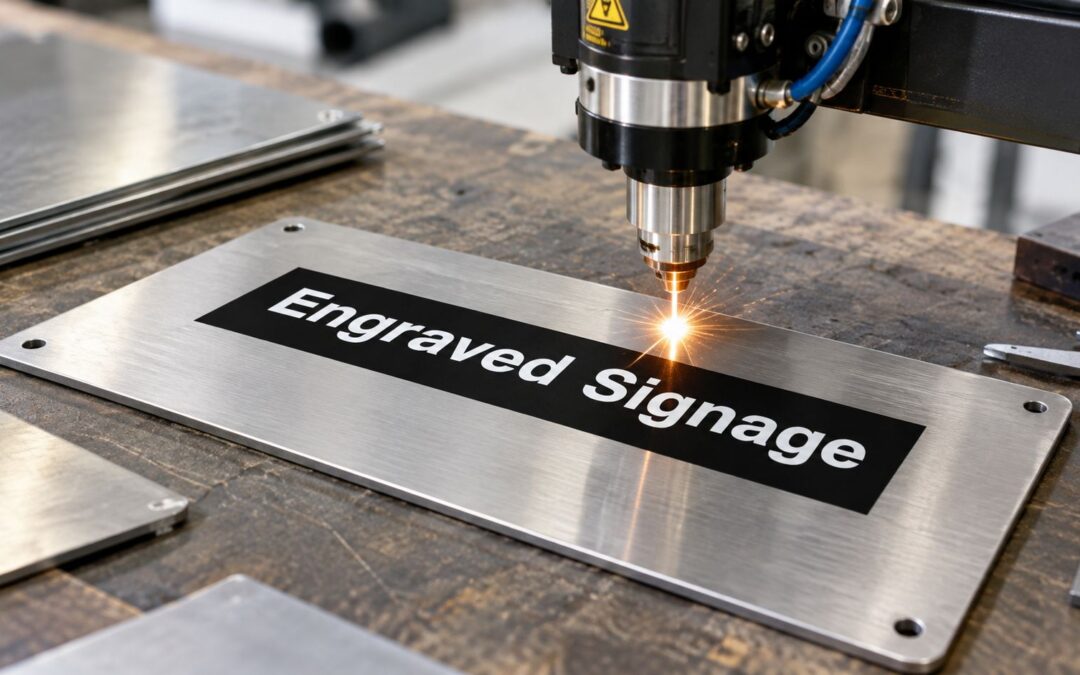
With 188 traumatic workplace fatalities in Australia in 2024, compared with 200 in 2023, engraved signage is a permanent, high-contrast form of machine marking or cut lettering used for durable asset identification, safety warnings and wayfinding in demanding industrial environments. In the same period, Australian workers recorded 146,700 serious workers' compensation claims, reinforcing why readable visual controls matter on every site.
A technician arrives at a plant room and finds three isolators identified by faded stickers. One label is peeling, another has been obscured by dust, and the third no longer matches the maintenance schedule. Nearby, a visitor follows inconsistent corridor signs towards the wrong service area. These are ordinary site problems, but they create hesitation exactly where workers need quick, unambiguous information.
Engraved signage helps establish a permanent visual layer across machinery, switchboards, pipework, transport areas, healthcare facilities and infrastructure assets. The result depends on more than choosing a durable substrate. Material, contrast, viewing distance, lighting, accessibility and production quality all affect whether a sign performs its safety role.
Why Engaged Teams Need Engraved Signage
A maintenance crew should not have to debate whether a damaged label identifies an emergency stop, an isolation point or an adjacent machine. On a busy manufacturing floor, vibration, oil, abrasion and repeated cleaning can leave a printed label as little more than blank adhesive. In a plant room, heat, moisture and chemical exposure can curl a low-cost sticker away from its surface. In hospitals and public facilities, inconsistent room identifiers can slow wayfinding for staff, contractors and visitors.
Engaged site teams treat those failures as visual risk-control problems, not minor presentation issues. They review where people need information, how far away they will stand, what lighting they will work under and which cleaning agents or contaminants the sign must withstand. That review guides material, contrast, mounting position and message length. A Trotec laser engraving workflow can support consistent artwork and repeat identification across equipment, while Evright Industrial provides compliant industrial signage solutions for demanding site requirements.
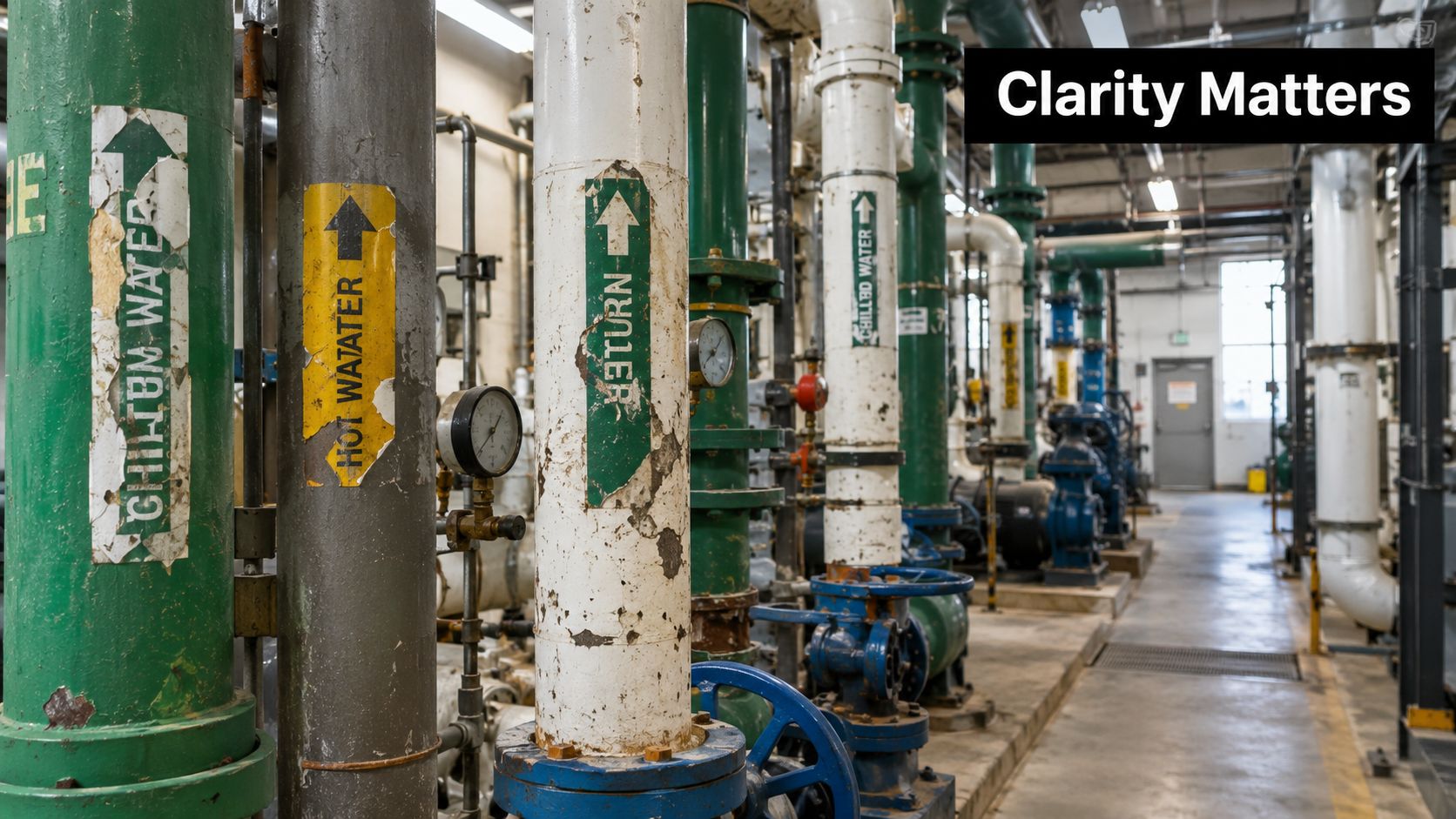
A visual control, not a decorative extra
Safe Work Australia's analysis found that being hit by a moving object or injured by an object accounted for 42% of workplace fatalities in 2024, while falls from height accounted for 13%. The figures do not prove that signage alone prevents these events. They do show why workers need clear identification, warnings and directional information at the point of work. Safe Work Australia's workplace safety analysis supports treating signage as one part of a broader visual risk-control system.
Practical rule: If a worker needs the information during a handover, isolation, inspection or emergency response, do not rely on a label that can disappear with the next cleaning cycle.
The sign supports the wider control system. Guarding, training, procedures and lockout controls still manage the hazard, while fixed identification helps workers locate the correct asset, confirm its identity and recognise the relevant warning. Evright's discussion of signage as a critical part of commerce and life gives teams a useful basis for assessing how permanent visual communication fits into site operations.
What Engraved Signage Actually Is
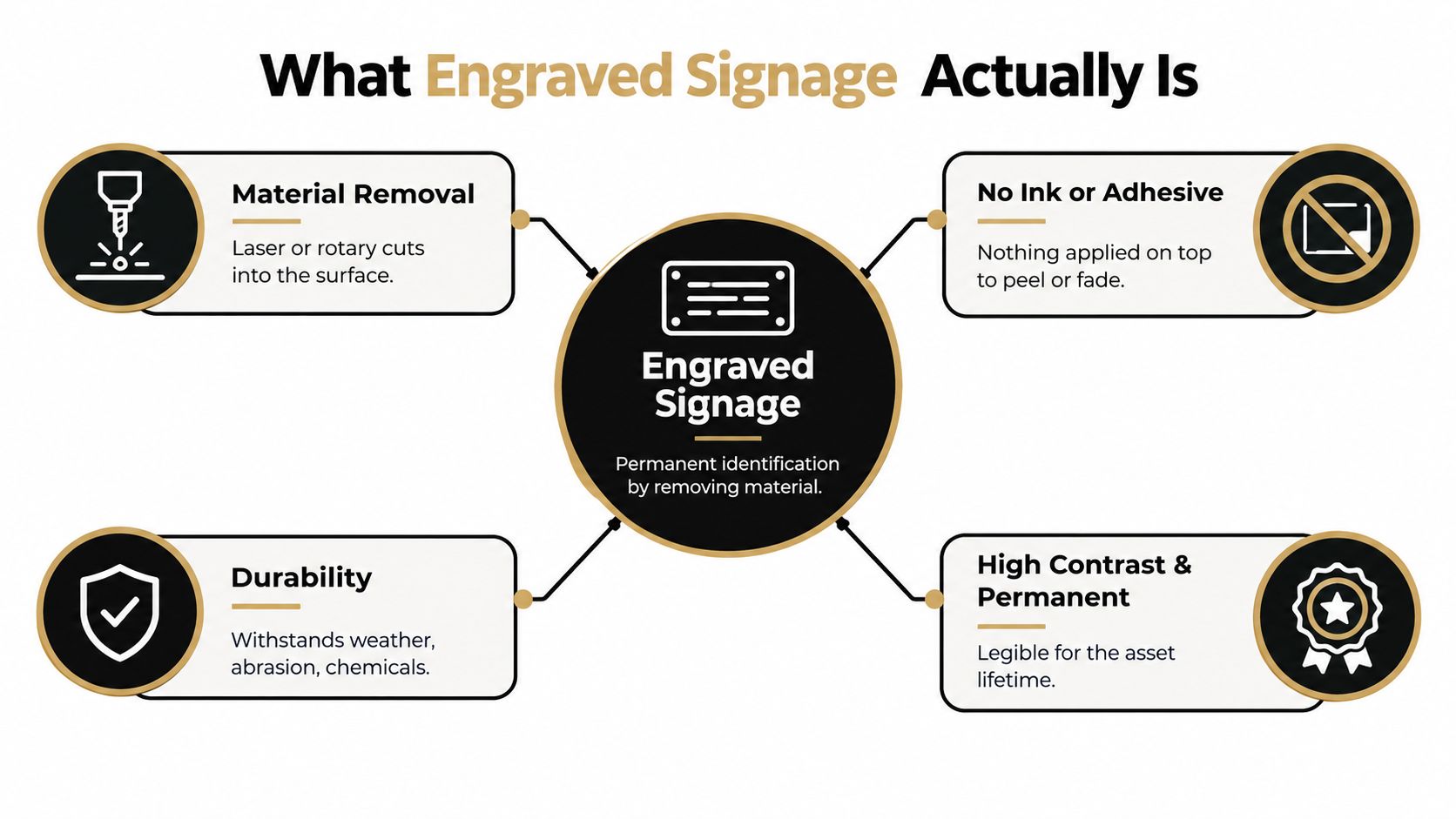
Engraved signage is identification created by removing material from a plate or altering its surface, rather than applying a printed message or adhesive film over the top. Rotary engraving cuts a channel mechanically. Laser engraving uses a focused beam to remove, darken or modify a controlled area of the substrate. Both approaches can create permanent information, but the correct process depends on the material, required finish and operating environment.
A printed label can be appropriate for temporary instructions, changing information or low-exposure applications. Vinyl decals are useful where a lightweight, replaceable message is required. They become a poor choice when the label sits beside abrasive equipment, receives frequent disinfectant cleaning or must remain legible through weather and handling. Engraving avoids the specific failure mode of a surface film peeling away, although the finished mark still needs enough contrast and depth for the environment.
How a Trotec laser creates the mark
A Trotec Laser machine follows digital artwork to control position, speed and energy across the workpiece. Depending on the material, the process can remove a top layer, expose a contrasting core, darken the surface or mark a metal through a controlled reaction. The operator first checks the substrate, artwork, character size, line weight and required contrast, then tests settings before production.
That machine-driven workflow matters when a project includes a long series of equipment tags. The same typography, spacing and numbering logic can be repeated across plates, switch labels, room signs and asset identifiers. It also allows the production team to preserve logos, symbols, arrows and machine-readable layouts without relying on inconsistent manual lettering.
For a practical explanation of how laser engraving and machine-led production work, visit evright.com, where the process can be considered alongside material and application requirements. The important point isn't that laser marking suits every sign. It's that a controlled production method makes it easier to match the mark to the substrate and the conditions in which people will read it.
Materials, Finishes, and Durability Trade-offs
No single material is right for every industrial sign. A stainless-steel plate may suit a harsh plant room, while an engraved plastic may provide clearer colour contrast on an indoor control panel. Aluminium can reduce weight where a large plate needs mounting, but the finish and marking method still need to suit abrasion, chemicals, UV exposure and cleaning.
Match the substrate to the worksite
Stainless steel is a sensible choice for equipment plates, electrical identification and exposed infrastructure where mechanical strength, corrosion resistance and a professional finish matter. It can be marked or engraved for asset numbers, warning text and technical information. Its strength doesn't eliminate glare, so brushed or suitably finished surfaces can be preferable where reflected light affects reading.
Aluminium is lighter and can work well for machine plates, switchboard labels, safety signs and outdoor identification. An anodised or coated surface can provide a contrasting layer for the engraving. The production team should confirm how the finish reacts to the selected laser process, because the desired result may be a bright exposed metal mark, a darkened mark or a removed coating.
Engineered plastics and composite panels offer useful colour contrast, low weight and design flexibility. They can suit internal room signs, control panels, pipe markers and equipment identifiers, provided the chosen grade tolerates the site's cleaning agents, temperature and impact conditions. A plastic that looks clear in a sample room may not be suitable beside a hot process or an aggressive chemical washdown.
The practical comparison is less about naming a universal winner and more about documenting the exposure:
| Site condition | Production question |
|---|---|
| Abrasion and handling | Will the face, infill or coating retain contrast after contact? |
| Oils and chemicals | Has the substrate been checked against the actual substances used on site? |
| UV and weather | Will the finish remain distinguishable in the installed position? |
| Repeated cleaning | Can the sign be cleaned without removing the contrast layer? |
| Mechanical impact | Does the plate need a stronger substrate, protected mounting or different location? |
Depth and contrast are connected
A shallow recessed mark can collect dust, oil or cleaning residue and lose visual separation. A deeper mark isn't automatically better if it creates a rough surface that holds contamination or weakens a narrow character. Infill colour can improve recognition, but it must be selected for the substrate, cleaning regime and lighting.
Before approving a batch, ask for a sample made from the proposed material and finish. Check it under the lighting and from the distance used by operators, not only on a desk. Evright's laser marking materials information provides a useful starting point for comparing substrates and marking approaches.
Compliance, Legibility, and Accessibility Rules
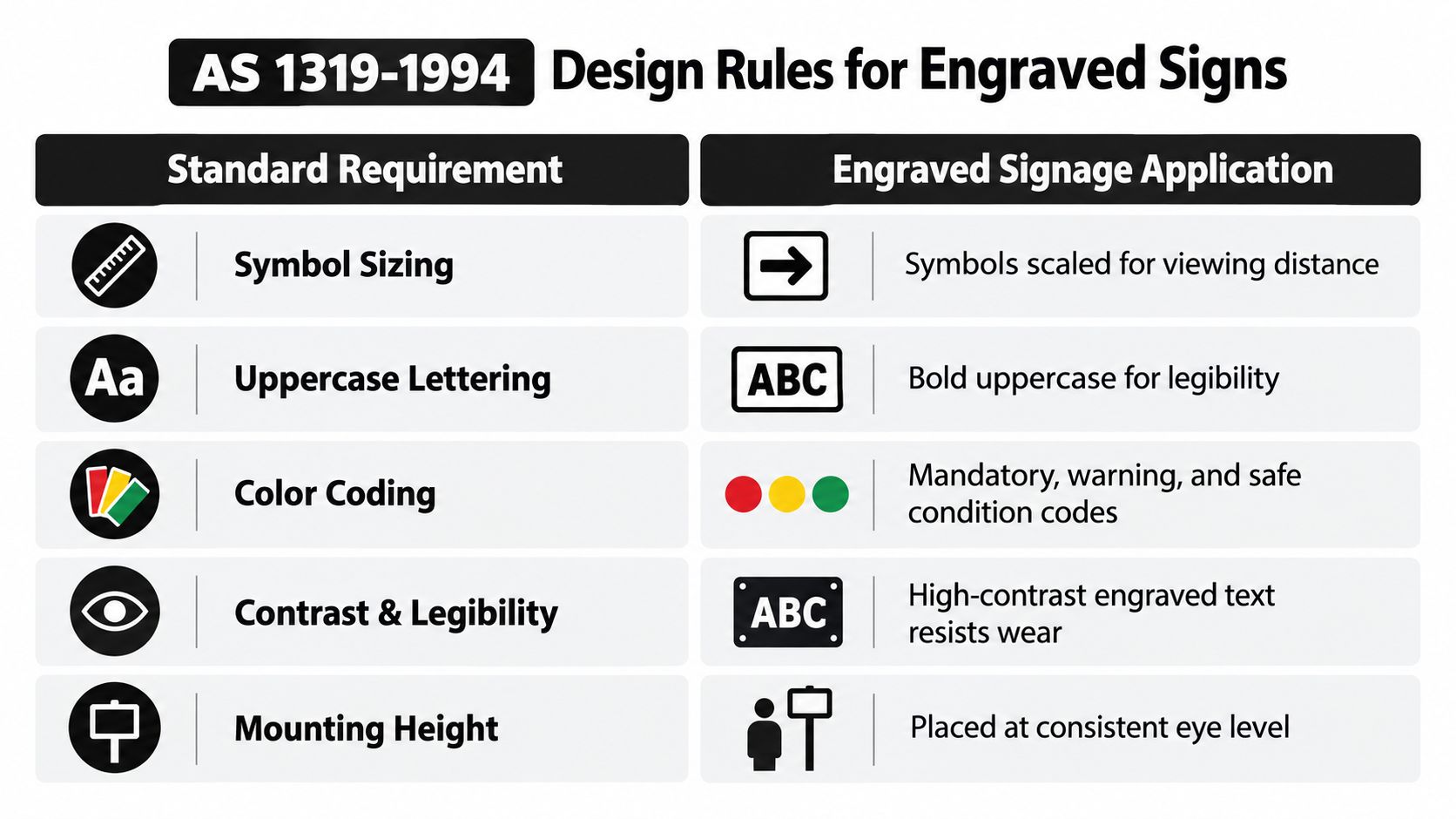
A durable sign can still fail if workers can't read it from the required position. Australian workplace safety signage follows the design principles of AS 1319-1994, which covers signs that regulate safety behaviour, warn about hazards and provide emergency or fire-protection information. The sign must suit its application, and workers should understand its purpose. The standard doesn't prescribe one mandatory material or one nominal sign size.
ACT WorkSafe guidance, referencing AS 1319-1994, recommends symbols of at least 15 mm in height per metre of viewing distance and uppercase text of at least 5 mm per metre under good lighting. Those dimensions should increase by at least 50% in poor lighting or difficult viewing conditions. At a viewing distance of 4 m, that means symbols of at least 60 mm and uppercase text of at least 20 mm in favourable conditions. ACT WorkSafe's signage guidance explains the relationship between distance, lighting and character size.
Design for the installed view
The sign should sit against a contrasting background, remain unobscured, stay clean and receive enough illumination. That means the design review should include the mounting position, expected viewing distance and likely contamination. A black infill on a pale plate may work in a clean corridor, while a plant room may need a different combination of substrate, infill and illumination.
Retroreflective materials can complement engraved identification where signs need to remain noticeable around vehicles, access points or low-light work areas. A practical reference on retroreflective tape materials can help teams understand where reflective treatments may support, rather than replace, permanent engraved information.
Accessibility introduces a separate production issue. The National Construction Code requires tactile characters to be raised or embossed between 1.0 and 1.5 mm, generally use sentence case, and normally have uppercase heights from 15 to 55 mm. Characters, symbols and sign edges need rounded profiles. The Code also requires Grade 1, uncontracted Braille, with raised domed dots positioned 8 mm below the bottom line of associated text and left justified. The National Construction Code requirements for Braille and tactile signs make clear why a recessed laser mark alone isn't enough.
Accessibility check: Treat tactile lettering and Braille as engineered components with specified relief, spacing and placement. Don't treat them as visual artwork added after engraving.
South Australian accessible-wayfinding guidance also recommends letters 17.5 mm high for each metre of viewing distance and at least 30% luminance contrast between a sign and its background. It places raised tactile and Braille signs 1200 to 1600 mm above the floor or ground. The South Australian accessible wayfinding guidance provides additional reference points for healthcare, government, infrastructure and commercial environments.
Industrial Applications That Matter on Site
The strongest applications for engraved signage fall into three connected groups: safety communication, equipment identification and wayfinding. Each has a different information need, but all depend on workers seeing the right message at the right location.
On a manufacturing floor, a plate may identify a machine, show an emergency stop, mark an isolation point or distinguish one production line from another. Pipe markers can use directional arrows and text to show flow, while switchboard plates can identify circuits, panels and service areas. The sign becomes part of the operator's physical reference system, particularly during maintenance and handover work.
Healthcare sites place different demands on the same principle. Room identifiers, service areas, plant rooms, electrical assets and emergency directions need to remain readable through regular cleaning and busy movement. Accessibility may require a combination of visual engraving, raised characters and compliant Braille rather than a single recessed plate.
Infrastructure worksites often combine permanent asset identification with changing site conditions. Equipment plates may sit outdoors, near vehicles, exposed services or maintenance zones. Wayfinding signs need clear arrows and strong contrast, while hazard signs need to remain visible beside barriers, access routes and work areas.
Signs work inside a larger control system
A Safe Work Australia survey found that 54% of surveyed workers identified posters, signs or notices at work as a source of work health and safety information. The same dataset recorded that, in 2014, Australian businesses most commonly obtained work health and safety information from government documents and publications at 33%, the media at 32%, and employer or industry associations at 31%. The Safe Work Australia survey on sources of WHS information places signage within a broader communication system.
That evidence supports a measured conclusion. Fixed signs are an established channel, but they work alongside training, procedures, supervision and other controls. An engraved warning won't make an unsafe task safe by itself. It can, however, keep a defined instruction, asset identity or hazard visible when workers need to act.
A useful site audit asks three questions:
- What must be recognised quickly? List hazards, isolation points, asset numbers and emergency information.
- Who reads it and from where? Record operator positions, visitor routes, maintenance access and viewing distances.
- What will attack the sign? Note cleaning chemicals, UV exposure, abrasion, vibration, heat, oil and impact.
Choosing Professional Trotec Laser Engraving and Evright Industrial
Professional production becomes valuable when a project includes repeated asset numbers, regulated signage, tight typography or multiple substrates. A Trotec laser machine can follow controlled digital artwork to produce consistent positioning, fine detail and repeatable marking. The operator still has to select suitable settings and verify the result, but the workflow reduces variation between plates.
A low-cost in-house approach can look attractive for a small label run, but it often shifts the difficult decisions to the buyer. Someone must confirm material compatibility, clean the artwork, manage numbering, test contrast, inspect every plate and maintain the machine. For a regulated or multi-site project, those checks matter more than the apparent simplicity of producing one sample.
Evright Industrial provides laser engraving and asset-labelling services for applications including safety signs, equipment plates, switch plates, electrical switchboards, stencils and product marking. Its work can cover industrial sectors such as manufacturing, electrical services, healthcare and government infrastructure, with production decisions based on the specified material and installation environment.
Ask for evidence rather than broad claims
A supplier conversation should cover:
- Artwork control: Can the production team manage revisions, numbering and repeat orders without changing the approved layout?
- Material selection: Has the proposed substrate been checked against cleaning, weather, chemicals and impact?
- Accessibility: Are tactile and Braille elements being produced as raised components where required?
- Inspection: What checks confirm dimensions, contrast, spelling, mounting holes and quantity?
- Project readiness: Can samples, packaging and delivery be organised around the installation sequence?
Sustainability also needs evidence. Australian Government sustainable-procurement guidance identifies energy efficiency, climate impacts, environmental impacts, circularity and recycled materials as relevant considerations. Its Environmentally Sustainable Procurement Policy expands from 1 July 2025 to certain furniture, fittings and equipment, ICT goods and textiles procurements valued at or above AUD 1 million, where tenderers may need to submit a Supplier Environmental Sustainability Plan. The Australian Government sustainable-procurement clause bank is relevant when buyers need to document supplier claims.
A long-lasting plate may reduce replacement waste, but durability alone isn't proof of sustainability. Ask about material origin, recycled content, expected service life, repair or replacement options, production waste, energy use, packaging and end-of-life pathways.
Visit evright.com for detailed information about how Trotec laser engraving, material testing and professional production workflows can be applied to an industrial signage project.
How to Evaluate Engraved Signage for Your Site
Start with the failure, not the product. Photograph labels that have faded, peeled, become illegible or been hidden by equipment. Record where workers hesitate, ask for confirmation or use an outdated asset number. Those observations reveal whether the site needs stronger materials, better contrast, larger characters, clearer placement or a more controlled production process.
Then specify each sign against its actual duty:
- Define the message. Separate hazard warnings, asset identifiers, isolation instructions, room names and directional information. Don't combine unrelated messages if doing so makes the sign crowded.
- Measure the viewing condition. Note the distance, lighting, mounting height and likely viewing angle. Use the relevant Australian guidance rather than selecting type size from a computer screen.
- Describe the exposure. Include cleaning products, oils, chemicals, weather, UV, heat, vibration, abrasion and impact.
- Select the construction. Compare stainless steel, aluminium, engineered plastics and composite panels. Decide whether visual engraving, infill, coating, raised characters or Braille components are required.
- Approve a site-relevant sample. Inspect it in the installed lighting and from the operator's position. Check contrast after cleaning and confirm that symbols, text and arrows remain easy to distinguish.
- Control the production record. Keep approved artwork, material details, numbering schedules and inspection criteria so replacement signs match the original system.
For metal plates and harsh-use identification, engraved metal labels may be a suitable option to investigate. The final decision should still follow the site conditions and applicable accessibility or safety requirements.
A capable Australian production partner should be able to discuss the substrate, mark, contrast, tactile requirements and installation context before quoting. That conversation is more useful than choosing a sign from a catalogue based only on thickness or appearance.
End users should also plan maintenance. Even permanent signage needs to remain clean, visible and unobscured. Include it in inspections, replace damaged plates promptly and update asset registers when equipment or room functions change.
Evright Industrial offers precision laser engraving and asset labelling for equipment identification, safety signage, switchboards, healthcare facilities and infrastructure projects. Visit Evright Industrial to discuss materials, Trotec laser workflows, accessibility requirements and a production approach suited to your site.
Recent Comments