

The scanner beeps, but the warehouse system rejects the read. A picker wipes the label on the tote, tries again, and gets the same result. The stock is physically present, yet the digital record remains uncertain. That small failure can delay a pick, send the wrong item to despatch, or leave an audit trail with a gap.
Barcode labels for inventory are asset-identification components, not disposable stationery. The material, adhesive, symbology, print method, placement and data structure all need to match the conditions the label will face. A label on a carton moving through an indoor warehouse has a different job from a permanent tag on a pump, a medical device or an outdoor pallet.
Australian operations also work within established identification frameworks. GS1 Australia says its standards have underpinned Australian retail since 1979, and that most major retailers require authorised barcodes because they support inventory management and point-of-sale operations. The right specification starts with the asset's full lifecycle, not the cheapest roll available.
Why the Right Barcode Label Matters on a Busy Floor
At 2 a.m., a smudged Code 128 label on a tote is rarely treated as a materials problem. The picker sees a failed scan, the supervisor reprints the label, and the team tries to recover the run. If the same issue affects several totes, the delay spreads into replenishment, packing and despatch.
That's why a barcode should be treated as the readable identity of a SKU, bin, pallet or fixed asset. It connects the physical object to the inventory record. When the printed bars fade, the adhesive lifts or the label surface becomes too scratched for the imager, the system loses that connection even though the item itself hasn't moved.
For a useful overview of how labels support receiving, storage, picking and stock control, see these best practices for inventory management. The operational principle is simple: every scan point depends on a label that remains identifiable at the moment a worker needs it.
Failure starts with the environment
A Brisbane yard exposes an asset label to intense sunlight, heat and dust. A Melbourne cold store introduces condensation, frozen surfaces and repeated temperature changes. A Sydney chemical plant may expose the same label to solvents, cleaning agents and glove friction. Each condition attacks a different part of the label construction.
A paper label can look perfectly acceptable when it leaves the printer. That sample tells you little about whether the face stock will retain contrast after outdoor exposure or whether the adhesive will remain bonded after a cold start. Production teams need to test the finished label on the actual substrate and against the dominant stressor.
Practical rule: Specify the label for the hardest part of its journey, not the easiest part of its first day.
Before ordering, record where the item will be received, stored, handled, cleaned, transported and audited. Note whether workers scan through shrink wrap, whether the barcode sits against a curved surface, and whether the asset must retain its identity for its entire service life. Those answers determine the label architecture.
Choosing the Right Barcode Symbology
The barcode format controls what data fits, how much space the symbol needs and how carefully the label must be printed. Start with the identifier and the scanning workflow, then choose the symbology. Don't select a format merely because the printer software offers it.
Code 128 is a practical general-purpose choice for warehouse labels, internal SKUs, serial numbers and logistics data. It can encode letters and numbers in a compact linear symbol, making it suitable where a handheld scanner is aimed at a reasonably flat label. For GS1 logistics applications, the data structure and Application Identifiers matter as much as the bars themselves.
Code 39 remains relevant in Defence and heavy industrial environments, particularly where established systems and legacy scanners already use it. It's usually less compact than Code 128, so the label may need more horizontal space.
EAN and UPC belong at retail and grocery interfaces. If a product already carries an authorised retail identifier, preserve that identity rather than creating an internal replacement for the receiving end.
QR codes and DataMatrix are useful when a small label needs to carry more structured information, such as a serialised asset identity, lot information or a link to a maintenance record. DataMatrix is common on small components and healthcare items, while QR codes are familiar to mobile devices and can support broader user interaction.
Match the symbol to the operating context
GS1 Australia's framework is the starting point for products entering a shared commercial supply chain. A retail item, an outer carton and a logistics unit may need different identifiers, such as a GTIN or SSCC, depending on the transaction and packaging level. Healthcare and regulated environments may require additional identifiers and data controls, so confirm the relevant system before artwork is released.
| Symbology | Typical use | Data capacity | Best for | Watch out for |
|---|---|---|---|---|
| Code 128 | Warehouse and logistics labels | Compact linear data | SKUs, serials and structured logistics data | Quiet zones, print contrast and bar width |
| Code 39 | Defence and industrial legacy systems | Moderate linear data | Existing heavy-industry workflows | Larger footprint and older scanner dependencies |
| EAN/UPC | Retail and grocery | Fixed product identification | Point-of-sale and retailer receiving | Authorised numbering and exact dimensions |
| QR | Mobile-friendly asset and product labels | Two-dimensional data | User access, service records and compact labels | Adequate module size and clear surrounding space |
| DataMatrix | Small components and healthcare | Dense two-dimensional data | Serialised parts and traceability | High print quality and correct decoding settings |
Keep the human-readable identifier on the label, but don't allow extra text to crowd the symbol. Quiet zones must remain clear, and a compact 2D code still needs sufficient module size for the scanner and surface conditions. For a practical example of how QR formats can support fixed-asset identification, review QR code asset tags.
Materials and Adhesives That Survive the Environment
A barcode label has two separate material decisions: the facestock carries the printed image, while the adhesive keeps that image attached to the asset. A durable facestock with the wrong adhesive still fails. So does a strong adhesive paired with a surface that scratches or loses contrast.
Paper with a suitable acrylic adhesive works well for short-life cartons in a dry indoor warehouse. It prints cleanly and remains economical when the label only needs to survive receiving, putaway and despatch. Moisture, rubbing and repeated handling quickly change that calculation.
Polypropylene, often called BOPP, and polyethylene are better suited to flexible or damp applications. They resist moisture and surface abrasion more effectively than ordinary paper, which makes them useful in cold stores where condensation can form as stock moves between temperature zones.
Polyester, or PET, is the usual choice for demanding asset identification. It offers a stable surface for thermal-transfer printing and can be paired with protective laminates where UV, abrasion or chemical exposure is expected. On a Melbourne wharf crate, a UV-stabilised polyester label is a more credible specification than a paper sticker, even if the initial unit price is higher.
Adhesive chemistry is part of the specification
Removable adhesives suit temporary location labels, reusable containers and changeable stock positions. They're deliberately designed to release, so they aren't appropriate for a permanent asset register.
Permanent adhesives are available in several behaviours. Rubber-based systems often provide strong initial grab and can suit general industrial surfaces. Acrylic adhesives tend to offer better resistance to ageing and environmental exposure. High-tack acrylic is useful on low-surface-energy plastics, textured coatings and difficult housings, but it needs the surface to be clean and properly prepared.
A freezer decal at minus 20 °C needs an adhesive that can wet the substrate and remain bonded at low temperature, not merely a face stock that looks waterproof. A chemical drum label needs a printed surface and laminate that can tolerate isopropyl wipe-downs. A label applied to oily equipment may require cleaning, a primer or a different adhesive altogether.
| Environment | Facestock | Adhesive | Why it works | Failure if wrong |
|---|---|---|---|---|
| Indoor warehouse cartons | Paper | General permanent acrylic | Clean print and economical short-term identification | Moisture ingress, tears and unreadable bars |
| Cold store | Polypropylene or polyester | Cold-temperature permanent adhesive | Handles condensation and low-temperature bonding | Edge lift or brittle adhesive failure |
| Outdoor yard | Polyester with UV protection | Weather-resistant permanent acrylic | Resists sunlight, rain and handling | Fade, cracking and loss of contrast |
| Chemical plant | Polyester with protective laminate | Chemical-resistant permanent adhesive | Supports wipe-downs and solvent exposure | Ink attack, swelling or label release |
| Low-surface-energy plastic | Polyester or polypropylene | High-tack acrylic | Improves contact on difficult plastics | Curling edges and early detachment |
For environments involving cleaners, oils or solvents, define the actual chemical exposure rather than using the broad term “chemical resistant”. Chemical-resistant labels should be selected against the substance, concentration, contact time and cleaning method.
Durability and the Cost of Label Failure
A failed barcode label costs more than a replacement sticker. Staff may need to identify the asset, pause or slow the process, remove the damaged label, clean the surface, print another one and update the record. If the item has moved to a remote yard or sits inside a sealed assembly, the intervention takes longer and may require specialised access.
Australian outdoor conditions expose the difference between a material decision and a low-cost consumable. One Australia-based asset-label supplier reports 98% readability after 12 months of outdoor Australian exposure for polyester or vinyl labels with UV-resistant barcodes, compared with 65% for standard paper-based labels. The figures, reported by AssetTrack Australia, support validating the finished label against its intended service environment rather than relying on appearance alone.
Diagnose the dominant stressor first
UV reduces contrast and attacks exposed surfaces. Abrasion removes bars through pallet contact, fork-truck handling and repeated wiping. Moisture can enter paper fibres or weaken an exposed edge. In cold storage, adhesive flexibility and application performance can deteriorate. Clean-in-place chemicals and solvents may attack the ink, laminate or adhesive layer.
Thermal label stocks are generally suitable only for short-term use up to 6 months and are not UV-stable in direct sunlight. Use that material guidance with the outdoor readability figures as one specification reference, not as separate evidence.
| Stressor | Typical service life | Common failure mode |
|---|---|---|
| Indoor dry handling | Short to medium term | Scuffing, tearing or adhesive contamination |
| Direct outdoor UV | Depends on material and protection | Fade, contrast loss and surface cracking |
| Cold-store exposure | Depends on application and adhesive | Edge lift, brittle bond or condensation failure |
| Pallet and tool abrasion | Depends on placement and laminate | Missing bars and scratched quiet zones |
| Solvent or cleaning exposure | Depends on chemical compatibility | Ink attack, swelling or label detachment |
The 2025 GS1 Australia impact report records more than 1.2 million barcodes tested since 2007, showing that verification is an established part of the local identification system. It also identifies 607,618 active GTINs in the National Product Catalogue, with almost two thirds used in healthcare and another 16% in food and beverage. In these sectors, scan quality supports stock control, recalls and compliance, so it cannot be treated as a cosmetic concern. See the 2025 economic impact report on supply-chain standards.
Make the calculation across the asset lifecycle. Identify the stressor, specify the facestock and adhesive, test the finished label, then compare replacement labour and downtime with the initial unit price. A cheaper label costs less only when it stays attached and readable.
Printing Methods for Industrial Barcode Labels
Choose the printing method from three questions: how long must the label last, what surface will carry it, and how often will the data change?
Direct thermal suits short-life shipping labels, temporary carton identification and documents that move quickly through a controlled environment. The printer uses a heat-sensitive coating and doesn't require a ribbon. That simplicity is useful, but the exposed image can fade or darken under heat, sunlight and friction. It's a poor choice for a fixed asset expected to remain identifiable for years.
Thermal transfer is the industrial workhorse for durable inventory labels. A ribbon transfers ink onto the facestock, allowing operators to pair paper with wax-resin for general warehouse stock, or synthetic materials with resin ribbons for stronger abrasion and chemical resistance. It handles variable data such as serial numbers, batch codes and locations, but the printer needs correct ribbon settings, pressure and temperature.
Laser marking earns its place when permanence matters more than label changeover speed. A Trotec Laser machine can mark suitable metals and engineered plastics without leaving a conventional printed layer that can peel away. The process needs material testing, correct focus and controlled artwork, particularly for small DataMatrix symbols or dense serialised information.
On-demand colour inkjet can work where branding, variable colour information or short-run customer-facing packaging matters. It isn't automatically the right answer for an industrial asset register, where black contrast, abrasion resistance and long-term readability usually matter more than colour.
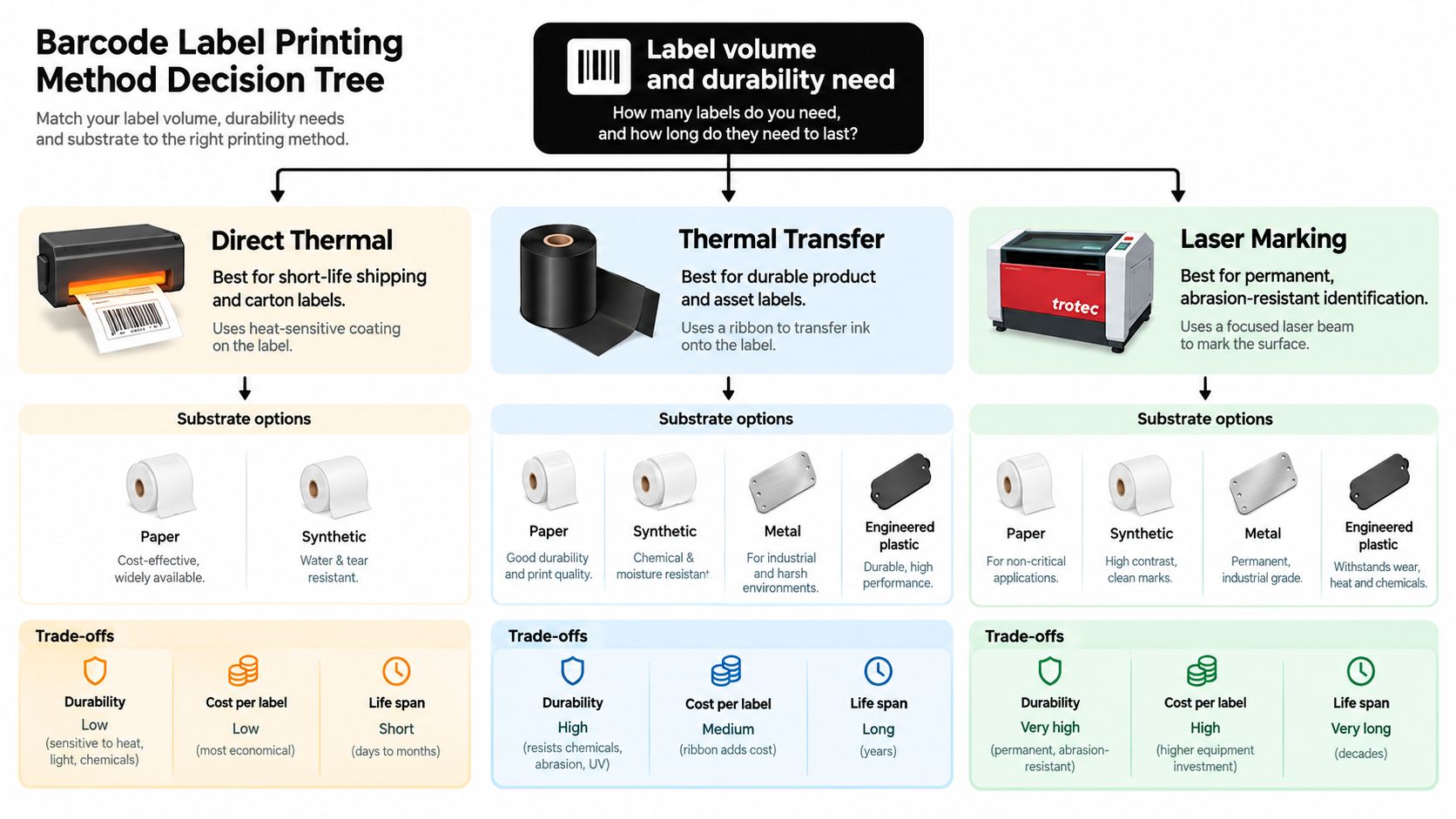
A practical decision tree
- Short journey and low exposure: Choose direct thermal for labels that only need to remain readable through dispatch or short-term internal movement.
- Durable synthetic label: Choose thermal transfer when the label needs a polyester or polypropylene substrate, variable data and resistance to routine handling.
- Permanent equipment identity: Choose laser marking or an engraved metal plate when the mark must remain with the item through long service, harsh cleaning or heavy abrasion.
- Changing data: Keep variable serial, batch and location information in a controlled print workflow, with approval before production.
- High-value or regulated asset: Validate the mark on the actual material and scan it with the equipment used on the floor.
Trotec Laser imagery and videos are useful for showing the marking process, but the visual demonstration shouldn't replace a material trial. A clean-looking mark can still fail if the contrast, depth or code geometry doesn't suit the scanner.
Australian Specifications You Can Model Your Labels On
Australian organisations often express label requirements through asset identity, placement and record control rather than through a generic request for “a barcode sticker”. Their documents provide useful models for building an internal specification, even when your operation isn't supplying government or healthcare customers.
Queensland Health's SAID guideline requires financial assets and maintainable items to receive a SAID number barcode label. It distinguishes white labels for financial assets and yellow labels for maintainable items, requires the label to be attached on receipt and specifies one SAID label per individual item. The Queensland Health SAID guideline shows how colour, timing and quantity rules can make an asset register easier to administer.
The University of Sydney's standard requires each asset to have a unique equipment code. Where a physical barcode is affixed, the physical code and associated asset information are captured as a single entry in the asset database, as set out in its Asset Identification and Labelling Standard. That linkage is critical. A durable label without a controlled database entry is only a mark, not a functioning asset identity.
Defence takes the permanence requirement further. Its policy says a Unique Identification mark must be applied directly to the item or to a securely fastened plate, tag or label, and that the mark is intended to remain permanent for the life of the item. Packaging labels also need to be applied when items are repackaged, while existing product labels cannot just be treated as inventory labels. The Defence automatic identification policy is a strong reminder to separate manufacturer information from the organisation's controlled inventory identity.
South Australia's TS0133 asset-label specification distinguishes an Asset Location Label from an Asset Identification Label and describes plate and tag formats. It also states that tag labels are attached with wire and connector or cable tie, according to the SA TS0133 asset-label reference.
| Element | Purpose | Typical AU specification source |
|---|---|---|
| Unique identifier | Connects the physical item to one record | Queensland Health, University of Sydney |
| Human-readable line | Supports visual checking during handling | University of Sydney and Defence practices |
| Barcode symbology | Makes the identifier machine-readable | GS1 and organisational asset systems |
| Colour convention | Separates asset classes or workflows | Queensland Health |
| Placement diagram | Shows where the label belongs | Defence and state asset specifications |
| Attachment method | Controls permanence on irregular assets | SA TS0133 |
| Change control | Prevents unauthorised identity changes | Regulated asset-register practice |
A mid-sized operation can borrow this structure without adopting every government-specific code. Document the identifier format, human-readable text, symbol, quiet zone, substrate, adhesive, placement, verification method and approval owner before production starts.
Placement and Scanning Workflows That Keep Read Rates High
A good label can still fail if a strap, seam, corner or shrink-wrap fold interrupts the scan. Apply the barcode to the flattest practical face, away from package joins and frequent contact points. Keep a clear quiet zone around the symbol, preserve the intended orientation and avoid placing it where a pallet runner or lifting point will scrape it.
On cartons, use a consistent placement zone so receiving staff don't hunt for the code. On drums and cable reels, consider a tag or a protected curved-surface position. On pallet bases, check that forklifts, pallet jacks and floor contact won't destroy the label before the next scan.
Build checks into every hand-off
At receiving, confirm that the label matches the purchase or asset record. During putaway, scan both the item and location where the workflow requires it. At picking and issuing, look for abrasion, oil, condensation, overlaminate damage and shrink-wrap tension before relying on the first scan.
Scanner geometry matters too. Excessive tilt, skew, glare and inconsistent standoff distance can turn a technically correct label into a frustrating one. Test the symbol with the actual handheld imager, mobile device or fixed scanner used by the team, rather than relying only on a desktop verification scan.
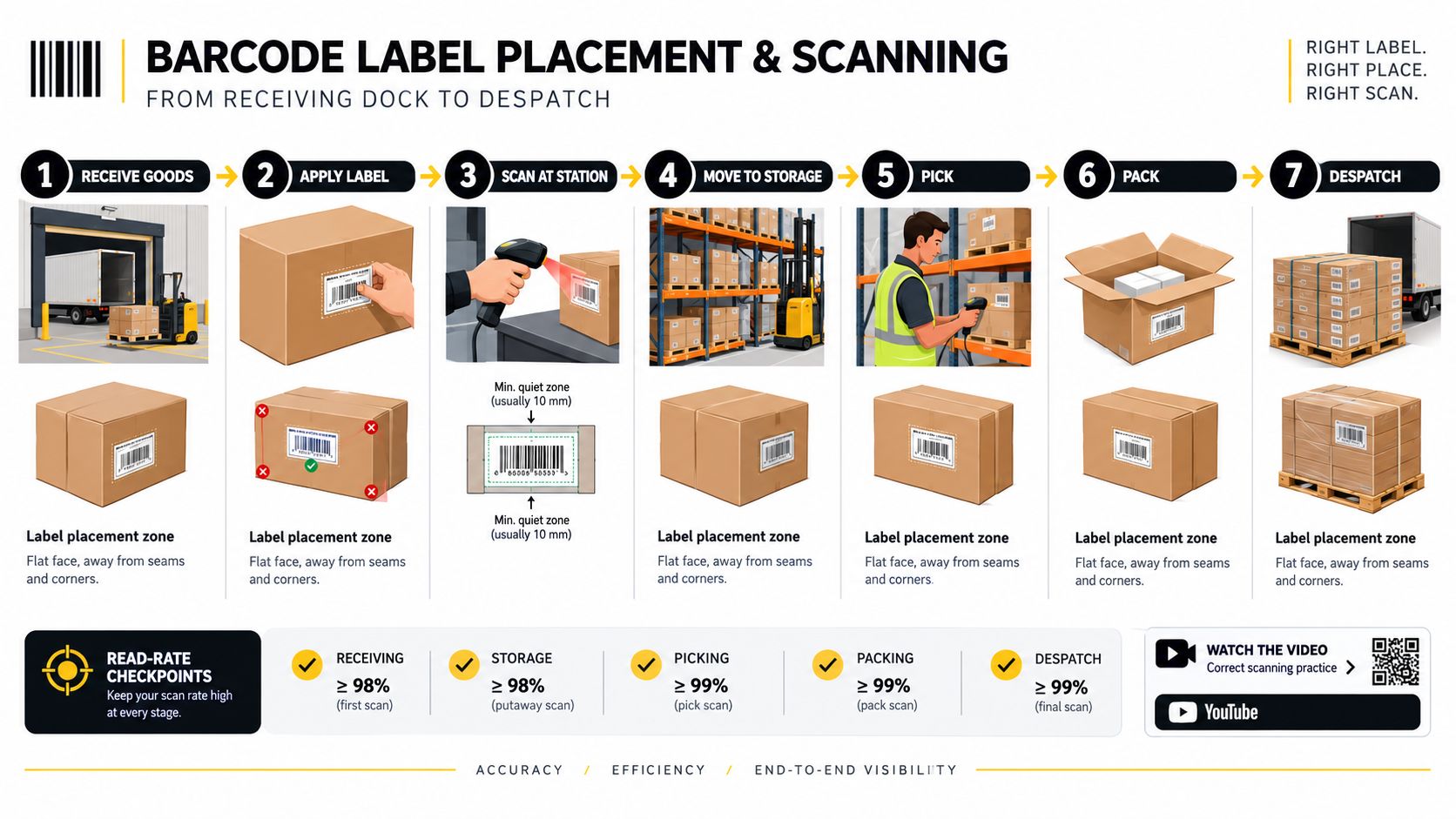
A short pre-shift check can catch defects before they stop a run:
- Surface check: Confirm the barcode face is clean, dry and free from torn laminate.
- Position check: Make sure seams, straps, wrap and corners haven't obscured the symbol or quiet zone.
- Data check: Scan a sample from receiving, storage and despatch equipment.
- Record check: Confirm the physical identifier opens the correct item or location record.
- Exception check: Quarantine labels that need repeated attempts instead of allowing them into normal circulation.
For teams formalising the workflow, this practical guide on tracking stock with scanning provides useful context for connecting physical scans with inventory movements.
The most reliable programme treats barcode labels as part of the asset register, not as a printer-room task. Review the specification whenever the asset, cleaning method, storage location or scanning equipment changes.
Evright Industrial produces durable asset labels, equipment identification and laser-marked solutions that can incorporate barcodes, QR codes and serialised data for demanding Australian environments. Visit Evright Industrial to discuss the substrate, marking method and attachment approach that fit your inventory lifecycle.
Recent Comments