

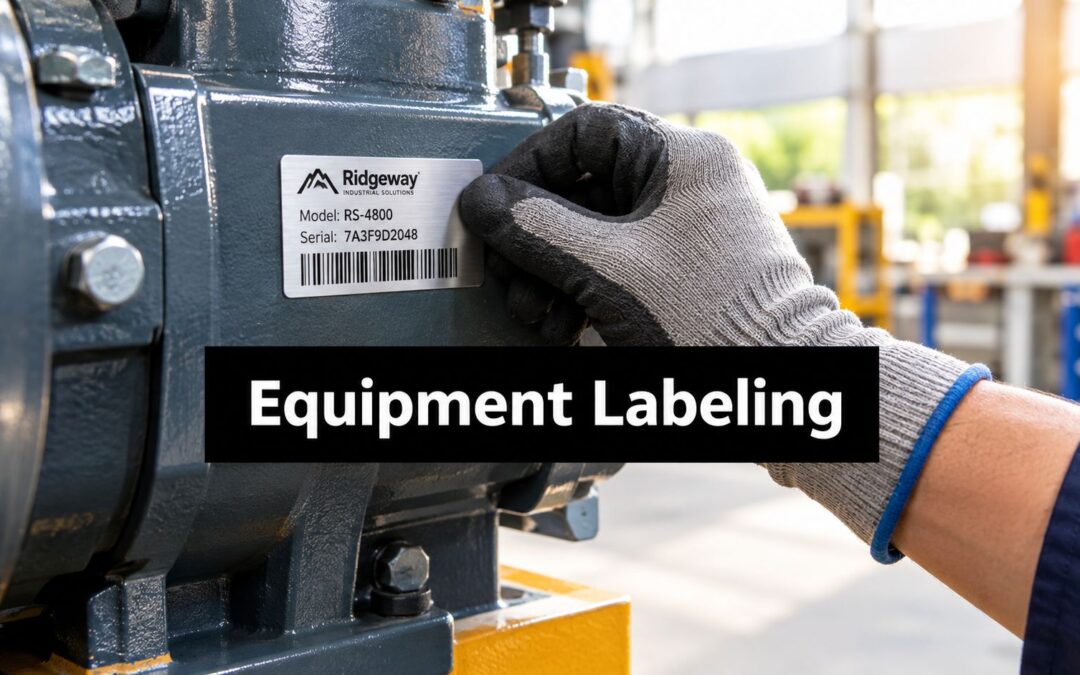
The audit starts before breakfast. A maintenance technician is standing in front of a switchboard with a faded adhesive label, an equipment register that lists two similar assets, and no obvious way to confirm which unit was tested last. The plant can't be isolated confidently, the service history is uncertain, and a simple identification task has become a safety and compliance problem.
That's where an equipment labeling system earns its keep. A durable mark is only one part of the system. The identifier must be unique, captured in the right asset register, positioned where people can see and scan it, and made from a material that survives the equipment's actual environment. Washdowns, chemicals, ultraviolet exposure, heat, abrasion and repeated handling will expose a weak specification quickly.
Australian operators also face overlapping requirements. The Regulatory Compliance Mark, workplace testing tags, safety signage rules, asset-register conventions and emerging medical-device traceability requirements can all affect how equipment is identified. The practical answer isn't to cover every surface with labels. It's to decide what each mark is communicating, who maintains it and what evidence supports it.
Why Your Equipment Labelling System Fails Before It Starts
A labelling system can fail before the first plate reaches the engraving bench. An outdated spreadsheet, an unverified number sequence and unclear installation responsibility are enough to create duplicate identities, missing fields and uncertain ownership. The labels may look orderly on delivery, while the underlying records are already unreliable.
The failure becomes obvious during an audit or breakdown. A faded plant number slows identification. A duplicated asset code can open the wrong maintenance history. A missing test indicator makes it harder to confirm whether electrical equipment is safe to use. The label is only the visible symptom. The problem is the broken link between the equipment, its record and the person responsible for acting on it.
Queensland Health's SAID guidance gives maintainable items and financial assets a useful structure. It calls for one barcode label per item, with the identifier recorded in the relevant system and installed in a standard, visible position wherever practical. For harsh conditions, it recognises alternatives such as etching and a separate label class for assets exposed to weather, harsh chemicals, infectious-control requirements or frequent cleaning. Queensland Health's SAID guidance is a sound reference for setting internal rules that remain consistent across sites and audits.

The system has three jobs
A working equipment labeling system separates three functions:
- Identify the asset: Give each maintainable item one durable identity.
- Support safe work: Show test status, warnings, isolation information or restrictions where required.
- Prove history: Connect the physical item with maintenance records, ownership, location and compliance evidence.
These functions may need different marks. A permanent asset plate does not replace an electrical test tag, and a warning label must remain visible rather than sit beneath a barcode. Each mark needs a defined purpose, owner and replacement process.
For systems that connect labels with equipment records, the Evright Industrial asset tagging and tracking system provides a relevant example. A durable plate can combine a human-readable identifier with a barcode or QR code, while software stores changing details such as location, service history and status. That separation helps preserve the physical identity when equipment moves or its condition changes.
Practical rule: If a technician cannot identify the asset and reach its current record without guessing, the system is unfinished.
Durability also depends on placement. Keep the mark visible after guards, covers and panels are fitted, but away from abrasion, standing water and routine chemical contact where possible. Confirm that the chosen material and marking method suit washdowns, solvents, ultraviolet exposure, heat and repeated handling. RCM evidence, WHS tagging and UDI-related traceability may involve different records, yet poor identification can undermine all three during inspection.
Trial a sample on the actual equipment before approving production. A plate that survives a clean workshop bench may fail in a chemical store, food-processing washdown area or outdoor infrastructure site. The specification should be based on the asset's full working life, not the day it is installed.
Planning Your Asset Register and Identification Rules
A label order starts with an asset policy, not artwork. Define what the organisation owns, maintains, isolates, audits or transfers between teams. The scope may cover plant and machinery, switchboards, electrical equipment, enclosures, portable tools, ladders, scaffolding components and site equipment. Mark only the items whose history, location, safety status or ownership matters.
Set the asset boundary before assigning numbers. Separate maintainable items from assemblies, consumables, spare parts and temporary equipment. A pump with its own service history usually needs its own identity. If a removable component is tracked separately, record its relationship to the parent asset rather than applying an unexplained second label.
Legacy equipment needs a controlled intake process. Items arriving without identifiers should enter a quarantine or handover queue until someone confirms the description, manufacturer, model, serial information, location and responsible owner. Search existing records before creating a new number. If no match exists, assign a new identity, photograph the equipment and retain the old supplier or site reference in the record as a cross-reference.
Set the identity before you set the artwork
Use this planning sequence:
Reserve one identifier. The number must remain unique and permanent in the register. Do not recycle a code after disposal. Give a replacement asset a new identity and retain the previous record under the organisation's document-control rules.
Choose a naming convention. A code may reflect a site, asset class or sequence. Avoid loading it with details that become wrong after relocation or ownership change. Keep the visible code short and readable, with richer information stored behind the scan.
Define the minimum record. At receipt, connect the identifier to the equipment description, manufacturer, model or serial information, location, owner, status and relevant maintenance history. A durable label cannot repair an incomplete register.
Set parent and component rules. State when a motor, control panel, guarding section or removable module receives its own record. Link related identities so technicians can see whether they are servicing a complete assembly or one component.
Write the placement rule. Specify the preferred position for each asset class, the required access height and the fallback when the surface is curved, exposed or unavailable. Record approved alternatives such as etching for difficult environments. Field improvisation creates inconsistent identification.

Keep the visible code useful
A technician should read the asset number at normal working distance. Use a sensible character size, strong contrast and clear space around any barcode or QR code. Keep the scan target off bends, welds, hinges, drain paths and surfaces operators routinely grip.
The University of Sydney's asset identification practice highlights the value of unique equipment codes and defined barcode placement. Consistent positioning reduces search time and lets different teams scan assets in the same way. Australian rail identification guidance also supports marking physical objects early in the value chain, ideally at manufacture, with both machine-readable and human-readable identification.
RCM records, WHS tagging and UDI-related traceability may sit in different systems, but each depends on a reliable identity. Give the identifier an owner, an approval path and a correction process. The The SAID framework remains a useful model for organising those responsibilities, even where an industrial operator uses different software.
For equipment received from several suppliers, make identification part of handover. The receiving person confirms the number, scans the mark, checks the record and photographs the installed position when access is restricted. For unfamiliar components or incomplete documentation, riconoscimento pezzi con foto e OCR provides relevant context for identifying industrial parts from photographs and OCR.
Use the Evright Industrial asset tagging template to brief label content and placement. Assign one person to control number allocation, another to approve artwork and a named owner to correct the register after installation. That ownership is what keeps the system accurate after equipment changes hands, moves location or returns from repair.
Choosing Materials and Production Methods That Survive Harsh Environments
The cheapest label is often the most expensive choice once access, labour and downtime are included. A printed polymer label may perform well inside a clean electrical cabinet, then curl or fade when exposed to solvent wiping, outdoor sunlight or repeated pressure washing. A thick metal plate may last for years but become a poor choice if the surface is curved, space is restricted or the label needs to be removed during a controlled replacement.
Start with the exposure profile. Ask what touches the equipment, how often it's cleaned, whether it sees direct sun, whether operators rub tools against it and whether the surface becomes hot. The right material is the one that matches the worst routine condition, not the average day.

Material trade-offs on the shop floor
Anodised aluminium is a strong general-purpose option for indoor industrial equipment and controlled outdoor locations. Laser engraving removes the anodised layer to create a clear, durable contrast. It's light, neat and suitable for asset numbers, serial information, barcodes and QR codes, but the specification still needs to account for abrasion and aggressive chemicals.
Stainless steel is the conservative choice for heavy industry, exposed infrastructure and areas where corrosion resistance matters. It handles demanding conditions well, although it usually costs more, weighs more and may require drilling, rivets or screws rather than relying on adhesive alone.
Traffolyte remains useful where colour-coded, layered plastic signage is required for equipment identification or control panels. It can deliver clear lettering and strong visual differentiation, but the exact grade and exposure should be checked before using it outdoors or in a chemical-heavy environment.
Polyester and vinyl work for mild, clean environments and temporary or frequently updated information. They're flexible and convenient, but printed surfaces can lose clarity sooner under ultraviolet exposure, solvents, abrasion and repeated washing. Don't specify them for a permanent asset identity because the initial quote is lower.
| Material / Format | Best For | Durability Notes | Fixing Method |
|---|---|---|---|
| Anodised aluminium plate | Indoor plant, machinery and electrical equipment | Laser-engraved contrast suits routine industrial exposure; confirm chemical and abrasion conditions | Adhesive, screws or rivets |
| Stainless steel plate | Heavy industry, outdoor infrastructure and corrosive locations | Strong choice where heat and corrosion are the dominant risks | Screws, rivets or approved mechanical fixing |
| Traffolyte plate | Control panels and colour-coded equipment information | Clear layered construction; verify suitability for sunlight and chemicals | Adhesive, screws or rivets |
| Polyester or vinyl label | Mild environments and changeable information | Flexible and practical, but less suitable for harsh permanent exposure | Pressure-sensitive adhesive |
| Metal tag format | Assets needing hanging identification or isolation information | Access and movement must be considered during use | Wire, connector or cable tie |
Why laser marking earns its place
Mechanical engraving uses a cutting tool to remove material. It can produce durable results, but tooling wear, burrs, minimum detail and material handling can affect repeatability. Printing places ink or thermal-transfer material on the surface, so the mark depends on the coating, substrate and exposure conditions.
A Trotec Laser system marks with a controlled beam and can produce fine, repeatable detail without a mechanical cutting head contacting the plate. That makes it well suited to serial numbers, machine-readable codes, small lettering and consistent production runs. The mark still depends on the chosen substrate and settings. Laser engraving isn't a magic shield against a poor material specification.
Trotec Laser machine imagery should show the marking process clearly, rather than substituting unrelated mechanical equipment. This Trotec Laser YouTube demonstration gives a visual reference for how laser marking is produced.
The process is straightforward in principle. Artwork and data are prepared, the material is positioned, the machine marks the surface, and the finished plate is inspected for contrast, dimensions and readability. Evright Industrial's industrial laser engraving service explains how that production approach can support equipment plates and identification work across demanding applications.
For field attachment, SA Water's TS0133 is a useful example of separating plate and tag formats. Plate labels are fixed with screws or rivets, while tags use wire and a connector or cable tie. Choose the format according to access, isolation tasks and the likelihood of impact. For severe exposure, consider direct marking or etching where a separate plate could be damaged or lost.
The Evright Industrial asset tracking labels range is relevant when the mark must combine physical permanence with a readable asset code. Ask for sample plates and test them with the same cleaners, gloves, tools and washdown routine used in service.
Integrating Barcodes QR Codes and Digital Traceability
A barcode or QR code only creates value when the scan opens the correct record. A beautifully engraved code that points to an outdated spreadsheet is still a failed control. Digital traceability begins with the identifier schema and ends with a technician confirming that the scan, asset and record all agree.
The Australian rail identification guideline recommends marking objects as early as possible, ideally at manufacture, and using a GTIN, GTIN with lot or serial identification, or a GIAI. It also recommends both machine-readable and human-readable formats. The Australian rail AIDC implementation guideline is particularly helpful for infrastructure teams standardising identification across suppliers.
Choose the code around the lifecycle
Use the simplest schema that supports the traceability you need.
- GTIN: Suitable for identifying a trade item or product type where individual-asset history isn't required.
- GTIN plus serial or lot information: Appropriate where units of the same product must be distinguished and linked to production or supply information.
- GIAI: Useful for identifying a specific asset across its operational life, including changes of location, owner or maintenance status.
Put the human-readable identifier beside the code. A worker must still be able to report the asset when a scanner is dirty, a phone battery is flat or the code has been partially obstructed. The digital record should hold changing information such as work orders, inspection history, manuals, isolation records and disposal status.

Design for the scanner, not the brochure
Leave a quiet area around the barcode. Don't squeeze the symbol into a decorative border, wrap it around a cylinder or place it where glare, dirt or standing water will interfere. Select a position that a handheld reader or phone can reach without forcing the operator into an unsafe posture.
Test the finished mark on the actual asset. Scan it with the devices used by maintenance, stores and compliance teams. Check it after cleaning, wearing gloves and viewing it from the normal access angle. If the code fails in those conditions, changing the software won't solve the physical problem.
QR codes can link to a controlled landing record rather than a fixed document. For teams assessing that model, CertSeal's guide to dynamic QR codes provides useful background on changing the destination while retaining the physical code. Governance matters, though. A dynamic link needs an owner, access controls and a process for handling retired or transferred assets.
Australia's direction of travel also favours stronger digital identity. The Therapeutic Goods Administration states that mandatory Unique Device Identification labelling for most medical devices is scheduled to apply from 1 July 2026, as set out in its Australian Unique Device Identification legislation. Healthcare equipment managers should therefore choose label substrates and placement that preserve scan readiness over the expected service life, not just satisfy today's inventory process.
Installing Maintaining and Staying Compliant Over the Asset Lifecycle
Installation is where a good specification can be ruined. Dirt, oil, loose paint and condensation reduce adhesive performance, while a label placed over a service panel can disappear during the next repair. Before fixing a plate, clean the surface using a method compatible with the equipment finish, allow it to dry fully and confirm that the mark won't obstruct ventilation, controls, lifting points or isolation access.
Mechanical fixing needs the same discipline. Rivets and screws provide strong retention, but drilling can compromise an enclosure, coating or certified assembly if the location hasn't been approved. Cable ties and wire connectors suit hanging tags, especially where the label must remain movable or visible during operating and isolation tasks.
Separate identification from safety communication
AS 1319-1994 applies to occupational safety signs used to regulate behaviour, warn about hazards and provide emergency information. WorkSafe guidance identifies it as the relevant standard for safety signs in work environments, while exit signs in buildings are covered separately by AS 2293.1. A safety-function label therefore needs appropriate wording, colour, contrast, placement and visibility. It shouldn't be treated as ordinary branding.
Electrical testing and tagging adds another operational layer. WorkSafe ACT states that the Work Health and Safety Regulation 2011 prescribes mandatory testing and tagging for electrical power equipment used in conditions likely to damage the equipment or shorten its life. After inspection and testing, compliant equipment must carry a durable, non-reusable, non-metallic tag or other indicator. Unsafe equipment should be withdrawn immediately and labelled to warn against further use. WorkSafe ACT's electrical equipment guidance sets out that relationship between testing, tagging and workplace control.
Build checks into routine work
A useful inspection routine is simple:
- At installation: Confirm the correct identifier, record the position and verify the scan against the asset register.
- During scheduled maintenance: Check legibility, adhesion, fasteners, corrosion, surface damage and code readability.
- After an incident: Inspect labels following impact, fire, flooding, chemical exposure or unauthorised repair.
- Before an audit: Reconcile physical assets against the register and resolve duplicates, missing marks and incorrect locations.
- At disposal or transfer: Close or update the record without reusing the old identity.
RCM obligations require their own evidence trail. EESS guidance says in-scope electrical equipment must not be sold unless it carries the RCM in line with AS/NZS 4417.1 and AS/NZS 4417.2, with dimensional and placement rules that generally locate the mark near model identification. The EESS RCM guidance explains why the mark must be applied before sale and supported by compliance evidence.
ACMA requirements may overlap with the same product. ACMA notes that a product can have multiple applicable technical standards, labelling rules and record-keeping obligations, and its remade Telecommunications Labelling Notice and standards took effect in 2025. ACMA's product compliance steps are useful when a mixed fleet includes electrical, telecommunications and radio equipment.
Don't assume one generic label covers every category. Australian government guidance identifies separate schemes including the Energy Rating Label, WELS for relevant plumbing products and appliances, and ADR81/02 fuel-consumption labelling for new vehicles up to 3.5 tonne gross vehicle mass, including electric vehicles. Business.gov.au's product-labelling guidance makes the central point clear: the applicable scheme depends on the equipment type.
Making Your Labelling Investment Pay Off
A durable label earns its value through the work it prevents. One correctly identified asset record can save a technician from searching multiple cabinets, reduce uncertainty during maintenance and give an auditor a clear path from equipment to evidence. A failed label does the opposite. It creates repeat production, reinstallation labour and an opportunity for the register to drift further from the physical site.
The decision shouldn't be based on plate price alone. Compare the initial material and marking cost with access difficulty, cleaning exposure, replacement frequency, shutdown requirements and the consequences of an unreadable identity. Laser-engraved aluminium may be a sensible choice for one indoor plant area, while stainless steel, mechanical fixing or direct marking may be justified for outdoor infrastructure or corrosive service.
Brief the supplier with operational facts
Give the labelling specialist more than a logo and a quantity. Provide:
- Asset types and approximate dimensions
- Surface material, coating and curvature
- Heat, UV, chemical and washdown exposure
- Required identifier schema and human-readable content
- Barcode or QR format and scanning device
- Preferred plate or tag attachment
- Safety-sign requirements where applicable
- RCM, ACMA, testing and tagging considerations
- Sample equipment or photographs showing installation conditions
Evright Industrial is a specialised division of evright.com that provides laser engraving and asset labelling for equipment identification, safety signage and related industrial marking. Its work can include asset numbers, company names, serial numbers, barcodes and QR codes on labels for manufacturing, healthcare, essential services and infrastructure applications, using Trotec Laser machinery and material-focused production methods.
The partner should be willing to discuss what won't work. That means questioning a flexible printed label in a solvent-heavy area, rejecting a hidden placement behind a removable guard and testing a barcode before approving a production run. Responsible material selection and energy-efficient production can also reduce waste when labels stay in service rather than being repeatedly replaced.
Choose the identifier rules first, test the mark in the field, and make the maintenance system responsible for the record. That combination turns an equipment labeling system from a collection of plates into a durable operational control.
Evright Industrial produces laser-engraved equipment labels, plates and safety signage designed around asset identity, scanability and demanding Australian service environments. Visit Evright Industrial to discuss materials, Trotec Laser marking, barcode or QR integration, and a labelling specification built for your equipment's lifecycle.
Recent Comments