
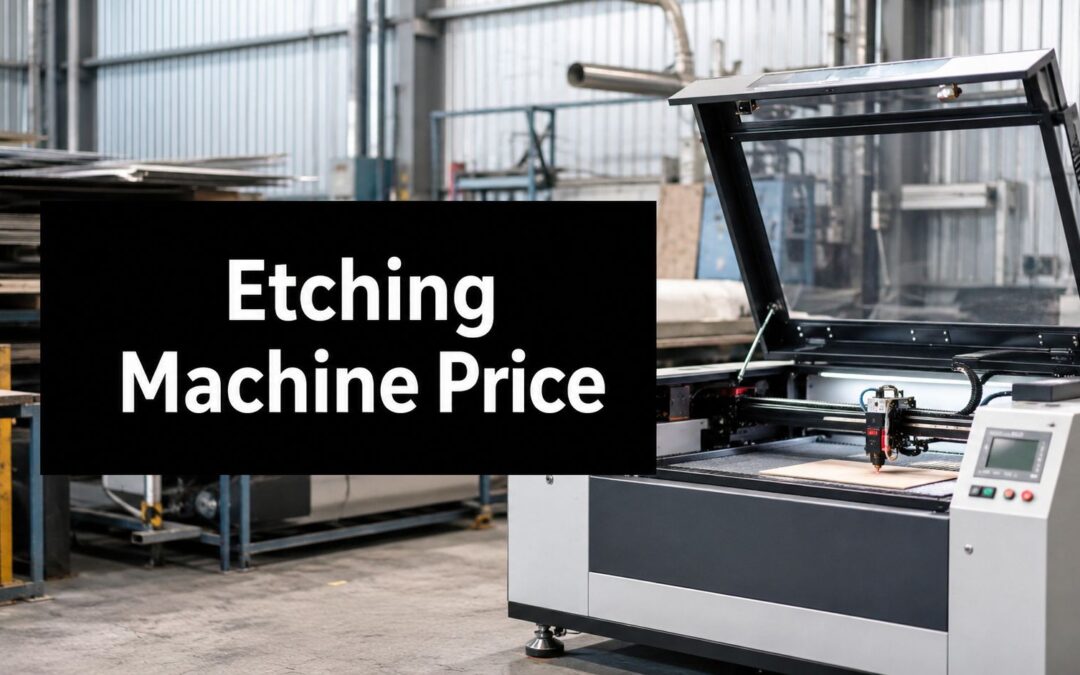
Industrial etching machine prices in Australia start around AU$1,500 for a bench-top diode and can stretch past AU$600,000 for a heavy-duty industrial line. The sticker price is only the first number, because freight, GST, power, extraction, commissioning and compliance can change the total spend fast.
You're usually staring at two very different quotes on your desk. One looks affordable enough to sign today, the other feels excessive until you price the room around the machine, the power upgrade and the downtime you'd cop if the job runs short.
What You Will Pay for an Etching Machine in Australia
If you are buying for an Australian workshop, the first quote is rarely the final figure. Bench-top diode units sit around AU$1,500 to AU$2,800, mid-range CO2 or desktop fibre machines land around AU$5,500 to AU$25,000, industrial fibre marking systems sit in the AU$40,000 to AU$180,000 range, and heavy-duty conveyorised lines start at AU$200,000 and go up to AU$600,000+ when you need serious throughput.
That spread is why I ignore sticker prices on their own. Global pricing still sets the shape of the market, but it does not tell you what the machine costs once it lands in Australia, clears freight, and gets tied into your site. A Laser engraving market forecast puts the market at USD 4.14 billion in 2026 and USD 7.00 billion by 2033, at a 7.8% CAGR, which explains why premium industrial systems hold their price. The broader etching equipment market is also expanding, with the etching machine market report showing forecasts of USD 11.44 billion in 2024 rising to USD 12.86 billion in 2025, and longer-range projections reaching USD 19.58 billion at 11.1% CAGR, or USD 28.09 billion by 2030 at 13.4% CAGR. Those numbers are not Australian quotes, but they do explain why the top end keeps its value.
Practical rule: if a quote looks cheap and it is meant for compliance signage, asset labels or permanent identification, assume the missing costs are sitting somewhere else.
Australian Etching Machine Price Bands 2026
| Machine class | AU price band (2026) | Typical AU use case | Service alternative? |
|---|---|---|---|
| Bench-top diode | AU$1,500 to AU$2,800 | Light engraving, small labels, low-volume work | Yes, often |
| Mid-range CO2 or desktop fibre | AU$5,500 to AU$25,000 | Signage, mixed materials, general industrial marking | Sometimes |
| Industrial fibre marking | AU$40,000 to AU$180,000 | Asset tags, serial numbers, compliance plates | Sometimes |
| Heavy-duty conveyorised line | AU$200,000 to AU$600,000+ | High-throughput production, large-format industrial work | Often no |
Australian buyers need to price the full site, not just the machine. The unit, extraction, power, setup, freight, and support all belong in the landed cost. If you want a clean comparison between buying and using a service model, start with a local laser etching machine Australia option and compare it against the machine price plus install and upkeep. That is the only way to judge whether ownership makes sense.
For a lot of compliance signage and asset labelling work, outsourcing beats ownership. A cheaper machine can still be expensive once you add the room around it, and a more capable machine can still be the wrong buy if your workload is patchy. I keep coming back to landed cost because that is the number that matters in Australia.
Laser Type, Beam Source and Why It Changes the Number
The biggest reason two quotes look nothing alike is the beam source. If you don't match the laser type to the material, you end up paying for capability you'll never use or buying a cheap unit that won't do the work properly.

Match the beam to the substrate
Diode lasers are the entry point. They suit light engraving on wood, leather and coated materials, and that's why they're the cheapest route into the category. They're fine for simple marking jobs, but I wouldn't buy one for serious Australian compliance work unless the material mix is soft and forgiving.
CO2 is the workhorse for signage, plastics, stone and anodised aluminium, and it's the class most signage shops end up using for day-to-day output. That's also why it shows up so often in Trotec laser machine ranges used by Australian shops. If your work is mostly signage, panels and mixed non-metal substrates, CO2 deserves a hard look.
Fibre is the right answer for bare metals, serial numbers, asset tags and compliance plates. It's the one I'd spec when the mark has to survive handling, heat and abrasion. UV is the cold-marking option for medical devices, glass and electronics, where heat distortion is a problem.
Why similar bed sizes can cost wildly different amounts
The optics chain, tube life and consumables story change with each laser class, and that's where the price gap comes from. A fibre marker and a CO2 engraver with a similar bed size can still sit five to ten times apart because they're solving different problems. The cost isn't just the source, it's the whole chain from beam generation to motion control.
A useful reference point is that a 2026 pricing guide puts the average new laser engraver at US$5,280, with CO2 averaging US$3,680, fibre averaging US$5,060 and UV averaging US$5,780. In the same market, UV prices were about 20% lower than the previous year's US$7,120 average. Those numbers don't replace an Australian quote, but they do show that beam source choice still drives the invoice. 2026 laser engraver pricing guide
If you're shopping in Australia, use this rule. Soft materials and decorative work point to CO2 or diode. Metal identity and compliance work point to fibre. Sensitive substrates point to UV. That's the decision that matters before you even ask for a quote.
Laser etching machine options for Australia
Power, Bed Size and Precision Levers That Move the Price
Power is the first thing sales reps talk about because it's easy to sell. I care more about what the power does to speed, repeatability and the materials you can run without rework.
Wattage is not just wattage
A 30 W diode behaves nothing like a 100 W CO2 tube or a 300 W fibre source. Higher power can mean faster marking, deeper engraving or the ability to handle tougher substrates, but it also pushes the price up fast. The source data shows that laser engraver pricing climbs as power rises from 20 W to 300 W and table sizes scale up to 5' x 10', which is exactly why the bigger platforms cost more.
The buyer mistake is thinking power is the whole story. Power without the right optics, bed size and motion precision just gives you an expensive machine that still misses the job.
Bed size and precision decide whether the machine fits the job
A small A4 desktop machine is one thing. A 600 × 900 mm bed is another. Once you move into 1300 × 900 mm or 1500 × 2500 mm territory, you're paying for frame stiffness, motion control and a much larger usable envelope. That matters for memorial work, large safety panels and oversize fabrication jobs.
Precision is the other cost driver people underestimate. A stone etching machine listing with 80/100 W power and a 900 × 600 mm working area claims positioning accuracy better than ±0.01 mm, while market-wide engravers can range across build sizes and repeatability levels. In real buying terms, the jump from ±0.1 mm to ±0.01 mm is what starts making a compliance-grade signage line expensive. Stone etching machine listing
What each Australian buyer should actually spec
- Safety signage shops: 600 × 900 mm and CO2 capability for anodised aluminium-ready work.
- Manufacturing lines: 20 to 50 W fibre with sub-0.05 mm repeatability for serial plates and asset tags.
- Memorial businesses: a wide bed and a rotary axis, because plaques and stone pieces rarely fit a neat, small envelope.
A larger bed, tighter precision and higher power all add cost, but not equally. If the quote's jumped, check whether the seller upgraded the source, the motion system or just the table size. That's usually where the extra zeros came from.
Industrial laser engraver details for metal work
Hidden Costs Most Australian Buyers Underestimate
A cheap quote turns into an expensive mistake fast. The machine price is only one line on the spreadsheet, and the rest of the bill usually shows up after the deposit clears.
The costs that rarely appear in the first quote
International freight and insurance hit first, then customs duty and GST. After that, Australian buyers usually have to deal with a three-phase power upgrade, extraction and filtration, site preparation, installation, software licences, training and the first service contract. If the machine is going into a live industrial site, each of those items takes time and cash.
The market evidence for etching equipment makes the point plainly. High-spec etching systems can cost USD 3 million to USD 15 million per unit, and that kind of capital spend only makes sense when the surrounding infrastructure is ready. Even on much smaller systems, one guide notes that shipping, installation and commissioning can add 20% to 40% on top of the ex-works price. I treat any quote that ignores setup as incomplete. Etching machine market report, metal etching price guide
What Australian buyers usually forget to budget
- Freight and insurance: sea or air transport, plus damage risk on arrival.
- Power and cabling: three-phase work, switchboard changes and electrician call-out.
- Extraction and filtration: a typical Australian laser extraction install can run into the AU$5,000 to AU$25,000 bracket depending on flow rate.
- Training and setup: operator handover, job settings and file prep.
- Service access: if you're regional, a technician visit can mean travel time on top of labour.
If two machines both quote at AU$50,000, the first-year real cost can still diverge sharply once the room around the machine is built properly.
That's why I do not compare machine-only prices unless the buyer is shopping for a hobby unit. In an industrial setting, landed cost matters more than the invoice. If you undercook extraction, skip the power review or forget commissioning, you've bought a machine that is not ready to work.

Buying Versus Outsourcing to a Trotec Service Bureau
Owning a machine only wins when the volume, turnaround and material mix justify the fixed cost. If the job list is irregular, outsourcing usually beats buying, and it beats it hard.
Use the work, not the machine, to make the decision
Start with three questions. How many marks do you need each year, how long does each job take, and how urgent is turnaround? Then compare the total annual cost of owning a machine against a per-job outsourced quote. If a job is short, infrequent and low urgency, the capital asset sits idle too often to earn its keep.
A small electrical contractor doing a few labels each week almost always loses by buying. A hospital, by contrast, usually wins by owning or by locking in a dedicated service partner because the compliance workload is constant and the turnaround expectations are unforgiving.
Why a bureau makes more sense for many AU operators
A Trotec-equipped service bureau gives you the machine capability without the capital sink. You also get premium materials, fast turnaround and the ability to absorb surges without buying another asset that sits quiet half the year. That matters for Australian operators with mixed demand, regional service constraints or tight capital rules.
For context on whether your marketing or manufacturing spend is even worth the effort, Machine Marketing's ROI framework is a useful place to sanity-check the economics before you sign any purchase order. It won't tell you which machine to buy, but it will force a proper look at payback and volume.
A five-minute rule that saves bad purchases
- Low volume, low urgency: outsource.
- High volume, constant compliance demand: buy.
- Mixed workload with seasonal spikes: keep the fixed asset out of the equation unless you've already proved the payback.
That's the key consideration. If a Trotec laser machine would spend more time waiting than marking, ownership is the wrong move. If it's the centre of a daily compliance workflow, the numbers start to favour buying quickly.

Financing, Leasing and ROI for the AU Industrial Buyer
Most Australian buyers don't pay cash outright, and they shouldn't rush that decision anyway. The finance structure matters because it changes the payback maths, the tax treatment and how much breathing room the business keeps.
The funding options that actually get used
Chattel mortgage is common when the machine is a true business asset. Equipment finance lease and operating lease suit buyers who want predictable monthly outgoings. Hire purchase sits in the middle, and for some operations the smartest funding decision is to skip the machine altogether and redirect capital into a managed-service contract with a Trotec-equipped bureau.
A good ROI check is brutally simple. Take the purchase price, divide it by the annual labour and outsourcing savings, then add consumables, service and software over a five-year view. If the machine doesn't pay back cleanly inside your own planning horizon, the finance paperwork only hides the problem.
A practical way to test the numbers
Suppose you're looking at a mid-bed Trotec laser machine at roughly AU$60,000. If outsourcing the same work costs AU$8 to AU$25 per job, the spreadsheet answer depends on how many jobs you really run and how much labour you burn managing them. A low-volume shop will struggle to justify ownership, while a high-volume compliance operation can get there quickly.
The important part is to include the boring costs. Consumables, training, service, software and machine downtime all belong in the calculation. If you only model purchase price and labour savings, the result is fiction.
Build one row and the answer gets clearer
The one spreadsheet row I want every buyer to fill in is this, annual jobs multiplied by outsourced unit cost, minus annual in-house running cost. If that difference doesn't comfortably cover the capital cost, don't buy yet. If it does, then finance the machine on terms that leave the business enough slack to survive the slow months.
A helpful cross-check is to compare your own numbers against a structured ROI approach like the one used by manufacturers who treat marketing spend and capital spend the same way, as a payback problem rather than a gut feel problem. That keeps the machine decision honest.
Pre-Purchase Checklist and the Final Buying Decision
The cleanest machine quote in the world still falls apart if the site can't support it. I'd rather see a buyer slow down for one week than discover, after delivery, that extraction, power or software training were never included.
The checklist that stops expensive mistakes
- Bed size: match the largest panel you'll ever run, not the average one.
- Beam type: pick the source that suits your primary substrate, not the cheapest source on the quote.
- Positioning accuracy: tie the tolerance to your compliance requirement, not to the sales brochure.
- Service and support: confirm local technician access and warranty terms in Australia.
- Total cost of ownership: include freight, installation, extraction, power, software and training.
A few buying mistakes show up repeatedly. Under-spec extraction is common, and so is ignoring three-phase availability until the electrician arrives. I also see buyers choose a cheap import for compliance work when they needed a more reliable long-term industrial platform. That's a false economy.
Use the quote meeting to ask the right questions
Ask who installs the machine, who trains the operator and who services it if the source fails after six months. Ask whether the price includes commissioning and whether the software licence renews. Ask what consumables you'll need in the first year and whether they're easy to source locally.
A simple decision rule works better than a long wish list. If the machine is central to daily asset labelling, safety signage or production identification, buy on capability and support, not on headline cost. If it isn't, or if the work is intermittent, outsourcing stays the sharper move.
The central point is still the same. Etching machine price in Australia is a landed-cost, TCO and ROI conversation, not a sticker-price exercise. If you can't justify a full-time machine, you still have a defensible Australian alternative in a Trotec-equipped production service backed by nearly six decades of experience and built for asset labelling, safety signage and memorial plaques.
Industrial engraving equipment for sale
If you're pricing an etching machine for compliance signage, asset labels or memorial work, talk to Evright Industrial and get a quote that reflects the actual landed cost, not just the machine on the dock. They can help you compare ownership against outsourced production properly, so you don't buy more machine than your workload can justify.
Recent Comments