
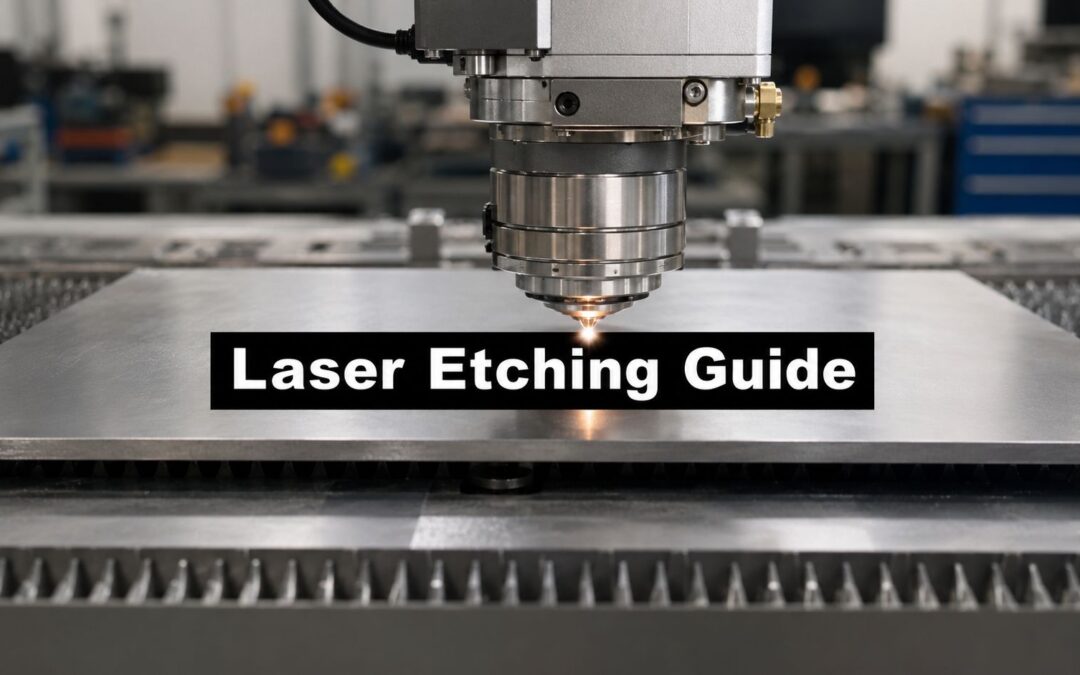
A laser etching machine in Australia is typically sought for applications beyond a hobby tool. Such needs often involve faded asset tags, inconsistent compliance plates, unreadable serial numbers, or equipment that requires long-term identification after paint, stickers, and ink have failed.
That's the gap most online content misses. It talks about craft projects, desktop setups, and entry-level pricing. Industrial buyers have a different problem. They need marks that stay legible on metal, survive handling and weather, and fit into a maintenance, manufacturing, utilities, transport, or healthcare workflow without creating a service headache later.
In that environment, laser etching isn't a novelty. It's a practical marking method for traceability, compliance, and long-term asset identification. Premium systems such as Trotec laser platforms are relevant here because they're built around repeatability, workflow control, and industrial use rather than weekend production.
The Modern Challenge of Industrial Asset Identification
An operations manager in Australia usually notices the problem after the second failure, not the first. A tag on a pump station starts lifting. A printed plate on a coastal site loses legibility. A barcode on plant equipment is still technically there, but no one can scan it without guessing the number underneath.
That's not just a labelling issue. It affects maintenance records, stock control, inspection history, and proof of compliance. If an identifier fails, the asset becomes harder to trust and harder to manage.
For teams working through understanding asset management best practices, durable identification is one of the details that quickly becomes operationally important. The asset register only works if the physical item can still be matched to the record in the field. The same logic shows up in practical guidance around asset tracking best practices, where consistency and permanence matter as much as the data itself.
The wider market tells the same story. The Asia-Pacific region is projected to contribute 40% of global laser engraving machine market growth, and the overall market is forecast to expand by USD 563.8 million from 2024 to 2029 according to Technavio's laser engraving machine market analysis. For Australian buyers, that matters because it points to a mature regional supply environment, not a fringe category with thin support.
Industrial marking works when the identifier outlasts the surrounding wear, not when it looks good on day one.
In practice, that's why laser marking has become common in applications such as equipment identification, compliance plates, durable tags, panel labels, and serialised metal components. The machine is only part of the story. The core value is that the mark becomes part of the operational system, not a disposable accessory attached to it.
Etching vs Engraving vs Cutting A Clear Explanation
People often use these terms interchangeably. On a production floor, that leads to the wrong machine, the wrong process, and the wrong expectation.
The simplest way to separate them is this. Etching changes the surface. Engraving removes material to create depth. Cutting goes through the material completely.

What etching does
Think of laser etching like permanently changing the skin of the material. You're affecting the top layer to create contrast and legibility, usually without chasing much physical depth. That makes it suitable for serial numbers, machine IDs, QR codes, barcodes, and fine logos where readability matters more than cut depth.
On many industrial jobs, this is the sweet spot. You get a fast, crisp mark with minimal distortion and good control over fine detail.
What engraving does
Engraving is closer to carving. The laser removes more material and creates a visible recess. If the part will see abrasion, repainting, blasting, or repeated cleaning, deeper engraving can be the safer choice because the mark isn't relying only on surface contrast.
That said, deeper isn't always better. It takes more time, usually requires more energy or more passes, and can reduce throughput if you're marking batches of parts.
What cutting does
Cutting is exactly what it sounds like. The beam passes through the material and separates it into pieces or produces a finished profile. For labels and plates, cutting often pairs with engraving or etching. One machine may cut the plate shape, then mark the text or code.
Practical rule: If you need a high-contrast identifier on a metal tag, ask for etching or marking first. If you need the mark to remain readable after surface wear, ask whether engraving depth is necessary.
A lot of confusion comes from suppliers using the terms loosely. For a project manager, the better question is not “Do I need etching or engraving?” It's “What must the mark survive, and what must still be readable after service exposure?” Once you ask it that way, the process choice usually becomes much clearer.
Types of Laser Etching Machines for Industrial Use
When buyers search for a laser etching machine in Australia, they usually encounter a messy mix of desktop units, maker equipment, and industrial systems. The industrial decision is narrower than it looks. Most serious marking applications come down to fibre laser or CO2 laser equipment.
Premium brands such as Trotec Laser sit in this conversation because they're often used as the benchmark for professional-grade workflow, software integration, enclosure quality, and repeatable output. That doesn't mean every job needs the same machine class, but it does show buyers what industrial expectations look like.
Fibre lasers for metal marking
For metal asset plates, stainless tags, anodised aluminium identifiers, and machine components, fibre is usually the first place to look. Industrial fibre-laser systems typically use a 1064 nm wavelength, which suits metal marking well. A representative machine specification also shows marking speeds of up to 7,000 mm/s or higher, using a galvo scanning head with ±0.1 μm positioning accuracy on an Australian-market product page for Monport's fibre laser engraver.
Those figures matter, but not in the way new buyers often think. Raw speed on paper doesn't guarantee fast production in real life. Fixture design, part presentation, operator setup, and mark strategy often limit throughput before the laser itself does.
A second Australian-market spec for a metal-focused fibre system lists 20 to 60 kHz pulse frequency, 150 ns pulse width, air cooling, and marking speed up to 7,000 mm/s on an OMTech fibre laser product page. That combination points to a practical truth. The machine can move quickly, but consistent production depends on process control more than headline motion speed.
CO2 lasers for non-metal materials
CO2 lasers belong in the conversation when the job involves plastics, timber, acrylic, coated materials, rubber, glass, or other non-metal substrates. They're not the first choice for most direct metal marking tasks, but they're widely used for industrial labels, control panel components, signage elements, and fabricated identification pieces where the material is laser-compatible.
If your workflow includes both profile cutting and surface marking on non-metal materials, a CO2 setup can be very efficient.
Fibre laser vs CO2 laser
| Attribute | Fibre Laser | CO2 Laser |
|---|---|---|
| Best fit | Metal marking and direct part identification | Non-metal materials and cut-and-mark work |
| Typical industrial use | Serial numbers, barcodes, compliance plates, machine IDs | Plastic labels, acrylic panels, signage, organic materials |
| Beam delivery style | Commonly galvo-based for fast marking | Often configured for broader material processing tasks |
| Mark character | High-contrast, precise, fine detail on metals | Strong versatility across many non-metal substrates |
| Trade-off | Less flexible for general organic-material work | Not the first choice for most metal direct marking jobs |
What buyers should actually compare
The wrong comparison is desktop machine versus industrial machine on purchase price alone. The better comparison includes:
- Material fit: Is the machine matched to stainless steel, anodised aluminium, coated metals, plastics, or mixed workloads?
- Repeatability: Can it produce the same legible mark across batches without constant operator adjustment?
- Support model: If optics, extraction, software, or electronics fail, who services it in Australia?
- Production method: Is it a machine purchase, or would a service model be more practical through options such as industrial etching equipment and marking solutions?
For industrial work, machine choice is really process choice. Most buying mistakes happen when people buy by wattage and advertised speed instead of by material, durability requirement, and serviceability.
Why Laser Etching is the Industrial Standard for Traceability
Traceability fails when the mark fails. That's why laser marking has moved from specialist capability to normal industrial infrastructure.
The market scale reflects that shift. The global laser marking machine market was valued at USD 4.1 billion in 2024 and is projected to reach USD 10.08 billion by 2034, according to Global Market Insights. The same source links that growth to permanent traceability and regulatory marking across industries such as automotive and medical equipment.

Why operations teams prefer it
Laser etching solves several operational problems at once.
- Permanent identification: The mark is applied directly to the part or a durable plate rather than relying on ink, toner, or adhesive print.
- Fine detail: Small text, dense data fields, and machine-readable codes are easier to produce cleanly.
- Non-contact process: The system marks the part without physical tool contact, which helps with fragile, finished, or tightly toleranced components.
- Automation potential: Laser systems can fit into production cells, fixture-based workflows, and repeatable labelling processes.
That combination matters in workshops and plants where every unidentified part turns into a manual investigation later.
Where it outperforms older methods
Dot peen still has a place. Stamping still has a place. Printed stickers still have a place. But each of those methods introduces trade-offs in noise, contact stress, aesthetic finish, or short service life.
Laser etching is often chosen because it gives a cleaner mark with better control over code quality and placement. On data plates and equipment identifiers, that usually means easier scanning, easier visual confirmation, and fewer arguments between production and maintenance about whether the number can still be read.
A working view of the process helps:
A readable identifier is a quality control tool, not just a label.
For project managers, that's the business case. Laser etching supports compliance, maintenance history, service tracking, and product accountability. It reduces ambiguity at the moment someone needs certainty.
Australian Procurement and Compliance Considerations
The cheapest laser on a product listing is rarely the cheapest laser to own in Australia. That's the part buyers usually discover after a control board fails, a lens cracks in transit, software support vanishes, or the machine arrives with unclear compliance documentation.
Australian industrial buyers need to think beyond the machine and into the operating environment. A site in the Pilbara, a coastal treatment plant, a metro switchroom, and a fabrication shop all impose different demands on equipment, marking materials, and service support.

The hidden cost of bargain machines
A low-cost desktop unit can look attractive if the brief is narrow and the expected volume is small. The trouble starts when that machine is pushed into industrial duty.
Common failure points aren't always dramatic. Sometimes it's inconsistent focus. Sometimes it's poor enclosure quality, weak extraction integration, unreliable software, or no practical parts pathway when something minor stops production.
The harder question is durability. Australian buyers need to ask which process and machine will survive harsh site conditions, corrosion, and abrasion, and how support will work when uptime matters, as highlighted by Australian Engraving's laser services page.
What to ask before approving the purchase
Procurement should test the whole support model, not just the sample mark.
- Compliance fit: Confirm the machine is suitable for workplace use and that electrical and safety requirements are clear for your environment.
- Service access: Ask who repairs it locally, how consumables and parts are supplied, and what happens if the system is down.
- Material proofing: Test the actual substrate you use, not a showroom sample on ideal stock.
- Output expectation: Decide whether you need shallow contrast marking, deeper engraving, cut-and-mark capability, or a mix.
A lot of electrical and facilities teams run into adjacent issues once identification work starts, especially around panel, board, and infrastructure labelling. That's where practical guidance on switchboard labelling requirements becomes relevant, because the marking process has to support the compliance outcome.
Local support often decides the real value
Industrial systems with Australian support usually cost more upfront than anonymous imports. In return, buyers often get clearer warranty pathways, service continuity, and fewer operational surprises.
That matters more in Australia than many overseas buying guides acknowledge. Long freight distances, remote worksites, and narrow shutdown windows all amplify the cost of downtime. If a machine only looks economical while it's working perfectly, it isn't an industrial buying strategy. It's a gamble.
Partnering with Evright Industrial for Asset Labelling
For many organisations, buying a laser etching machine isn't the best answer. They need durable asset labels, compliance plates, switchboard identifiers, engraved tags, or serialised components, but they don't need to become a laser production business to get them.
That's where a specialist service model makes sense. Evright Industrial provides laser etching and asset labelling as a production capability, using Trotec laser equipment for industrial marking work rather than requiring the client to buy, set up, maintain, and validate an in-house machine.

When outsourcing is the better move
Outsourcing usually works well when the job has one or more of these conditions:
- Irregular production demand: You need batches of plates or tags, but not enough volume to justify machine ownership.
- High consequence marking: The identifier must be accurate, durable, and consistent because it supports safety, compliance, or maintenance records.
- Mixed materials or formats: The work includes different substrates, layouts, or finishing requirements that would otherwise require trial-and-error in-house.
- Limited technical bandwidth: Your team already runs operations, maintenance, or projects and doesn't need another specialised process to manage.
How the workflow typically works
The process is usually straightforward. You provide the asset data, design intent, plate specification, or compliance requirement. The marking file is prepared, the material is selected, and the job is produced to suit the application.
There's also a practical advantage in working with a business connected to evright.com, because that broader engraving heritage supports the industrial division's work with established production knowledge and long-running engraving capability. For buyers, that often means less experimentation and a clearer path from brief to finished label.
Outsourcing makes sense when the objective is dependable identification, not machine ownership.
If you need in-house control and high throughput, buying a machine may still be right. If you need durable industrial marking done properly and without adding another maintenance burden, a specialised production partner is often the more efficient option.
Frequently Asked Questions on Laser Etching
Is laser etching permanent on stainless steel?
It can be, but the answer depends on the process used. A surface mark that relies mainly on contrast behaves differently from a deeper engraved mark. If the part will face abrasion, repeated cleaning, or harsh exposure, ask for the mark type to be matched to the service condition rather than assuming all stainless marks perform the same way.
Is laser etching the same as annealing?
Not exactly. Buyers often group them together because both can create visible marks on metal. In practice, the method and result differ. What matters on the shop floor is whether you need surface contrast, minimal material disturbance, or greater physical depth.
Do industrial laser systems need safety controls?
Yes. Industrial lasers aren't plug-and-play office devices. Enclosure design, operator protection, extraction, and site-safe operating procedures all matter. Fume control is especially important because the material being marked influences what must be extracted and managed.
Is laser better than chemical etching or dot peen?
For many industrial marking jobs, yes. Laser offers fine detail, clean code definition, and a non-contact process. Dot peen can still suit some heavy-duty marking tasks, and chemical methods still exist, but laser is often preferred when buyers want precision, cleaner workflow, and less mess around the marking station.
Can one machine do every job?
Usually not. Fibre and CO2 systems suit different material groups, and even within one machine type, fixture design and process setup change the result. The right question is whether the machine fits your material, marking requirement, volume, and support expectations.
Should you buy a machine or outsource the work?
Buy when marking is frequent, integrated into production, and supported internally. Outsource when the work is intermittent, high-consequence, or specialised enough that machine ownership would create more overhead than value.
If you're reviewing options for a laser etching machine in Australia and need durable asset labels, compliance plates, or engraved identification without guesswork, Evright Industrial can help assess the application, material, and marking method, then produce a practical solution that fits the job.
Recent Comments